
Before I left, I dropped her off at exactly 6:15. I kissed her forehead and whispered that Daddy would be there by 7.
By 7:30, she was the only child still sitting in her chair.
I know that because her teacher, Mrs. Trammell, called me. The music in the background was so loud I could barely make out her words, but I heard the part that mattered.
“Courtney has been sitting here alone for more than an hour. She won’t dance with anyone. She keeps watching the doorway.”
My chest tightened.
The thing was, my ex-husband, Rodney, had given his word. He promised me without hesitation. “I’ll be there, Sheryl. There’s no way I’m missing it.” Courtney had proudly told me earlier, “Daddy even bought brand-new shoes for our dance.”
But he never came.
I tried calling him nine different times. Every single call went straight to voicemail.
I was still twenty minutes away, wearing my scrubs after pulling a double shift. My mascara had run halfway down my face, and I was trying not to cry while driving nearly 80 on the freeway. But no matter how fast I got there, I wasn’t the person she was waiting for. She wanted her father, not me.
A few moments later, Mrs. Trammell sent me a picture. I nearly had to pull my car over.
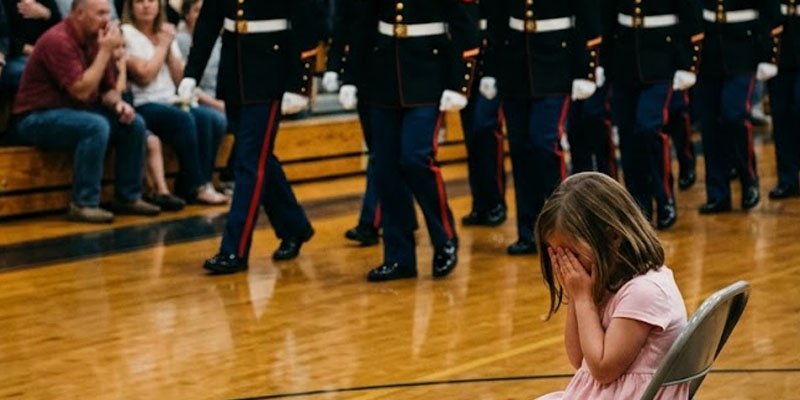
There was Courtney, sitting alone on a plastic chair against the wall. Her hands rested quietly in her lap. Her lavender dress was wrinkled. Around her, every other little girl was twirling happily with her dad. My little girl simply sat there, head lowered, watching them. She wasn’t even crying anymore. It looked like she had already accepted that he wasn’t coming.
That image has never left my mind.
I was only five minutes from the school when Mrs. Trammell called again. This time, though, her voice sounded completely different.
“Sheryl, you need to get here right now. Something’s happening.”
I could hear shouting in the background. Not frightened yelling—more like the kind of excitement that fills a school gym when something unforgettable suddenly happens.
I sped into the parking lot and barely stopped the car before jumping out.
I rushed through the double doors of Eastwood Elementary—and froze where I stood.
The music had stopped completely. Every parent, every child, and every teacher was standing motionless, all staring toward the entrance of the gym.
Six United States Marines stood there in perfect formation, wearing full dress blues. Their posture was flawless, white gloves spotless, medals shining beneath the fluorescent lights.
Standing in front of them, removing his cover, was someone I hadn’t seen in fourteen months.
My brother, Brigadier General Terrance Webber.
He had been deployed overseas, somewhere he could never tell me about, carrying out missions he would never discuss. The last time I’d heard his voice was during a scratchy satellite phone call on Courtney’s birthday. He had started singing “Happy Birthday” before the connection suddenly died.
He wasn’t expected home for another four months.
Courtney still hadn’t moved. She remained frozen in that plastic chair, her mouth hanging open, the lavender bow in her hair slightly crooked.
Terrance crossed the gym floor with the same steady precision he would have used on a parade ground. Every measured step echoed across the hardwood floor while the other Marines remained standing in formation by the entrance.
When he reached Courtney, he lowered himself onto one knee—the same man who had once knelt before a President—and gently extended his hand.
“I heard my favorite girl needed someone to dance with.”
Courtney’s expression completely fell apart. Not with sadness this time, but with overwhelming emotion. She leaped from her chair so quickly that it slid backward and slammed into the wall. She threw herself into his arms, clutching the front of his uniform with both hands as though letting go meant losing him again.
The entire gym erupted with emotion. Parents cried openly. Teachers wiped away tears. Children cheered, even if they didn’t fully understand why.
Then the DJ—bless him—started playing “Isn’t She Lovely.”
Terrance lifted Courtney into his arms with ease. She wrapped both arms tightly around his neck as they slowly danced together in the center of the gym while hundreds of tear-filled eyes watched them.
But what happened next was something no one in that room expected.
As soon as the music ended, Terrance gently placed Courtney back on her feet. He faced the crowd and reached into the breast pocket of his uniform, pulling out a neatly folded letter. His hands trembled. This was a man who had led battalions into difficult situations, yet now his hands were shaking.
He unfolded the paper and quietly said, “There’s something I need to read. Because my niece isn’t the only reason I came home tonight.”
Then he looked directly at me.
The gym fell completely silent.
He began reading, and before he had even finished the second sentence, my knees nearly gave way beneath me. The letter wasn’t written by him.
It was from Rodney.
The opening words read: “Sheryl, I didn’t miss the dance because I forgot. I missed it because three days ago, I was diagnosed with…”
My mind instantly finished the sentence on its own. Something serious. Something life-changing. All the anger I’d been carrying throughout the evening suddenly transformed into a heavy knot of dread deep inside my stomach.
Terrance paused for a moment, cleared his throat, and steadied himself.
Then he looked down at the page again before lifting his eyes toward the crowd, toward me, and toward Courtney, who was standing beside him holding his hand.
“It actually says: Sheryl, I didn’t miss the dance because I forgot. I missed it because three days ago, a little boy I had never met was diagnosed with Acute Myeloid Leukemia.”
Confused whispers spread across the gym. I could feel everyone looking in my direction.
Nothing made sense. Rodney. A sick child. Missing the dance. I couldn’t understand how any of those pieces connected or explained why our daughter had been left waiting.
Terrance continued reading, his voice carrying every word written on the fragile sheet of paper.
“The little boy’s name is Sam. He’s eight years old. He loves baseball and video games, just like I did when I was his age. And the only thing that could save his life was a bone marrow transplant. His parents had been told that the chance of finding a perfect donor match was less than one percent.”
The sheet of paper shook ever so slightly in his hands.
“Last month, I registered with the national donor registry. I never mentioned it to anyone. It just felt like… I don’t know… something I needed to do. Maybe a way to make up for all the times I wasn’t the man I should have been.”
My own hands began trembling. This didn’t sound like Rodney. The Rodney I knew always found excuses—he wasn’t the kind of man who quietly gave something of himself.
“Three days ago, I received the call,” Terrance continued reading. “I was the match. One person out of a million. They told me it couldn’t wait. It was literally life or death. The procedure was scheduled for yesterday.”
Yesterday—the day before the father-daughter dance.
“I’m writing this from a hospital bed at County General. The doctors say everything went well. But no one tells you how difficult the recovery is. I’m exhausted, Sheryl. I can’t even sit upright without feeling dizzy. I wanted to call you, but I just didn’t have the strength to explain.”
Every ounce of anger disappeared. It vanished completely, replaced by such overwhelming disbelief that I had to steady myself against the wall.
“I didn’t tell you or Courtney beforehand because I know how much you worry. And I couldn’t bear making a promise I might not be able to keep. I honestly believed I’d recover in time for the dance. I could see it so clearly—me wearing my new shoes, and her wearing her lavender dress.”
He even remembered the color of her dress.
“When I finally realized I wasn’t going to make it, I felt like the biggest failure in the world. I was letting her down all over again. So I did the only thing I could think of. I emailed the one man I knew would never let her down.”
Terrance carefully folded the letter again, every movement calm and deliberate.
“I’ve made more mistakes than I can count, Sheryl. I know that better than anyone. But please tell our little girl I’m sorry. Tell her her daddy couldn’t be with her tonight because he was trying to be someone’s hero. Not the kind of hero everyone notices, like her uncle. Just a quiet hero for a little boy named Sam.”
That was the end of the letter.
The silence inside the gym was complete. It wasn’t an awkward silence—it felt deep, meaningful, almost sacred.
Terrance slipped the folded letter back into his uniform pocket.
Then he looked down at Courtney. Her eyes were still wide, filled with confusion that was slowly giving way to understanding.
“Your daddy is a very brave man, sweetheart,” he said gently. “He did something incredibly good.”
Courtney looked back and forth between her uncle and me, her small face full of mixed emotions.
“Daddy’s… okay?”
“He’s more than okay,” I whispered, finally able to speak again. “He’s incredible.”
Then something changed throughout the gym.
Mr. Gable, who lived just down the street and was wearing a suit that looked a size too small, stepped onto the dance floor. Smiling warmly at Courtney, he said,
“Well, it looks like there’s an empty spot on your dance card. My daughter says I’m a terrible dancer anyway. Would you mind helping me practice with a real expert?”
Courtney glanced up at Terrance, who smiled and nodded encouragingly. With a shy smile, she placed her hand in Mr. Gable’s.
The DJ understood exactly what the moment needed and started playing a slow, gentle song.
As Mr. Gable carefully spun my daughter beneath the disco ball, another father walked forward.
Then another.
And another.
Soon, they formed a line.
A line of fathers dressed in their nicest suits and polished shoes, patiently waiting for their chance to dance with the little girl whose own father they had never even met.
Each man treated her with kindness. Some danced with playful energy, others slowly and carefully. Some made silly jokes that brought out her laughter as her lavender dress twirled around her. Others simply smiled, letting the music speak for them.
Mrs. Trammell quietly came to stand beside me and handed me a tissue.
“I think,” she said through tears, “this is what a community really looks like.”
I couldn’t find the words to answer.
I simply nodded as I watched my daughter—the little girl who had been the loneliest person in the room just an hour earlier—become the center of the entire evening. She wasn’t simply sharing dances with those fathers. She was being embraced by the shared compassion and kindness of every good father in that gym.
My brother wrapped an arm around my shoulders.
“He reached out to my commanding officer through the Red Cross,” he said softly, answering the question I hadn’t even voiced. “He told them it was a family emergency. They were already sending me back to the States for a debriefing. Rodney’s letter just… helped move everything along more quickly.”
“Did he ask for you?” I asked, still trying to take it all in.
Terrance nodded. “He told me he couldn’t be the man wearing the suit,” he said quietly, “so he sent the man wearing the uniform instead.”
After every father had taken a turn dancing with Courtney, leaving her smiling and out of breath from laughing, Terrance gently walked her back to me. The evening was coming to an end.
She looked up at me with quiet determination.
“Can we go see him?” she asked softly. “Can we visit Daddy?”
The drive to the hospital passed in silence. Courtney held tightly to my hand while her other fingers absentmindedly traced the bow on her lavender dress. She was trying to make sense of everything—the disappointment, the pride, and the love—in the simple, honest way only a child can.
We located Rodney’s room on the fourth floor. The door was cracked open.
He was asleep.
His face looked pale, and somehow smaller than I remembered. An IV ran into his arm. Sitting on the bedside table, still untouched inside their box, was a pair of shiny new dress shoes.
He had brought them with him.
Just in case he made it.
Courtney quietly tiptoed into the room and stood there for a long moment without saying a word. She didn’t try to wake him. Instead, she gently reached out and rested her hand on the shoebox.
“His new shoes,” she whispered.
A tear rolled down my face.
He hadn’t simply made a promise.
He had believed he could keep it.
A man and woman stood uncertainly in the hallway outside the room. When they noticed us, they slowly walked over.
“Are you… Rodney’s family?” the woman asked. Her eyes were swollen from crying, yet there was a spark of hope shining through them.
I nodded.
“I’m Sheryl,” I said. “And this is our daughter, Courtney.”
The woman knelt in front of Courtney.
“My name is Sarah,” she said. “This is my husband, Tom. Our son… our son is Sam.”
She didn’t have to explain anything more.
“Your daddy,” she said, her voice trembling with emotion, “gave our little boy another chance at life. We had run out of hope. We were preparing ourselves to say goodbye.”
Tom, a broad-shouldered man whose rough hands suggested years of hard work, quickly brushed tears from his eyes.
“The doctors came in this morning,” he said. “They told us the transplant was a perfect match. They said Sam finally has a real chance because of your father.”
He looked at Courtney, then at me, before glancing toward Rodney sleeping peacefully in the hospital bed.
“I own a construction company,” he continued after clearing his throat. “It’s nothing fancy, but the business is doing well. I told Rodney that once he’s healthy again, there’ll be a foreman position waiting for him. Good salary. Full benefits. A steady future.”
It was more than just a steady job.
It was a fresh start.
For years Rodney had drifted from one temporary job to another. That constant instability had been one of the biggest reasons our marriage eventually fell apart. He had never been able to find solid ground.
Just then Rodney shifted slightly, his eyes slowly opening.
He saw me first, and guilt immediately crossed his face.
Then he noticed Courtney, still wearing her lavender dress.
His eyes filled with tears.
“I’m so sorry, sweetheart,” he whispered hoarsely.
Courtney hurried to his bedside.
“It’s okay, Daddy,” she said. “Uncle Terry came instead. And I got to dance with all the dads.”
She paused and looked at him with complete seriousness.
“And I met Sam’s mommy and daddy. They told me you’re a hero.”
Rodney looked over her head at me. His face searched mine for answers.
I simply nodded, offering him a small, gentle smile.
For the first time in years, the anger between us was gone.
In its place was something quiet, delicate, and hopeful.
Yes, he had missed the dance.
Nothing could erase that.
He had broken a promise to his daughter, and healing that wound would take time.
But he had missed it to keep another promise.
A promise made to someone he had never even met.
A promise to become a better man than he had been before.
That was when I truly understood that heroism isn’t always found in dramatic moments on a battlefield.
Sometimes it begins with a quiet decision made inside a sterile hospital room.
Sometimes it means showing up—not where people expect you to be, but where you are needed most.
Rodney wasn’t there to hold his daughter’s hand during their special dance.
Instead, he gave another little boy the chance to hold his own father’s hand for many years to come.
And somehow, that became the most beautiful dance of all.