
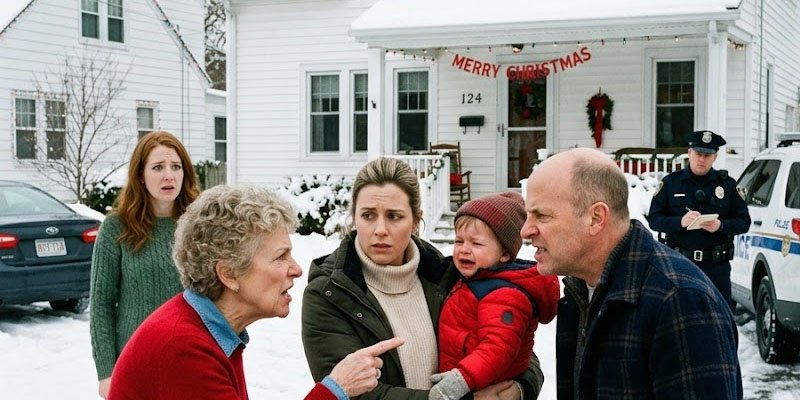
On a freezing December night in suburban Ohio, my daughter stood on my porch with my soaked three-year-old granddaughter in her arms.
Emily’s hair was plastered against her face. Her coat was hanging open, while little Sophie trembled beneath a thin pink blanket.
“He brought another woman home,” Emily whispered. “His mother threw our bags together and slammed the door.”
For a second, I wondered whether I had heard her correctly.
“Daniel brought another woman into your home?”
Emily nodded, tears mixing with the rain running down her cheeks.
“And Lorraine put you and Sophie outside?”
She nodded again.
I grabbed my keys from the table in the hallway.
“Get in,” I told her. “They picked the wrong family.”
Twenty minutes later, my SUV pulled up in front of the two-story house Emily had shared with Daniel Carter for six years.
Every window downstairs was lit.
Looking through the living-room window, I spotted Daniel sitting on the sofa beside a blonde woman I recognized from pictures Emily had shown me before. Rachel Monroe. Daniel’s “coworker.”
Lorraine, Daniel’s mother, stood beside the Christmas tree, drinking wine as though she had just won a victory.
Emily grabbed my arm.
“Mom, please. I don’t want Sophie seeing a fight.”
“She won’t.”
I called my brother, Michael, who lived only ten minutes away.
“Bring the truck,” I told him. “And bring the folder from my office labeled Carter.”
Emily looked at me in confusion.
“What folder?”
“The one I prayed I’d never have to use.”
The house had been purchased three months before Emily married Daniel. Daniel had told everyone that his parents had provided the down payment.
They hadn’t.
I had.
After Daniel’s credit collapsed following a failed business venture, I loaned Emily $82,000. My attorney insisted that the loan be formally documented. Since Daniel couldn’t qualify for the mortgage, the deed was initially recorded solely in Emily’s name.
Two years later, Daniel convinced her to refinance.
But there was one thing Daniel apparently forgot.
My loan had never been repaid, and the lien securing that money had never disappeared.
Michael arrived with the folder.
I walked to the entrance and rang the doorbell.
Lorraine answered.
Her smile disappeared immediately.
“You need to leave,” she said.
I raised a certified copy of the lien.
“No,” I answered. “You need to explain why you unlawfully removed a legal homeowner and a three-year-old child from property securing eighty-two thousand dollars of my money.”
Daniel appeared behind her.
“Patricia, stay out of our marriage.”
“I was staying out of it,” I said. “Until you left my granddaughter standing in the rain.”
Then flashing lights reflected across the wet driveway.
Emily looked at me.
“You called the police?”
“No,” I said.
Lorraine’s face suddenly lost its color.
Because the police cruiser wasn’t the only vehicle coming down the street.
A sheriff’s deputy was right behind it.
And he had paperwork in his hand.
Daniel stepped onto the porch.
“What paperwork?”
The deputy looked at Emily first.
“Emily Carter?”
“Yes.”
“I have a temporary protective order issued tonight based on a report filed earlier this evening.”
Emily stared at him.
“I didn’t file anything.”
“You didn’t,” I said.
Daniel’s eyes immediately turned toward me.
Earlier, while Emily was driving to my house, she had called her friend Nicole from a gas station. After hearing Sophie crying and learning that Daniel had physically prevented Emily from getting back inside, Nicole contacted the police.
A patrol officer had already spoken with Nicole and with a neighbor who had seen Lorraine throw two suitcases onto the lawn.
Even more importantly, the neighbor’s security camera had recorded Daniel pushing Emily backward when she tried to get Sophie’s winter coat.
Emily had never mentioned that part to me.
I turned toward her.
“He pushed you?”
Her silence was answer enough.
Daniel raised both hands.
“It wasn’t like that.”
The officer stepped between us.
“Mr. Carter, do not come any closer.”
Rachel stood in the hallway wearing one of Emily’s sweaters.
That nearly shattered my daughter.
She stared at the sweater for several seconds before speaking quietly.
“Take it off.”
Rachel crossed her arms.
“Excuse me?”
“That belonged to my grandmother.”
Lorraine laughed.
“Oh, for heaven’s sake. It’s just clothes.”
Emily looked at her mother-in-law, and something inside her changed.
The exhausted woman who had arrived on my porch disappeared.
“My daughter was outside in thirty-four-degree rain,” Emily said. “And you’re standing in my house drinking wine.”
Lorraine motioned toward Daniel.
“It’s his house too.”
Emily took the property documents from my hands.
“Then perhaps you should have checked whose name is actually on the current deed.”
Daniel went completely still.
During the refinance, Emily had included Daniel on the mortgage application, but complications caused by his outstanding judgments kept his name from being added to the recorded deed. The closing attorney had told them to correct the issue later.
They never did.
The house still legally belonged to Emily.
Daniel had contributed toward the mortgage, but that was separate from ownership.
The deputy examined the paperwork while Lorraine’s confidence faded.
“You can’t throw my son out before Christmas,” she protested.
The officer looked at her.
“Ma’am, he allegedly forced the property owner from her residence. We’re going to follow the court order.”
Daniel stared at Emily.
“You’re really doing this?”
She gave a single laugh, without any warmth.
“You brought Rachel into our bedroom.”
“That marriage was already over.”
“No. You were too afraid to end it before replacing me.”
For the first time, Rachel looked uncomfortable.
“Daniel told me you two had agreed to separate.”
Emily turned toward her.
“He told me this morning that he loved me.”
Rachel’s expression changed.
Daniel muttered, “Emily—”
Rachel slapped him.
Lorraine screamed.
Michael covered his mouth to keep from grinning.
The deputy ordered everyone to calm down.
Then Emily went inside.
Five minutes later, she returned carrying Sophie’s yellow winter coat, her laptop, and a small wooden jewelry box.
She looked around the living room one final time.
Six years of photographs.
Christmas decorations.
A couch they had selected together.
A marriage falling apart beneath strings of warm white lights.
Daniel stood waiting near the staircase.
“Where am I supposed to go?”
Emily zipped up Sophie’s coat.
“Ask your mother.”
Lorraine stepped forward.
“You’ll regret humiliating this family.”
Emily looked straight at her.
“No, Lorraine. The mistake I regret was spending six years trying to become part of it.”
She walked past me toward my SUV.
I followed, but before getting inside, I glanced back at Daniel.
He looked frightened now.
Good.
Because losing the house wasn’t the worst problem that was waiting for him.
Inside Michael’s folder was something Emily still knew nothing about.
Daniel had taken out credit using paperwork containing her forged signature.
And the bank had already begun asking questions.
The following morning, Emily sat at my kitchen table wearing one of my old college sweatshirts while Sophie ate pancakes beside her.
Outside, the storm had passed, leaving every branch covered in ice.
Inside, the house felt strangely silent.
Emily had barely slept.
Neither had I.
Around seven, Sophie looked at her mother.
“Are we going home today?”
Emily stopped stirring her coffee.
Children had a way of reducing devastation to one innocent question.
She forced a smile.
“Not today, sweetheart.”
“Daddy there?”
“Yes.”
Sophie thought for a moment.
“Grandma Lorraine mad?”
Emily closed her eyes.
I quickly stepped in.
“How about some more strawberries?”
Sophie nodded.
After breakfast, Michael took her into the living room to watch cartoons.
Then I placed the folder on the kitchen table.
Emily looked at it.
“What are you keeping from me?”
I opened it.
Six months earlier, I had received an unusual phone call from a loan officer at Midwest Community Bank.
The officer had been attempting to verify information tied to a small-business credit application involving Daniel.
My name had been listed as a reference.
That alone didn’t concern me.
What concerned me was the attached financial statement that named Emily as a co-guarantor.
When I briefly asked Emily about it, she told me Daniel had abandoned his plans for another business.
So I called my attorney, David Rosen.
David searched the public records.
Daniel had not abandoned anything.
He had established a logistics company called Carter Regional Transport LLC and borrowed nearly $140,000.
Emily’s name appeared on several documents.
Her supposed signature appeared on every one.
She examined the copies.
“I never signed these.”
“I know.”
“This isn’t my signature.”
“I know.”
Her hands began to shake.
The documents revealed more than one loan.
There was a $48,000 equipment loan.
A $32,000 revolving credit account.
A business credit card with almost $19,000 owed on it.
And a personal guarantee supposedly signed by both Daniel and Emily.
She covered her mouth.
“How much?”
“Possibly more than two hundred thousand dollars, depending on what else we haven’t uncovered.”
She stood so quickly that her chair scraped across the floor.
“I’m calling him.”
“No.”
“He used my name.”
“Yes.”
“He could ruin my credit.”
“Yes.”
“And you knew?”
That question hurt.
“I suspected something was wrong. I didn’t have enough evidence to accuse him without proof.”
Emily looked away.
“For six months?”
“I was trying to protect you.”
“By keeping it from me?”
I had no clever response.
“I should have told you sooner.”
That was the truth.
She folded her arms tightly.
For several minutes, neither of us said anything.
Then her phone buzzed.
Daniel.
She stared at his name.
The first call ended.
A second one immediately followed.
Then a third.
Emily answered and put the phone on speaker.
“What?”
Daniel spoke rapidly.
“Where are you?”
“With Mom.”
“We need to talk without her.”
“No.”
“Emily, please.”
I heard a car door slam somewhere behind him.
“Where are you?” she asked.
“At Lorraine’s.”
That meant the order was already being enforced.
Daniel was no longer inside Emily’s house.
He continued.
“I want to explain what happened last night.”
“Explain Rachel.”
Silence.
“Things got complicated.”
“They seemed pretty simple when she was wearing my grandmother’s sweater.”
“Rachel shouldn’t have done that.”
Emily gave a cold laugh.
“You brought her into my home.”
“I made one mistake.”
“No, Daniel. You made deliberate arrangements.”
Another silence followed.
Then his voice changed.
“Are you planning to divorce me?”
“Yes.”
The answer came immediately.
Daniel clearly hadn’t expected it.
“Emily, think about Sophie.”
“I am.”
“She needs a father.”
“She needs a father who doesn’t put her mother out in the rain.”
“I didn’t throw Sophie out.”
Emily’s expression hardened.
“You allowed your mother to lock the door while Sophie was standing beside me.”
“Mom was angry.”
“So was I. I didn’t leave a three-year-old outside.”
Daniel exhaled heavily.
“We can fix this.”
Emily looked at the documents spread across the table.
“Then tell me about Carter Regional Transport.”
Nothing.
For the first time since answering the phone, Daniel said absolutely nothing.
“Daniel?”
“Where did you hear that name?”
“Tell me why my signature is on a loan guarantee.”
He ended the call.
Emily stared at her phone.
That afternoon, David arrived with another attorney who specialized in financial fraud.
Her name was Rebecca Stein.
Rebecca was fifty-two, calm, exacting, and entirely unimpressed by excuses.
She reviewed the documents and explained the situation plainly.
If Emily truly hadn’t signed the paperwork, she needed to dispute the documents immediately, preserve records, file a police report, and notify every lender in writing.
“Do not negotiate privately with your husband,” Rebecca said.
Emily nodded.
“Could I lose the house?”
“Not because of these documents if the signatures are forged and the lenders don’t have a valid security interest in the property. But we need to verify everything.”
“What about the mortgage?”
“You remain responsible for your legitimate mortgage.”
“And Daniel?”
Rebecca looked at her.
“Daniel needs an attorney.”
By four that afternoon, Emily had filed the first formal fraud report.
By five, two banks had opened investigations.
By six, Daniel had called twenty-three times.
Emily ignored every call.
Then Lorraine called me.
I almost ignored her.
Almost.
“What?” I answered.
Her voice was furious.
“You have destroyed my son’s life.”
I stepped into the laundry room so Emily wouldn’t hear.
“Your son seems perfectly capable of doing that himself.”
“You’ve always hated him.”
“No. I distrusted him.”
“You turned Emily against us.”
“Daniel brought another woman home.”
“They were separated.”
“They were having dinner together that morning.”
Lorraine went quiet.
Then she said something revealing.
“Rachel was supposed to arrive after Emily left.”
I stopped.
“What?”
Lorraine realized too late that she had said too much.
“You knew?”
There was no answer.
“You knew Rachel was coming?”
“This marriage has been unhappy for years.”
“That wasn’t what I asked.”
“My son deserved to be happy.”
“And Sophie deserved pneumonia?”
“Oh, stop exaggerating.”
“You locked a three-year-old outside in December.”
“For ten minutes.”
I tightened my grip on the phone.
“How do you know it was ten minutes?”
Silence.
Emily had never told Lorraine how long she had remained outside.
Neither had I.
Lorraine had been there.
She hadn’t merely packed the bags.
She had deliberately waited without unlocking the door, offering help, or doing anything while her granddaughter cried in the rain.
“Don’t call me again,” I said.
I ended the call.
Three days later, Emily returned to her home with Rebecca and a police officer while Daniel remained at Lorraine’s.
Rachel was gone.
Several valuable belongings were gone too.
The television.
Daniel’s gaming computer.
A sound system.
Two watches Emily had given him.
And a locked file cabinet from the basement.
Emily photographed every empty space.
The file cabinet concerned Rebecca the most.
“Was it his?”
“I thought it contained tax records.”
Rebecca immediately contacted the detective handling the fraud investigation.
Later that evening, officers went to Lorraine’s house.
Daniel initially denied having the cabinet.
Then they found it in the garage.
Inside were tax returns, business invoices, copies of Emily’s Social Security card, bank statements, and blank sheets containing multiple versions of her signature.
There were also documents involving three other lenders.
Daniel’s problem was no longer simply a failed marriage.
It was now an official investigation.
A week before Christmas, he hired an attorney named Scott Meyers.
Scott contacted Rebecca with an offer.
Daniel would cooperate with the divorce.
He would surrender any claim to the house.
He would temporarily accept monitored visitation.
In exchange, Emily would provide a written declaration stating that she believed Daniel had never intended to cause her financial harm.
Rebecca read the proposal aloud.
Emily looked at her.
“Would that help his case?”
“Possibly.”
“Then no.”
Daniel increased the offer.
He agreed to pay child support.
Emily still said no.
He offered to transfer his vehicle.
No.
Finally, Daniel sent Emily a direct message.
I made mistakes. But if you push this, Sophie might lose her father.
Emily showed Rebecca the message.
Rebecca told her not to respond.
Emily didn’t.
Christmas morning remained simple.
Sophie opened presents beside my fireplace.
Michael gave her a wooden playhouse, I gave her a toy medical kit, and Emily gave her a purple bicycle.
For nearly an hour, she was simply happy.
Then she asked whether Daddy had received presents too.
Emily knelt beside her.
“I’m sure he has.”
“Can I call him?”
Emily hesitated.
The temporary order allowed monitored phone contact.
So she called.
Daniel answered immediately.
“Merry Christmas, baby.”
Sophie smiled.
“Daddy!”
For fifteen minutes, they talked about Santa, pancakes, and the bicycle.
Daniel never mentioned Emily.
When the call ended, Sophie hurried back toward her new toys.
Emily remained seated on the couch.
“You okay?” I asked.
“No.”
It was the first time she had answered honestly.
“I still love parts of him,” she whispered. “Is that foolish?”
“No.”
“I hate what he did. But sometimes I remember him helping Sophie learn to walk. Or dancing with me in the kitchen.”
I sat beside her.
“Six years don’t disappear just because one night exposed the truth.”
She wiped her eyes.
“I feel stupid.”
“You trusted your husband.”
“That trust cost me so much.”
“Not everything.”
She looked toward Sophie.
“No,” she said. “Not everything.”
By February, investigators had uncovered Daniel’s scheme.
His transportation business had been losing money almost from the start.
Instead of shutting it down, he kept borrowing.
When lenders became hesitant, he began adding Emily’s income and credit history to applications without her permission.
He had forged her signature.
He had intercepted mailed notices.
He had even created an email address close enough to hers to deceive one lender during verification.
Rachel had known nothing about the scheme.
She cooperated with investigators and provided messages in which Daniel claimed he was financially secure and only days away from divorcing Emily.
Those messages also established that the affair had continued for eleven months.
Lorraine had known about Rachel for at least four months.
She had encouraged Daniel to “choose happiness.”
The divorce became final the following September.
Emily kept the house.
Daniel kept his own vehicle and roughly $18,000 in legitimate marital debt.
The fraudulent business debts remained involved in criminal and civil proceedings.
Eventually, Emily’s credit reports were cleared of the accounts associated with the forged applications.
The process took months of letters, affidavits, phone calls, and legal expenses.
It wasn’t cinematic.
It was exhausting.
That was the part people rarely talked about.
Real life continues after the police leave.
There are forms.
Appointments.
Bank statements.
Custody schedules.
Insurance changes.
School paperwork.
Nights when a child asks why Daddy lives somewhere else.
Mornings when a woman who believed she understood her future has to create a new one before breakfast.
Daniel eventually entered a plea to several financial offenses as part of a negotiated settlement.
He avoided the harshest potential prison sentence but still received incarceration followed by monitored release and repayment obligations.
Lorraine blamed my daughter until the very end.
She sent angry messages, followed by remorseful ones, and then angry ones again.
Emily stopped reading them.
Communication concerning Sophie went through a parenting app operating under the custody agreement.
Rachel moved to another state.
Michael changed the locks on Emily’s house.
I repainted Sophie’s room.
And one Saturday in October, almost a year after that freezing night, Emily invited me over for dinner.
When I arrived, music was playing throughout the house.
Sophie was dancing around the kitchen in mismatched socks.
Emily stood beside the stove preparing pasta.
For a moment, I remembered something she had told me the previous Christmas.
She had remembered dancing with Daniel in that same kitchen.
Now she was dancing with Sophie.
Not because everything had been repaired.
Some things never fully healed.
But the house felt different.
It belonged to the people who were living honestly inside it.
After dinner, Sophie fell asleep across the couch.
Emily and I carried her upstairs.
At the entryway, I noticed something displayed beside the coat rack.
A framed photograph.
It showed Emily and Sophie standing on the porch in spring.
Both were smiling happily.
I smiled.
“New picture?”
Emily nodded.
“I wanted something from afterward.”
“After what?”
She looked around the house.
“After I stopped believing that leaving Daniel meant losing my future.”
Outside, the October air was cold, though nowhere near as severe as that December night.
Emily walked with me to my car.
Before I left, she hugged me.
“Do you remember what you said that night?”
“I said a few things.”
“You said they picked the wrong family.”
I smiled gently.
“I was angry.”
“You were right.”
I looked back at the house.
The same windows.
The same porch.
The same door Lorraine had once ordered shut against my daughter and granddaughter.
Only now Emily had the key.
“No,” I told her. “They chose the wrong woman.”
Emily smiled.
Then she went inside.
Her home.
And this time, nobody could shut her out.