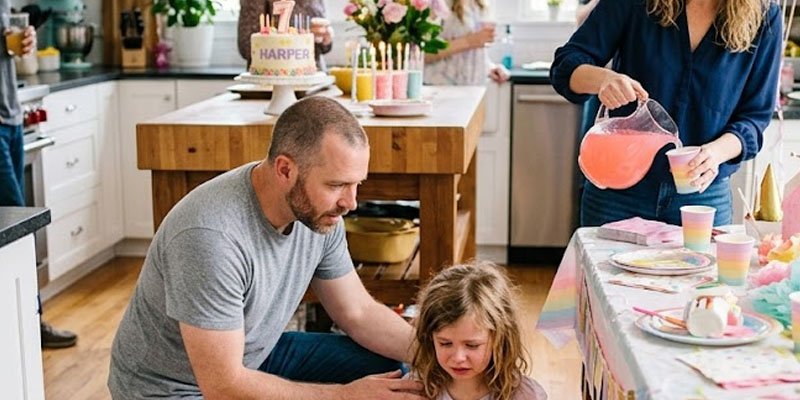
The birthday candles hadn’t even been placed on the cake.
That single image stayed with me because the candles were still sitting inside their clear plastic package beside the cake—bright little sticks waiting for a celebration that would never happen.
The kitchen smelled of vanilla frosting, pink lemonade, and the warm cardboard scent rising from the pizza boxes stacked next to the stove.
Balloons floated close enough to the ceiling fan that their ribbons lightly brushed the spinning blades with soft, uneven taps. Every few moments, someone laughed as another ribbon drifted into a guest’s hair.
Harper had chosen the unicorn theme herself.
She was seven years old, completely in love with glitter, and firmly believed pink lemonade tasted better from the cup with the shiny silver horn because, in her words, ordinary cups were “for regular days.”
That Saturday was never supposed to be ordinary.
It was supposed to be a simple birthday celebration at home—the kind where the adults leaned against the kitchen counters, children ran between the backyard and the house, and nobody worried that the pizza arrived before the decorations were perfectly straight.
I spent the entire morning rushing from one task to another.
I frosted the cake twice after the first layer tore away, forgot to buy extra ice, and burned a pan of cheesy bread while answering messages from parents asking for our address again.
None of it felt unusual.
It was simply the familiar chaos that comes with trying to make your child’s birthday feel unforgettable.
My older sister, Sabrina, walked in carrying two grocery bags, wearing the calm, polished expression she always put on whenever she wanted everyone to believe she was the most capable person in the room.
“Let me take care of the drinks so you can actually enjoy your daughter’s birthday,” she had texted me at 2:14 p.m.
At the time, it sounded genuinely thoughtful.
That was always Sabrina’s style.
She rarely tried to take control outright.
Instead, she offered to help, waited until everyone depended on her, and then acted offended if anyone questioned the decisions she made once they had handed her responsibility.
At 2:37 p.m., she carried the bags through my front door and placed them beside the drink station.
I thanked her.
I remember that part perfectly.
I thanked her because I had a stack of paper plates tucked under one arm, was trying to answer the front door, and was reminding Harper not to touch the frosting flowers before everyone arrived.
Sabrina kissed my cheek and told me to breathe.
She had been telling me to breathe ever since we were teenagers.
Sometimes it was because she genuinely cared.
More often, it meant she had already decided I was overreacting.
By the time everyone gathered around the cake, I had almost convinced myself that whatever tension existed between us could stay outside for the afternoon.
Our parents had come.
Our neighbors were there.
Several families from Harper’s class had joined us.
Surely Sabrina wouldn’t turn a seven-year-old’s birthday party into yet another argument about the family business, my voting shares, or whether I was emotionally fit to make important decisions.
At least, that’s what I believed.
One little girl standing near the back door laughed so hard she started hiccupping.
Harper laughed with her.
Then Harper stopped laughing.
It didn’t slowly fade.
It didn’t become quieter.
It ended.
Her knees suddenly gave out beneath her as though an invisible support had been cut away.
The unicorn cup slipped from her fingers, struck the hardwood floor once, and bounced beneath the kitchen island while pink lemonade splashed across the floorboards.
Her eyes rolled upward.
They remained open, but they were no longer focused on me.
The sound coming from her chest was faint, strained, and unmistakably wrong.
For one brief moment, every adult in the room seemed to pause, almost expecting reality to correct itself.
A paper plate slid off the countertop.
One little boy dropped his cupcake frosting-side down onto the floor.
My mother’s hand froze above the cake knife.
The birthday banner hanging across the window fluttered gently in the moving air.
“Harper?” I whispered.
My voice sounded impossibly small compared to what I was seeing.
Then I found myself on the floor.
I don’t remember deciding to move.
I only remember the sharp ache in my knees against the hardwood and the cold lemonade soaking through my jeans as I reached toward my daughter.
I called her name once.
Then again.
Then so many times that it no longer sounded like her name.
Nolan had only recently come home from his first-responder shift.
He was still wearing his uniform shirt, the shoulders creased from a long day, with a dried coffee stain near one cuff from the gas station where he had stopped to buy the extra ice I had forgotten.
He pushed through the crowd and knelt beside Harper.
The most frightening part wasn’t that he looked frightened.
It was that he didn’t.
His face settled into the focused expression he always wore when fear had to wait until the emergency was over.
“Move the chair,” he instructed.
Someone immediately pulled it away.
“Give her space.”
The adults stepped back, guiding the children away with them.
He checked Harper’s airway first, then reached for her pulse.
“Camille, what did she eat or drink?”
“Cake,” I answered.
The word came automatically, even though the cake hadn’t really been served and Harper had only scraped a little frosting from one corner with her finger.
“And lemonade,” I quickly added. “The pink lemonade.”
Nolan’s eyes shifted toward the unicorn cup.
Across the kitchen, Sabrina remained standing beside the drink table.
She still held the plastic ladle in one hand.
Her posture looked strangely calm.
That was the first thing that didn’t make sense.
Everyone else had changed the instant Harper collapsed.
Parents rushed toward their children.
My father steadied himself with one hand against the counter.
My mother stared at Harper as though looking away would somehow make everything worse.
But Sabrina stood quietly beside the pitcher, the ladle hanging loosely from her fingers.
Then the corner of her mouth moved.
It wasn’t a full smile.
It was smaller than that—a brief twitch that disappeared almost as quickly as it appeared.
“Camille, sweetheart,” Sabrina said, “please don’t make this into something dramatic. Children get overtired at birthday parties all the time.”
Her voice remained gentle.
That only made it more unsettling.
Sabrina never raised her voice when she wanted to win.
She lowered it instead, forcing everyone else to lean closer, then waited for my panic or anger to make me appear irrational by comparison.
I knew that tone all too well from years of family meetings.
I remembered hearing it the afternoon she convinced our parents that I was “too emotional” to help oversee the family business, despite the fact that I had spent nine years investigating corporate fraud and had built my career on uncovering details other people missed.
I remembered hearing that same voice three months earlier in the county clerk’s office when she suggested my voting shares should be placed “temporarily” into a trust until I became more stable.
Stable was one of my family’s favorite words.
It never represented peace.
It simply made things easier.
Nolan looked up from where Harper lay.
“What exactly did she have to drink?”
“The pink lemonade Sabrina prepared,” I answered.
For the first time that afternoon, Sabrina’s face shifted.
The change lasted less than a second.
Then she tilted her head slightly and offered everyone the same calm, reassuring smile.
“Or maybe Camille accidentally mixed something up while she was preparing the food,” she said. “She’s been under a lot of stress lately. We all know that.”
The accusation was crafted with precision.
She never outright claimed I had done anything wrong.
She merely planted the idea and left everyone else to consider it.
She wanted every guest to remember the burned cheese bread, the forgotten ice, the crooked decorations, and the way I had rushed from one task to another.
She wanted the ordinary pressure of hosting a birthday party to become evidence that I was careless.
The atmosphere in the room changed.
The children became still.
One mother pulled a young boy against her shoulder so he wouldn’t have to watch Harper lying on the floor.
My father lowered his gaze.
My mother stared silently toward the unopened package of birthday candles.
Not one person spoke in my defense.
That realization hurt.
But it also made something inside me crystal clear.
The tears stopped.
Before I became a mother, I spent nine years as a senior corporate fraud investigator.
I questioned employees who lied with shaking hands and executives who lied while smiling confidently.
I traced missing funds through routine approvals, duplicate invoices, manipulated access records, and explanations that sounded believable until every timestamp was compared side by side.
The people with the most to fear did not always run.
Some stood perfectly still.
Some simply watched.
Some studied the room before deciding on their next lie.
Sabrina was watching.
Her eyes moved from Nolan to me, then toward our parents, and finally to the guests standing closest to the drink table.
She wasn’t wondering what Harper needed.
She was measuring who believed her version of events.
At 2:14 p.m., Sabrina sent me a message: Let me handle drinks so you can enjoy your baby’s day.
At 2:37 p.m., she carried two grocery bags into my home and placed them beside the drink table.
At 3:06 p.m., our hallway security camera captured her walking into the laundry room with Harper’s unicorn cup in one hand.
Those timestamps didn’t come back to me as vague memories.
They lined up in perfect order.
The security cameras throughout my house were clearly visible.
They weren’t hidden, nor had they ever been installed for any secret investigation.
Nolan had set up a basic security system after someone stole packages from our front porch the previous winter.
There was a doorbell camera outside, a hallway camera near the laundry room, and a kitchen camera mounted above the pantry facing the back entrance.
Sabrina remembered the front camera because everyone knew it was there.
People always noticed the camera greeting them at the entrance.
They rarely noticed the one behind them.
Nolan carefully slid one arm beneath Harper and gently lifted her.
The muscles in his jaw tightened until one twitched near his ear.
“Call 911,” he said.
“I already did,” someone answered from somewhere behind me.
To this day, I still don’t know who made the emergency call first.
Several guests had phones in their hands, but none of them were recording.
They were calling for help, leading the children away, making room around Harper, and trying not to step into the pink lemonade spreading across the hardwood floor.
Sabrina stepped forward.
“I really think everyone needs to calm down before people start making accusations.”
The plastic ladle was still in her hand.
I kept one hand wrapped around Harper’s sock-covered foot while Nolan supported the rest of her body.
Letting go of her—even for a moment—felt impossible.
A wave of rage crashed through me so violently that, for an instant, I pictured throwing the pitcher against the wall before I ever moved.
I imagined pink lemonade exploding across the painted wall and shattered plastic scattering beneath the kitchen cabinets.
I imagined Sabrina’s spotless white blouse finally carrying visible evidence of the destruction she always left in other people’s lives.
But anger makes noise.
Evidence stays quiet.
So I swallowed my fury.
That decision cost me more than anyone standing in that kitchen could possibly understand.
I lowered my eyes to the unicorn cup lying on its side.
Pink lemonade slowly seeped into the narrow seams of the hardwood floor.
Tiny beads of condensation collected along the outside of the plastic.
The silver horn pointed toward the pantry.
Then I looked directly at Sabrina.
Her red lips still carried that calm, patient smile, but the way she gripped the ladle had changed.
Her knuckles had turned white.
“Nolan,” I said.
My own voice barely sounded like mine.
“The pantry camera.”
Sabrina’s smile didn’t vanish.
Instead, it became more guarded.
That was even more unsettling.
Nolan lifted his eyes toward the small black security camera mounted above the pantry door.
Then his gaze moved to the unicorn cup, the pitcher of lemonade, and finally Sabrina.
“Who prepared this drink?”
He asked the question quietly.
The entire kitchen fell silent, waiting for someone to answer.
Sabrina’s fingers tightened around the ladle again.
My father finally looked in her direction.
My mother shifted her attention away from Harper and toward the drink table.
For the first time all afternoon, my sister no longer looked like the dependable family member who had arrived early to help.
She looked like someone who had suddenly remembered that walls can keep records.
Nolan didn’t argue with her.
He carefully placed Harper into my mother’s arms for a brief moment, reached into his pocket, and took out his phone.
With the steady hands he had trained through years of emergency work, he opened the security camera app while everything around him threatened to fall apart.
Sabrina stepped closer.
“Camille, this is ridiculous,” she said. “Your daughter needs medical attention, not another one of your investigations.”
There it was again.
The same familiar narrative.
Not a mother protecting her child.
Not a professional recognizing an inconsistency.
Just Camille being emotional.
Just Camille being unstable.
Just Camille causing a scene in front of everyone.
Nolan selected the hallway camera.
The screen displayed the narrow hallway outside the laundry room.
A timestamp glowed in the corner.
3:06 p.m.
There was Sabrina.
She walked into the laundry room holding Harper’s unicorn cup in her hand.
Visually, nothing about the footage seemed remarkable.
Nobody was running.
Nobody was struggling.
Nothing suspicious appeared in plain sight.
That was precisely why it mattered.
Only moments earlier, Sabrina had suggested that I might have accidentally mixed something into the drinks while preparing the food.
But the footage showed her taking my daughter’s cup away from the party.
No one had to rely on my memory anymore.
No one had to decide which sister sounded more believable.
The cup was there.
Sabrina was there.
The timestamp was there.
My father slowly raised his head.
My mother looked from the phone to Sabrina, and I watched the confusion in her face transform into fear.
Sabrina let go of the ladle.
It started to fall, but Nolan caught it before it struck the floor.
“Why did you take her cup into the laundry room?” I asked.
“She wanted me to rinse it,” Sabrina replied.
The answer came far too quickly.
Her explanation solved nothing.
The footage had already changed everything because it established one undeniable fact: before Harper collapsed, Sabrina had taken her cup into the laundry room.
One of the mothers covered her mouth with both hands.
My father stepped away from the kitchen counter.
My mother pulled Harper even closer against her chest.
The first video clip didn’t reveal what happened inside the laundry room.
It didn’t show what was placed into the cup.
It didn’t answer the question Nolan had asked.
What it accomplished was far simpler—and far more important.
It proved that Sabrina had lied about her involvement with Harper’s drink.
That single fact changed the entire atmosphere.
For years, Sabrina had survived every family conflict by redirecting attention toward my emotions.
The security footage removed emotion from the equation.
Now there was only a video, a timestamp, and Harper’s cup in Sabrina’s hand.
Nolan switched to another camera.
The kitchen feed appeared, wide enough to show the back door, the pantry, and one side of the drink table.
He dragged the timeline backward from 3:06 p.m. to 2:37 p.m.
The exact moment Sabrina entered the house carrying the two grocery bags.
On the phone screen, her expression looked calm and composed.
Standing beside us in the kitchen, she was no longer smiling.
Nolan rested his thumb above the play button.
For one suspended moment, everyone at the birthday party waited to see exactly what my sister had brought into my home.