
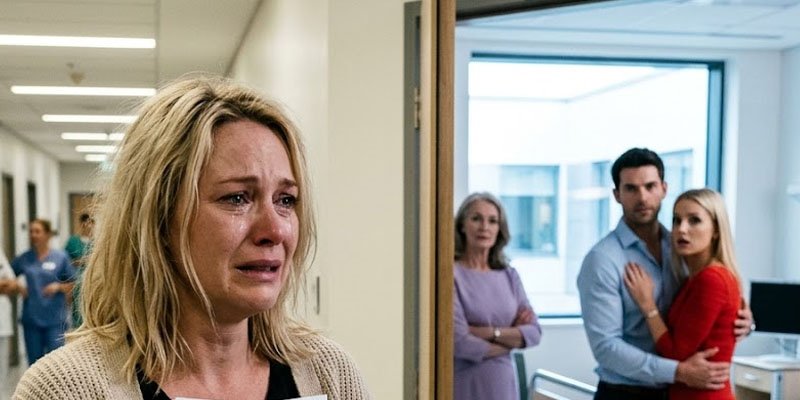
I sold the home my father left me to save my husband’s life. But when I arrived at the hospital carrying the sale documents, I discovered him in perfect health, standing beside his bed while another woman held him tightly. His mother smiled at me and asked, “Did you bring the money?” Then I played the first recording, and the entire deception started falling apart.
I sacrificed the final gift my father had ever left me because I truly believed it was the only way to keep my husband alive.
Less than twenty minutes after signing the closing papers, I walked into his hospital room and found him smiling while another woman wrapped her arms around his neck.
For the previous three weeks, Daniel had supposedly been “far too weak” to even sit up in bed.
His mother, Elaine, called me several times every day, delivering updates in a voice so somber it sounded like she was announcing a funeral.
“The specialist says treatment has to begin right away,” she whispered. “If we don’t get the money, he may not survive the month.”
The treatment was supposedly going to cost four hundred and eighty thousand dollars.
My father’s house was worth more than that, but to me it had never been just another piece of property.
He had built the front porch with his own hands. Inside the pantry door, the pencil marks showing my height from age six through sixteen were still there. Selling that home felt like saying goodbye to him all over again.
On the morning of the sale, I stood alone in the empty kitchen with my hand resting against the wall.
I remembered the final piece of advice my father ever gave me.
“Love generously, Maya, but never surrender your judgment.”
At the time, I cried because selling the house felt like I was betraying his memory.
Even so, I signed every document.
When I entered Daniel’s private hospital room carrying the paperwork for the transfer, his bed was empty.
Daniel was standing by the window wearing jeans and a fitted shirt. He looked healthy enough to pick Vanessa, his former assistant, right off the ground as she kissed his cheek.
Elaine sat nearby in a chair, calmly sipping her coffee.
There was no oxygen machine.
No medical monitors.
No shaking hands.
Daniel stopped cold the moment he noticed me.
Vanessa slowly let go of him and stepped back.
Elaine smiled.
“Did you bring the money?”
Hearing those words hurt even more than seeing Daniel with another woman.
I looked directly at him. “You were dying.”
He let out an annoyed sigh. “Maya, stop being so dramatic.”
Vanessa crossed her arms. “He’s been under a lot of stress. The doctors told him he needed rest.”
“For four hundred and eighty thousand dollars?”
Elaine stood up from her chair. “That money is for his recovery and for his new business. A good wife stands behind her husband.”
Daniel’s face hardened. “Give me the transfer papers.”
I placed the envelope on the table.
His eyes immediately lit up.
Then I took my phone from my pocket.
“There’s something you need to hear first.”
I tapped the screen.
Elaine’s voice echoed through the room, clear and unmistakably satisfied.
“Once she sells the house, Daniel won’t have to pretend anymore. She’s emotional, not smart.”
Vanessa instantly turned pale.
Daniel lunged toward me, trying to grab my phone, but I stepped out of his reach.
“That’s only the first recording,” I said.
For the first time, I saw uncertainty flicker across his face.
What none of them realized was that I had spent twelve years working as an insurance fraud investigator for the state attorney general’s office.
By the second day, I had already recognized the fake medical terminology Elaine was using in her messages.
By the fourth day, I had begun saving every phone call, invoice, threat, and demand they sent me.
Selling the house was completely real.
But I had never intended to hand them a single dollar.
PART 2
Daniel recovered from the shock almost instantly.
“You recorded my mother without permission,” he said sharply.
“No,” I answered. “She recorded herself when she left those voicemails.”
Elaine pressed her lips into a tight line.
Vanessa pointed toward the hallway. “You should leave before security throws you out.”
I almost laughed.
Even then, they still believed they had the upper hand.
Daniel grabbed the envelope from the table and ripped it open.
Instead of the completed transfer documents, he found blank paperwork, a copy of my divorce filing, and a legal preservation notice ordering him not to destroy or erase any financial records.
Every bit of color drained from his face.
“What have you done?”
“Exactly what you taught me,” I replied. “I stopped believing everything I saw.”
The hospital administrator walked into the room with two security officers and Dr. Patel, the physician whose signature appeared on Daniel’s supposed diagnosis.
Dr. Patel looked absolutely furious.
“I have never treated this patient,” he said. “And no real specialist would ever write the ridiculous claims in those reports.”
Elaine stumbled backward. “There has to be some misunderstanding.”
“There is,” I replied. “You forged the signature of the wrong doctor.”
My career had exposed me to countless cases involving fake illnesses, fabricated treatment plans, and families manipulated into selling their homes or emptying their savings.
Daniel’s medical paperwork was poorly put together.
The financial evidence, however, was much more revealing.
That was exactly why I had allowed their plan to continue.
Every fake invoice, every demand for money, and every threatening message gave investigators one more piece of proof.
Daniel attempted to take control of the situation again.
“This is nothing more than a family disagreement.”
A voice answered from behind him.
“Fraud is not a family disagreement.”
My supervisor, Deputy Attorney General Nora Blake, walked into the room accompanied by financial crimes detectives.
Vanessa nearly collapsed.
Elaine whispered, “Daniel…”
He turned toward her. “This was your idea.”
Her eyes grew wide. “You told me she would never verify anything!”
The detectives exchanged quick glances.
I pressed play on the second recording.
Daniel’s voice filled the hospital room.
“After the sale goes through, transfer two hundred thousand to Vanessa’s company. Mom gets what’s left. Maya will sign whatever we put in front of her if she believes I’m dying.”
Vanessa covered her mouth in shock.
Daniel looked at me with undisguised hatred. “You trapped us.”
“No,” I answered. “I gave you every chance to stop.”
The house had indeed been sold, but the money from the sale had been placed into an escrow account controlled by my attorney.
My father’s will also contained a safeguard allowing any sale completed through proven fraud or coercion to be legally challenged before the funds were released.
Daniel knew the property existed.
He had simply never taken the time to read the will.
Then came the revelation that completely shattered his confidence.
The buyer was the Mercer Heritage Trust, a nonprofit preservation organization my father had quietly helped establish before his death.
The trust had purchased the home under an agreement giving me the right to buy it back after the fraud investigation was complete.
Daniel stared at me. “You still own the house?”
“Not yet,” I replied. “But you never owned it.”
Elaine burst into tears.
Vanessa spoke with a shaking voice. “I didn’t know he was married when all this began.”
I opened her text messages on my phone.
“Would you like me to play the one where you called me his useful little widow?”
She immediately fell silent.
The detectives separated the three of them.
Daniel shouted that I was resentful and vindictive.
Elaine pleaded with me to remember that we were family.
For the first time, none of them looked certain of themselves.
PART 3
None of them were arrested that afternoon.
In real life, consequences are rarely as instant or dramatic as stories of revenge make them seem.
Instead, investigators gathered statements, confiscated electronic devices, froze financial accounts, and left Daniel, Elaine, and Vanessa to spend six weeks wondering which one of their lies would bring them down first.
Then the indictments were handed down.
Daniel was charged with conspiracy, attempted wire fraud, forgery, and insurance fraud.
Elaine faced those same charges, along with identity theft for using the credentials of a retired nurse to support the fabricated treatment plan.
Investigators also learned that Vanessa’s business was nothing more than a shell company established to receive stolen funds.
The three of them wasted no time turning against each other.
Daniel arrived at our divorce hearing wearing an expensive suit he had paid for using my credit card.
Before the judge entered the courtroom, Daniel leaned closer to me.
“You destroyed my life because of money.”
I looked him straight in the eye. “No. You destroyed your own life because you assumed my love made me blind.”
His attorney offered a settlement.
Daniel would give up any claim to my property if I agreed to stop assisting with the criminal investigation.
I declined.
The judge carefully examined the recordings, fabricated medical reports, forged paperwork, and messages outlining Daniel’s plan to convince me that if I delayed selling the house, his death would be my fault.
Then she turned her attention directly to him.
“You exploited your wife’s grief over her father’s passing and invented a terminal illness in an attempt to steal her inheritance. Your request for spousal support is denied.”
Daniel’s face fell.
Outside the courtroom, Elaine hurried after me.
“Please,” she begged through tears. “I’m an old woman. I won’t survive prison.”
I stopped walking.
“You smiled when you asked me if I had brought the money.”
Her lips quivered. “I was scared.”
“No,” I answered. “You were thrilled.”
Then I turned and walked away.
Daniel eventually accepted a plea agreement that included six years in federal prison, full restitution, and a permanent ban on handling or managing anyone else’s financial accounts.
Elaine received a four-year prison sentence.
Vanessa cooperated with the prosecution and was sentenced to eighteen months. She also lost her company, her professional license, and every client who had once placed their trust in her.
The hospital also filed its own lawsuit against them for using its name, facilities, and reputation as part of their fraudulent scheme.
Whatever money they had left disappeared into restitution payments and legal expenses.
Eight months later, I returned to my father’s porch.
The Mercer Heritage Trust had repaired the roof and transferred ownership of the property back to me under the terms of our repurchase agreement.
I unlocked the front door using my father’s old brass key.
Inside the pantry, every pencil mark remained exactly where he had left it years before.
Beneath them, I added one final mark.
Maya—free.
I did not keep the house as a memorial.
Instead, I transformed the first floor into a resource center for people facing financial coercion from spouses or family members.
We offered fraud assessments, emergency planning, and referrals for legal support.
On opening day, Nora presented me with a framed copy of the transcript from the very first recording.
“You stayed calm when most people would have fallen apart,” she said.
I watched the sunlight spread across my father’s wooden floor.
“I did fall apart,” I replied. “I simply refused to remain that way.”
That evening, I sat alone on the porch, listening to the wind rustling through the trees.
For the first time in years, the silence no longer felt empty.
It felt like justice.