
Half an hour after the judge officially declared my marriage over, I climbed into the back seat of a yellow taxi with my eight-year-old son, Noah. A single suitcase rested between us, and two one-way tickets to London were safely tucked inside my coat pocket.
Noah leaned his forehead against the window as the streets of Manhattan blurred by in streaks of gray buildings, steel, and icy winter rain.
“Mom,” he whispered, “is Lily going to be okay?”
I closed my eyes.
My six-year-old daughter, Lily, was still with her father.
Not because I wanted it that way.
But because my ex-husband, Grant Holloway, had money, powerful lawyers, undeniable charm, and the kind of smile that convinced judges he was a devoted father instead of the man who had torn our family apart for his mistress, Vanessa Blake.
The divorce agreement granted us temporary split custody until the final custody hearing. That weekend, Lily was scheduled to stay with Grant.
And that same weekend, he was marrying Vanessa.
I had begged him not to involve Lily.
“She’s only six,” I told him the evening before. “She barely understands everything that’s happened.”
Grant let out a quiet laugh over the phone. “She understands enough to know Vanessa is part of her life now.”
“She isn’t ready to be in your wedding.”
“She’ll be the flower girl,” he replied. “The pictures will be perfect.”
Perfect.
That had always been Grant’s favorite word.
Our marriage looked perfect. Our Christmas cards looked perfect. Every photo on his Instagram appeared perfect. Yet behind every picture, I was slowly disappearing while he came home carrying another woman’s perfume.
Noah understood much more than any child his age ever should. He had heard the fights. He had seen me crying behind the laundry room door. Once, he even found Lily hiding beneath her bed, hugging her stuffed rabbit while Grant shouted that I was “too emotional to be a proper parent.”
So once our divorce became official, I did the only thing the law allowed. I took Noah—whose passport I already had and whose transfer to a new school had been arranged—and boarded a flight to London, where my older sister, Caroline, was waiting for us.
But Lily had to remain behind.
For forty-eight hours.
Those forty-eight hours nearly broke me.
At the airport, Grant sent me a single photograph.
Lily stood beside Vanessa in a pale pink dress, holding a tiny basket filled with white rose petals. Pearls pinned back her curls. Yet the smile that should have been on her face was missing.
Below the photo, Grant had written:
She looks beautiful. Try to be happy for us.
My hands shook so badly that Noah gently took the phone from me.
“Don’t look,” he said.
But I couldn’t stop.
Thousands of miles away, inside a white chapel in Newport, Rhode Island, my little girl was being used as nothing more than decoration for the wedding built on the ruins of my marriage.
The ceremony began at four o’clock.
The chapel was filled with guests—Grant’s business partners, Vanessa’s friends, Grant’s parents, and people who had once shared meals at my table while pretending they knew nothing about the affair.
Lily slowly walked down the aisle, dropping flower petals one by one. Vanessa smiled proudly at her, as though she had won a prize.
When Lily reached the altar, Grant leaned closer.
“Good girl,” he whispered.
Lily looked up at him.
“My mommy said I don’t have to do this.”
Grant’s jaw tightened.
“Stand still.”
The music faded, and the officiant began speaking.
By that moment, I was already high above the Atlantic Ocean, gripping Noah’s hand while our plane shook through thick clouds.
Then came the moment no one expected.
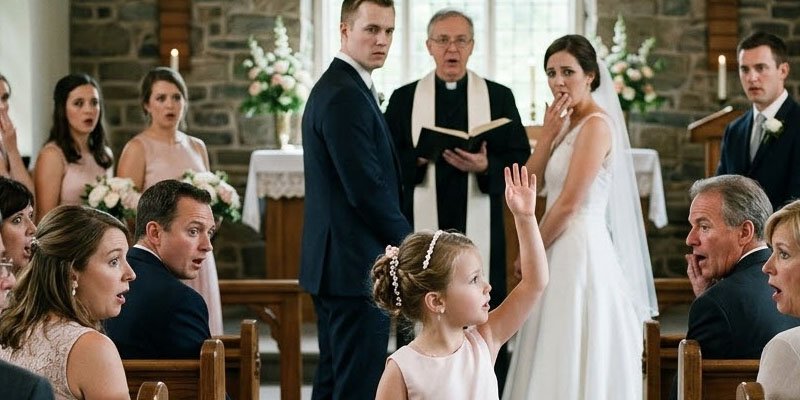
The officiant turned toward the guests and asked, “Does anyone object to this marriage?”
Silence filled the chapel.
Then my little daughter slowly raised her hand.
Vanessa gave an uneasy laugh.
“Oh, sweetheart—”
But Lily spoke before anyone could stop her.
“My daddy told me to lie.”
The entire chapel froze.
Grant’s face instantly lost its color.
Holding her little basket at her side, Lily looked toward the guests.
“He told me to tell everyone Miss Vanessa was nice to Mommy. But she made Mommy cry. And Daddy said if I didn’t smile today, Mommy would lose me forever.”
No one moved.
For what felt like three endless seconds, even the photographer lowered his camera.
Grant was the first to react. His polished shoes echoed against the chapel floor as he stepped toward her.
“Lily,” he said through clenched teeth, still wearing a forced smile, “that’s enough.”
But Lily had inherited the one trait from me that Grant had always hated.
Whenever she was frightened, she told the truth.
She looked at Vanessa before turning back to the crowd.
“Daddy said Mommy left because she didn’t want me,” Lily continued. “But Mommy tells me every day that she loves me. Daddy took away my tablet so I couldn’t call her.”
Soft whispers spread through the chapel.
Grant’s mother, Patricia, slowly rose from the front row, her face completely drained of color.
“Grant?” she whispered.
Vanessa’s smile instantly disappeared.
“This is absurd,” she snapped. “She’s just a little girl. She doesn’t understand.”
“I do understand,” Lily answered.
Her voice shook slightly now, but she refused to stop.
“Daddy told me that after today I had to call Miss Vanessa ‘Mommy Vanessa.’ I don’t want to. I already have a mommy.”
The officiant slowly closed his folder.
“Mr. Holloway,” he said in a calm tone, “perhaps it would be best if we paused the ceremony.”
For the first time, Grant’s composed expression cracked.
“No,” he replied sharply. “We are not stopping my wedding because of a child’s tantrum.”
That was when Vanessa’s father, Richard Blake, a retired police captain, stood up from the second row.
“That didn’t sound like a tantrum,” he said.
The mood inside the chapel shifted once again. The whispers grew louder, and guests began pulling out their phones.
Grant noticed immediately and lost his temper.
“Put those away,” he yelled. “Every one of you.”
Lily flinched.
That single instinctive movement damaged Grant’s image more than any accusation ever could.
Patricia stepped into the aisle and knelt beside her granddaughter.
“Lily,” she asked softly, “did your daddy tell you that your mommy left you?”
Lily nodded.
“He said she chose Noah because Noah listens better.”
Patricia covered her mouth.
On the other side of the Atlantic, I still had no idea any of this was happening.
The moment my flight landed at Heathrow, my phone exploded with notifications.
Caroline called first.
“Emma,” she said, breathing hard, “are you sitting down?”
My heart nearly stopped.
“Is Lily okay?”
“She’s safe. But something happened during the wedding.”
I gripped my phone tightly while Noah stood quietly beside me, his face pale.
Caroline sent me the video.
Standing in the airport arrivals hall among complete strangers, I watched my daughter as her tiny voice echoed through my phone.
My daddy told me to lie.
By the time the video ended, I was crying so uncontrollably I could barely catch my breath.
Then another message appeared.
It was from Patricia.
Emma, I’m so sorry. I believed him. I should have protected you and the children. Lily is with me now. Grant is not taking her anywhere.
I called her immediately.
Patricia answered before the second ring.
“Please put Lily on,” I said.
I heard a soft rustling sound.
Then a tiny voice.
“Mommy?”
I slowly slid down against the airport wall.
“Baby, I’m here.”
“I told the truth,” she whispered. “Are you mad at me?”
“No,” I answered through tears. “No, sweetheart. I’m so proud of you.”
“Daddy said you left me.”
“I never left you. I was coming back for you. I promise.”
Noah gently took the phone from my trembling hands.
“Lil,” he said, trying his best to sound brave. “It’s me.”
“Did Mommy choose you?”
“No,” Noah replied. “Mommy chose both of us. She always will.”
That evening, instead of celebrating his wedding, Grant found himself confronted by his own relatives, abandoned by nearly half of his guests, and watched as Vanessa walked out of the chapel before either of them ever said, “I do.”
But his actions were far from over.
Shortly before midnight in London, an email arrived from his attorney accusing me of coaching Lily, committing parental alienation, emotionally manipulating the children, and becoming an international flight risk.
At the bottom was a warning.
Return to the United States immediately, or Mr. Holloway will pursue emergency full custody.
I stared at the screen until there were no tears left to cry.
Then I called my lawyer.
“Emma,” she said, “save everything. The video. The text messages. The photograph. The threats. Every single piece of it.”
“What happens now?” I asked.
“Now,” she answered, “we stop running.”
I flew back to the United States forty-eight hours later.
Not because Grant demanded it.
Because Lily was there.
Noah sat beside me on the flight, quiet but constantly alert, like a young soldier pulled into a battle he had never asked to fight. Inside his backpack, he carried Lily’s stuffed rabbit. He said she would want it once we were home again.
At JFK Airport, my attorney, Marissa Cole, was waiting beside baggage claim in a navy coat and plain black flats.
She wasn’t the kind of person who greeted clients with hugs.
Instead, she silently handed me a folder.
“Emergency hearing tomorrow morning,” she said. “Grant filed first. We filed with stronger evidence.”
“What do we have?”
“The wedding video. Patricia’s text messages. Your phone records. The photograph he sent you. Lily’s statement to her grandmother. And one more piece.”
She opened the folder.
Inside was a printed screenshot of a message from Vanessa.
I read it twice.
Grant, this has gone too far. You promised Emma would lose custody after the wedding. You said the judge would believe she abandoned Lily.
A chill spread through my body.
Marissa watched my reaction carefully.
“Vanessa sent it to Patricia after Grant blamed her for everything that happened at the ceremony.”
“Why would she do something that helps us?”
“She isn’t trying to help us,” Marissa replied. “She’s trying to protect herself.”
The next morning, the family courthouse carried the scent of old files, burnt coffee, and damp wool coats.
Grant arrived in a charcoal-colored suit, clean-shaven and outwardly composed, though anger simmered beneath the surface. He looked straight past me as if I were nothing more than another piece of furniture.
Vanessa was nowhere beside him.
Patricia was.
She stood on my side of the hallway, gently holding Lily’s hand.
The moment Lily saw me, she slipped free and ran.
“Mommy!”
I dropped to my knees just in time to catch her. She threw her arms around my neck and buried her face against my shoulder, crying.
“I thought you were gone.”
“I’m here,” I whispered softly. “I’m here, sweetheart.”
Noah knelt beside us and pulled Lily’s stuffed rabbit from his backpack.
Lily grabbed it with one hand while holding tightly onto Noah’s sleeve with the other.
Grant watched us from across the hallway.
For the first time, no one stepped forward to comfort him.
Once inside the courtroom, Grant’s attorney tried to paint me as emotionally unstable.
He argued that I had fled the country immediately after the divorce.
He claimed I had confused the children.
He insisted Lily’s words during the wedding ceremony had been “clearly rehearsed.”
Then Marissa stood.
She played the recording.
The courtroom fell completely silent as Lily’s small voice echoed through the room.
My daddy told me to lie.
Grant kept his eyes fixed ahead, although a muscle tightened along his jaw.
Marissa didn’t deliver an emotional speech.
Instead, she did something far more damaging to Grant.
She carefully built a timeline.
She introduced the wedding invitation showing Lily listed as the flower girl before our divorce had even become final.
She presented the message where I begged Grant not to involve Lily.
She displayed his reply: The photos will look perfect.
She submitted the airport timestamp proving I had not disappeared in secret but had legally traveled with Noah during my assigned custody time.
She introduced Patricia’s sworn statement confirming that Grant had taken away Lily’s tablet.
Then she revealed Vanessa’s message.
Grant finally turned his head.
His attorney leaned over and whispered something urgently, but the damage had already been done.
The judge, a silver-haired woman named Hon. Rebecca Albright, removed her glasses and looked directly at Grant.
“Mr. Holloway,” she said, “did you tell your six-year-old daughter that her mother had abandoned her?”
Grant answered without hesitation.
“No, Your Honor. My daughter misunderstood a difficult situation between adults.”
Judge Albright looked down at the documents.
“Did you tell her she would have to call Ms. Blake ‘Mommy Vanessa’?”
Grant exhaled slowly.
“I encouraged her to be respectful.”
“That was not the question.”
His silence spoke for itself.
Lily was never required to testify in front of the courtroom. Instead, the judge met with her privately while a child advocate stayed with her throughout the conversation. When Lily came back, she climbed into my lap and tucked her face into my coat.
After that, events unfolded rapidly.
The judge granted me temporary primary physical custody of both children. Grant received only supervised visitation until a full psychological assessment and custody evaluation could be completed. He was also ordered not to discuss the divorce, the wedding, Vanessa, or any custody matters with the children.
As soon as the ruling was announced, Grant rose to his feet.
“This is ridiculous,” he protested.
Judge Albright’s face became stern.
“Sit down, Mr. Holloway.”
He obeyed.
The scrape of his chair sliding backward before settling into silence felt like the first real sound of freedom.
The full custody case continued for another six months.
Grant fought relentlessly.
He insisted I was acting out of bitterness. He claimed Noah had been manipulated by me. He argued Patricia had turned against him only because she felt embarrassed by what happened at the wedding. He hired expert witnesses. He replaced his attorneys. He flooded my inbox with long emails sent at two o’clock in the morning, blaming me for destroying his life.
But he no longer controlled the room.
Vanessa eventually gave her deposition.
She admitted Grant had promised that once the wedding was over, he would seek full custody and paint me as mentally unstable. She admitted he insisted on having Lily participate in the ceremony to “normalize the transition” and create public pressure. She also admitted she had known about me long before Grant ever filed for divorce.
Patricia testified too.
It was the hardest day of them all.
She cried while sitting on the witness stand.
“I chose to believe my son because it was easier than facing the truth about who he had become,” she said. “But when my granddaughter stood in that chapel and spoke honestly, I realized how silent I had been.”
Noah met privately with the child advocate.
He described the shouting, the locked doors, and how Lily would hide whenever Grant came home angry. He explained that he wanted to live with me and only see his father when he felt safe.
In the final judgment, I was awarded sole physical custody along with full decision-making authority over education, medical treatment, and therapy. Grant was granted limited supervised visitation, subject to future review only after completing court-ordered counseling and parenting classes.
When the judge finished reading the decision, Grant never looked in my direction.
Lily did.
She sat beside Noah, gently swinging her little legs above the floor. As soon as she heard she would stay with me, she leaned over and whispered something into her brother’s ear.
For the first time in months, Noah smiled.
Outside the courthouse, there were no television cameras. No crowd gathered. No dramatic rainstorm. No perfect movie ending.
There was only crisp air, passing cars, and my children holding tightly to my hands.
Lily looked up at me.
“Do I still have to wear the pink dress?”
I laughed, cried, and then laughed again.
“No, sweetheart.”
“Can we throw it away?”
“Burn it,” Noah suggested.
“No burning,” I answered with a smile.
So we chose something better.
That weekend, we donated the dress to a children’s charity. Lily carried it inside herself, carefully placed it on the counter, and said, “Maybe another little girl can wear it for something happy.”
The woman behind the counter smiled kindly.
“I’m sure she will.”
One year later, we were living in a modest home just outside Boston. It had blue shutters, creaky wooden floors, and a backyard barely big enough for a swing set.
Noah joined a soccer team. Lily started first grade. Some evenings were still hard. Lily asked painful questions. Noah occasionally woke from nightmares he insisted he couldn’t remember. Healing was never quick or dramatic. It came through quiet, ordinary moments.
Saturday pancakes.
Wednesday therapy sessions.
Bedtime stories.
Packed lunches.
Loose baby teeth.
Calm mornings without fear.
Grant remained exactly who he had always been. He mailed birthday gifts that were far too expensive for children and emails far too long to deserve forgiveness. But the court’s boundaries stayed firmly in place.
Lily saw him from time to time, always with supervision. Some visits ended peacefully. Others ended early. I stopped trying to predict which version of him would appear.
One afternoon in the spring, Lily came home from school carrying a drawing.
It showed four people—me, Noah, Lily, and Caroline—standing beneath an enormous yellow sun. In one corner, she had drawn a small pink flower basket with blossoms spilling out.
“What’s that?” I asked carefully.
She shrugged.
“That’s from the day I used my brave voice.”
I looked at her quietly.
“That’s what you call it?”
She nodded.
“Daddy said nobody wanted to hear me. But everybody did.”
Noah, sitting at the kitchen table finishing his homework, looked up.
“I heard you first,” he said.
Lily smiled.
“I know.”
That evening, after both children were asleep, I sat alone on the porch holding a cup of tea that had long since gone cold.
For years, I imagined escaping would happen in one dramatic moment.
A door slamming shut.
A suitcase packed.
A plane crossing an ocean.
But real freedom arrived much more quietly.
It was Lily sleeping with her bedroom door open because she no longer felt afraid.
It was Noah laughing in his room while talking with a friend.
It was seeing Grant’s name appear on my phone without my heart racing anymore.
It was realizing my six-year-old daughter had stood inside a chapel full of adults and spoken the truth when every adult around her had failed to do so.
Eventually, people asked whether I regretted flying overseas with Noah that day.
The answer was never simple.
I regretted leaving Lily behind in that chapel.
I regretted believing legal agreements more than my own instincts.
I regretted every year I stayed silent to preserve the image of a family Grant had already destroyed.
But I never regretted starting over.
Because thirty minutes after my divorce became final, I believed I was leaving with only one child.
I had no idea that my six-year-old daughter, carrying nothing more than a basket of rose petals, had already begun finding her way back to me.