
PART 1
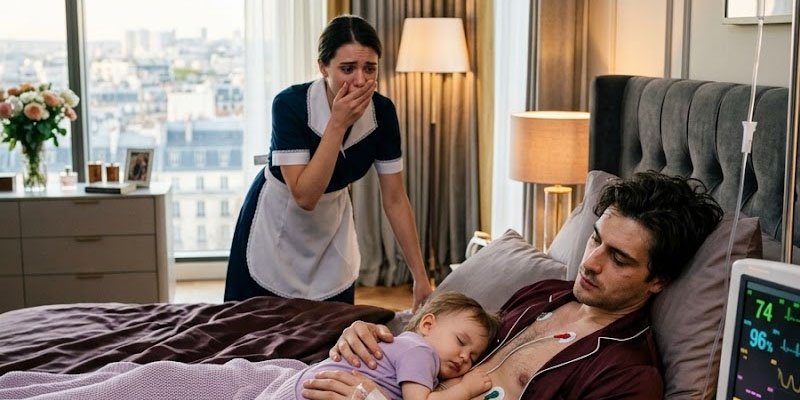
The man everyone believed was about to be buried suddenly moved one hand and weakly curled his fingers around my son’s blanket.
I stood frozen beside the bed, convinced for a moment that exhaustion had made me imagine it.
For three hours, I had been pacing around the servants’ quarters of the enormous Bellevue Crest estate with Theodore. He was nine months old, feverish because of teething, and nothing seemed capable of calming his cries. I rocked him, sang softly to him, and offered him warm milk, but his little whimpers only became more persistent.
Needing a different environment, I eventually carried him into Raymond Winslow’s silent bedroom.
The doctors had said he had only a few days remaining.
At forty-six, Raymond had amassed a fortune through regional transportation fleets, yet he had spent almost two months confined to his bed, unable to speak or move. His arrogant nephew, Christopher, was already casually making funeral plans, speaking about them as though he were simply making a dinner reservation.
I had taken the live-in caregiver position because I desperately needed a dependable income and, more importantly, because it was the only job that permitted Theodore to remain with me.
That evening, I sat beside Raymond to give my aching arms a break. Theodore continued crying, so almost without thinking, I carefully placed him on the sick man’s chest for a few moments.
The baby fell asleep almost instantly.
Then something impossible occurred.
Raymond’s fingers twitched and eventually brushed against the blue blanket.
“Mr. Raymond?” I whispered into the stillness of the room.
His eyelids began to tremble.
One dark eye slowly opened enough to look directly at me.
He was awake.
And he understood everything.
For the remainder of that night, I discovered that we could communicate through his eye movements. One blink meant yes. Two blinks meant no. Looking toward the doorway meant someone was coming.
“Can you hear everything people say while they are around you?” I asked in a hushed voice.
He gave one slow blink.
A cold shiver passed through me.
By noon, his lips had regained enough movement to form barely audible words. I leaned closer.
“Christopher… he isn’t waiting for my inheritance,” he whispered weakly. “He is making the process happen faster.”
Before I could ask what he meant, footsteps sounded in the hallway.
Christopher entered without bothering to knock.
He was dressed in a perfectly tailored gray suit, an expensive watch around his wrist, and an irritated look on his face.
“How is our dear patient doing today?” he asked casually.
“There have been no changes at all,” I answered at once, deliberately keeping my voice emotionless.
He gave his uncle hardly a glance.
“Good. Dr. Wallace will be here at four. And another thing, Nora: if your son keeps crying like that throughout the night, the two of you will have to find somewhere else to stay.”
I tightened my jaw.
“It won’t happen again, sir.”
Christopher walked out.
I waited until the sound of his footsteps had completely disappeared.
Raymond opened his eyes all the way.
“Do not tell him anything,” Raymond said quietly.
I nodded.
At precisely four o’clock, Dr. Samuel Wallace arrived carrying a black leather briefcase. From inside, he pulled out a simple white box with nothing on it except a handwritten chemical name. He drew clear liquid into a syringe and injected it directly into Raymond’s IV line.
Ten minutes later, Raymond’s breathing changed noticeably.
His fingers became completely unresponsive.
“He is fading quickly now,” Dr. Wallace remarked with frightening calm as he gathered his equipment. “Five days remaining, perhaps six at the very most.”
Rather than throw the empty ampoules away with the rest of the medical waste, he carefully placed them back inside his briefcase.
That night, after Theodore had fallen asleep, I searched online for the chemical name I had memorized from the box.
I read its medical description three separate times.
It was a potent paralytic that could produce severe muscle immobility and dangerously suppress breathing if administered incorrectly.
I went back into Raymond’s room and looked at him.
He was not dying naturally.
Someone was intentionally imprisoning him inside his own body.
And the man who would inherit the estate was coming every day to ask how much time Raymond had left.
I took Raymond’s chilled hand.
“I’m not going to let them kill you,” I promised quietly.
His fingers gave my wrist a faint squeeze.
At that moment, I understood that I had become involved in something much more dangerous than simply losing my job.
But I still had no idea what we were about to discover.
PART 2
My quiet battle against Christopher had begun.
After each appointment with Dr. Wallace, I watched Raymond closely and followed only confirmed medical procedures. I recorded the times, medication names, and changes in his vital signs. I also secretly took photographs of suspicious medication boxes in case they became necessary later.
Little by little, Raymond began to recover.
First, he managed to turn his wrist.
Then he was able to raise his forearm.
Four days later, he could hold his head upright for a few seconds.
“There is a cell phone hidden inside the bottom drawer of my desk,” he told me one morning before sunrise. “No one in this house knows about it.”
I searched behind old files and found the phone.
Raymond gave me a telephone number.
“He is my private attorney,” Raymond carefully explained. “He works for me, not Christopher. He is one of the very few people I still trust.”
We sent a brief message and then erased all the evidence.
During the daytime, Raymond continued pretending to be helpless. Whenever Christopher came into the room, he allowed his jaw to hang loosely and stared blankly at the ceiling.
“I never thought pretending to be a helpless corpse would become such a valuable skill,” Raymond whispered with a faint grin after one of Christopher’s visits.
I covered my mouth so I wouldn’t laugh.
But two days later, there was nothing funny about the situation.
I came home after buying diapers and immediately realized that someone had been inside my room.
My travel bag was shut differently.
The baby-food jars were no longer where I had left them.
Inside the trash, I discovered two wrappers from sterile mouth swabs.
I rushed upstairs.
“I think Christopher collected DNA samples from Theodore, and possibly from me, while I was gone,” I whispered anxiously.
Raymond’s face became serious.
“DNA testing,” he murmured.
“Why would he do that?” I asked.
“He wants to find something he can use against you, or perhaps prove that you came here as part of some deliberate plan to manipulate me.”
His gaze moved toward Theodore, who was asleep on the bed.
Then he asked me something I hadn’t expected.
“You have never told me about the child’s father,” he said gently.
Painful memories tightened inside my chest.
“His name is Brandon,” I answered quietly. “He spent his childhood moving through different state foster homes, and we met while we were both working at a diner downtown. He left us when Theodore was only three months old.”
“How old is he?” Raymond asked.
“He’s twenty-nine,” I replied.
Raymond stared toward the ceiling.
“What are you thinking about?” I asked.
“It is nothing,” he said, although the tone of his voice made it obvious that it wasn’t.
Two days later, a courier delivered an envelope to Christopher in Raymond’s study.
I happened to be walking by with tea when I heard him yell.
“This cannot possibly be real!”
Papers were being moved around violently.
“Tell me that again,” Christopher demanded over the phone. “That laboratory result has to be completely wrong!”
The door suddenly swung open.
He rushed past me and headed straight for his truck.
That night, he returned accompanied by Dr. Wallace.
They shut themselves inside the private office for nearly two hours.
When they finally came out, I told Raymond what I had witnessed.
He listened quietly and then asked me to bring Theodore to him.
I carefully placed the baby in his left arm.
“Nora, I had a son many years ago,” Raymond told me softly.
I stared at him.
“He was seventeen, and his mother was almost my age,” Raymond continued. “Her wealthy family sent her out of town to conceal the pregnancy. Later, I was told that the baby boy had ended up in an institutional facility. I spent years trying to locate him, but eventually I stopped searching.”
He swallowed with difficulty.
“I buried myself in my growing business, and later I buried myself in my money,” he admitted regretfully.
His eyes lowered toward Theodore.
“If Christopher tested my DNA against the child’s sample to establish that you and I were complete strangers…”
He stopped before finishing the thought.
I finished it for him.
“Brandon might be your lost son,” I whispered breathlessly.
Raymond closed his eyes.
Theodore wrapped his tiny hand around one of Raymond’s fingers.
“And this little boy might be my biological grandson,” Raymond said softly.
The meaning became clear to me immediately.
Until that point, Christopher had one obvious reason for wanting Raymond dead: the inheritance.
Now Christopher had learned about a legitimate son and grandson who could completely ruin his plans.
“Christopher isn’t going to stop now,” I warned.
“No, he won’t,” Raymond agreed firmly.
He reached out his hand.
“Give me the hidden phone.”
“Who are you going to call?” I asked.
For the first time since I had met him, Raymond smiled with unmistakable authority.
“I am calling the people Christopher was certain would never arrive soon enough to stop him.”
When he told me who would be coming to the estate the following morning, I realized that the real fight had only just begun.
PART 3
At exactly 10:50 the following morning, three large vehicles came to a stop outside the gate.
Christopher was not home.
He had left early, still completely certain that his uncle remained paralyzed upstairs.
I opened the gate.
An elderly man carrying a thick leather folder walked inside, followed by a younger legal associate, two private investigators, and two uniformed law-enforcement officers who identified themselves before entering.
The older man was Harrison Vance, Raymond’s personal attorney for more than two decades.
“Where is Raymond?” Harrison asked while looking around the entrance hall.
I pointed toward the stairs.
“He’s upstairs getting ready,” I replied.
Harrison stared at me.
Then a thud sounded from above.
A second thud followed.
Raymond appeared at the top of the staircase.
He was wearing dark trousers and a clean white shirt, leaning heavily against a polished wooden cane.
For two nights, he had secretly practiced walking the short distance from his bed to his bedroom door.
He had never tried climbing the stairs.
“Mr. Winslow…” Harrison whispered in complete disbelief.
Raymond smiled.
“Don’t start planning my funeral yet, Harrison,” Raymond said dryly.
He made his way down one painful step at a time while I remained close enough to catch him if he fell.
By the time he reached the bottom, his shirt was soaked with sweat, but he was still standing.
Harrison hugged him without saying anything.
Raymond gently patted his back.
“Business first, Harrison,” Raymond said softly. “We can become sentimental later.”
For the next hour, everyone gathered in the library and examined photographs, medication schedules, phone records, and medical documents. The investigators had already begun making formal legal requests.
They discovered suspicious payments moving from a shell company controlled by Christopher into an offshore account belonging to Dr. Wallace.
They also found messages in which the two men discussed altering Raymond’s medication to make an unexpected recovery impossible.
Only one crucial piece was still missing: conclusive proof of precisely what had been injected and who had ordered it.
“The prosecutor’s office is examining the chemical reports now,” one officer explained. “We cannot arrest someone merely because we suspect what he intended to do, so we need undeniable evidence.”
“Then make certain the evidence is secured correctly,” Raymond demanded. “I want justice, not some theatrical performance.”
At 12:20, tires rolled over the gravel outside.
Christopher had returned.
He entered the lobby while talking on his phone.
“I need you to come here immediately because…”
He stopped.
First, he saw Harrison.
Then the officers.
Then me holding Theodore.
Finally, his eyes landed on Raymond.
His uncle was sitting upright in his favorite armchair, no longer attached to the bed or IV equipment, his hands firmly resting on his cane.
Christopher’s face went completely pale.
“Uncle…” he stammered.
“Good morning, Christopher,” Raymond said coldly.
“What are you doing out of bed?”
“That is hardly the most important question you should be asking at this moment,” Raymond answered smoothly.
He gestured toward an empty chair.
“Sit.”
Christopher remained where he was.
“The doctor specifically told us you were entirely incapable of moving!”
“The doctor has made quite a few inaccurate statements lately,” Raymond replied.
Christopher looked toward the exit.
One of the officers quietly moved into his path.
Raymond continued.
“A week ago, you were certain I would be dead before Sunday. Three days ago, you ordered a genetic test without Nora’s permission. And yesterday afternoon, you received a laboratory result that sent you straight to Dr. Wallace.”
Christopher finally turned his attention toward me.
His arrogance had disappeared.
“That woman has manipulated you!” Christopher yelled, pointing angrily at me.
“Has she?” Raymond asked calmly.
“She came here with some random child, moved into your home, and suddenly claims that the boy has some connection to you! How can you not see what she is doing?”
“What I can see very clearly,” Raymond answered sharply, “is that this tiny child made my fingers move after I spent weeks lying helplessly in bed while everyone discussed my funeral.”
His voice became quieter.
“That includes you, Christopher.”
Christopher said nothing.
Harrison opened his folder.
“The secondary DNA panel, performed by an accredited independent laboratory, confirms a compatible biological relationship between Mr. Winslow and the child,” Harrison announced. “We are now filing the necessary legal motions to determine the precise lineage through the child’s father.”
Christopher took a step backward.
“That proves nothing in a court!”
“It provides more than enough probable cause to raise serious questions,” Harrison replied evenly.
Raymond tapped his cane against the floor.
“When you received those genetic results, you had two choices,” Raymond said quietly. “You could have come to my bedside and told me that we might have found my lost family, or you could conspire with Wallace to end my life.”
Christopher’s breathing became faster.
“You were completely unconscious!”
“No, I wasn’t,” Raymond said firmly.
The room became silent.
“I heard every word you said,” Raymond continued.
Christopher’s expression fell apart.
“I heard you ask Wallace how much longer it would take. I heard you say that moving me to a hospital was a bad idea because dying at home would look much more peaceful. I heard you discussing what you would do if I recovered my speech before you could make me sign over those financial documents.”
Christopher looked toward the officers.
“You have no legal right to hold me here!”
“No one is arresting you at this precise moment,” the officer told him. “But you are required to remain available for official questioning.”
That seemed to frighten him more than handcuffs would have.
“I am contacting my lawyers immediately.”
He started toward the entrance.
Raymond allowed him to go.
“Christopher,” he called quietly.
His nephew turned around.
“For twenty years, I asked you to sit at my dining table because I believed you were the only genuine family I had left,” Raymond said sadly. “If I had died believing you were merely ambitious, perhaps I could have found a way to forgive you. But I lay in that bed and heard everything. You will never be able to explain that away with money.”
Christopher walked out without answering.
The consequences came quickly.
Forty minutes later, following a frantic phone call, he tried to leave the jurisdiction.
The investigation accelerated because Dr. Wallace had made one crucial mistake: he had kept detailed private records, perhaps to protect himself from Christopher, or perhaps because he never imagined anyone would examine them.
At his clinic, investigators discovered records showing unlisted paralytic compounds purchased outside ordinary pharmacy procedures, along with patient logs that contradicted Raymond’s official medical charts.
They also recovered deleted messages.
Then the decisive evidence surfaced.
An audio recording.
Christopher had secretly recorded a conversation with Wallace several weeks earlier.
Whether he had intended to use it as protection or leverage remained uncertain.
On the recording, the two men openly discussed Raymond’s worsening condition, ways to maintain his paralysis, and their fear that he might regain movement before Christopher completed the transfer of company assets.
It was no longer merely suspicion.
The prosecution now possessed direct evidence.
Christopher was captured later that afternoon after being involved in a minor highway accident. He had been driving too quickly through heavy rain and lost control while taking a slippery turn.
He survived with a broken arm and serious bruising.
Ironically, the ambulance transported him first to a facility belonging to the same healthcare network where Wallace practiced.
When Christopher realized where he had been taken, he demanded a different doctor.
Dr. Wallace was arrested several hours later.
When Harrison called Raymond with the news, Raymond listened quietly.
I expected him to feel satisfied.
He didn’t.
“Don’t you think the whole thing is deeply ironic?” I asked gently.
“A week ago, I might have seen some dark humor in it,” Raymond admitted, staring down at his weathered hands.
“Why don’t you now?”
“Because I raised Christopher myself,” Raymond said with a sigh. “He was not my biological child, but I welcomed him into my home and into my heart. I taught him how to handle the business. I helped him through personal problems. I gave him money whenever he asked, and sometimes when he never asked. I honestly believed I was creating a real family through all of that.”
He looked directly at me.
“Perhaps the only lesson I truly managed to teach him was that everything in life has a price.”
The months that came afterward were physically difficult.
Raymond underwent intensive rehabilitation to relearn ordinary movements: climbing stairs, fastening buttons, and holding a cup of coffee without trembling.
Once the legal case was underway, I began making plans to leave.
One morning, I entered his study.
“We need to talk seriously, Mr. Raymond,” I began.
“Conversations that begin like that rarely end well,” he observed, placing his pen on the desk.
“You’re recovering well now,” I explained gently. “Theodore and I should begin searching for a place of our own.”
He immediately shook his head.
“No. Absolutely not.”
“Mr. Raymond…”
“First, stop calling me Mr. Raymond after spending three weeks watching me pretend to be physically helpless,” he said with a small grin.
I smiled.
“Second,” he continued more seriously, “I have no intention of turning the enormous debt I owe you into some sort of financial transaction. If you truly want to leave, I will gladly give you whatever financial help you need to establish yourself wherever you decide to go. If you want to remain here and continue working, I will give you a proper contract with regular pay and ordinary working hours. But I will not purchase your continued presence because I feel guilty.”
His honesty caught me off guard.
“And Theodore?” I asked quietly.
“Theodore is a completely different matter,” Raymond answered smoothly.
“What does that mean?”
He opened a drawer and took out two official reports.
The expanded DNA panel confirmed with statistical certainty that Brandon, Theodore’s father, was Raymond’s biological son.
Investigators had also located archived records from the state orphanage where Brandon had spent his childhood.
The intake dates, admission records, and his mother’s maiden name all matched.
“I lost twenty-nine years of his life,” Raymond whispered painfully.
“He doesn’t know anything about this,” I reminded him.
“I know.”
“And there’s no way to know whether he will even want a relationship with you,” I added realistically.
“I understand that possibility.”
“Brandon can be a very difficult person,” I warned.
“I’m not exactly easy to deal with myself,” Raymond replied with a faint smile. “Perhaps that is something we share genetically.”
Christopher and Dr. Wallace’s criminal trial continued for several exhausting months, involving expert witnesses, forensic financial reports, testimony from witnesses, and formal court proceedings.
I attended only when my testimony was necessary.
Raymond appeared at two major hearings but remained home when the final verdict was delivered.
Both men received significant prison sentences for the serious offenses established against them.
Harrison called while Raymond was outside cutting dead branches from a citrus tree.
“Would you like me to read the complete legal details of the verdict?” Harrison asked over speakerphone.
“No, that won’t be necessary,” Raymond replied simply before ending the call.
I sat close by while Theodore played near my feet.
“Is that really the end?” I asked.
“That is the end.”
“I thought you would feel more personally satisfied,” I admitted.
Raymond pressed his gardening spade into the earth.
“The justice system exists to make sure those men cannot hurt anyone else,” Raymond said thoughtfully. “It was never meant to restore the precious months I lost while lying in that bed.”
He looked toward the house.
“If I want to rebuild my life, I have to stop looking backward and start moving forward.”
Two weeks later, the investigator’s final report arrived.
They had located Brandon.
He lived in a small industrial town in the Midwest and worked for a commercial maintenance company. He lived quietly, had no criminal history, and changed jobs regularly.
Raymond read the report several times.
“I’m going there myself to meet him,” Raymond said quietly.
“You’re really going yourself?” I asked in surprise.
“Yes.”
“You could send him a formal letter first,” I suggested.
“I want to deliver the message myself,” Raymond insisted.
“What will you do if he refuses to open the door?”
Raymond folded the report and slipped it into his jacket.
“Then I will respect his choice and accept it,” Raymond replied honestly. “For twenty-nine years, I avoided searching properly because I was terrified of finding a closed door. I have already paid an enormous price for letting fear control my decisions.”
I remembered the night Brandon left us.
He had not yelled or destroyed anything.
He had simply looked at me and said:
“I don’t know how to be anyone’s son, and I certainly don’t know how to be a father to that child.”
Then he quietly shut the door and disappeared.
“When he left that night,” I told Raymond softly, “I believed he would never come back.”
“He may choose never to return to your life,” Raymond said carefully.
His words hurt, but at least they contained no false promise.
“I’m not going to track him down and force him to become your companion or the father you wish he could be,” Raymond clarified firmly. “I’m going because I am the person who owes him an explanation for his entire life.”
Three days later, Raymond left.
He returned alone.
I did not ask him anything over dinner.
He barely touched his food and spent the rest of the evening inside his study.
The next morning, I found him watching Theodore move around the coffee table.
Raymond knelt down on the rug.
“Your father makes exactly that same stubborn face whenever he gets frustrated,” Raymond said with a gentle smile.
My heart began pounding.
“You actually talked to him?” I asked, leaning toward him.
“Yes.”
“What did he say?”
“Well, his first reaction was to slam the door directly in my face,” Raymond admitted with a quiet laugh.
“I’m sorry,” I whispered.
“Don’t be,” Raymond replied calmly. “Because ten minutes later, he opened the door again.”
Brandon did not suddenly move into the estate.
There was no dramatic reunion or grand emotional speech.
He did not promise to change overnight.
Their relationship began with cautious text messages.
Those eventually became brief weekly phone calls.
One afternoon, Brandon asked about Theodore.
Several weeks later, he asked how I was doing.
A month after that, he flew into town.
When he first stood in the living room with his father and young son, he spent almost thirty minutes nervously fidgeting because he didn’t know what to do with his hands.
I was just as uncertain.
“I didn’t come back expecting you to forgive me for leaving,” Brandon told me privately later that day.
“Good, because I haven’t forgotten,” I answered honestly.
He nodded.
“I came because I’m tired of running away from my responsibilities.”
I didn’t completely forgive him that day.
But I didn’t shut the door on him either.
By the spring of the following year, we gathered together for Theodore’s baptism.
Rather than rent an expensive venue, Raymond arranged long wooden tables throughout the estate garden.
Purple jacaranda flowers still filled the trees around the neighborhood, while bougainvillea covered the stone wall.
Theodore was now eighteen months old and had apparently decided that walking existed mainly so he could escape adults attempting to dress him in formal clothes.
Raymond caught him near the citrus trees.
He no longer relied on his cane, although a slight limp appeared whenever he became tired.
“Come back here, you little runaway heir,” Raymond laughed, holding the squirming child securely.
“Please don’t call him an heir,” I protested playfully from the table.
“And why not?” Raymond asked with a grin.
“Because he’ll grow up with an unbelievably huge ego,” I teased.
Brandon walked onto the lawn carrying glasses.
“Arrogance may simply be another family trait,” Brandon joked.
Raymond looked at his son.
For several moments, neither man said anything.
Then they both laughed.
They did not yet look completely like a traditional father and son.
But they were learning how to become one.
After the meal, Theodore fell asleep in Raymond’s arms.
His cheek rested against the exact same place on Raymond’s chest where I had placed him on that frightening night when everyone believed Raymond was dying.
Raymond immediately became completely still so he wouldn’t wake the child.
“Nora,” he whispered nervously, “he’s fallen completely asleep.”
“Then don’t move at all,” I told him with a smile.
“I’ve already spent more than enough of my life lying motionless,” he whispered playfully.
I looked at him, and he gave me a knowing nod.
Across the lawn, Brandon and Harrison were planting a young tree Raymond had purchased to commemorate Theodore’s milestone.
“Why are we planting another tree?” I asked curiously. “This garden is already overflowing with greenery.”
Raymond looked down at the sleeping child.
“Anyone with enough money can buy an enormous house,” Raymond said quietly. “But a genuine garden is planted for generations that haven’t arrived yet. A person puts a small seed into the ground today without ever knowing exactly who will one day sit beneath its shade.”
He watched Brandon cover the tree’s roots with dark earth.
“I wasted decades believing that leaving behind a huge financial fortune was the same as leaving something truly valuable,” Raymond admitted softly.
Theodore sighed against his chest.
Raymond gently stroked his hair.
“It turns out I was completely mistaken about what really matters in life.”
I sat beneath the jacaranda trees, watching two men quietly rebuild relationships that had once been lost or broken.
Nothing had become perfect.
I still could not predict what the future would bring for Brandon and me.
Raymond could never recover the twenty-nine years he had missed with his son.
Nor could he erase the fact that someone he loved had once tried to kill him for money.
But for the first time, I understood that family does not always arrive as a complete picture.
Sometimes it takes shape late.
Sometimes it appears carrying fear, mistakes, and doors that slam shut before eventually opening again.
And sometimes it begins during the dark hours of the morning, when an exhausted mother places her feverish baby on the chest of a man the world has already accepted as dead.
Theodore shifted while sleeping.
Raymond looked across the patio toward me.
“Now I can finally breathe without fear,” he said peacefully.
I looked around the garden, at Brandon pressing fresh earth around the young tree, and then toward the estate where, only months earlier, I had counted footsteps in terror that someone might uncover our secret.
There was nothing else that needed to be explained.
“Yes,” I replied softly, breathing in the spring air. “Now we can all finally breathe easily.”
As the breeze passed through the branches, I finally understood the true legacy a person leaves behind.
Not wealth.
Not a magnificent home.
Not a famous family name.
But the opportunity for the people who come after us to live without fear.




