
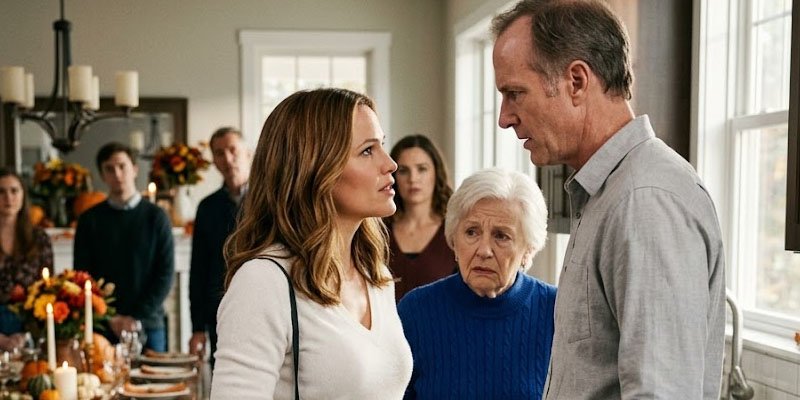
The turkey had been roasting in the oven for four hours when my husband walked into the kitchen and calmly informed me that he wanted a divorce.
Daniel didn’t raise his voice.
He didn’t wait until our guests had gone home or ask if we could talk somewhere in private.
Instead, he stopped beside the kitchen island, loosened his tie, and spoke with the quiet confidence of someone who had already made up his mind.
“I’ve met someone else,” he said. “She understands me in ways you don’t anymore.”
The entire kitchen fell silent.
Behind him, his mother froze while arranging the dinner rolls in the basket I had specifically asked her to leave alone.
Daniel’s sister immediately looked down at the floor.
His brother-in-law suddenly became fascinated by the muted football game playing in the living room.
Not one of them seemed shocked.
That was the exact moment I realized every one of them had known before I did.
Daniel glanced toward the oven.
“I don’t want to ruin today,” he continued. “Everyone traveled a long way. Finish making dinner, and we’ll talk once everyone leaves.”
I had been awake since 5:12 that morning.
The turkey was almost ready.
The mashed potatoes rested beneath a freshly folded kitchen towel.
The sweet potatoes were cooling beside the sink.
Two homemade pies sat on the breakfast table beside a bowl of whipped cream I had made from scratch because Daniel’s mother always claimed the canned version looked “careless.”
Eleven people were waiting to eat.
Nine of them had already known my marriage was over before I had any idea.
I slowly looked around the kitchen.
Daniel’s mother, Eleanor, finally raised her eyes to meet mine.
She wore a burgundy sweater along with the delicate gold cross she only wore during holidays.
There wasn’t a trace of sympathy on her face.
Instead, she seemed worried that I might humiliate the family by reacting like any normal person would.
“Claire,” she said gently, “this is hard on everyone.”
I reached behind my back and untied my apron.
It was cream-colored with faded red apple prints.
My daughter had given it to me years earlier after buying it at her school’s Christmas market.
I folded it carefully once.
Then I folded it again.
Finally, I placed it neatly on the counter beside the carving knife.
“So Daniel says the woman replacing me is younger, happier, and a better fit for this family,” I said.
No one spoke.
I looked straight at Eleanor.
“Then let your new daughter-in-law finish preparing Thanksgiving dinner.”
Daniel stared at me.
“Claire, don’t make a scene.”
I turned off every burner on the stove.
The gravy stopped simmering.
The green beans no longer steamed.
It felt as though the entire room had taken a deep breath with me.
“I’m not making a scene,” I replied. “I’m leaving.”
“You can’t leave now,” Eleanor protested. “The turkey hasn’t even been carved.”
I picked up my purse from the chair beside the pantry.
“Then I suggest you call the woman your son believes can do everything better than I can.”
Daniel stepped toward me.
“Where are you going?”
I looked at him for a long moment.
For twelve years, I had organized my entire life around his needs.
I remembered every dental appointment, helped prepare presentations when he changed careers, paid the mortgage during slow periods in his business, and hosted every holiday gathering his family insisted should happen in our home.
Somewhere along the way, he had mistaken my reliability for something that would always be there.
“I honestly don’t know,” I answered. “But it’s the first choice I’ve made in years without checking your calendar first.”
Then I walked into the living room.
Daniel’s father sat in my usual chair beside the fireplace with a glass of wine in his hand.
Two cousins lingered near the dining table pretending they weren’t listening.
My niece had placed her phone face down, although I had already noticed the screen light up when Daniel came into the kitchen.
The table had been set with my wedding china.
I had spent the previous evening polishing every piece of silverware.
At the front door, I slipped on my coat and stepped outside into the chilly Thanksgiving afternoon.
No one followed me.
My name is Claire Bennett.
I was forty-three years old that November, and until the instant the front door closed behind me, I truly believed I was in a happy marriage.
It wasn’t flawless.
I had never been unrealistic enough to expect perfection.
Daniel and I argued about money, busy schedules, his family, and his habit of leaving every cabinet door open as though someone else was responsible for closing them.
We experienced seasons when we drifted apart.
After my daughter, Sophie, left for college, our home became noticeably quieter.
Still, I convinced myself that silence was simply what happened as marriages grew older.
I believed our love had settled into comfortable routine.
Looking back now, I realize I had settled into a life of serving everyone else.
Daniel and I first met twelve years earlier during a community fundraiser in Raleigh.
At the time, I managed operations at a physical therapy clinic.
He had recently left a corporate sales career and was trying to build a residential renovation company.
Back then, he was incredibly charming.
Not polished the way he eventually became.
He was humorous, a little awkward, and constantly carried graph paper filled with hand-drawn floor plans.
He loved talking about restoring aging homes instead of tearing them down to build identical modern houses.
During our third date, he drove me through an older neighborhood near Five Points and pointed toward a boarded-up Craftsman house.
“Most people see something falling apart,” he said. “I see what it has the potential to become.”
I loved that answer.
I had already gone through one divorce.
Sophie was eight years old, and her biological father lived in another state.
I was extremely careful about introducing another man into her life.
Daniel never rushed me.
He quietly attended her school play and chose a seat in the back.
He remembered exactly which cereal she liked best.
When her bicycle chain slipped off, he knelt in our driveway wearing dress pants and fixed it with grease-stained hands.
Sophie trusted him before I ever fully did.
Eighteen months later, we got married.
The first years of our marriage were challenging in all the ordinary ways.
Daniel’s business went through difficult times.
Customers were slow to pay.
Contractors repeatedly broke the commitments they had made.
On two separate occasions, I dipped into our joint savings to cover payroll because he couldn’t afford to lose his employees.
After finishing my own full-time job, I took over the bookkeeping.
I prepared invoices, tracked every expense, and created the spreadsheet that kept the company from missing its quarterly tax obligations.
Night after night, I sat at the kitchen table balancing receipts while Daniel slept upstairs.
When the business finally took off, everyone praised him.
Eleanor proudly told people that her son had always possessed “an extraordinary business instinct.”
No one acknowledged the woman who had spent six years turning that instinct into an organized business.
I told myself it didn’t matter.
Marriage wasn’t supposed to be about competing for credit.
When Daniel landed his first major development project, he surprised me with a pearl necklace over dinner.
“For believing in me,” he said.
I wore it only twice.
Most of the time, I would have preferred if he had simply loaded the dishwasher without being asked.
Our home gradually became the gathering place for every family celebration because it was larger than Eleanor’s townhouse and because I knew how to host.
At first, I genuinely enjoyed it.
I loved setting an elegant table.
I enjoyed the smell of cinnamon and onions drifting through the kitchen.
My favorite moment was when everyone arrived, filling the hallway with winter coats while lively conversation brought warmth to every room.
Eventually, appreciation turned into expectation.
Eleanor stopped asking if Thanksgiving could be held at our house.
She simply informed me how many people would be coming.
Daniel began inviting business associates without mentioning it to me.
His sister started requesting special dishes.
One year, she asked me to prepare a separate stuffing because her husband had suddenly decided to avoid gluten.
I worked full-time.
Yet I continued handling everything.
Every holiday started with compliments.
“Claire is amazing.”
“Claire never forgets anything.”
“Daniel is so lucky.”
At first, those words sounded kind.
Later, I realized they were simply permission for everyone to expect even more from me.
The Thanksgiving that ended my marriage had actually begun three weeks earlier with a text from Eleanor.
We’ll have nine this year. Possibly eleven. Robert may bring the boys. Daniel said you won’t mind.
I showed the message to Daniel.
“You told her I wouldn’t mind?”
He stood in front of the bathroom mirror adjusting his collar.
“It’s Thanksgiving.”
“That doesn’t answer my question.”
“They’re family.”
“So am I.”
He met my eyes through the mirror.
“Why do you always make simple things so complicated?”
I almost laughed.
Apparently, the shopping, cooking, cleaning, preparing guest rooms, arranging seating, and dealing with leftovers were all considered simple because someone else was responsible for them.
“Will you help?” I asked.
“Of course.”
His entire contribution was buying two bottles of wine and asking three separate times whether the turkey was large enough.
During those weeks, Daniel seemed unusually distant.
He carried his phone everywhere, even into the garage.
He started working out before work and bought shirts far more expensive than anything he had worn during our marriage.
Whenever I asked whether something was bothering him, he blamed work.
“People depend on me,” he said.
I never pointed out that people depended on me as well.
The more distant he became, the harder I worked to make our life appear normal.
I planned Thanksgiving with almost obsessive attention to detail.
The menu was printed and taped to the refrigerator. I ordered a fresh turkey from a nearby farm. I purchased soft orange and cream-colored flowers. I washed the guest-room sheets and neatly folded fresh towels at the foot of every bed.
I convinced myself that if I made the house feel warm enough, perhaps the marriage inside it would somehow find its way back.
One week before Thanksgiving, our credit union called me.
The representative asked whether I had approved a new advance on our home equity line.
“I haven’t approved anything.”
She paused briefly.
“Mr. Bennett submitted the request through the business portal. Since the property is jointly owned, we require signatures from both owners.”
“How much?”
“Seventy-five thousand dollars.”
I slowly lowered myself into my office chair.
“What reason was given?”
“Business expansion.”
Daniel had never mentioned any plans to expand the business.
I asked the representative to email me the documents and explained that I wanted to review everything before making a decision.
That evening, after dinner, I brought it up.
“Did you request seventy-five thousand dollars against the house?”
Daniel stopped eating.
“For the business.”
“What do you need it for?”
“Cash flow.”
“What kind of cash-flow problem requires that much money?”
He carefully placed his napkin on the table.
“I handle the business, Claire.”
“I own half the company.”
“You take care of the books.”
“I became an owner when my inheritance kept the company alive.”
His face immediately tightened.
Several years earlier, after my grandmother died, I invested one hundred and twenty thousand dollars into Bennett Residential Group. Our attorney structured the investment as a fifty-percent ownership interest because the bank required documented equity.
Daniel had signed every single document.
Once the emergency had passed, he rarely remembered the paperwork.
“You know that arrangement was only technical,” he said.
“No,” I replied. “It was legal.”
“You’re making too much of this.”
“Show me the accounts.”
“I’m not bringing business problems into the house.”
“You’re trying to borrow against our home.”
Something changed in his expression.
Only a slight tightening around his mouth.
I recognized it immediately.
I had seen that exact look countless times from patients at the clinic whenever an uncomfortable question came dangerously close to the truth.
“Forget about the loan request,” he said. “I’ll figure something else out.”
He stood up, carried his plate to the sink, and left it there.
The following morning, I logged into the company’s accounting system.
My access had been revoked.
My password no longer worked.
I tried using the administrator recovery option.
The recovery email address had already been changed.
I didn’t confront Daniel about it again.
Instead of confronting him, I arranged a meeting with a family-law attorney named Tanya Brooks.
A coworker who had endured a difficult divorce once described Tanya as “the calmest frightening person I have ever met.”
Her office was located in a brick building near downtown Raleigh.
She wore a charcoal-colored suit, listened carefully without interrupting, and focused on asking for dates rather than emotions.
“Do you want a divorce?” she asked.
“I don’t know.”
“Do you believe your husband may be moving marital or business assets without your knowledge?”
“Yes.”
“Then whether you want a divorce is not the first issue. Understanding your legal position is.”
That single sentence gave me something solid to hold on to.
Tanya slid a checklist across the desk.
Tax returns.
Bank statements.
Business ownership documents.
Property deeds.
Insurance policies.
Retirement accounts.
Loan applications.
Credit-card statements.
Any messages connected to financial matters.
“Do not access anything you are not legally authorized to see,” she instructed. “Do not attempt to guess passwords. Do not move any money. Preserve every record you already possess.”
I returned home and quietly started gathering documents.
Daniel noticed nothing.
For reasons I couldn’t fully explain, that hurt almost as much as everything else.
For twelve years, I had kept every important document in our lives carefully organized. Daniel simply assumed the paperwork would always be there without ever considering who made sure it stayed that way.
Inside a locked drawer in the home office, I found the original company agreement confirming my fifty-percent ownership stake. I found documentation of the money I had invested from my inheritance. I also found copies of every mortgage payment made from my salary during the years his company struggled.
Then I came across a hotel charge.
It had been paid using a company credit card.
Two nights at a boutique hotel in Charleston.
Daniel had told me he was attending a contractors’ conference in Richmond.
Then I found another charge from the following month.
A restaurant.
A jewelry store.
A transfer of thirty-two thousand dollars to a newly formed consulting company called Northstar Brand Strategies.
The business was registered to a woman named Natalie Cross.
I searched for her online.
Natalie was thirty-one years old, worked in marketing, and had recently started appearing in Bennett Residential Group’s social media posts. In one photograph, she stood beside Daniel at a ribbon-cutting ceremony with one hand resting lightly against his back.
The caption introduced her as the company’s new strategic consultant.
In another photo, she was wearing the bracelet purchased with our company credit card.
I closed the laptop.
My hands remained steady.
At least for the moment.
I copied every document I was legally allowed to access and placed the copies inside a blue folder in my car.
I never actually told Tanya that I believed Daniel was having an affair.
I simply handed her the records.
She nodded.
“Facts first.”
Two days before Thanksgiving, Tanya called me.
“The company filings confirm that you own fifty percent of the business. The house is jointly titled. Most marital assets will require review. Do not sign the home-equity paperwork.”
“I wasn’t planning to.”
“Your husband may believe your legal and financial position is weaker than it actually is.”
“He usually does.”
“Then let him continue believing that until you decide what your next move will be.”
On Wednesday evening, I stood in my kitchen making pie crusts.
The contradiction wasn’t lost on me.
I suspected my husband was using our business to support another woman, yet I was still preparing Thanksgiving dinner for his family.
Why?
Because learning the truth doesn’t instantly erase twelve years of habit.
Part of me still wanted an explanation.
Part of me hoped there was another version of the story that would somehow make all those financial records mean something else.
And another part of me had already begun preparing to leave.
I woke before sunrise on Thanksgiving morning.
Daniel stayed asleep until eight-thirty.
When he finally came downstairs, I was chopping celery.
“Smells good,” he said.
He leaned over to kiss my cheek.
I turned my head just enough that his lips brushed my hair instead.
He didn’t even notice.
By ten o’clock, Eleanor arrived carrying nothing except her handbag and a fresh round of criticism.
“The flowers are beautiful,” she said. “A little low for the table, but beautiful.”
Without asking permission, she opened the refrigerator.
“Did you make the cranberry sauce yourself?”
“Yes.”
“Daniel always preferred the canned kind when he was little.”
Soon Daniel’s sister arrived with her husband and their two boys. A little later, his cousin Robert came with a woman nobody had mentioned beforehand.
Eleven expected guests suddenly became twelve.
Without saying a word, I added another place setting.
Around noon, Eleanor stood in the kitchen doorway while I basted the turkey.
“My son is very lucky,” she declared. “Claire can do everything.”
Daniel looked down at his phone and smiled.
Not at me.
At the screen.
An hour later, he walked into the kitchen and announced that he wanted a divorce.
I wasn’t entirely surprised.
But anticipating something doesn’t lessen the pain when it finally happens.
“I’ve met someone who’s better suited to the life I want,” he said.
“Does she have a name?” I asked.
His eyes shifted.
“Natalie.”
Of course.
“How long?”
“This isn’t the right time.”
“You’re the one who chose the time.”
Eleanor stepped between us.
“Claire, let’s stay civil.”
I looked directly into her eyes.
“You knew.”
She pressed her lips tightly together.
“Daniel has been unhappy for a long time.”
“How long have you known?”
“Several weeks.”
His sister lowered her gaze.
The cousins remained in the living room, but every conversation had fallen silent.
Every one of them had already known.
They had gathered at my home expecting me to prepare Thanksgiving dinner before Daniel replaced me.
“Where is Natalie?” I asked.
Daniel glanced toward the oven.
“She’s spending Thanksgiving with friends.”
“Will she be meeting you after I’m gone?”
He said nothing.
Eleanor let out a weary sigh.
“Please don’t make a scene.”
That was the moment I untied my apron.
I walked away because staying would have meant helping them stage my own replacement.
The cold November air caught in my chest.
I sat inside my car at the end of the driveway and looked back at the house.
Through the dining-room windows, I watched Eleanor moving back and forth between the kitchen and the table while Daniel stood near the front entrance, looking toward my car.
For a brief second, I wondered whether he would come after me.
He didn’t.
I drove toward downtown with no destination in mind.
Most restaurants were closed. Grocery store parking lots were nearly empty. Families crossed the streets carrying foil-covered dishes while early Christmas music played softly on the radio.
Eventually, I checked into a small hotel near the airport.
The young woman working at the front desk wore a paper turkey pinned to her sweater.
“Traveling for the holiday?” she asked.
“Something like that.”
My room had a king-size bed, a chair beside the window, and a framed photograph of an empty coastline hanging on the wall.
I slipped off my shoes.
Then I turned off my phone.
For the first time in years, I slept without listening for Daniel’s key in the lock, without wondering whether the dishwasher had been loaded, and without calculating when the turkey needed another layer of foil.
I woke shortly after six the following morning.
Sunlight filtered through the curtains.
For a few moments, I couldn’t remember where I was.
Then I noticed my neatly folded clothes resting on the chair and felt the unfamiliar relief of having no one expecting me to make breakfast.
I ordered coffee from the hotel lobby and switched my phone back on.
Thirty-two missed calls.
Fourteen from Daniel.
Nine from Eleanor.
Three from Daniel’s sister.
The rest came from relatives who had been at the house.
There were messages as well.
Where did you leave the gravy recipe?
The turkey is still raw in the middle.
Your oven won’t stop beeping.
Please answer.
Mom is upset.
People are leaving.
You embarrassed Daniel in front of everyone.
Come home so we can discuss this like adults.
The final message arrived at 1:18 a.m.
It was from Daniel.
Natalie isn’t answering. I need you to call me.
I stared at the screen.
The future he had carefully planned had failed to appear, and somehow he had decided that fixing it was now my responsibility.
I didn’t respond.
At nine o’clock, I called Tanya.
She answered from her home.
“You left?” she asked.
“Yes.”
“Are you safe?”
“Yes.”
“Do you intend to go back today?”
“No.”
“Good. Come see me on Monday. Save every message, and don’t argue about money through text messages.”
“What about the business?”
“Nothing today.”
“The accounts?”
“Leave them alone. I’ll prepare notices requiring both the marital and business assets to be preserved.”
My phone continued vibrating while we spoke.
By noon, I had accumulated fifty-eight missed calls.
Eleanor left a six-minute voicemail accusing me of abandoning the family on Thanksgiving. She complained that the turkey had been undercooked, the mashed potatoes had gone cold, and Robert’s guest had stormed out after an argument.
She never once mentioned that her son had announced an affair and demanded a divorce in my kitchen.
To her, the ruined meal had been the true disaster.
Daniel’s sister left a much quieter message.
I’m sorry. I should have warned you.
I listened to it twice.
Then I saved it.
By Saturday afternoon, the total number of missed calls had reached eighty-seven.
The number almost made me laugh.
Not because I believed eighty-seven people genuinely cared.
But because nearly every call came from someone discovering exactly which part of their comfortable life I had quietly been holding together.
Daniel couldn’t locate records he had never taken the time to organize.
Eleanor wanted serving dishes she had always assumed belonged to her son.
Daniel’s cousin couldn’t find the coat he had left in the guest room.
One contractor needed payroll approved.
The company credit card had been declined.
Natalie still refused to answer Daniel’s calls.
My silence became the first honest answer I had given any of them in years.
On Monday morning, I carried the blue folder into Tanya’s office.
She carefully reviewed the company agreement, property records, bank statements, hotel receipts, and the transfers made to Natalie’s consulting business.
When she finished, she folded her hands neatly in front of her.
“Your husband is operating under several misconceptions.”
“That’s a polite way to describe it.”
“He believes the business belongs entirely to him.”
“He always refers to it as his company.”
“Legally, the company belongs to both of you.”
“What about the thirty-two thousand dollars?”
“That transfer will need to be explained. The same applies to any marital or company funds that were used for personal expenses.”
“And the house?”
“You both own it jointly. You have every legal right to live there, although remaining elsewhere for now may be healthier for you emotionally. We can address possession of the home and related expenses through legal counsel.”
“I don’t want to fight over every single piece of furniture.”
“You don’t have to. Just don’t surrender your rights before you fully understand them.”
Tanya immediately sent formal legal notices to Daniel and the company’s bank.
The notices didn’t halt the company’s normal operations.
They simply prevented significant transfers, new loans, property sales, or ownership changes without proper review.
She also instructed Daniel to preserve every business and financial record.
That afternoon, around four o’clock, he called me from a number I didn’t recognize.
I answered because Tanya believed one brief conversation could resolve any immediate practical issues.
“Claire.”
His voice sounded different.
Less certain.
“I’ve been trying to reach you.”
“I noticed.”
“Where are you?”
“Somewhere peaceful.”
“You need to come home.”
“No.”
“We can work this out.”
“You announced your divorce in front of your entire family.”
“I handled it badly.”
“You expected me to finish serving Thanksgiving dinner.”
“I was under a lot of pressure.”
“From whom?”
Silence.
Finally, he spoke.
“Natalie misunderstood the situation.”
“What situation?”
“She believed I had already filed.”
“Had you?”
“No.”
“So you told her I was already gone.”
“I told her the marriage had already ended emotionally.”
“And your family knew.”
“Yes.”
“But I didn’t.”
“I was trying to find the right time.”
I looked through the hotel window as airplanes climbed into the sky beyond the parking garage.
“You chose Thanksgiving.”
“I panicked.”
“No, Daniel. Panic happens in the moment. You planned an audience.”
His breathing became slower.
“My lawyer received some aggressive letter.”
“It wasn’t aggressive. It explained ownership.”
“You’re trying to take my company.”
“Our company.”
“That arrangement was never supposed to make you my equal.”
“You signed it.”
“Because we needed the money.”
“My money.”
“We were married.”
“Yes,” I replied quietly. “We were.”
He fell silent.
Then his voice softened.
“Come home, Claire. We’ll talk. Mom will apologize.”
“I don’t need Eleanor’s apology.”
“What do you need?”
“Distance.”
“From me?”
“From the role you expected me to keep playing.”
He began to answer.
I ended the call.
The legal process moved much more slowly than family gossip.
Within a matter of days, everyone had created their own version of what had happened.
Eleanor insisted I had walked out on Thanksgiving after Daniel calmly suggested we have an adult conversation.
Daniel’s sister claimed the announcement had simply been poorly timed and that my decision to leave proved our marriage had already been falling apart.
One cousin insisted Natalie was only an emotional relationship and not an actual affair.
The hotel charges told a different story.
Nine days after Thanksgiving, Natalie contacted me through social media.
I think there are things Daniel hasn’t been honest about with either of us.
I didn’t respond immediately.
Tanya advised me not to meet with her privately but said I could ask that anything relevant be provided in writing.
So I replied:
Send anything you believe is relevant directly to my attorney.
Natalie sent screenshots.
Daniel had told her that we had been separated for eight months.
He claimed I had been living in the guest room.
He told her I had no involvement with the company and would receive “a fair settlement” from savings that, in reality, didn’t exist.
He promised her a house near the coast once he refinanced ours.
He had also asked Natalie to establish Northstar Brand Strategies so consulting payments could be transferred into an account under her control.
Natalie insisted she believed those payments were legitimate business expenses.
Whether that was true would ultimately be determined by documents, not by my assumptions.
The most revealing message had been sent on Thanksgiving morning.
By tonight it’s done. She’ll finish dinner because she never makes a scene. Then she’ll leave.
I printed it.
Daniel had always known exactly what he expected from me.
Cook.
Serve.
Disappear.
When Tanya presented those messages during the settlement conference, Daniel’s attorney immediately requested a recess.
After that meeting, Daniel stopped calling every day.
Eleanor didn’t.
She even came to my hotel once, even though I had never told her where I was staying. She found me through Daniel’s credit-card records because I had originally booked the room using our joint card before changing the payment to my personal account.
The front desk called to let me know that a family member was waiting downstairs.
I went to the lobby.
Eleanor was sitting beneath a large artificial plant, holding her handbag tightly with both hands.
She stood as soon as she saw me.
“You look tired.”
“I’m sleeping better.”
Her lips pressed into a thin line.
“Daniel is falling apart.”
“He should try calling Natalie.”
“She blocked him.”
“That sounds like a healthy boundary.”
Eleanor glanced toward the front desk.
“Can we speak somewhere private?”
We took seats by the window.
She lowered her voice.
“I don’t approve of the way he handled this.”
“You approved enough to be there.”
“I came for Thanksgiving.”
“You came knowing he intended to replace me afterward.”
“He told us the marriage had already been over for months.”
“Did I look like a woman who was separated when I served all of you dinner two weeks earlier?”
She remained silent.
“He told us you already knew,” she finally said.
“And you believed him because it allowed you to keep benefiting from everything I did.”
“That’s not fair.”
“No,” I replied. “It’s accurate.”
Eleanor opened her handbag and removed a small velvet jewelry box.
Inside was the pearl necklace Daniel had given me years earlier.
“I found this in the bedroom.”
“You went through my belongings?”
“I was looking for the insurance papers.”
“Of course you were.”
She set the box on the table.
“Claire, I know you’re hurting. But marriages survive mistakes.”
“Respect shouldn’t begin only after betrayal.”
“He’s your husband.”
“Not for much longer.”
Her eyes filled with tears.
For the first time, I saw something beneath her sense of entitlement.
Fear.
Without me, Daniel’s life had become disorganized. He missed appointments, forgot to make payments, and called Eleanor at every hour of the day. She had encouraged his fantasy without ever realizing who had always carried its weight.
“You were good for him,” she whispered.
“I was good to him.”
“That’s what I meant.”
“No,” I said softly. “It isn’t.”
I closed the jewelry box and gently slid it back across the table.
“Give it back to him.”
“You don’t want it?”
“I don’t want something that was given as thanks for work he never stopped taking for granted.”
Eleanor left with the necklace still tucked inside her purse.
Two months after Thanksgiving, Daniel arrived at Tanya’s office for mediation.
He looked older.
His expensive haircut had grown out. His suit fit a little more loosely. For years, I had managed all the invisible details of his life—doctor appointments, dry cleaning, meals, travel arrangements, and every small routine that made success appear effortless.
Without that support, the effort was finally visible.
We sat across from one another at a polished conference table.
Our attorneys were seated beside us.
Daniel began by apologizing.
“I made the biggest mistake of my life.”
I waited.
“I was under stress. Business was slowing down. Natalie made me feel appreciated.”
“I appreciated you.”
“You depended on me.”
“That isn’t the same thing.”
He lowered his gaze.
“I felt invisible.”
The sentence almost made me laugh.
Instead, I asked, “Who remembered your mother’s medication schedule?”
He frowned.
“What?”
“Who planned your father’s birthday dinner?”
“You did.”
“Who handled payroll while you were in the hospital?”
“You did.”
“Who managed your licensing renewals, health insurance, taxes, client gifts, family holidays, and every document that kept the business operating?”
“You.”
“And which one of us was actually invisible?”
Daniel leaned back in his chair.
Silence settled across the room.
His attorney looked down at the papers.
“I didn’t see it,” Daniel admitted.
“No,” I said. “You benefited from not seeing it.”
“I can change.”
“You may.”
“Then give me another chance.”
“No.”
The answer came without hesitation.
Not because I had stopped caring.
Because I finally understood that loving the person someone used to be did not require me to give them another opportunity to diminish me.
Daniel’s expression tightened.
“What about twelve years?”
“They happened.”
“You can really just walk away from all of it?”
“I’m not walking away from it. I’m leaving with every part of it—the joy, the heartbreak, the work, and the lesson.”
He stared at me.
“Natalie meant nothing.”
“She meant enough for you to end our marriage during Thanksgiving dinner.”
“I was confused.”
“You were certain.”
Tanya placed the proposed settlement on the conference table.
The company would undergo an independent valuation. Daniel could either purchase my ownership interest or sell me his share. Every transfer made to Northstar would be fully accounted for. The house would be sold unless one of us refinanced it and bought out the other’s ownership interest.
Retirement accounts and marital savings would be divided according to negotiated terms.
Daniel read the first page.
His expression immediately changed.
“You can’t seriously expect half the company.”
“I already own half.”
“You didn’t build it.”
I met his eyes.
“I financed it, managed it, protected it, and kept it alive through every year you proudly called yourself the founder.”
His attorney quietly raised a hand.
“Daniel.”
He stopped speaking.
For once, someone else reminded him that confidence meant nothing when compared to signed legal documents.
The mediation lasted seven hours.
We didn’t reach a final settlement that day, but something important had shifted.
Daniel arrived believing I would exchange my legal rights for emotional reconciliation.
I left knowing I never would.
Three months later, the company’s valuation was completed.
Its value turned out to be lower than Daniel had publicly claimed and higher than he had argued during mediation. The contracts, equipment, client relationships, and properties acquired throughout the marriage all contributed to its worth.
Daniel couldn’t afford to purchase my ownership interest.
Eventually, a regional construction company offered to buy the business.
He resisted until even his own attorney explained that dragging out the ownership dispute would cost both of us financially.
The sale was finalized in June.
I received payment for my ownership share, reimbursement of my original investment, and my negotiated portion of the marital value.
The house sold later that summer.
On the final morning, I stood alone in the kitchen.
The rooms were empty. Faded rectangles marked the walls where photographs had once hung. The dining room no longer held the table where I had hosted twelve years of family holidays.
The apple-patterned apron rested on the kitchen counter.
Two weeks after Thanksgiving, I had returned with Tanya’s instructions and a coworker to collect my belongings. The apron was still folded exactly where I had left it.
I had taken it with me.
That final morning, I placed it inside a cardboard box labeled KITCHEN.
I didn’t leave it behind.
The apron had never betrayed me.
I had simply worn it for far too long while surrounded by people who mistook my care for something they were entitled to.
I bought a smaller home near the greenway outside Cary.
It had two bedrooms, a bright kitchen, and a screened porch where I could drink my morning coffee without anyone criticizing how it was made.
I furnished it slowly.
Blue dishes.
Yellow curtains.
A dark green sofa Eleanor would have called impractical.
Sophie came home during fall break to help me hang pictures.
She learned about the divorce on Thanksgiving evening after Daniel called, hoping for sympathy.
She immediately called me.
“Mom, why didn’t you tell me?”
“I didn’t know until today.”
She was quiet.
“He did it while you were cooking?”
“Yes.”
“Grandma Eleanor was there?”
“Yes.”
“I’m coming home.”
“No.”
“Why?”
“Because you’re three hours away, the roads are crowded, and I’m safe.”
“Where are you?”
“In a hotel.”
“By yourself?”
“Yes.”
There was another pause.
Then she said, “Maybe that’s not the worst thing.”
It wasn’t.
After I moved, Sophie visited often.
We cooked because we wanted to, not because anyone expected us to.
She continued seeing Daniel, but their relationship changed. She refused to act as a messenger between us and told him directly that forgiveness required honesty, not self-pity.
The first Thanksgiving after the divorce, I invited eight people to my new house.
Sophie.
Two coworkers.
My neighbor and her husband.
A woman from my walking group.
Tanya, who initially declined because she avoided socializing with former clients until I reminded her I was no longer one.
And an older widower from down the street who brought cornbread and apologized four separate times for how it looked.
Everyone brought something.
Sophie prepared the sweet potatoes.
My neighbor baked the pie.
Tanya arrived carrying wine.
The widower carved the turkey because he had worked in a restaurant during college and believed that qualified him for life.
I wore the apple apron.
This time, someone else washed the dishes.
After dinner, we wrapped ourselves in blankets on the screened porch while gentle rain drifted through the trees. No one asked me to refill a drink. No one treated the house as though it existed only for their comfort.
Sophie rested her head on my shoulder.
“Do you miss him?” she asked.
“Sometimes.”
She looked surprised.
“After everything?”
“Missing someone isn’t the same as wanting them back.”
“What do you miss?”
“The man I believed he was. The years before we stopped truly seeing one another.”
“Do you think he misses you?”
I looked through the porch screen toward the warm glow of the kitchen.
“He misses what I did.”
“That’s different.”
“Yes.”
Daniel never married Natalie.
She moved to another state and dissolved Northstar after returning part of the disputed consulting money through the settlement. Eleanor continued telling relatives that the divorce had been unnecessary, although she stopped calling after I declined three invitations to “clear the air.”
On the second anniversary of that Thanksgiving, Daniel sent me a letter.
Not a text message.
A handwritten letter.
Claire,
I used to believe the eighty-seven missed calls proved I was trying to save our marriage. Now I understand that most of them were really attempts to restore the life you quietly maintained for me.
I never realized how much you carried because you carried it without ever complaining.
That isn’t an excuse.
I am sorry.
I read the letter twice.
Then I placed it inside a desk drawer.
I didn’t respond immediately.
A month later, I sent him a brief note.
I hope you build a life you can maintain honestly.
Nothing more.
Some endings don’t need reconciliation.
They need truth.
The day Daniel announced our divorce, he believed he was bringing my future to an end.
He expected me to cry, finish serving Thanksgiving dinner, pack my suitcase, and leave every asset, every routine, and every responsibility exactly where he wanted them.
Instead, in the most painful way imaginable, he handed my life back to me.
I will never be thankful for the pain he caused.
But I refuse to waste the freedom that came afterward.
For years, I believed sacrifice was the ultimate proof of love.
Now I understand that sacrifice only has value when it is recognized, shared, and freely chosen. When one person sacrifices endlessly while everyone else accepts it as normal, love has already been replaced by expectation.
Those eighty-seven missed calls were never proof that they loved me.
They were proof that they had finally noticed everything I was no longer doing.
By then, the apron had already been folded.
The stove had gone cold.
And I was already gone.