
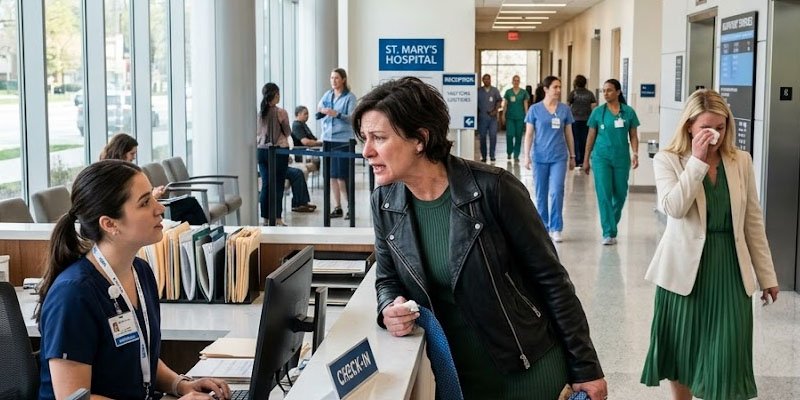
I visited the hospital where my husband served as the chief surgeon and calmly informed the receptionist that I was his wife. She gave me an uncertain smile and politely insisted that couldn’t be possible—because his wife had checked in only a few minutes before.
I arrived at my husband’s hospital just after lunchtime, carrying a paper bag with his favorite turkey club sandwich from Delaney’s along with the blue tie he had forgotten on the back of our bedroom chair earlier that morning.
My husband, Dr. Nathaniel Pierce, was the chief surgeon at St. Catherine’s Medical Center in Boston.
People reacted differently the moment they heard his name.
Nurses immediately stood a little straighter.
Residents spoke more quietly.
Donors greeted him with brighter smiles.
We had been married for eleven years—long enough for me to understand the pace of his professional life and the polished image he maintained within the hospital.
A sign posted near the entrance read:
“Visitors must check in first.”
So I walked over to the reception desk.
The receptionist appeared to be around twenty-five years old. She had shiny brown hair, a polished smile, and a name badge that read Emily Warren.
“Who are you here to see?” she asked. “Patient or staff member?”
“Dr. Nathaniel Pierce,” I answered. “I’m his wife.”
Her hands froze above the keyboard.
Then she smiled.
It wasn’t openly rude. It was the kind of smile someone gives when they believe they’ve heard an innocent misunderstanding and are trying to correct it kindly.
“That can’t be right,” she said. “His wife was just here.”
For a brief moment, every sound around me disappeared.
The carts rolling through the hall.
The elevator bell.
The overhead announcements in the distance.
The only thing I could hear was the pounding of my own heart.
I smiled and let her keep talking.
“She left about ten minutes ago,” Emily explained, glancing toward the private elevator. “Tall, blonde, wearing a cream-colored coat. She said Dr. Pierce asked her to collect some documents from his office.”
I carefully set the lunch bag on the counter.
“Did she sign in?”
“Of course.”
Emily slightly turned the visitor log toward me before pausing.
“I probably shouldn’t—”
“It’s all right,” I said softly. “Nathan is always telling me the hospital has become much stricter about security.”
The compliment immediately eased her tension.
“She signed in as Mrs. Pierce,” Emily replied. “First name… Vanessa.”
Vanessa.
Not one of his patients.
Not one of his coworkers.
Not a name Nathan had ever mentioned to me.
I lowered my eyes and pretended to search inside my handbag.
In truth, I was watching Emily’s reflection in the glass behind her.
She had begun replaying our conversation in her mind and now looked uneasy.
“Did she have authorization?” I asked.
“She was holding his badge,” Emily whispered. “Not attached to a lanyard. Just carrying it in her hand.”
My smile never faded.
Only three days earlier, Nathan had told me his badge had gone missing.
I thanked Emily, rode the elevator to the surgical administration floor, and headed straight to Nathan’s office.
His assistant, Marjorie, was out for lunch.
The office door was locked.
But marriage teaches you countless things.
Birthdays.
Weaknesses.
Passwords.
And exactly where your husband hides his spare key.
Inside the office, the top drawer of Nathan’s desk had been left partially open.
One folder was gone.
The label beside the empty space read:
Patient Incident Review — L. Monroe.
Just then, my phone vibrated.
A text message from Nathan appeared.
Where are you?
I stared at the empty space where the file had been and replied:
At the hospital.
Three dots appeared.
Then disappeared.
Then appeared again.
Finally, his response came through.
Don’t move.
PART 2
I moved.
Not because I wasn’t scared.
I was terrified.
A quiet instinct deep inside me wanted to leave the hospital, drive home, lock every door, and act as though the name Vanessa had never crossed my path.
But I moved because Nathan had specifically told me not to.
After eleven years of marriage, I knew exactly how to recognize the difference between his anger and his fear.
That message had been written out of fear.
I carefully closed the drawer exactly the way I had found it, wiped the brass handle with a tissue, and stepped back into the hallway.
The surgical administration wing appeared completely ordinary.
White walls.
Framed certificates.
Photos of Nathan shaking hands with governors, generous donors, and members of the hospital board.
A man admired by everyone needed his walls lined with proof of his reputation.
At the nurses’ station, an older woman dressed in navy scrubs was sorting through patient charts.
Her name badge read:
Denise Carter, RN.
“Excuse me,” I said. “I’m trying to find Vanessa.”
A subtle change crossed her face.
The reaction was almost impossible to notice—a slight tightening of her lips and a quick glance toward the elevators.
“Vanessa who?” she asked.
“That’s exactly what I’m trying to figure out.”
Denise looked me over.
My wedding ring.
My coat.
My face.
“You’re Mrs. Pierce,” she said.
“The real one, it seems.”
Her gaze dropped.
Before she could answer, a door farther down the hallway opened.
Nathan stepped out of Conference Room B wearing his white coat. His silver hair was perfectly in place, and his expression stayed calm and composed.
The hospital’s legal counsel, Gregory Hale, walked beside him along with two board members I recognized from charity events.
Nathan noticed me.
For the first time in years, my husband looked genuinely startled.
“Claire,” he said, hurrying toward me. “You shouldn’t be up here.”
“I brought lunch.”
“This isn’t a good time.”
“No,” I replied. “I can imagine it isn’t.”
Gregory Hale glanced from Nathan to me.
“Dr. Pierce, we need to continue.”
Nathan never took his eyes off me.
“Go home. I’ll explain everything tonight.”
“You can explain it now.”
His jaw clenched.
Then I noticed her.
At the far end of the hallway near the stairwell, a tall blonde woman wearing a cream-colored coat stood partially concealed inside a vending-machine alcove.
Beautiful.
Someone I had never met.
Yet oddly familiar, the way a stranger becomes unforgettable after turning your life upside down.
Our eyes locked.
She turned and ran.
I immediately chased after her.
Nathan called out my name, but I was already inside the stairwell.
My heels echoed against the metal steps as the scent of concrete and disinfectant filled the air.
“Vanessa!” I shouted.
She reached the landing below, slipped, and grabbed the railing to keep herself from falling.
I caught up before she could push through the next door.
“Who are you?” I demanded.
She looked frightened.
But not guilty.
“My name is Vanessa Monroe,” she said.
Monroe.
The missing report.
A wave of cold swept through me.
“L. Monroe,” I said. “From the incident review.”
Her eyes filled with tears.
“Lily Monroe was my sister.”
The stairwell door swung open above us.
Nathan’s voice echoed down the stairs.
“Claire.”
Vanessa stepped closer and slipped something into my hand.
A small flash drive.
“He destroyed her career,” she whispered. “Then he let her die.”
Nathan appeared on the landing above us, breathing heavily, the flawless expression he always wore at the hospital completely gone.
“Claire,” he said again, this time more quietly. “Give that to me.”
I looked at my husband.
Then tightened my fingers around the flash drive.
PART 3
For several long seconds, nobody moved.
The fluorescent lights buzzed softly overhead.
Beyond the stairwell walls, an announcement called for a respiratory therapist in the east wing.
Normal hospital routines carried on just beyond the concrete walls, separated from us by fire doors, reputation, and silence.
Nathan stood three steps above me.
Vanessa stood one step below.
And I remained caught between the woman who had falsely presented herself as my husband’s wife and the man who had spent eleven years convincing me he never lost his composure.
“Claire,” Nathan said cautiously, “you don’t understand what she’s trying to do.”
Vanessa let out a harsh, bitter laugh.
“Of course. That’s where you’d begin.”
Nathan paid no attention to her and kept his eyes fixed on me.
“That flash drive contains confidential hospital records. If you leave here with it, you could face charges. She knows that. She’s manipulating you.”
“What’s on it?” I asked.
“Nothing you’re qualified to understand.”
Even trapped and visibly perspiring, Nathan’s first instinct was still to assert his superiority.
I turned toward Vanessa.
“What’s on it?”
“My sister’s surgical timeline,” she answered. “Internal emails. An audio recording. A copy of the complaint she submitted before she died.”
Nathan’s face grew harder.
“Lily Monroe died because of a post-operative complication. It was tragic, but it was thoroughly reviewed.”
“She should never have been in that operating room,” Vanessa shot back. “You made sure she was assigned to your case after she reported you.”
I looked back at Nathan.
For the first time, he had no immediate answer.
Vanessa continued, her voice shaking.
“Lily was a surgical fellow here. She uncovered that Dr. Pierce had been allowing an unauthorized medical-device representative into surgeries. The representative wasn’t simply observing. He was directing device placement during spinal procedures because the company was financing Nathan’s research program.”
“That’s false,” Nathan said.
“It’s the truth,” Vanessa replied. “Lily reported it. After that, her evaluations suddenly changed. She became ‘unstable.’ ‘Difficult.’ ‘Not a team player.’ Then she was assigned an exhausting emergency shift and placed into a procedure she had already objected to.”
The name came rushing back.
Lily Monroe.
Two years earlier, Nathan had come home unusually quiet for three nights in a row.
He had told me a young physician had died after complications following an appendectomy.
He described it as a heartbreaking but unavoidable loss—the kind of tragedy that haunted even the finest hospitals.
I made him tea.
I sat beside him on the couch while he stared silently into the distance.
I had comforted him.
The memory made me feel sick.
“What happened to her?” I asked.
Vanessa swallowed hard.
“She developed sepsis after surgery. There were delays and warning signs that were ignored. The attending physician documented that Nathan was notified twice.”
Nathan stepped down one stair.
“That’s enough.”
I stepped backward, farther away from him.
That single movement affected him more than anything I could have said.
“Claire,” he said, now trying wounded vulnerability because anger had failed, “you know me.”
“I thought I did.”
Gregory Hale entered the stairwell behind Nathan, followed by a hospital security officer.
Gregory looked pale, but determined.
“Mrs. Pierce,” he said, “please hand over the flash drive.”
“Why?”
“It may contain protected health information.”
“Then you should be far more concerned that a stranger walked into this hospital using my husband’s badge and removed documents from his office.”
Gregory pressed his lips into a thin line.
Vanessa lifted her chin.
“I didn’t steal anything that hadn’t already been copied and hidden. Lily emailed part of the evidence to herself before she died. I only came back for the original incident report because someone warned me the board was meeting today to destroy the remaining drafts.”
“That’s ridiculous,” Gregory said.
“Is it?” I asked.
No one replied.
The security officer shifted uncomfortably.
He was a large man with gentle eyes who clearly wished he hadn’t been assigned to a confrontation involving influential doctors and the secrets they were protecting.
Nathan slowly reached his hand toward me.
“Claire. Give me the drive. We’ll go home. We’ll talk about this in private. Whatever she’s told you, whatever she believes happened, I can explain.”
His voice softened when he said the word home.
Once, that would have been enough.
But now I understood far too much.
His supposedly missing badge.
The fake wife.
The missing report.
The attorney.
The board members gathered behind a closed conference-room door.
His very first message hadn’t asked whether I was safe or what had happened.
It had simply said:
Don’t move.
He hadn’t been worried about me.
He had been worried about what I had uncovered.
I slipped the flash drive into my coat pocket.
Nathan’s eyes tracked every movement.
“Claire,” he said in a voice low enough that only I could hear, “think this through. Everything you have—the house, the foundation, your seat on every board in this city—came because of my name.”
There he was.
Not the heartbroken surgeon.
Not the gifted husband.
Not the charismatic man who kissed my forehead at elegant events.
The man who believed he owned everything.
I smiled at him the same way I had smiled at Emily downstairs.
“You forgot one thing, Nathan.”
His nostrils flared.
“I had a name before I ever took yours.”
Then I turned toward the security officer.
“Please escort me to the public lobby. I don’t want to be alone with my husband.”
The officer glanced at Gregory.
Gregory looked toward Nathan.
Nathan remained silent.
That silence became the first visible fracture in the empire he had built.
When we stepped into the lobby, Emily looked up from the reception desk.
Her eyes widened as she saw Nathan approaching from behind, his white coat hanging open and every trace of warmth gone from his face.
“Mrs. Pierce?” she asked quietly.
“Yes,” I answered. “The real one.”
I walked outside into the cold Boston afternoon and called my older brother, Daniel Whitaker.
Daniel wasn’t a surgeon.
He didn’t charm wealthy donors or enjoy black-tie galas.
He disliked tuxedos, hospital fundraisers, and men like Nathan who hid their threats behind calm, measured voices.
But he was a federal prosecutor.
He answered before the third ring.
“Claire?”
“I need you.”
His voice changed immediately.
“Where are you?”
“At St. Catherine’s. I have a flash drive. It may involve medical fraud, retaliation, and a patient’s death.”
He paused.
Then he said, “Don’t give it to anyone. Don’t go home. I’m sending someone to you right now.”
Forty minutes later, I was sitting in the back room of a coffee shop two blocks from the hospital with Daniel, Vanessa, and an investigator named Mara Singh.
Vanessa’s cream-colored coat lay folded across her lap.
Without the confidence that came with her disguise, she looked much younger.
Completely exhausted.
Her grief had sharpened into anger.
Mara connected the flash drive to an offline computer.
The files opened one after another.
Emails.
Board meeting minutes.
Revised incident reports.
Audio recordings.
Nathan’s voice filled the room through the speakers, calm but irritated.
“We need to be careful with the wording. Dr. Monroe was emotionally compromised. Her recollections are unreliable.”
Another voice asked, “What about the device representative?”
Nathan replied, “He was there only as a technical observer. Nothing more.”
A third voice said, “Lily has screenshots.”
After a brief silence, Nathan answered, “Then her access should have been revoked sooner.”
Vanessa covered her mouth with her hand.
I kept my eyes fixed on the screen.
The next document was even more disturbing.
A draft investigation report stated that Lily had reported unsafe conduct six weeks before her emergency surgery.
The finalized report had removed that entire section.
Another email showed Nathan recommending that Lily be denied a transfer to another hospital because of her “concerning instability.”
Attached below were her earlier evaluations describing her as disciplined, meticulous, and exceptionally promising.
Then we opened the operative timeline from the night she passed away.
Page after page of entries.
Delays.
Phone calls.
Failures to escalate.
Nathan’s name appeared twice.
Not as her surgeon.
As the administrator who had been notified when her condition worsened.
He had told me he barely knew anything about the case.
He had lied to me beneath the lights in our kitchen while holding the cup of tea I had made for him.
Daniel leaned back in his chair, his face grim.
“This is enough to get started,” he said. “Maybe even more than enough.”
Vanessa turned to me.
“I’m sorry I used your name.”
I believed she meant it.
But forgiveness wasn’t the first thing I felt.
I felt rage.
Humiliation.
And an unexpected sense of clarity.
“Why today?” I asked.
Vanessa wiped away her tears.
“A nurse reached out to me. She said the board was meeting about a sealed settlement and that today might be my last chance to recover the evidence.”
“Who contacted you?”
She hesitated.
“Denise Carter.”
The nurse from the administration floor.
Mara closed the laptop.
“Then we need her statement before the hospital’s lawyers get to her.”
They got it.
By that evening, Denise had given a sworn statement.
She had kept copies of staffing records because Lily’s death had never seemed right to her.
She admitted she had contacted Vanessa after overhearing Gregory Hale mention “document cleanup” before the board meeting.
By midnight, Nathan had called me seventeen times.
I answered none of them.
At 1:12 a.m., he sent me a message.
You are making a terrible mistake.
I read it from Daniel’s guest room while wearing borrowed clothes, my wedding ring resting on the bedside table.
For years, I had mistaken Nathan’s confidence for real strength.
But true strength never depends on everyone else staying silent.
It doesn’t require locked drawers, deleted emails, frightened nurses, or dead women being dismissed as unstable.
The following morning, federal subpoenas were delivered to St. Catherine’s Medical Center.
By noon, news of the investigation had leaked.
Not Lily’s private medical information.
Not Vanessa’s disguise.
But enough.
Chief Surgeon Placed on Administrative Leave Amid Federal Inquiry.
Nathan’s photograph appeared beside words he could no longer control.
He immediately tried to reclaim the narrative.
Through his attorney, he described the allegations as “false, defamatory, and personally motivated.”
He referred to me as “my estranged wife,” even though we had not become estranged until I opened his desk.
That afternoon, Daniel, two police officers, and I returned to the house so I could collect my belongings.
Nathan was waiting.
He stood beneath the chandelier we had bought in Milan.
His suit was flawless.
His expression wasn’t.
“You brought police into my house?” he asked.
“Our house,” I answered.
His eyes dropped to my bare hand.
“You took your ring off.”
“You noticed that sooner than you noticed your lies catching up with you.”
His jaw tightened.
“You have no idea what you’ve done. Hospitals are complicated. Surgery is complicated. People die, Claire. Careers are destroyed because outsiders want simple villains.”
“Lily Monroe wasn’t an outsider.”
“She was unstable.”
The word came out far too easily.
I truly looked at him then.
I wondered how many women he had diminished with that word whenever they dared challenge him.
Unstable.
Emotional.
Difficult.
Confused.
Words used like surgical instruments, leaving no visible wound.
“I’m filing for divorce,” I said.
For the first time, genuine fear appeared on his face.
“Claire.”
“No.”
“I can protect you from all of this.”
“You’re the one I need protection from.”
His eyes became empty.
There was nothing left to say.
The investigation continued for nine months.
Nathan was never charged with murder because real life is rarely that straightforward.
Prosecutors could not prove he intended for Lily Monroe to die.
But they proved fraud involving the medical-device company.
They proved retaliation.
They proved obstruction.
And they proved hospital records had been altered after Lily’s death.
Nathan lost his medical license.
St. Catherine’s reached a public settlement with Vanessa and Lily’s parents.
Gregory Hale resigned.
Two members of the hospital board resigned as well.
Denise Carter kept her position because the public attention made retaliation against her impossible.
Vanessa used part of the settlement to create a scholarship in Lily’s name for surgical fellows who reported patient-safety concerns.
As for me, I sold both the house and the chandelier we had purchased in Milan.
The divorce became as ugly as divorces often do when powerful men realize they cannot charm legal documents.
Nathan argued over money.
His reputation.
The furniture.
Even an antique mirror that had belonged to my mother.
He lost more than he expected, but less than I wished.
That probably meant the legal outcome was fair.
The last time I saw him was outside the courthouse.
He looked older.
Not broken.
Men like Nathan rarely allow themselves to fall apart in public.
They simply become smaller and call it dignity.
“You destroyed my life,” he said.
I adjusted my coat.
“No,” I replied. “I just checked in at reception.”
Then I walked past him.
Six months later, I returned to St. Catherine’s for a dedication ceremony.
The surgical education wing had been renamed after a donor, but one lecture hall now displayed a new bronze plaque.
The Lily Monroe Patient Safety Forum.
Vanessa stood beside me, her blonde hair pinned neatly back.
The cream-colored coat was gone.
She wore black.
Not the black of mourning.
Something stronger.
Something chosen with purpose.
Emily Warren, the receptionist, was there too.
She looked embarrassed when she saw me.
“I’m sorry,” she said. “That day, I honestly thought—”
“I know.”
She gave me a faint smile.
“You were incredibly calm.”
“No,” I told her. “I was incredibly angry. Calm just looks better in photographs.”
For the first time, she laughed.
The lecture hall filled with young doctors.
Denise Carter spoke first.
Then Vanessa took the podium.
She told them that Lily had loved surgery, not because she wanted authority, but because she believed precision could save lives.
Then Vanessa looked toward me.
“And sometimes,” she said, “the truth survives because one person refuses to give it back.”
I lowered my gaze.
I hadn’t saved Lily.
None of us had.
But we stopped Nathan from writing the final chapter.
And that mattered.