
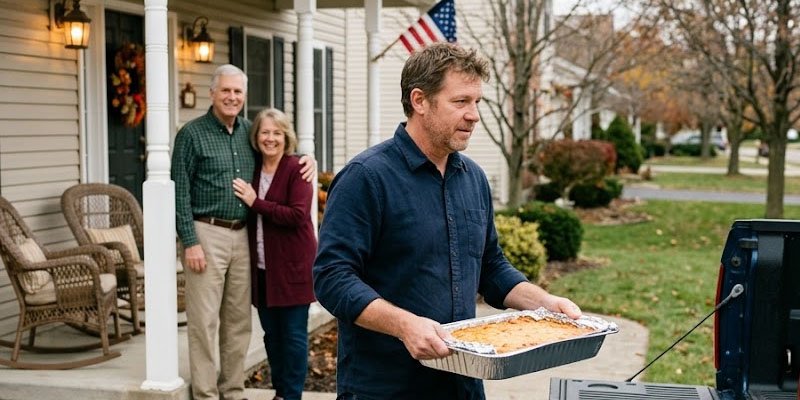
My name is Rick Dalton. I’m fifty-two years old, and I supervise a small HVAC crew in Fort Wayne, Indiana.
Most of my days are spent around ladders, furnaces, crawl spaces, and the sort of work people hardly notice until something stops functioning.
I’ve never had a problem with that.
My father taught me years ago that honest, useful work carries its own dignity, whether anyone recognizes it or not.
Dad’s name is Jack Dalton.
He’s seventy-four now, and he spent fifty years working at the GM plant in Anderson.
He’s the kind of man who shows affection by being there when someone needs him.
If your water heater quits at ten on a Sunday night, Dad will show up with his toolbox before you’ve even figured out who to call.
If you try thanking him, he brushes it off as though being thanked makes him uneasy.
His garage has always carried the smell of motor oil, cold concrete, and old tools.
To me, that smell has never represented grime.
It represented dependability.
When I was growing up and something broke, nobody panicked.
We waited for Dad.
Because Dad could almost always get things working again.
My wife Karen’s family came from an entirely different world.
Her parents, Don and Margaret Whitfield, built their wealth through commercial real estate.
They cared about polished manners, costly clothing, appearances, and the sort of social expectations nobody ever bothered to explain.
They were never directly cruel toward my father.
In certain ways, that would have been easier.
Instead, they treated him with an exaggerated courtesy that always seemed to make it clear he was merely being tolerated.
For twelve years, I allowed it to continue.
Not because I agreed with them.
Not because I believed fifty years of factory work somehow made my father less deserving of a place at a holiday table.
I kept quiet because I convinced myself that maintaining peace was important.
I told myself I could stand between the two families and absorb whatever tension came along with it.
That was my mistake.
I didn’t realize how serious that mistake was until Thanksgiving morning.
It was around eleven.
The turkey had already been cooking for two hours, and the house smelled exactly the way a Thanksgiving house somehow always does.
Warm.
Familiar.
Comforting.
I called Dad to tell him I was getting ready to come pick him up.
Usually, he would have joked about whether my truck had enough room for a man who had already eaten breakfast twice.
Instead, his voice sounded cautious.
“Rick, I don’t think I’m coming this year.”
I stopped.
“What?”
“Karen called last night. She said it was going to be a small dinner and she didn’t want me feeling crowded.”
For a moment, I said nothing.
“She called you?”
“Yeah. She was nice about it.”
He paused.
“She’s probably right anyway. You know me. I’m not much for crowds.”
That wasn’t true.
My father had spent five decades working alongside hundreds of people.
He could strike up a conversation with almost anybody.
He wasn’t making an excuse for himself.
He was making one for Karen.
That was the kind of man he was.
He would take somebody else’s unkindness and reshape it into something easier for everyone around him to accept.
“I’ll call you back, Dad.”
I walked into the dining room.
Karen was setting out the silverware.
The good set.
The one she only brought out for holidays or important guests.
“Why did you tell my father not to come?”
She placed a fork beside a plate before turning toward me.
She didn’t appear surprised.
“Rick, you know how my parents are.”
“What does that have to do with Dad?”
She sighed.
“Your father smells like an old garage. My mother notices things like that, and I don’t want to spend Thanksgiving managing the situation.”
I stared at her.
“He’s not coming,” she added.
She said it matter-of-factly.
As though she had simply handled a scheduling issue.
For several seconds, I said nothing.
I’m better at dealing with problems that have physical answers.
A broken furnace.
A leaking line.
Something you can dismantle, inspect, and correctly put back together.
This wasn’t that kind of problem.
But eventually, I understood exactly what I was seeing.
This wasn’t really about a smell.
My father had carried a faint trace of his work with him for as long as Karen had known him.
She had eaten at his table.
Accepted his help.
Let him drive forty minutes one February morning to repair our furnace when it stopped working.
Nobody had objected to the smell of his garage then.
This was about who Karen believed belonged in the room.
And who didn’t.
For twelve years, she had assumed I would continue smoothing things over.
That morning, I stopped.
“Fine,” I said.
“Fine?”
“If Dad isn’t welcome, then we’re not having Thanksgiving here.”
Karen blinked.
“What are you talking about?”
“Exactly what I said.”
“My parents will be here in an hour.”
“I know.”
“You can’t be serious.”
“I am.”
I didn’t raise my voice.
I didn’t slam anything.
I didn’t throw anything.
I walked into the kitchen and looked at the food.
The turkey was perfectly browned.
Sweet potatoes were heating in the oven.
Green bean casserole was sitting on the counter.
Fresh rolls.
Pumpkin pie cooling nearby.
Everything Karen had prepared for the people she believed belonged at the table.
I opened the cabinet above the refrigerator and took out several foil trays.
Karen appeared in the doorway.
“What are you doing?”
“Packing dinner.”
“Rick.”
I kept going.
“I heard you tell my father he wasn’t welcome in his son’s home on Thanksgiving because he smells like the work he spent fifty years doing.”
She stared at me.
“I’m not sitting down to dinner after that.”
“So you’re ruining Thanksgiving?”
“No.”
I covered the sweet potatoes with foil.
“I’m having Thanksgiving with my father.”
Karen told me I was acting childish.
She said her parents would be embarrassed.
She said I couldn’t just take the food and walk out.
She said I was making a mistake.
I listened as I packed everything into my truck.
But I didn’t argue.
There was nothing left to discuss.
I drove to Dad’s house.
The drive normally took twenty-two minutes.
That morning, with most people already settled wherever they planned to spend the holiday, it took seventeen.
Dad lived in a small 1960s ranch house on a corner lot.
His detached garage had never had an empty bay for as long as I could remember.
There was always something inside that needed fixing.
A neighbor’s lawn mower.
An old pickup.
A friend’s snowblower.
Something.
The porch light was on.
It almost always was.
I knocked.
Dad opened the door, looked at me, then looked at the foil trays in my arms.
Then he looked back at me.
“Rick?”
“Happy Thanksgiving, Dad.”
He stared for another moment.
“You planning on standing out there all day?”
He moved aside.
His house smelled of coffee, pine cleaner, and the faint hint of motor oil that seemed permanently embedded in everything he owned.
I had always found it comforting.
I placed the food on his kitchen table.
Dad watched as I uncovered the trays.
“Karen know you’re here?”
“She knows.”
He went quiet.
“Everything all right?”
I looked at him.
At the man who had worked for half a century.
The man who repaired our furnace without being asked.
The man who had tried to spare me conflict by acting as though being left out didn’t bother him.
“No,” I said.
“But it will be.”
Dad nodded once.
Then he went to the cabinet and pulled out two plates.
We ate Thanksgiving at the kitchen table he had built himself in 1987.
The turkey was excellent.
The sweet potatoes had become a little soft during the drive.
Dad took two servings anyway.
We watched the end of the parade.
Then we watched a football game neither of us particularly cared about.
Mostly, we talked.
About my work crew.
About the old Silverado carburetor he was rebuilding for a neighbor.
About winter.
About whether I needed to replace the weatherstripping around his garage doors.
He never asked me again what had happened.
He understood.
Later, while we had coffee and pie, Dad said quietly,
“You didn’t have to do this.”
“Yes, I did.”
“She’s your wife, Rick.”
“I know.”
I looked at him.
“And you’re my father. I should have said something years ago.”
Dad stared down into his coffee.
“I really didn’t mind staying here.”
I knew what he was doing.
Trying to make things easier for me.
“You should have been there,” I said. “You’ve always deserved to be there.”
He didn’t respond.
After a while, he looked at his plate.
“Good pie.”
I smiled.
“Karen made it.”
Dad nodded.
“She’s a good baker.”
That was my father.
Seventy-four years old.
Excluded from Thanksgiving by his daughter-in-law.
Still complimenting her pie.
My phone had been buzzing for most of the afternoon.
Karen called several times.
Don called twice, which was unusual because he had never directly called me during the twelve years I had known him.
By late afternoon, Karen’s messages had shifted from anger to concern.
I stayed with Dad until evening.
When I left, I hugged him and promised I’d come back Saturday to check the garage.
He told me to bring a proper lunch because he was tired of sandwiches.
When I got home, Karen was sitting in the living room.
Her parents were gone.
The dining table was still set.
Six untouched places.
The good silverware.
Crystal glasses.
Everything arranged perfectly for a meal that had been eaten twelve miles away on a table my father had built with his own hands.
Karen had obviously been crying.
“Sit down,” I said.
We sat across from each other.
And finally, I said what I should have said years before.
“My father is not something you manage around.”
Karen looked at me.
“He is the reason I know how to work. He taught me to show up when people need help. He taught me to repair things instead of throwing them away.”
I pointed toward the untouched table.
“When you called him and told him there wasn’t room for him, you weren’t protecting your parents’ comfort. You were telling him that their preferences mattered more than everything he has meant to me.”
Karen didn’t interrupt.
I continued.
“Your parents have spent years looking down on him because he worked with his hands.”
“That isn’t what I—”
“I know you probably didn’t think of it that way.”
She stopped.
“And that’s part of the problem.”
We talked for a long time.
It wasn’t easy.
Karen wasn’t naturally a cruel person.
That mattered.
But she had absorbed her parents’ ideas about status so thoroughly that she no longer recognized when she was repeating them.
She believed she had merely been handling an uncomfortable situation.
I saw it another way.
“My father built the table we ate on today,” I told her.
“He built it almost forty years ago and refinished it twice. He has never asked anyone for something he couldn’t repair, build, or earn himself.”
Karen glanced toward our dining table.
I continued.
“Your parents have never done anything for us without making sure we understood exactly what it cost.”
She didn’t argue.
Two days later, I called Dad before heading over.
He answered immediately.
“Bring lunch worth eating.”
“I’ll stop at the deli.”
“Get turkey.”
I laughed.
“You just ate turkey.”
“I’ve been thinking about turkey.”
When I ended the call, Karen was standing in the doorway.
“Can I come?”
I looked at her.
“That’s your decision.”
She nodded.
“But if you come, don’t come because you’re trying to manage anything.”
“I understand.”
“And we’ll probably spend most of the afternoon in the garage.”
“That’s fine.”
“You know what the garage smells like.”
She looked at me for a moment.
“I know.”
So Karen came.
She sat on an old stool while Dad showed me the carburetor he was rebuilding.
To my surprise, she began asking questions.
Real questions.
Why was that part worn?
How did the fuel mixture work?
Was restoring the truck worth the time?
Dad answered every question patiently.
He didn’t punish her.
He didn’t humiliate her.
He simply treated her the way he treated nearly everyone.
By the time we went inside for lunch, something felt different.
Not fixed.
Different.
Twelve years of quiet disrespect don’t disappear after two hours in a garage.
Karen and I had many more conversations during the months that followed.
Some were uncomfortable.
Some forced both of us to acknowledge things we would have preferred not to admit.
But something changed that Thanksgiving.
For the first time, I stopped taking responsibility for everyone else’s discomfort.
In December, Don Whitfield called me.
He spoke formally, as usual.
He said he understood there had been “some difficulty” at Thanksgiving.
I answered him directly:
“My father will be invited to every holiday dinner in this house from now on. If his presence bothers anyone, that is their problem to solve.”
Don was silent.
Then he said,
“Your father worked at GM for a long time.”
“Fifty years.”
“That’s a long time.”
“Yes.”
Don didn’t apologize.
I hadn’t expected him to.
But at Easter, he sat beside Dad.
Karen and I had prepared the table for eight.
Dad was there.
Just like everyone else.
Don asked him about the vintage Silverado.
Dad answered.
Then, somehow, they began talking about the Chicago Cubs.
For twelve years, those two men had apparently shared an interest neither one knew the other had because nobody had ever given them the opportunity to discover it.
Dad wore a clean flannel shirt.
He always wore clean clothes to family gatherings.
He smelled like soap.
And beneath that, very faintly, like the garage.
Like work.
Like himself.
If Don noticed, he didn’t say anything.
After dinner, Karen told me her mother had asked on the drive over whether Dad would be coming.
“What did you say?”
“I told her he was bringing pie.”
He had.
Cherry pie.
Months earlier, he had asked our niece Natalie which kind she liked best.
She told him cherry.
He remembered.
Dad always remembered things like that.
He always showed up.
That evening, after everyone had left, I stood at the kitchen sink looking out into the backyard.
The good silverware was drying beside me.
The pie plate was empty.
And I thought about Thanksgiving morning.
About foil trays.
A gray Indiana sky.
A seventeen-minute drive.
And my father’s porch light glowing in the distance.
He had left it on.
He always did.
Just in case someone needed to find their way home.
Some things take fifty years to build.
Respect.
Trust.
A reputation for showing up.
And sometimes, all it takes is one afternoon to realize how badly you have failed to protect those things.
My father had spent his entire life being the man who came whenever people needed him.
The least I could do was make certain there was always a place waiting for him when he arrived.
That Easter night, Dad drove home knowing one thing for certain.
He was welcome.
And in the end, that was everything.




