
My mother called me in tears, pleading with me to cover my younger brother’s $46,000 debt, so I promised to send the money before noon. Then she forgot to end the call, and I heard my father say, “I knew she’d give in,” while my brother laughed that I needed to feel needed. When Mom called my million-dollar home a “consolation prize,” I finally spoke from the other side of the line—and everything changed…
My mother accidentally left the call connected, and within a minute, I heard exactly how my family talked about me when they believed I wasn’t listening.
It started with yet another crisis involving my younger brother, Darius.
Mom had called me crying, telling me he was terrified and could lose everything. Dad apparently hadn’t been sleeping properly for days. Then came the sentence I had heard my whole life whenever Darius created another mess: “I don’t know what this family would do without you.”
For years, I had mistaken those words for love.
So I agreed.
Forty-six thousand dollars.
I told Mom I would authorize the transfer before noon the following day. Darius didn’t need to call because I already understood. Everything would be okay.
“You’re a blessing, sweetheart,” she whispered.
I assumed the conversation was over.
I carried my coffee toward the sink when Mom’s voice suddenly came through the speaker beneath my kitchen cabinets again.
Only now, the crying was gone.
“So,” she said.
Dad replied, “I told you she’d cave.”
Then Darius laughed.
It wasn’t an uncomfortable or guilty laugh.
He laughed like someone watching a prediction come true.
“Camille can’t help herself,” he said. “She needs to be the hero.”
My grip tightened around the mug.
Mom said that although I acted independent, I was actually desperate to feel needed.
Then Dad added, “At least all that loneliness finally serves a purpose.”
The mug hit the sink hard enough to chip its handle.
I stared at my reflection in the dark patio doors as they continued talking.
Darius said I lived alone in my “giant house” anyway and suggested that someone should get something useful out of all that money.
Then Mom said the words that permanently changed something inside me.
“That million-and-a-half-dollar house is basically her consolation prize.”
She said I had built a beautiful life because I couldn’t build a real one.
For several seconds, I couldn’t breathe.
This was the same woman who posted photos of my garden and told everyone how proud she was of her successful daughter. The same woman who kept dresses in my guest room because she enjoyed staying with me. The same woman who hosted almost every holiday under my roof while I covered the bills and made space for everyone.
Suddenly, every room felt different.
The six bedrooms.
The dining table Mom insisted needed to seat the entire family.
Dad’s favorite chair in the theater room.
Darius’s boxes taking up space in my garage.
The family photographs lining the hallway.
The house hadn’t felt like home for years. I had simply been too busy proving how generous I was to admit it.
Then Mom said she would call the next morning and tell me Darius had broken down crying when he found out the $46,000 was coming.
That would make sure I didn’t change my mind.
Something inside me suddenly became completely still.
I walked over to the counter, picked up the phone, and said, “You don’t have to call tomorrow.”
Every voice went silent.
Mom whispered my name.
“Camille… how long have you been listening?”
“Long enough.”
She immediately started explaining. She said I had misunderstood. Darius told me not to make it into something bigger than it was.
I almost laughed.
Even after being caught, he still expected to decide what everyone else was allowed to feel.
“Darius,” I said, “you’re not getting the money.”
“What?”
“The $46,000. It’s not happening.”
Mom gasped and said I couldn’t punish my brother simply because I had overheard a private conversation.
“A private conversation?” I asked.
Dad finally intervened and told everyone to calm down.
“I’ve been calm for most of my life, Dad,” I said. “That’s how we ended up here.”
Mom started crying again.
But for the first time, I could hear what was behind it. The timing. The pressure. The way the tears always appeared just before she asked me to abandon myself.
“You called my life a consolation prize,” I said.
“I was upset,” she whispered.
“No. You were relaxed. You thought I couldn’t hear you.”
Dad tried to shift the conversation toward my own flaws, saying that everyone says hurtful things sometimes.
Maybe that was true.
But there was a difference between one imperfect statement and an established pattern.
“You’re right,” I told him. “I’m not perfect. I’m also not financing Darius anymore.”
My brother snapped that I thought I was better than everyone because I had bought a mansion.
That was when I finally told them why I had bought it.
“I bought it because I hoped all of you would finally look at me and see something worth celebrating.”
Silence.
“Tonight, I learned you only saw an address and a bank balance.”
I ended the call.
Standing alone in that enormous kitchen, surrounded by everything I had spent years building, I realized I didn’t feel successful.
I felt awake.
The next morning, I called my closest friend, Tasha.
She listened quietly while I told her everything.
When I finished, there was a long silence.
Then she said four words I never expected to hear.
“Then build an exit.”
IF FACEBOOK BROUGHT YOU HERE, HERE’S THE CONTINUATION YOU’VE BEEN WAITING FOR. ENJOY!
Tasha arrived roughly 50 minutes later carrying two coffees, a legal pad, and the expression she normally wore before a difficult business negotiation.
She hugged me first.
So tightly that my knees almost gave out.
Then she stepped back and studied me. “Okay,” she said. “Now tell me what you actually want.”
I looked toward the dining room.
“I want to leave this house.”
She waited.
“I didn’t buy it because I wanted six bedrooms. I bought it because I thought that if I built something impressive enough, they would finally respect me.”
Tasha nodded.
“They don’t,” I said.
“No.”
“They see the money. The space. The access. The place where everyone can gather. They don’t see me.”
Tasha slowly took a sip of her coffee. “Then sell it.”
The suggestion hit me harder than I expected.
Sell the house.
Darius had casually suggested the same thing, except he wanted the difference turned into something useful for the family.
I wanted my life back.
At 9 that morning, I called my attorney, Celeste Rowan. She had repeatedly warned me that the way I handled family money and property left me vulnerable. After hearing about the call, she went silent for several seconds.
Finally, she said, “I would like the record to show that I have been waiting for this day.”
We made a list.
Stop the $46,000 transfer.
Change every exterior access code.
Deactivate relatives’ garage remotes.
Inventory their belongings.
Suspend automatic payments.
Review previous transfers.
Move important family communication into writing.
And most importantly, stop making spontaneous loans.
Celeste called it basic asset and boundary management.
Tasha called it removing squatters from my nervous system.
That afternoon, I also contacted a realtor, Marisol Vega.
She toured the house two days later.
We walked through the kitchen, study, dining room, and sunroom. Marisol said almost nothing until we reached the windows overlooking the garden.
“This is a gorgeous property,” she said.
Then she looked at me.
“You don’t like living here.”
I blinked. “What makes you say that?”
“People who love their homes touch them,” she said. “They stop to admire a favorite window. They straighten something without thinking. You’ve walked through every room as if we’re inspecting evidence.”
I swallowed.
“That might be the most accurate thing anyone has said to me all week.”
We agreed to market the house privately at first.
No family announcement.
No dramatic explanation.
Verified buyers only.
That evening, I sent Mom one message.
I heard the conversation after you thought the call had ended.
I will not be sending Darius any money.
I am not discussing this tonight.
Her replies came almost immediately.
First came an explanation.
Then a claim that she had been emotional.
Then she said I had misunderstood.
Then she asked Dad to speak with me.
Finally came the familiar plea not to destroy my brother over something she had said.
Not a single message began with, “I’m sorry.”
Dad called twice.
I ignored him.
Darius kept calling until I blocked his number.
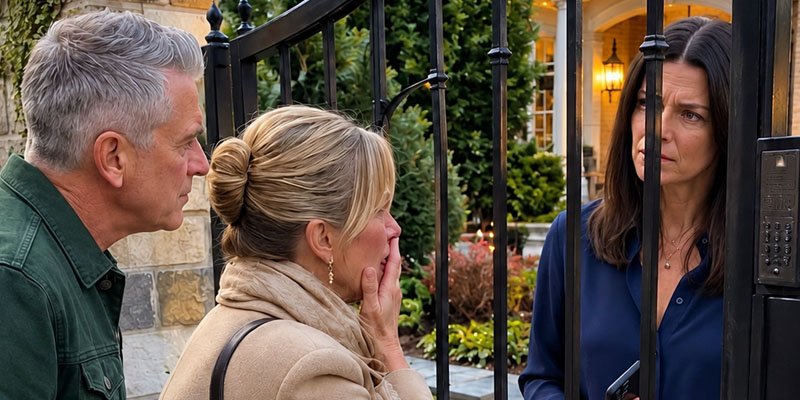
Around seven that evening, the gate intercom buzzed.
Mom was standing outside.
She tried the old code twice before calling.
“Camille, the gate isn’t opening.”
“I changed the code.”
She stared into the camera.
“Why?”
“Because I changed it.”
“Sweetheart, I’m standing outside my daughter’s house.”
“Exactly,” I said. “My house.”
Dad stepped into view.
“Open the gate,” he said. “We need to discuss this like adults.”
“No.”
Mom started crying.
“Can we please just come inside?”
“No.”
They had their own home thirty minutes away.
When Mom asked, “Then where are we supposed to go?” I realized just how completely everyone had come to believe that my house belonged to the family.
“Go home,” I said.
Then I ended the intercom.
They stayed outside for nearly half an hour before leaving.
Once their car disappeared, I sat beside the sofa and cried.
Not because I regretted changing the code.
Because I finally understood how long I had waited for permission to have boundaries.
Tasha stayed that night.
The following week brought calls from relatives.
My aunt Relle called first.
She said Mom was barely eating and that there had been some misunderstanding.
After Celeste explained that the communication system had automatically archived the call and verified the relevant metadata, I sent Aunt Relle a short recording.
She went quiet.
Then she said, “Baby, I’m sorry. Thank you.”
She had heard enough.
The family divided.
Some said I was being emotional.
Some called Mom’s words a one-time mistake.
Others admitted they had always been uncomfortable with how often I was expected to solve Darius’s problems.
Then someone discovered I planned to sell the house.
Mom called in a panic.
“You’re selling?”
“Yes.”
“Why would you do that?”
“Because I don’t want it anymore.”
She cried and said I was destroying everything over one conversation.
“This is where the family gathers,” she said.
I looked around my kitchen.
“No,” I told her. “This is where everyone gathers while I disappear into whatever role makes the gathering possible.”
She fell silent.
Then she whispered, “Don’t sell your home just to hurt us.”
“I’m not selling it to hurt you,” I said. “I’m selling it so it stops hurting me.”
Dad later emailed me, accusing me of choosing ego over blood and behaving emotionally.
Celeste helped me answer with facts.
I wasn’t responsible for Darius’s business obligations.
I wasn’t responsible for maintaining property that other adults had become dependent on.
Personal belongings could be collected by appointment.
Future financial requests had to be submitted in writing and could not be treated as automatically approved.
Dad replied, “This is not the daughter we raised.”
I stared at the sentence for nearly a minute.
Then I answered:
“You’re right.”
And muted the thread.
Three weeks later, Marisol called.
A couple relocating from Colorado had submitted a full-price cash offer.
Since changing the codes, the house had become strangely peaceful.
No jackets tossed over chairs.
No relatives opening the refrigerator without asking.
No mother rearranging decorations.
No father claiming the biggest chair.
Only quiet.
“Accept it,” I told her.
“Are you sure you don’t want until tomorrow?”
“I’ve been thinking about this house for years,” I said. “I just didn’t know that’s what I was doing.”
We accepted.
Closing was scheduled for 32 days later.
Ten days after that, Darius arrived with a rental truck.
He wasn’t there for his storage boxes.
He wanted my furniture.
Security called from the gate.
Through the camera, I saw him standing beside the truck with his arms crossed.
He called from an unfamiliar number.
“Camille, stop acting ridiculous.”
“Why are you here?”
“Mom said some things in the house should stay with family.”
“Which things?”
“The dining table. The theater seats. One of the guest bedroom sets. The entry mirror. Dad wants the smoker.”
I almost laughed.
“You came with a truck to take furniture from my house.”
“You’re selling everything anyway.”
“I’m selling my property. That doesn’t make it yours.”
He called me selfish, then irrational.
Finally, he said, “You think selling this place makes you powerful? You’re still alone.”
Once, that sentence would have destroyed me.
It didn’t.
“Maybe I am alone sometimes,” I said. “But I’d rather eat dinner alone than feed people who laugh at me afterward.”
I hung up.
Security escorted him away.




