
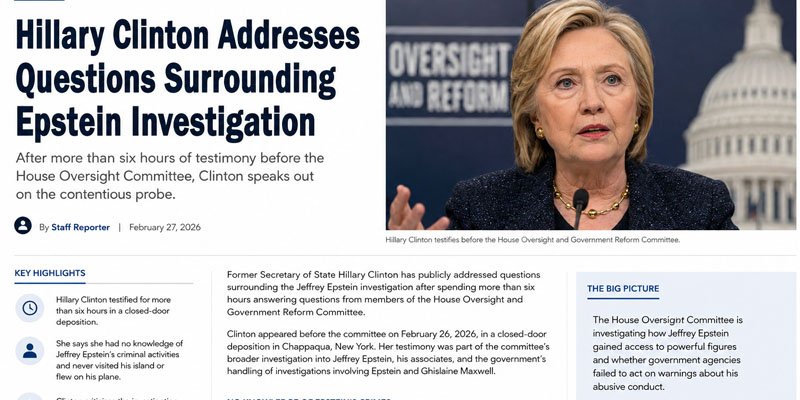
Hillary Clinton Addresses Questions Surrounding Epstein Investigation After Six-Hour Congressional Testimony
Former Secretary of State Hillary Clinton has publicly addressed questions surrounding the Jeffrey Epstein investigation after spending more than six hours answering questions from members of the House Oversight and Government Reform Committee.
Clinton appeared before the committee on February 26, 2026, in a closed-door deposition in Chappaqua, New York. Her testimony was part of the committee’s broader investigation into Jeffrey Epstein, his associates, and the government’s handling of investigations involving Epstein and Ghislaine Maxwell.
During the deposition, Clinton told lawmakers that she had no knowledge of Epstein or Maxwell’s criminal activities. She said she did not recall ever encountering Epstein and denied having any personal connection or communication with him.
Clinton also stated that she had never flown on Epstein’s plane or visited his island, homes, or offices. She described her acquaintance with Maxwell as casual and said she had encountered her through social connections involving the Clinton family.
A Lengthy and Contentious Deposition
The testimony followed months of political and legal tension between the Clintons and the House Oversight Committee.
The committee had previously subpoenaed both Hillary Clinton and former President Bill Clinton as part of its investigation. After the Clintons initially resisted appearing in person, the committee advanced contempt measures against them. They eventually agreed to provide sworn testimony, avoiding a potential escalation in the congressional dispute.
Clinton later said that many of the questions directed at her were repetitive. She argued that she repeatedly gave the same answer regarding whether she knew Epstein.
According to video and reporting released after the deposition, Clinton expressed frustration during the questioning, saying she had repeatedly explained that she had never visited Epstein’s island or properties.
Clinton Criticizes the Investigation
After leaving the deposition, Clinton criticized the way the investigation had been conducted.
She argued that lawmakers could have spent their time more productively investigating how Epstein was able to operate for so long and whether government agencies properly handled allegations against him.
Clinton also said that some questions moved beyond the central focus of the Epstein investigation, including questions involving UFOs and the debunked Pizzagate conspiracy theory.
Her comments reflected the increasingly political nature of the congressional investigation, with Republicans arguing that prominent figures connected to Epstein should answer questions under oath, while Democrats have accused Republicans of using the investigation for political purposes.
Questions About Bill Clinton
Hillary Clinton was also asked about her husband’s past association with Epstein.
She maintained that she was confident Bill Clinton had no knowledge of Epstein’s criminal conduct at the time of their association. She said his relationship with Epstein ended several years before Epstein’s criminal activities became publicly known.
Bill Clinton subsequently appeared before the same committee for his own deposition.
The committee’s investigation has focused not only on the Clintons but also on how Epstein cultivated relationships with influential people and whether government agencies adequately investigated his activities.
A Broader Congressional Investigation
The House Oversight Committee’s inquiry is part of a much larger effort to examine the Epstein case and the government’s handling of it.
Lawmakers have sought testimony and information from numerous people connected in different ways to Epstein, including former associates and other prominent individuals. The committee has said its investigation is intended to examine the federal government’s handling of Epstein and Maxwell, Epstein’s efforts to gain influence, and possible failures in government oversight.
The release of testimony and related records has continued to generate intense public interest, particularly because Epstein had connections with numerous wealthy and influential figures.
However, being mentioned in Epstein-related records or having had an association with him does not by itself establish criminal wrongdoing. That distinction remains important as lawmakers and the public examine the large volume of material connected to the case.
What Hillary Clinton Says Comes Next
Following her testimony, Clinton continued to argue that the investigation should focus on establishing what happened, how Epstein was able to avoid serious consequences for so long, and whether government institutions failed victims.
For Clinton, the six-hour-plus deposition was an opportunity to publicly repeat her position: she says she had no knowledge of Epstein’s criminal activities and no personal relationship with him.
The committee, meanwhile, has indicated that its investigation is continuing.
As additional testimony, documents and video become public, the congressional inquiry is likely to remain a major political and legal story. The central questions will continue to be what government agencies knew, when they knew it, how Epstein was able to maintain access to powerful circles, and whether officials or institutions failed to properly investigate his crimes.