The final word my mother ever called me in public was “defect.”
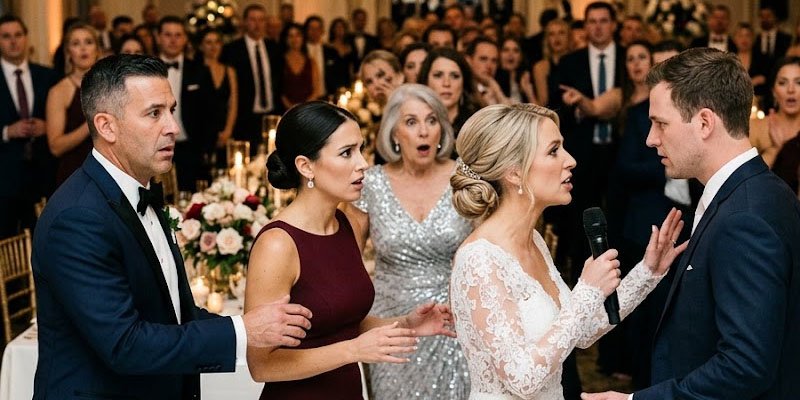
She said it inside a stone ballroom filled with nearly two hundred wedding guests, nine years after she had stopped treating me as her daughter.
For one breathless moment, nobody moved.
The string quartet beside the terrace doors had already gone quiet. Waiters remained motionless beside the silver coffee urns. My sister Camille was still holding the microphone she had used to announce, in unmistakable terms, that I was not invited.
My husband Jonah stood at my side.
Across the ballroom, my mother’s carefully controlled expression—the same one she wore at hospital fundraisers, faculty dinners, and family photographs—had vanished.
And somewhere behind me, Camille’s new husband was beginning to understand that the woman his bride claimed not to know had just been called forward by name.
I looked down at my left wrist.
Grandma Adele’s old steel nursing watch was still fastened there.
Its face was scratched.
The band had been repaired twice.
It was worth almost nothing.
Yet it was the most valuable possession I had.
That watch was the reason I didn’t leave when Camille cornered me near the coat check and whispered, “You need to go.”
It was why I remained when Mom looked directly at me and said, “Do not make a scene.”
And it was why, when everyone in that ballroom eventually discovered who I was, I felt none of the satisfaction I had imagined for so many years.
I felt exhausted.
Because before Northlight Home Care employed hundreds of caregivers across three states, before I married a surgeon, before my name quietly appeared on documents signed by influential people who had never seen my face, I was simply Meredith Ashford.
The wrong daughter in a family fixated on the right credentials.
Growing up outside Baltimore, one wall in our house carried more importance than any other.
We called it The Wall.
It ran along the upstairs hallway.
Eleven framed medical degrees were arranged with perfect precision beneath museum-style lighting.
My great-grandfather’s diploma.
My grandfather’s.
Two great-aunts.
My father’s internal medicine degree.
My mother’s medical degree and specialty certificate.
A cousin’s dental degree.
When we were children, Camille used to count them.
“Eleven,” she would say.
Mom always corrected her.
“Eleven so far.”
That distinction mattered.
There was always meant to be another.
My parents never described medicine simply as a career.
They treated it as something inherited.
We were Ashfords.
Ashfords became doctors.
That was simply how our family story worked.
My father, Charles, was quieter than Mom, but he was equally certain.
He believed in systems.
Investments.
Long-term return.
If Mom saw medicine as family honor, Dad saw it as a portfolio.
Camille fit into that world perfectly.
Three years older than I was, she was disciplined, ambitious, polished, and exceptionally good at giving adults the answer they wanted before they had even finished asking the question.
She had wanted medical school since she was twelve.
Or perhaps she had learned to want it because everyone celebrated whenever she said she did.
I never knew which.
I loved Camille when we were growing up.
That matters.
She climbed into my bed whenever thunderstorms frightened her.
She taught me how to braid my hair.
When I was nine and terrified before a recital, she stood backstage making ridiculous faces until I laughed.
Families rarely become painful in a single moment.
Usually, affection and resentment grow side by side until nobody can remember which one came first.
By high school, Camille’s achievements had become family occasions.
Perfect SAT score.
Honor society.
Pre-med acceptance.
Every accomplishment brought champagne, speeches, framed photographs, and another story Mom could repeat over dinner.
Mine were different.
I liked caregiving.
That was the problem.
At sixteen, I volunteered at a long-term care center because my guidance counselor required community-service hours.
I expected to hate it.
Instead, I met Mrs. Parrish, who had taught elementary school for forty years and could no longer remember the names of most of her students.
But she remembered songs.
If I hummed something from the 1950s, her entire face transformed.
The first afternoon I helped her brush her hair and choose a sweater, I discovered something I had never experienced while touring medical schools with my parents.
I liked being useful in small rooms.
Not impressive.
Useful.
I liked noticing an untouched water glass.
A blanket that had slipped down.
Someone too embarrassed to ask for help getting to the bathroom.
A daughter who had called twice even though her mother had forgotten both conversations.
Care had its own rhythm.
Thousands of details that nobody applauded.
I loved it.
Mom called it “good exposure.”
She assumed I was getting ready for medicine.
For a while, I allowed her to think that.
Then came my high-school graduation dinner.
We held it in a private room at my parents’ country club.
Camille had just been accepted into a prestigious medical program.
Technically, the evening was supposed to celebrate me.
The speeches made that questionable.
After dessert, Mom stood holding a champagne flute.
“First,” she said, “we have to congratulate Camille.”
Everyone applauded.
Camille smiled.
Mom described the school.
The acceptance rate.
The legacy.
Dad looked proud.
Then she turned toward me.
“And of course we should say something about Meredith too.”
The room gave a light laugh.
She paused as though searching for the appropriate words.
“Well.”
Another pause.
“We celebrate what there is to celebrate.”
A few people laughed again.
Polite laughter.
The kind people offer when they are uncertain whether a parent is joking but assume she must be.
I stared at the chocolate frosting on my plate.
Nobody corrected her.
Not Dad.
Not Camille.
Not Aunt Lynn.
Nobody.
After dinner, Mom took me upstairs at home.
The hallway lights illuminated The Wall.
At the bottom, beneath the eleven diplomas, stood a twelfth frame.
Empty.
I had never noticed it before.
“What’s that?”
“Yours.”
I looked at her.
Mom folded her arms.
“In this family, love is not separate from responsibility.”
I remember the exact wording because mothers can say cruel things so calmly that your mind preserves them more clearly than shouting.
“This frame is waiting.”
“For medical school?”
“For something worthy.”
I swallowed.
“I don’t want to go to medical school.”
Her expression changed slightly.
I continued before my courage disappeared.
“I want to work in patient care. Maybe nursing. Maybe home health. I’m still figuring it out.”
She stared at me.
“You want to spend your life doing support work.”
“Yes.”
“Why?”
“Because I like it.”
Mom laughed.
“Meredith, liking something is not a career plan.”
“It can be.”
“You have every advantage.”
“I know.”
“You have tutors, connections, a college fund, family recommendations.”
“I know.”
“And your goal is what? Wiping strangers?”
That sentence stayed with me for years.
Not because I was ashamed of the work.
Because I understood exactly what she meant.
To Mom, the closer you stood to ordinary human need, the less professional value you had.
Doctors directed.
Other people carried.
Grandma Adele saw things differently.
Adele Marsh was my mother’s mother.
She had worked as a registered nurse for forty years—emergency rooms, surgical units, and eventually home care.
Mom respected her in the complicated way people sometimes respect the person who raised them while still believing they had surpassed them.
Grandma never cared.
“Your mother likes titles,” she told me once. “Titles are easier than people.”
The night after my graduation dinner, I drove to Grandma’s small brick house.
She sat on the porch swing drinking iced tea.
I told her about the empty frame.
She listened.
Then she unfastened the plain stainless-steel nursing watch she had worn since the late seventies.
She placed it in my hand.
“What are you doing?”
“My hands don’t need it anymore.”
“I can’t take this.”
“You can.”
She fastened it around my wrist.
The metal felt cold.
“Your mother is wrong about one thing.”
“Only one?”
Grandma smiled.
“Nobody earns love, honey.”
She paused and looked toward the street.
“You can earn trust. You can earn respect. You can earn a paycheck and a degree and a seat at a table.”
She touched the watch.
“But love that makes you audition isn’t love. It’s employment.”
I laughed.
So did she.
Then she began another sentence.
“You were never the empty—”
Her neighbor called across the yard about a sprinkler problem.
Grandma rolled her eyes, got to her feet, and never finished.
That unfinished sentence remained in my mind for years.