
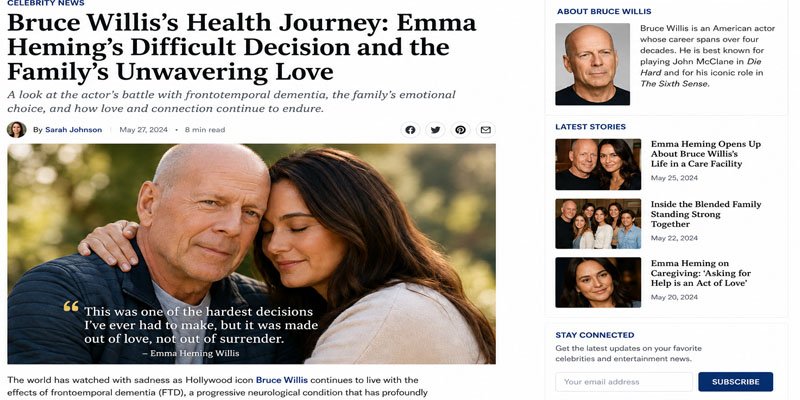
Bruce Willis’s Health Journey: Emma Heming’s Difficult Decision and the Family’s Unwavering Love
The world has watched with sadness as Hollywood icon Bruce Willis continues to live with the effects of frontotemporal dementia (FTD), a progressive neurological condition that has profoundly changed his life and the lives of those closest to him.
Best known for his legendary portrayal of John McClane in Die Hard, as well as memorable performances in films such as The Sixth Sense, Willis spent decades portraying characters defined by confidence, determination, and resilience. Today, however, his family is facing a very different kind of challenge—one that cannot be solved on a movie set and cannot simply be overcome through strength of will.
At the center of that journey is his wife, Emma Heming Willis, who has become an outspoken advocate for dementia awareness and for the millions of families who find themselves navigating the difficult realities of caregiving.
Bruce Willis’s Dementia Diagnosis
Bruce Willis’s family initially announced in 2022 that the actor had been diagnosed with aphasia, a condition that can affect a person’s ability to communicate. In 2023, the family provided a more specific diagnosis, revealing that Willis had frontotemporal dementia.
FTD is a progressive form of dementia that can affect areas of the brain responsible for language, behavior, personality, and decision-making. Unlike some other forms of dementia, memory loss is not always the earliest or most prominent symptom.
For Willis, communication has become one of the major challenges associated with his condition. Emma has spoken publicly about how the disease has affected his ability to communicate and how the family has had to adapt to his changing needs.
A Difficult Change in His Living Arrangements
One of the most emotional aspects of Bruce Willis’s journey has been the decision to change his living arrangements as his condition progressed.
Reports have clarified that Willis was moved into a separate home close to the family residence rather than being sent away to a distant nursing facility. The arrangement allows him to have professional care and support around the clock while remaining close to Emma, their daughters, and the rest of the family.
For Emma, the decision was not about abandoning her husband. It was about making sure he could receive the level of care he needed while also protecting the well-being of the entire family.
As dementia progresses, caregiving can become increasingly demanding. What may once have been manageable at home can eventually require specialized assistance, trained caregivers, and constant supervision.
Emma has emphasized the importance of recognizing this reality rather than viewing professional caregiving as a failure.
Emma Heming’s Emotional Caregiving Journey
Emma Heming Willis has been open about the emotional challenges of becoming a full-time caregiver to someone she loves.
In interviews and public discussions, she has described how difficult it can be to watch a loved one change because of a progressive neurological disease. She has also spoken about the importance of accepting help rather than trying to carry every responsibility alone.
Her experience has given her a new perspective on caregiving. Instead of believing that being a devoted wife means personally handling every aspect of Bruce’s care, Emma has increasingly focused on creating the best possible environment for him.
That includes relying on trained professionals while preserving the family connection that remains so important to Bruce.
Protecting Their Daughters
Another major consideration has been the couple’s two young daughters, Mabel and Evelyn.
Emma has had to balance Bruce’s changing medical needs with the emotional and everyday needs of their children. Having Bruce close by while also having professional caregivers available provides the family with a structure that can be adapted as circumstances change.
For children, dementia can be difficult to understand. A parent may physically be present while their communication, personality, or abilities gradually change.
The family has therefore tried to maintain a sense of normality and connection while allowing the girls to continue spending meaningful time with their father.
The Support of a Blended Family
Bruce Willis’s family extends beyond his marriage to Emma.
His former wife, Demi Moore, and their adult daughters—Rumer, Scout, and Tallulah—have remained part of his wider family circle. Together with Emma and Bruce’s younger daughters, they represent a blended family that has continued to rally around him.
The family’s public comments have repeatedly highlighted the importance of staying connected and supporting one another during this difficult period.
Rather than allowing the diagnosis to completely define Bruce’s identity, his loved ones continue to see him as a father, husband, friend, and family member.
Finding New Ways to Communicate
Because frontotemporal dementia can affect language and communication, the family has had to learn new ways of connecting with Bruce.
Communication is not always limited to words. Familiar voices, music, facial expressions, routines, and simply spending time together can all provide meaningful forms of connection.
For a family accustomed to Bruce’s powerful screen presence and unmistakable voice, these changes are undoubtedly emotional. Yet Emma and the rest of the family have focused on meeting him where he is rather than expecting him to remain the person he was before the disease progressed.
That shift is one of the most important lessons of their experience.
Emma Is Changing the Conversation Around Caregiving
Emma Heming Willis has also used her experience to challenge the stigma surrounding professional caregiving.
Many caregivers feel guilty when they reach a point where they can no longer manage everything themselves. They may worry that accepting professional help means they are failing their loved one.
Emma has argued for a different way of looking at caregiving.
Asking for help can be an act of love.
Professional care can give a person with dementia access to specialized support while allowing family members to spend time together without every interaction being dominated by medical responsibilities.
For Emma, this distinction has become increasingly important.
Bruce Willis’s Legacy Beyond Hollywood
Bruce Willis’s legacy was already firmly established long before his dementia diagnosis.
From Die Hard to The Sixth Sense and countless other films, he became one of Hollywood’s most recognizable stars. His performances helped define an era of American cinema, and his influence continues to be felt by audiences around the world.
But his current chapter has revealed another side of his legacy.
Away from the cameras, Willis is surrounded by a family determined to protect his dignity and remain connected to him as his illness progresses.
His story is no longer simply about the action hero who seemed impossible to defeat. It is also about a family confronting something far more complicated: a progressive illness for which there is currently no simple solution.
Love and Connection Still Matter
Although Bruce Willis’s condition has changed many aspects of his life, his family continues to emphasize that love and connection remain important.
The goal is no longer to make life look exactly as it did before the diagnosis. Instead, the family is adapting to the present and finding meaningful moments within it.
That may mean spending quiet time together, sharing familiar experiences, listening to music, enjoying meals, or simply being present.
These moments may seem ordinary, but for families living with dementia, they can become incredibly meaningful.
A Family Learning to Live With Change
The journey of Bruce Willis and his family is ultimately a story about adaptation.
Emma Heming has had to make painful decisions while also caring for two children and protecting her own well-being. Bruce’s adult daughters have had to watch their father navigate a disease that gradually changes communication and independence. Demi Moore and the wider family have continued to provide support and remain part of his life.
There is no perfect roadmap for a family facing frontotemporal dementia.
Instead, there are difficult decisions, changing circumstances, professional support, and moments of uncertainty. There are also opportunities to create new memories and preserve relationships in ways that may look different from the past.
Bruce Willis’s Story Continues
Bruce Willis’s move into a more structured care arrangement should not be viewed simply as a goodbye.
It represents a new stage in the family’s caregiving journey—one designed to provide him with the support he needs while allowing his loved ones to remain close.
For Emma Heming Willis, the experience has become both deeply personal and a platform for advocacy. By speaking openly about the realities of dementia and caregiving, she is helping other families understand that needing professional support does not mean giving up on someone.
Bruce Willis may no longer be able to live the life he once knew, but his identity extends far beyond his illness.
He remains a beloved father, husband, and Hollywood icon.
And as his family continues to navigate the difficult road ahead, their message remains powerful: care can change, circumstances can change, and life can change—but love and connection can endure.