They thought they could intimidate me into giving up the one thing I had spent my entire adult life building, but they had no idea who they were up against. When my new neighbors moved in, they didn’t just arrive with expensive renovations and matching silver SUVs—they brought an overwhelming sense of entitlement that threatened everything I had worked so hard to create. They convinced themselves that my driveway, an essential part of both my home and my business, actually belonged to them. They weren’t simply stepping over a property line; they were declaring outright war. What they failed to realize was that I had no intention of backing down.
My name is Nate Brennan, and I spent nine years transforming a modest corner property into both a comfortable home and the headquarters for my landscaping business. The wide gravel driveway wrapping around the house wasn’t a luxury feature—it was vital for parking my trucks, trailers, and equipment without blocking the road or inconveniencing the neighborhood. When Brent and Elise Callaway bought the house next door, it looked like something straight out of a home renovation advertisement. However, beneath the polished appearance was an attitude driven by entitlement. Before long, their friendly talk about “improving the neighborhood” turned into loud comments over the fence criticizing my work trucks and landscaping equipment.
The real conflict started one Saturday evening during one of their dinner parties. After returning from a job, I found one of their guest’s BMWs parked diagonally across the entrance to my driveway. I politely asked for the car to be moved, but Brent simply smiled and told me it would only be there “for a few hours.” Then he dropped the statement that launched months of legal battles. He insisted that my driveway extended eight feet onto his property. This wasn’t a simple misunderstanding—it was carefully planned. He had already paid for a so-called survey that conveniently redrew the property line in his favor.
I refused to panic or argue. Instead, I went inside and retrieved my original closing paperwork along with the certified property survey completed when I purchased the home in 2014. The documents were precise, detailed, and unmistakably clear: every inch of the driveway was located on my property. When I showed Brent the paperwork, he casually brushed it aside and claimed, “Things shift.” It was textbook gaslighting, as though I should question facts backed by legal documents. But property boundaries don’t randomly move, and I wasn’t about to let someone in sockless loafers pressure me into surrendering land that legally belonged to me.
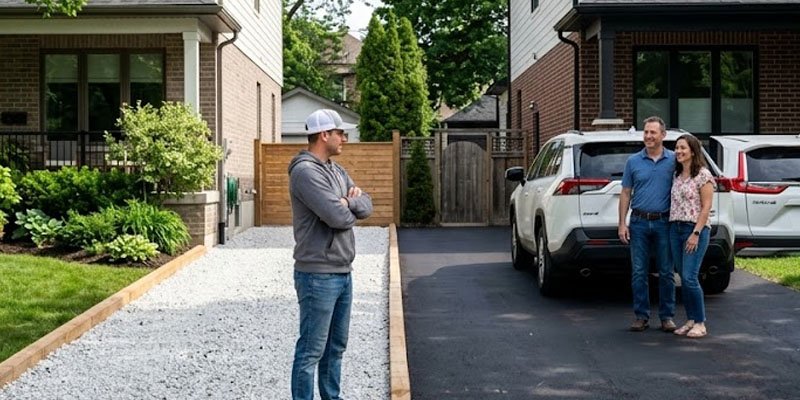
I contacted a professional surveyor I trusted, who confirmed once again that the entire driveway was unquestionably mine. Meanwhile, Brent’s survey proved to be riddled with errors and appeared to have been manipulated to produce the result he wanted. When I handed him the independent report, he didn’t hesitate or reconsider. Instead, he stubbornly rejected the findings altogether. Two weeks later, the situation escalated dramatically. I returned home from work to discover a four-foot chain-link fence with a locked gate cutting directly across my driveway, beginning eight feet from the road.
The police responded, but they gave me the familiar answer: “This is a civil matter.” I stood there unable to reach the rear portion of my own property because of the barrier Brent had installed. As I looked at the fence, Brent watched from inside his house with a satisfied smile. He believed he had already won. He assumed the courts would take months to resolve the dispute and that I would eventually become frustrated enough to leave. He thought I valued avoiding conflict more than protecting my property rights. He couldn’t have been more mistaken.
I hired Angela, an attorney who specialized in property rights, and we immediately sought an emergency injunction. While we waited for the legal process to move forward, I found another way to respond. I made full legal use of the section of my driveway that Brent hadn’t fenced off. Every day, I parked my large landscaping truck and trailer right against the fence. Instead of enjoying the refined view he wanted, Brent woke up each morning to commercial mowers, trailers, and pallets of stone. His dinner guests had to carefully maneuver around my vehicles whenever they visited. It was undeniably petty, but it was completely lawful. Day after day, it reminded him that I wasn’t leaving.
The day of the hearing finally arrived. Brent’s attorney argued that the property boundaries were “under dispute,” but the judge saw through the claim almost immediately. After reviewing decades of deeds along with multiple independent surveys, the judge systematically dismantled Brent’s position. His commissioned survey was recognized for exactly what it was—an attempt to take land that didn’t belong to him. The court granted the injunction, and the sheriff’s office carried out the order. I watched from my front porch as workers dismantled the chain-link fence, removed every section, and charged Brent for the entire removal process.
Even after losing in court, Brent refused to stop. He filed appeal after appeal, submitted false zoning complaints against my landscaping business, and repeatedly contacted code enforcement claiming I was storing equipment illegally. Every investigation reached the same conclusion: I was fully compliant with every applicable rule. I had carefully followed the regulations, maintained complete records, and stayed within the law at every step. No matter what he tried, I remained the obstacle his determination couldn’t overcome.
Six months later, a “For Sale” sign appeared in front of the Callaway home. They could no longer tolerate seeing me every day or being reminded that their attempt had failed. More importantly, they finally accepted that wealth couldn’t rewrite legal property boundaries. They eventually relocated to a gated community, the type of neighborhood where a homeowners association decides everything down to the approved shade of gray for a driveway. It seemed they had finally found the perfectly uniform environment they wanted.
The family that moved in afterward was respectful, friendly, and understood the simple importance of honoring property boundaries. My gravel driveway remains exactly as it always was, wrapping around the side of my home, and I still take pride in keeping it well maintained. Whenever I pull my truck into the driveway after a long day’s work, I sometimes glance at that eight-foot section of gravel and remember the fence that once stood there. It reminds me that property rights are more than words written on legal documents—they are rights worth defending. Brent Callaway believed he could improve his life by taking something that belonged to someone else, but all he truly taught me was that your greatest strength comes from refusing to surrender when others expect you to give in. The driveway is mine—entirely, legally, and permanently. That was always the only ending that truly mattered.