PART 1: The Table for Leftovers
“That meal isn’t meant for girls who will never continue the family name,” Doña Patricia declared as she removed my daughters’ dinner plates right in front of everyone.
She spoke without ever raising her voice, using the quiet, venomous composure of someone convinced that humiliation is simply another way to teach a lesson. Sofía, eight years old, sat frozen with her fork paused halfway to her mouth. Valentina, only five, looked at the piece of fish on her plate as if she couldn’t understand why her own grandmother would take away her dinner in the middle of a family celebration.
The gathering was taking place at a rented hacienda outside Querétaro, even though my husband, Andrés Villaseñor, had spent weeks boasting that he had finally purchased the property. Long banquet tables were dressed with white linens and extravagant floral centerpieces. Waiters in uniform moved gracefully among the guests while a live mariachi band played nearby, and nearly ninety relatives lifted their glasses to celebrate “the man who had restored the Villaseñor family name.”
My daughters and I had been seated at a table near the gardens, tucked off to one side and far from the main table where Andrés laughed with his brothers, uncles, and business associates. According to his mother, that was exactly where we belonged—close enough to attend, but far enough not to interfere; visible, yet never important.
Doña Patricia approached wearing an ivory-colored suit, a string of pearls, and a smile that never reached her eyes.
Without asking or hesitating, she picked up Sofía’s plate first and then took Valentina’s.
“Grandma, I was still eating,” Valentina whispered.
Patricia let out a short, cold laugh.
“My dear, the finest table is reserved for women who give this family sons. By now, your mother should have learned that.”
A few of my aunts quietly looked down at the table. One cousin suddenly became very interested in a message on their phone. No one spoke.
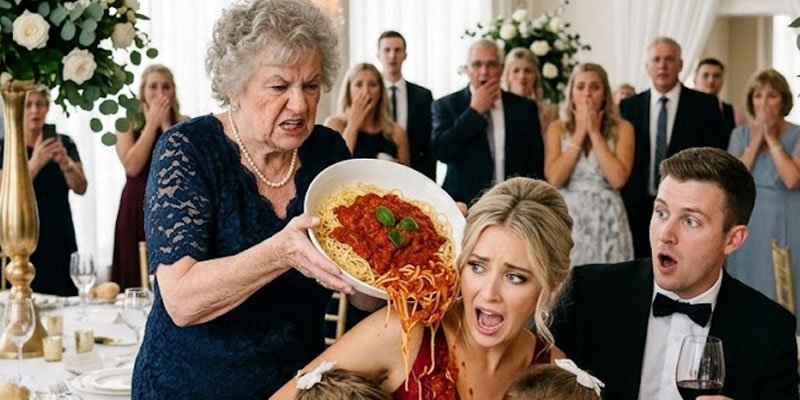
Instead, Patricia set a plastic container filled with cold leftovers in front of us—rice stuck together, stale slices of bread, mashed vegetables, and spilled sauce. As she shoved the tray across the table, red sauce splattered onto Valentina’s yellow dress and landed across Sofía’s cheek.
My oldest daughter never cried. Somehow, that hurt more than tears would have. She simply looked toward her father, silently expecting him to stand up for us.
Andrés saw exactly what had happened. From the head table, he lifted his glass and called out,
“Lucía, stop making everything into a scene. Mom knows how these things are done. Let me enjoy my day.”
My day.
He never mentioned “our daughters.” He never admitted that his mother had crossed the line. He offered nothing that could protect even the smallest piece of dignity those two little girls still had.
I picked up a napkin and gently wiped the sauce from Sofía’s face.
Then I carefully cleaned Valentina’s dress with the same slow patience someone uses when removing broken glass from the floor so their children won’t get hurt.
For eleven years, every member of the Villaseñor family had believed I was simply a wife supported by her husband. Andrés had convinced them that I only worked part-time selling modest apartments. His mother introduced me as “the little girl who got lucky enough to marry into money.”
Every Christmas, while my sisters-in-law unwrapped luxury designer handbags, I received mops, detergent, and aprons disguised as “funny gifts.” Patricia always reminded me that I should appreciate the fact that Andrés had not abandoned me for failing to give him a son.
What none of them realized was that I was the founder and majority shareholder of Horizonte Capital Inmobiliario, a real estate investment and development company with projects in Monterrey, Guadalajara, and Mexico City.
They also had no idea that the hacienda wasn’t owned by Andrés.
And they definitely didn’t know that inside my handbag was a copy of a 5.4-million-peso promissory note carrying his own signature.
I slowly rose from my chair. I lifted Valentina into my arms, reached for Sofía’s hand, and looked directly at Patricia one final time.
“Enjoy your place at the head table,” I said. “Sometimes the real leftovers aren’t the food on the plates—they’re the people sitting around them.”
Andrés immediately jumped to his feet, his face burning with anger.
“Lucía, don’t you dare humiliate me.”
I gave no reply. Holding my daughters close, I walked toward the exit while the mariachi continued playing and every guest pretended not to stare.
Just before we stepped through the doorway of the hacienda, Sofía tightened her grip on my hand and asked a question that changed my life forever.
“Mom, is Dad ashamed of us?”
At that moment, I understood that the worst part of everything was still waiting ahead.
PART 3: The House Where No One Eats Leftovers
“Whose house is this, Mom?”
“Ours,” I replied.
Valentina’s eyes grew wide with surprise.
“Can we have dinner here too?”
I knelt down in front of her.
“No one will ever take your plate away in this home.”
That night, the two of them slept side by side, nestled together among brand-new pillows. I stood quietly in the doorway watching them, realizing that love doesn’t always end with one devastating moment.
Sometimes it slowly decays while a woman keeps making herself smaller so a man can keep feeling bigger.
The following morning, at exactly 9:15, the security guard called from the front gate.
“Mrs. Lucía, there’s a gentleman and an older lady here claiming they’re your family.”
I checked the security monitor.
Andrés stood outside wearing the same suit, now wrinkled and disheveled. Patricia had on oversized dark sunglasses despite the cloudy sky.
In Andrés’s hand was the black folder that had the power to destr0y everything.