
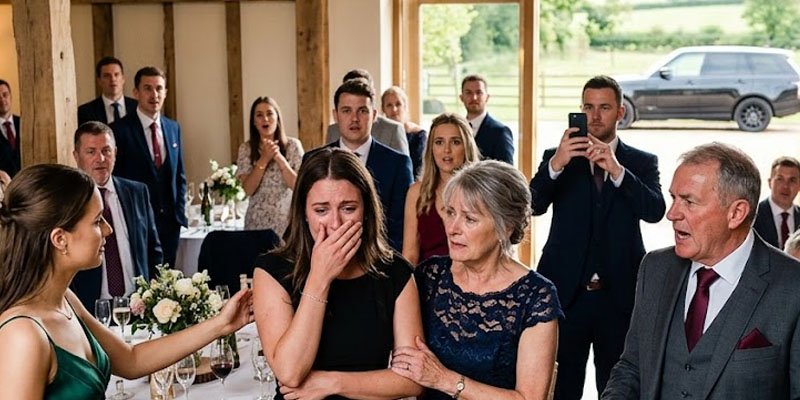
I had been at my younger sister Madison’s wedding for precisely forty-three minutes when my father decided to give away the most valuable possession I had ever bought.
The reception was being held at a renovated vineyard outside Charlottesville, Virginia.
I was twenty-nine years old, three years into running my own logistics company, and after years of driving a battered Honda Civic, I had finally bought myself a brand-new black Lexus RX. I had personally paid the down payment and every financing document was signed in my name.
Then Dad tapped his champagne glass.
“Before we go any further,” he announced with a smile at Madison and her new husband, Eric, “your mother and I have one final surprise. Claire has agreed to give Madison her new Lexus as a wedding present.”
The entire room burst into applause.
I stood there completely frozen.
Madison turned toward me with both hands over her mouth, putting on a terrible show of surprise. Mom smiled as if she had just created the perfect family portrait.
I stood.
“No.”
The applause died instantly.
Dad’s smile vanished. “Claire, don’t do this.”
“I never agreed to give her my car.”
Madison’s face hardened. “You said family helps family.”
“I said I would help with your honeymoon deposit. I did. That car belongs to me.”
Dad stepped closer. “You can afford another one.”
“That doesn’t mean you get to give mine away.”
Someone near the dance floor whispered. Madison heard them. Embarrassment flickered across her face.
“You always have to make everything about yourself,” she snapped.
Then she closed the gap between us, grabbed a fistful of my hair, and yanked.
Pain shot across my scalp. I stumbled backward.
Before I could regain my footing, she forced me onto the hardwood floor.
My shoulder struck first, then my cheek.
Guests screamed.
Eric pulled Madison away, while Mom rushed toward her instead of me.
“Look what you made her do!” Mom yelled.
I pushed myself back up, completely stunned.
Dad pointed at me. “You embarrassed your sister at her wedding. Leave.”
I looked at all three of them.
“You’ll regret this.”
Dad laughed. “Stop being dramatic.”
I grabbed my purse and headed outside.
Thirty minutes later, two police cruisers, a tow truck, and the vineyard’s general manager arrived in the reception parking lot.
But the police were not there because I had reported what happened.
They had arrived because the Lexus Dad had publicly promised Madison had just set off a fraud investigation involving my parents’ company, a falsified loan application, and nearly four hundred thousand dollars they had borrowed under my identity.
The manager locked down the office doors while officers instructed Dad to step away from the guests.
Through the windows, I watched his expression change when one detective said my full legal name.
And the tow truck was only the beginning.
I had found the first evidence of the fr@ud two days before the wedding.
A lender called Blue Ridge Commercial Finance had emailed me about a missed payment on a business equipment loan.
At first, I assumed the message was spam until I noticed the last four digits of my Social Security number, my old home address, and the name of my parents’ company, Whitmore Event Rentals.
My parents had run the company for eighteen years. They rented tents, tables, lighting, and portable bars for weddings and corporate events across central Virginia. I had worked there during college, but I had never owned any part of the business, signed its debts, or agreed to guarantee any loans.
When I called the lender, the representative told me I was listed as a personal guarantor on two loans totaling $386,000.
I asked for copies.
The signatures looked like mine.
They were not mine.
Worse, the application included a scan of my driver’s license from four years earlier, back when Dad had photocopied it because I occasionally drove company vans.
I spent almost the entire next day with my attorney, Dana Patel, discussing the situation and filing an identity-theft report. Dana told me not to confront my parents until we knew exactly how far the scheme went. She also contacted the lender’s fraud department.
The lender moved more quickly than either of us expected.
One of the loans had been used to refinance several company vehicles. Another had been secured against equipment Whitmore Event Rentals claimed to own outright.
When investigators checked the serial numbers, they found that some of the same equipment had already been pledged to another bank.
That explained why the police appeared at the vineyard.
Dad had unknowingly chosen one of the company’s own rental venues for Madison’s wedding.
Several pieces of lighting and sound equipment being used during the reception were listed among the disputed collateral.
Detective Aaron Cole told me to stay near the parking lot while he spoke with my parents.
Inside, the music had stopped.
Guests stood around with untouched champagne while officers questioned Dad. Mom repeatedly insisted there had been “a misunderstanding.” Madison, still wearing her veil, shouted that I had intentionally ruined her wedding.
Then a tow operator hooked chains onto the Lexus.
Madison hurried outside.
“What are you doing?” she screamed.
I stood beside Dana, who had arrived twenty minutes after the police.
“It’s my car,” I said.
Madison pointed at me. “Dad gave it to me.”
“No. Dad announced that he was giving you property that didn’t belong to him.”
Dad came running outside behind her.
“Claire, tell them to stop.”
Dana stepped between us. “Mr. Whitmore, you should communicate through your attorney.”
Dad ignored her. “This family has done everything for you.”
I stared directly at him. “Did you sign my name?”
His expression answered the question before he did.
Mom came outside next. “Your father was trying to save the business.”
“So you knew?”
She looked away.
That hurt more than Madison knocking me onto the floor.
Dad lowered his voice. “We were going to pay it back. You were never supposed to find out.”
Detective Cole heard him.
Dana heard him.
So did at least a dozen wedding guests standing near the open reception doors.
Dad seemed to realize what he had done only after the words were already out.
Cole approached him. “Mr. Whitmore, I’m going to advise you not to say anything else.”
Madison began crying, but the fraud was not what had upset her.
“What am I supposed to drive now?”
I almost laughed.
Instead, I touched the swelling on my cheek and said, “That should be the least of your worries.”
Because while everyone had been arguing about the Lexus, the lender had obtained an emergency order freezing the business accounts connected to the disputed loans.
Whitmore Event Rentals could no longer run payroll, pay vendors, or move money from its operating account.
And Monday morning was just forty-eight hours away.
By Sunday afternoon, the wedding photos were already circulating through the family group chats, but nobody was talking about Madison’s dress or the flowers.
They were talking about the police cars.
I spent that day in Dana’s Richmond office with an ice pack against my shoulder and a folder full of documents spread across the conference table. The lender’s fr@ud team had given us copies of everything tied to my identity. There were loan guarantees, a financial statement listing me as a minority owner of Whitmore Event Rentals, and even a fabricated resolution claiming I had attended a company meeting and authorized Dad to borrow money in my name.
I had never seen any of those documents.
Dana pushed one page toward me.
“This goes beyond a forged signature,” she said. “They built a paper trail designed to make you appear involved.”
I immediately recognized the dates.
One supposed meeting had taken place while I was in Denver attending a client conference. Another was dated during the same week I had been recovering from an emergency appendectomy.
The fraud contained careless mistakes that only became obvious once someone actually investigated it.
On Monday morning, Whitmore Event Rentals failed to make payroll.
By noon, two vendors had stopped service after electronic payments bounced.
By three, several employees were reaching out to me because my name appeared in the lender’s paperwork and they assumed I was part of management.
I gave every one of them the same response.
“I’m not an owner. I never borrowed that money. Please speak with the company or your own attorney.”
Dad called seventeen times.
I did not answer a single call.
Mom left four voicemails. The first accused me of destroying the family. The second said Dad had made “a paperwork mistake.” The third asked whether I could lend them enough money to cover payroll.
The fourth sounded gentler.
“Claire, please. Your father could lose everything.”
I listened to that message twice.
Then I deleted it.
The criminal investigation moved more slowly than the company’s collapse, but the financial d@mage happened immediately. The lender demanded records. The second bank holding liens against some of the same equipment began its own investigation. The company’s insurer questioned the ownership and financing arrangements. Several clients canceled upcoming events after learning that equipment might be repossessed.
Three days after the wedding, Dad finally hired a lawyer.
That attorney contacted Dana and proposed a private settlement.
My parents would admit to “administrative errors,” remove my name from any future company paperwork, and reimburse me for any direct financial loss if I agreed to stop cooperating with investigators.
Dana read the offer aloud and raised an eyebrow.
“They want you to help them bury it.”
“I’m not doing that.”
She nodded. “Good.”
I had spent most of my life making excuses for my parents.
Dad had always called himself practical. If he borrowed my laptop without asking, he was being practical. If Mom volunteered me for a holiday weekend, she was keeping the peace. If Madison needed money and I was expected to provide it, that was simply what older sisters were supposed to do.
The Lexus was not some isolated act of entitlement. It was simply the first time they had tried something like that in front of two hundred witnesses.
The following week, Detective Cole asked me to come to the station for a formal interview.
He showed me a copy of a document containing my forged signature and asked whether I recognized the handwriting anywhere else on the page.
I did.
Dad’s.
Not because the signature looked like his. It didn’t. But he had written the date using the same block letters I had seen on birthday cards and invoices for years.
Cole asked, “Are you willing to testify to that?”
“Yes.”
He studied me for a moment. “Even knowing where this could lead?”
“Yes.”
There was no sense of dramatic satisfaction when I said it. I was exhausted.
Madison called that evening from Eric’s phone because I had blocked hers.
“You actually spoke to the police?”
“Yes.”
“You’re trying to send Dad to prison.”
“No. Dad forged my name. I told the truth about it.”
“He did it for the family.”
“He did it for his business.”
“That is the family.”
“No. That’s the problem.”
She fell silent.
Then she said, “You ruined my wedding.”
“You as:saulted me because I wouldn’t give you my car.”
“You em.bar.ras.sed me first.”
I almost answered, but there was nothing more worth explaining.
“Madison, don’t contact me again.”
I ended the call.
Two weeks later, the county prosecutor authorized charges connected to identity theft, forgery, and obtaining money through fraudulent documents.
Dad was arrested at his attorney’s office after arranging to surrender voluntarily.
Mom was not arrested that day, but investigators continued looking into whether she had knowingly participated. Her name appeared on several company records, and emails showed that she had forwarded financial documents to the lender.
Madison posted a long message on social media claiming that our parents were victims of an aggressive bank and a vindictive daughter.
She never mentioned the forged signatures.
She never mentioned the $386,000.
She never mentioned pulling my hair.
Unfortunately for her, someone at the wedding had recorded Dad’s announcement about my Lexus.
Another guest had captured part of the confrontation afterward, including Dad telling me I could “afford another one.”
The recordings spread among people we knew locally. I never uploaded them. I didn’t need to.
Within a month, Whitmore Event Rentals entered an emergency restructuring process.
Most of the disputed equipment was surrendered or repossessed.
The company dismissed nearly half of its employees.
The family home had been pledged as collateral for an older line of credit, and when the company stopped meeting its obligations, that loan also came under pressure.
Mom temporarily moved into my aunt Rebecca’s basement after the house was put up for sale.
That was when she came to see me.
She arrived at my office without an appointment, looking ten years older than she had at the wedding.
My receptionist asked whether I wanted security.
I almost said yes.
Instead, I met Mom in the conference room with the door left open.
She sat across from me with her purse resting in her lap.
“Your father says you won’t speak to him.”
“That’s right.”
“He’s frightened.”
“So was I when I learned someone had borrowed hundreds of thousands of dollars using my name.”
Mom flinched.
“He believed the company would recover.”
“You knew he used my identity.”
Her eyes filled.
“I knew he put your name on some paperwork.”
“That’s a very carefully chosen sentence.”
“I didn’t understand everything.”
“You sent my tax return to the lender.”
She stared down at the table.
I had found that email in the evidence. Mom had forwarded a PDF of my tax return from an old family bookkeeping folder after Dad asked for “Claire’s income proof.”
“I thought he needed it to show family backing,” she whispered.
“You knew I had not agreed.”
She said nothing.
That was enough.
Mom leaned closer. “We can still fix this. If you tell the prosecutor that you misunderstood—”
I stood.
The meeting was over.
She looked up at me in disbelief.
“You came here to ask me to lie?”
“I came here to save your father.”
“No. You came here to make me pay for what he did.”
Her expression hardened. For one familiar moment, she looked exactly like the woman who had stood over me on the wedding floor and claimed I had made Madison attack me.
“You’ve become very cold,” she said.
I opened the conference room door.
“And you’ve become very clear about what you want.”
She left without saying another word.
The case took eight months to reach its conclusion.
Dad ultimately accepted a plea agreement. He admitted that he had forged my signature on several lending documents and used my identifying information without permission.
Because he had no prior criminal record and because much of the money had gone toward keeping the company operating rather than paying for personal luxuries, his sentence was not as severe as Madison had predicted, but it was still real: a period of incarceration followed by supervised release, restitution requirements, and restrictions concerning financial management.
Mom was not charged with those same offenses, but the investigation and civil lawsuits left her financially devastated.
She and Dad lost the house.
Whitmore Event Rentals was sold off in pieces. Competitors bought the remaining inventory. A regional event company purchased the customer list and warehouse lease.
The business that had dominated our family discussions for almost twenty years disappeared in less than a year.
Madison blamed me until the day Eric filed for divorce.
That happened eleven months after the wedding.
According to Eric, the marriage had been falling apart almost from the start. He had been embarrassed by what happened at the reception, but what bothered him more was everything that came afterward. Madison became obsessed with proving that I was responsible for every consequence.
She spent money they didn’t have helping Mom with legal expenses. Whenever Eric suggested that Dad had caused his own problems, she called him disloyal.
The final argument came after Madison asked Eric to take out a personal loan for Mom.
He refused.
She threw his phone against a wall.
He moved out the next morning.
I learned most of this from Eric months later, when he emailed to apologize for not stepping in sooner during the wedding.
I accepted his apology, but we did not become friends.
I had no interest in gathering people from the wreckage.
What mattered was rebuilding the parts of my own life that had been dragged into it.
It took months to repair my credit. I had to file fraud alerts, dispute accounts, change banks, change passwords, freeze my credit, and move several personal records out of the old family storage.
I also sold the Lexus.
Not because Madison had touched it.
Not because Dad had tried to give it away.
I sold it because every time I looked at it, I saw the ballroom, the champagne glasses, and two hundred people applauding as my father offered my property as proof of his generosity.
I replaced it with a blue Volvo SUV.
The first day I drove it home, I parked outside my apartment and stayed behind the wheel for a while.
It wasn’t a symbol of revenge.
It was simply mine.
A year and a half after the wedding, I received a letter from Dad.
He apologized for the forged paperwork, but even then he wrote that he had been “under impossible pressure” and believed he could repay everything before I suffered any harm.
I read the letter once.
Then I put it in a file with the court records.
I did not reply.
Madison made one final attempt.
On my birthday, she sent me a message saying she missed having a sister and wanted to “put the past behind us.”
I answered with two sentences.
“I hope you’re doing well. I’m not interested in resuming contact.”
That was the end.
People sometimes picture a family coll@pse happening in one explosive instant.
Mine didn’t.
The wedding was simply the moment when everyone could finally see the cracks.
Dad had already forged the documents.
Mom had already helped him obtain my records.
Madison had already learned that anything I owned could become hers if she demanded it loudly enough.
All I did at the wedding was say one word they were not accustomed to hearing from me.
“No.”
Thirty minutes later, the police arrived.
Eight months later, Dad stood before a judge.
Eleven months later, Madison’s marriage ended.
A year later, the family business was gone.
None of it happened because I cursed them, plotted against them, or somehow engineered their downfall.
It happened because, for the first time, I stopped protecting them from the consequences of decisions they had already made.
And that, as it turned out, was enough.