
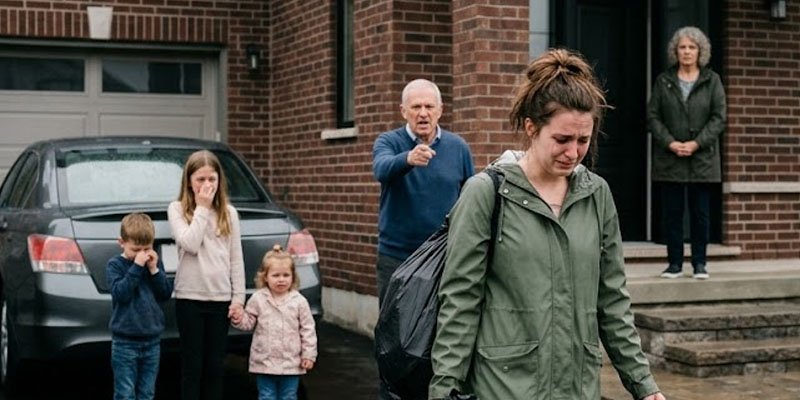
My husband betrayed me on a rainy Thursday in Ohio, inside the very house where our children’s artwork still hung crookedly across the refrigerator.
I found out because his mistress called me.
Not through a text.
Not by email.
She phoned me.
Her name was Vanessa, and she sounded young enough to believe that hurting another woman somehow made her feel powerful. She told me she was tired of living in secret. She claimed Grant had promised to leave me after Christmas. Then she sent photos. Reflections in hotel mirrors. His hand resting around her waist. His wedding ring still on his finger.
For ten straight minutes, I stood in the laundry room with my phone shaking in my hand while the dryer rumbled behind me like a steady heartbeat.
Then I began packing.
Not everything. Just the children’s clothes, their birth certificates, medications, school tablets, my emergency savings, and as much food as I could fit into a grocery bag. My oldest daughter, Lily, who was twelve, asked if Dad was coming with us.
“No,” I answered.
Ethan, eight years old, quietly carried his dinosaur blanket without saying a word. Grace, four, burst into tears because I had forgotten her pink boots.
Grant came through the front door just as I finished zipping the last suitcase.
“Rebecca, don’t do this,” he said, standing in the hallway to block my way.
I looked at the man I had loved for fourteen years. “Move.”
“You’re overreacting.”
I almost laughed.
I drove three hours through relentless rain to my parents’ house in Columbus. I imagined my mother wrapping the children in a warm embrace. I pictured my father opening the door and saying, “Come in, honey.”
Instead, my father opened the door wearing his old gray cardigan. He looked at me, then at my three children standing behind me with wet hair and frightened expressions.
His face changed.
Not with sympathy. With hesitation.
“Rebecca,” he said quietly. “You should have called first.”
“I didn’t have time.”
My mother stepped into view behind him, pale and unable to speak.
“Dad,” I said softly, “Grant cheated on me. I just need somewhere to stay tonight.”
He glanced past me at my car crammed with garbage bags and backpacks.
Then, without a word, he slowly closed the door.
He didn’t slam it. He wasn’t angry. He simply shut it.
As if we were complete strangers knocking to sell something he never wanted.
Ten minutes later, my brother Daniel came out through the side gate, refusing to look me in the eye. “Becca, there just isn’t enough room. Dad’s overwhelmed. Mom’s blood pressure…”
“You live alone in a three-bedroom townhouse.”
He swallowed hard. “It’s complicated.”
My sister Claire answered my call on speakerphone and said I was acting rashly, that every marriage goes through hard times, and that I shouldn’t drag the children around because of my pride.
The rain soaked completely through my sweater.
Lily stood beside me holding Grace. Ethan kept staring at the closed front door.
I picked up the torn black garbage bag that had fallen onto the driveway, walked back toward my car, and quietly whispered three words.
“Watch me survive.”
I didn’t fall apart until we reached a gas station on the edge of town.
Not because of Grant. Not even because my father had closed the door on us. I cried because Grace asked if Grandma’s house was “broken,” and Lily answered before I could.
“No,” Lily said as she buckled her little sister into the booster seat. “They just decided not to open the door.”
That was the exact moment something inside me stopped begging for acceptance.
I splashed cold water on my face in the gas station restroom while the children waited in the locked car beneath the bright lights of pump number six. The woman staring back at me in the mirror looked like someone I barely recognized.
She was exhausted, her eyes were red, but she was completely awake.
I had one hundred and eighty-seven dollars in cash. Two debit cards that Grant could probably track. A phone with only 32 percent battery. Three children. No real plan.
So I made one.
First, I turned off location sharing. Then I called the only person I hadn’t spoken to in almost six years: Marisol Vega.
Marisol had been my closest friend before marriage, before becoming a mother, before Grant gradually convinced me that my friends were “bad influences” simply because they noticed I had stopped smiling. She answered on the fourth ring.
“Rebecca?”
My throat tightened.
“Are you safe?” she asked immediately.
That single question almost broke me all over again.
“I need a place for us to stay tonight,” I whispered. “Just for tonight. The kids are with me.”
She didn’t hesitate for even a second. No criticism. No deep sigh.
“Send me your location. I’m coming.”
Forty minutes later, Marisol arrived in an old blue SUV wearing pajama pants, boots, and a coat thrown over her shoulders. She hugged the children before anyone else. Then she wrapped me in such a tight embrace that my ribs hurt.
Her apartment was small, but somehow she found space for all of us. Lily slept on the couch. Ethan and Grace shared an air mattress. I lay on a blanket beside the kitchen, listening to the refrigerator hum while rain gently tapped against the window.
At 2:14 a.m., Grant called.
Then he called again.
Then the messages began.
Come home.
You’re scaring the kids.
You’re making this worse.
We can talk like adults.
Your family agrees with me.
That last message made my stomach knot.
At 7:30 the next morning, I called a family law attorney from Marisol’s kitchen table. By noon, I had an appointment. By three o’clock, I was sitting across from a woman named Judith Kane, dressed in a navy-blue suit and speaking with the kind of precision that made every word feel deliberate.
“Did he ever hit you?” she asked.
“No.”
“Did he control your finances?”
“Yes.”
“Did he isolate you from other people?”
I thought about the birthdays I missed because Grant didn’t like my friends. I remembered holidays spent apologizing for his behavior. I remembered my father closing the door, my brother’s lie, and my sister’s judgment.
“Yes,” I replied.
Judith gave a single nod. “Then we move forward carefully.”
That very afternoon, Grant emptied our joint checking account.
He left me with nineteen dollars and sixty-two cents.
I stood in the frozen food aisle of a Kroger, staring at my banking app while holding the box of waffles Grace had asked for.
Lily noticed the look on my face.
“Mom?”
I placed the waffles into the shopping cart.
“We’re getting them,” I said.
I paid using Marisol’s card and promised I would pay back every penny. She only smiled and said, “You will. Just not today.”
Three days later, Grant filed for emergency custody.
In his petition, he claimed I had “abducted” our children during what he described as a mental health episode. He painted me as unstable, irrational, and unable to support myself financially. He also stated that even my own relatives were worried about my behavior.
My father signed a statement.
My brother signed one too.
Claire sent me a text saying she hoped I would “get help before ruining everything.”
I sat in Judith’s office with the paperwork trembling in my hands.
For the first time, I understood that Grant hadn’t only betrayed me.
He had been planning for this all along.
Judith leaned closer. “Rebecca, listen carefully. Men like your husband rely on shame. They expect you to feel too humiliated to simply tell the truth.”
“What am I supposed to do?”
“You document everything. Every text message. Every dollar. Every phone call. Every witness. And you stop protecting the people who are helping him hurt you.”
That night, after the children had fallen asleep, I opened my laptop.
I created folders.
Grant.
Bank records.
Text messages.
Family statements.
Vanessa.
Children.
Then I created one more folder.
Survival.
The first hearing was scheduled for a Monday morning at Franklin County Domestic Relations Court.
I wore the only blazer I owned—a black one that fit just a little tightly across the shoulders. Marisol had ironed it while I packed snacks for the children. Lily insisted on brushing Grace’s hair. Ethan wore his church shoes and kept rubbing one foot against the other, silent and nervous.
Judith explained that the children would not be allowed inside the courtroom unless the judge specifically requested their presence.
Even so, they came with me because I had nowhere else for them to go. And after everything Grant had claimed about me, I wanted everyone to see the real picture waiting in that hallway: three clean, fed, frightened children leaning toward their mother instead of pulling away from her.
Grant arrived fifteen minutes late.
He was wearing his charcoal-gray suit, the same one I had bought him for a promotion dinner two years before. He looked refreshed.
For some reason, that upset me more than I expected. His hair was freshly trimmed. His shoes were polished. He carried a leather folder and wore the calm, sorrowful expression he always put on at funerals and workplace events.
Walking behind him were my father, my mother, Daniel, and Claire.
My mother never lifted her eyes from the floor.
My father looked straight through me.
Claire gave Lily a small wave.
Lily didn’t wave back.
Grant walked toward me slowly, as though every step was being recorded.
“Rebecca,” he said quietly. “You don’t have to keep doing this.”
Before I had the chance to answer, Judith stepped directly between us.
“Mr. Turner, all communication will go through legal counsel.”
Grant’s jaw tightened for only a moment.
Then his carefully practiced expression returned.
Inside the courtroom, his attorney presented a version of me that almost sounded convincing.
I was emotionally unstable. I had left without warning. I had no permanent place to live. I had taken the children across county lines without mutual agreement.
According to their argument, my own family had been “deeply concerned” about my behavior.
Then Judith stood.
She never raised her voice. She didn’t perform for the room. She simply opened her folder.
“Your Honor, Mrs. Turner left the marital home after receiving direct evidence of Mr. Turner’s ongoing affair. She took the children to what she reasonably believed would be a safe place with family. When that option was denied, she contacted a longtime friend who provided temporary housing. Since that time, she has maintained the children’s medical care, ensured they continued their schoolwork through remote access, and immediately retained legal counsel.”
Grant kept staring straight ahead.
Judith continued.
“Mr. Turner, however, emptied the parties’ joint checking account within twenty-four hours of her departure, leaving his wife and three children with nineteen dollars and sixty-two cents.”
The judge looked up.
Grant’s attorney shifted uncomfortably.
Judith handed the court printed copies of the bank statements.
Then she introduced the text messages.
Come home.
You’re embarrassing me.
Your parents know you’re unstable.
No judge will award children to a woman with no money.
You’ll be back before Friday.
I watched as the judge carefully read every single message.
For the first time in days, Grant looked uneasy.
But Judith was not finished.
She submitted hotel invoices. Screenshots Vanessa had sent me. A carefully organized timeline. Photos of my packed car at the gas station showing clear timestamps. Messages from Marisol confirming the exact time she picked us up. School login records proving Lily and Ethan had completed their assignments every day after we left.
Finally, Judith introduced one last piece of evidence.
My father’s signed statement.
Then she submitted a screenshot of a text Grant had sent my father the night before that statement was signed.
Need you to say she looked unstable. It strengthens the custody case. She’ll settle down once she realizes she has nowhere else to go.
The courtroom went completely silent.
The color drained from my father’s face.
I had that message because my mother sent it to me.
At 4:46 that morning, while I was making peanut butter sandwiches and placing them into plastic bags, my phone buzzed.
It was Mom.
I’m sorry. I should have opened the door.
Attached was a screenshot from my father’s phone.
Then another.
Then another.
My mother hadn’t defended me at the front door. She hadn’t argued with my father when he closed it in my face. But during the quiet guilt that followed over the next several days, she finally did one thing she should have done from the beginning.
She sent me the proof.
The judge denied Grant’s request for emergency custody.
Instead, she awarded me temporary primary custody, ordered Grant to return half of the money he had withdrawn from our joint account within forty-eight hours, and required that custody exchanges be supervised. He was granted parenting time, but not control.
When we walked out of the courthouse, my knees nearly gave out beneath me.
Marisol caught my arm before I fell.
Lily suddenly wrapped her arms tightly around me in the hallway.
“Does this mean we’re okay?”
I looked into her face, which seemed far older than it had just a week before.
“It means we have time,” I told her. “Right now, that’s enough.”
But life didn’t suddenly become easy just because one judge saw through Grant’s lies.
The months that followed were incredibly difficult.
Marisol’s apartment became crowded almost immediately. The children did their best to stay grateful, but gratitude alone isn’t enough for kids. Grace missed sleeping in her own bed. Ethan started wetting the bed again. Lily stopped asking for anything at all, and somehow that worried me more than anything else.
Through one of Marisol’s cousins, I found work at a medical billing office. The pay wasn’t impressive, but it was reliable. I answered phones, corrected insurance billing codes, and ate lunch at my desk while searching online for apartments I could realistically afford.
Most landlords heard “three children” and “new job,” then somehow never returned my calls.
Eventually, a woman named Mrs. Patterson agreed to rent me the upstairs apartment in a duplex in Dayton. The carpet was worn thin. The cabinet beneath the kitchen sink leaned slightly. The bathroom tile had a crack running across it like a bolt of lightning.
To us, it was perfect.
On our first evening there, we ate spaghetti from paper bowls while sitting on the living room floor because I didn’t own a dining table.
Grace twirled noodles around her fork and proudly announced, “This house opens.”
Lily laughed.
Ethan laughed too.
I hadn’t realized how desperately I needed to hear that sound.
Grant continued trying to rewrite what had happened.
During every custody exchange, he spoke in a soft, sorrowful voice, making sure nearby parents could hear him.
“Daddy loves you. Mommy is just angry.”
Lily stopped answering him.
One Sunday, Ethan came home and quietly asked, “Did you steal us?”
I sat beside him on the mattress he shared with Grace and explained the truth in words an eight-year-old could understand.
“No. I took you somewhere safe because Dad hurt our family and then tried to scare me. The adults are taking care of everything now. None of this is your responsibility.”
He nodded, although tears filled his eyes.
“Do I still love him?”
That question hurt more than anything cruel Grant had ever said to me.
“Yes,” I answered. “You’re allowed to love him. And you’re allowed to feel hurt too. Both feelings can exist at the same time.”
I never wanted to make my children into weapons against their father. Grant had already caused enough harm by trying to do exactly that. So I told them the truth without filling it with bitterness. I gave them facts instead of performances, and I saved my anger for the shower, where the running water could hide the sound of it.
My family slowly tried to make their way back into my life.
Claire was the first.
She sent flowers.
I threw them away.
Daniel sent a text.
I didn’t know the whole story.
I never answered.
My father left me one voicemail. His voice sounded quieter than I remembered.
“Rebecca, I was wrong. Grant told me you were hysterical. I thought refusing to let you stay would push you to go back home and work things out. I never realized—”
I deleted the message before he could finish.
My mother was the only person I agreed to meet.
She arrived at the duplex carrying grocery bags, her eyes swollen and red from crying. She stayed on the porch instead of asking to come inside, and that was the reason I opened the door.
“I failed you,” she said.
“Yes,” I answered.
She winced, but she didn’t try to defend herself.
“I was afraid of your father’s temper,” she admitted. “I’ve lived with that fear for a long time. That doesn’t excuse what I did.”
“No,” I said. “It doesn’t.”
She slowly nodded.
“I know.”
For several moments, we simply stood there—two women separated by years of silence that had always been disguised as family loyalty.
Then Grace ran to the doorway and shouted, “Grandma brought bananas!”
My mother burst into tears.
I invited her inside, but I didn’t make forgiveness easy. I had learned that trust isn’t like a door that can simply be opened again. It’s more like a floor. Once it cracks, every step afterward has to be taken carefully.
The divorce lasted eleven months.
Grant argued over every single detail. The couch. The minivan. The savings account he had already emptied. He insisted Vanessa meant nothing to him, yet only six weeks later he moved in with her. Vanessa, who had proudly introduced herself as my replacement, soon learned that winning a man who cheats doesn’t guarantee a happy ending.
She messaged me once.
Did he treat you like this too? The lies? Always disappearing?
I looked at her message for a long time.
Then I replied.
Yes.
Nothing more.
By the time of the final hearing, I had a better-paying job, a lease with only my name on it, and three children who had finally begun to breathe freely again. Lily joined the art club. Ethan signed up for soccer. Grace slept peacefully in her own bed beneath glow-in-the-dark stars stuck to the ceiling.
The court awarded us joint legal custody but granted me primary physical custody. Grant received scheduled parenting time, child support responsibilities, and a warning from the judge about manipulating the children.
When the final divorce decree was signed, Judith handed me my copy.
“That’s it,” she said.
I expected to feel happy.
Instead, I felt peaceful.
It was like walking out of a room filled with noise and suddenly realizing the ringing in my ears had disappeared.
That evening, I drove the children past my parents’ house.
I had no intention of stopping, but Lily recognized the street.
“Are we going inside?” she asked.
I looked at the porch where I had once stood in the rain holding a garbage bag. The front door was painted blue now. A wreath hung in the middle of it. From the outside, it looked like any ordinary home—warm, welcoming, and shaped like family.
“No,” I answered.
Ethan stared out the window.
“Are you still angry?”
I thought about the question.
“Yes,” I said. “But not the way I used to be.”
“What changed?” Lily asked.
I kept both hands firmly on the steering wheel.
“I stopped waiting for people to become who they should have been.”
For a few moments, nobody spoke.
Then Grace asked, “Can we get fries?”
So we stopped for fries.
One year after the night my father closed the door on me, I bought a small dining table from a thrift store. The tabletop was scratched, and one of the chairs wobbled, but it fit perfectly beneath the kitchen light.
Marisol came over carrying a cake. Judith mailed me a card. My mother arrived with flowers and asked permission before placing them on the counter. Daniel mailed me a check for the money Grant had convinced him not to lend me. I mailed it back.
Claire wrote me a long apology.
I read it twice.
Then I placed it inside a drawer.
I realized that forgiveness is never an emergency. No one has the right to demand it simply because carrying guilt has become uncomfortable.
That evening, after the cake had been eaten, the dishes were clean, and the children were asleep, I sat alone at my thrift-store table and opened the old folder on my laptop.
Survival.
Inside were screenshots, bank statements, court papers, apartment applications, job offer emails, grocery receipts, school notices, and one photograph Marisol had taken without telling me.
It showed me standing at the gas station on the night I left Grant.
My hair was drenched. My sweater clung to my shoulders. Behind me, the children were buckled into the car beneath bright fluorescent lights. I looked completely worn out.
But I was still standing.
The following day, I printed that photograph and placed it inside a simple black frame.
Not in the living room.
Not somewhere visitors could ask questions about it.
I put it on the dresser in my bedroom beside my jewelry box, where I would see it every single morning.
Because the woman in that photograph had been abandoned by her husband, turned away by her father, doubted by her siblings, and left standing in the rain with three children and a garbage bag.
Even then, she made herself one promise.
Watch me survive.
And she did.