PART 1: THE HOUSE THEY TRIED TO SELL
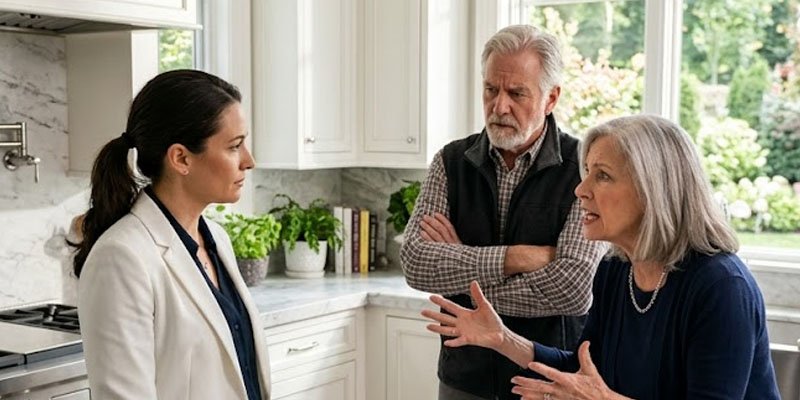
My mother looked at the sealed envelope as if it contained something dangerous.
My attorney’s voice echoed through the kitchen speaker, steady and deliberate.
“Before Richard and Elaine move forward with selling Natalie’s property, they may want to examine the default notice attached to their own residence.”
Just moments before, my parents had been talking about repair expenses, listing images, and the timeline for forcing me to leave.
Now my father held onto the kitchen island as though it was the only stable thing left beneath him.
The realtor, Ms. Brennan, opened the blue folder and read the county recording number, the legal property description, and the name written under OWNER OF RECORD.
Natalie Harper.
Not my father.
Not my mother.
Me.
“That can’t be right,” Mom whispered.
I slid the envelope across the counter toward her.
“Read it.”
She ripped it open, and a certified deed fell directly over the listing agreement she had already signed using her own name.
The ownership they had created in their minds was now buried beneath official legal evidence proving mine.
Dad grabbed the deed from the counter.
“This signature might have been fabricated.”
“It was completed inside Aunt Rose’s attorney’s office,” I said. “There were two witnesses present, the meeting was notarized, and the transfer was officially recorded eighteen months before she passed away.”
The timing was important.
Six months after Rose signed the deed, my parents started telling relatives that she was confused and no longer able to handle her own affairs.
That was false.
Until the final week of her life, Aunt Rose was completely alert. She handled her own finances, caught mistakes on medical statements, remembered every family birthday, and regularly beat me in chess.
She also understood my parents in a way I never had.
Ms. Brennan moved the listing agreement aside.
“You told me this property belonged to Rose’s estate.”
“It was supposed to,” Mom replied sharply.
“That isn’t what I asked.”
Dad accused me of taking advantage of a woman who was dying.
For years, those words would have made me panic. I would have tried to explain every detail and begged them to understand that I was not greedy or incapable.
This time, I stayed composed.
Aunt Rose taught me that facts did not need to be loud to be powerful.
I opened the folder once more.
Inside was a letter from Rose’s doctor confirming that she was mentally capable when she signed the deed. Behind it were written statements from her attorney and her financial adviser.
Rose had prepared for exactly this moment.
“This was arranged,” Dad said with anger.
“Yes,” I replied. “By Aunt Rose.”
Mom looked directly at me.
“Why would she give you a four-bedroom house?”
She was no longer asking if the documents were real.
She wanted to understand why Rose had selected me.
“I moved in after her surgery,” I explained. “I took her to doctor appointments, managed repairs, paid the property taxes when her accounts were temporarily frozen, and stayed here with her for three years.”
“We would have helped if she had reached out,” Mom argued.
“She did.”
Rose called my mother after her first operation, but Mom said hospitals made her uncomfortable. She asked Dad to take her to a specialist, but he had a golf tournament scheduled. She asked my brother Kevin to come visit, and my parents told him she needed professional care instead of family members constantly interfering.
Dad demanded that I disconnect the speaker.
“This is a private family matter.”
My attorney responded before I could.
“It became a legal issue when you entered a property you do not own, claimed to be the owners, and attempted to make Natalie sign paperwork agreeing to leave.”
Ms. Brennan immediately started removing the photographs she had taken.
“I was told Natalie was only an occupant refusing to cooperate with an estate sale.”
“The ownership is not under question,” my attorney said. “It has been officially recorded.”
Mom placed both hands firmly on the counter.
“Fine. Rose left the house to her. But how does that involve our property?”
I turned to the next document.
That was the moment the true fear started.
PART 2: THE DEBT THEY THOUGHT HAD DISAPPEARED
Seven years earlier, my father’s construction consulting company had fallen apart after two of its biggest clients failed to make their payments.
My parents quickly fell behind on their mortgage, property taxes, and credit card bills. To everyone around them, they claimed they were simply restructuring their investments.
The truth was that their house was only days away from being foreclosed on.
Aunt Rose stepped in to save them.
She covered their overdue mortgage and unpaid property taxes. In exchange, they signed a promissory note secured by their home. The interest rate was reasonable, and the monthly payments were much lower than any bank would have offered.
For several years, they made those payments.
Then Rose passed away.
Four months later, the payments stopped.
Dad picked up the assignment document.
“Rose would never have assigned this note to Natalie.”
“She placed it into her trust,” I explained. “I became the successor trustee.”
Mom let out a laugh, but it carried obvious nervousness.
“You? A trustee?”
My attorney confirmed that the assignment had been officially recorded and that multiple certified notices had been mailed to their address.
The look on Dad’s face exposed the truth.
He had received every one of them.
He had simply decided to ignore them.
“What notices?” Mom asked.
“I thought they were scams,” he muttered.
“They came from the same law firm that appeared on every annual statement you received over the past seven years,” my attorney replied.
Mom’s face turned white.
“You stopped making the payments?”
Dad shot her an angry look.
“I wasn’t about to send money to Natalie.”
The room became completely silent.
This was not about confusion or financial hardship.
It was about pride.
My father would rather risk losing his own home than repay a debt owed to the daughter he had spent years treating like a disappointment.
Just then, headlights swept across the windows.
Kevin walked inside wearing hospital scrubs beneath his coat.
“Mom said Natalie was refusing to move out.”
Then he saw the realtor, the paperwork spread across the counter, and the suitcase my mother had left in the hallway.
“What happened here?”
Mom pointed directly at me.
“She manipulated Rose into leaving her the house.”
Kevin looked over the deed.
“Is it valid?”
“Yes,” Ms. Brennan replied. “Rose transferred ownership of the property before she passed away.”
Dad cut in.
“And now Natalie is threatening to take our house.”
“I’m not threatening anyone,” I said. “Your loan is in default.”
Kevin frowned.
“What loan?”
For years, my parents had celebrated Kevin’s career while shielding him from anything that might tarnish their image of the perfect family. He knew Rose had helped them once, but he had never been told that she had prevented their home from going into foreclosure.
Dad brushed it off as an old family financial matter.
My attorney immediately corrected him.
“A recorded loan with an outstanding balance of three hundred twelve thousand dollars is not an old family financial matter.”
Kevin slowly took off his coat.
Mom fixed her eyes on Dad.
“You told me the balance was almost gone.”
“I told you it was taken care of.”
“You stopped paying four months ago.”
Dad stared at me as though his own decision had somehow become my betrayal.
“You could have called.”
“My attorney sent three separate notices.”
“You should have contacted us yourself.”
“So you could insult me again and tell me I was too incompetent to understand the paperwork?”
He had nothing to say.
Ms. Brennan closed her tablet.
“I won’t be representing anyone involved in this.”
Mom tried convincing her to list their house once the “misunderstanding” had been resolved.
The realtor looked over at my suitcase.
“I don’t think this is a misunderstanding.”
After she walked out, Mom finally asked a sincere question.
“What do you want?”
I pulled out another envelope.
“You have thirty days to pay the missed installments, late charges, legal costs, and the required tax reserve.”
“And if we don’t?” Dad demanded.
“The trust has the right to begin foreclosure proceedings.”
The color drained from Mom’s face.
“You would let your own parents lose their home?”
I looked at the suitcase she had pulled from my closet.
“Ten minutes ago, you gave me two weeks to leave a house that was never yours.”
“That was different.”
“Because you believed I had nowhere else to go?”
Kevin stepped between us.
“Can they still cure the default?”
“Yes. The agreement gives them that opportunity.”
Dad asked if I would forgive the fees.
“No.”
“So this is about revenge.”
“Revenge would mean inventing a debt that never existed. This is simply enforcing the contract you willingly signed.”
My attorney added that I had declined more severe legal options and instead chosen the least aggressive remedy available.
That completely destroyed the version of events my father wanted everyone to believe.
I was not trying to take his house.
I was simply refusing to protect him from the consequences of his own choices.
PART 3: WHAT THE HOUSE REALLY MEANT
Over the next twenty minutes, the rest of the story finally came to light.
Dad had poured a significant amount of money into a friend’s luxury development project. The development stalled, contractors began filing claims, and investors started demanding repayment.
Rather than admit the financial loss, he stopped making payments on Rose’s loan. He believed he could replace the money before anyone realized what had happened.
When the letters from my attorney arrived, he convinced himself that the debt had disappeared along with Rose.
Then my parents discovered that I was still living in her house.
Their plan was straightforward: sell my property, use the proceeds to fix their financial problems, and treat whatever remained as the inheritance they believed was rightfully theirs.
They never bothered to verify the deed because doing so might have proven they were mistaken.
Mom turned toward Dad.
“You told me this house belonged to us.”
“Rose always said the family would inherit it,” he replied.
“I am family,” I said.
The genuine shock on his face hurt more than any cruel remark ever had.
Kevin noticed it too.
“You came here intending to sell Natalie’s house without checking the title, consulting an attorney, or finding out what Rose actually wanted.”
Mom began crying.
“We were scared.”
“So that gave you a reason to call her a failure?” Kevin asked. “You threw her suitcase into the hallway?”
“I was upset.”
“About what?”
She looked straight at me.
“About Rose choosing her.”
That was the real source of the pain.
For years, my parents had measured me against Kevin’s career, salary, marriage, and reputation. They assumed my quieter life meant I had failed.
Aunt Rose never saw me that way.
She noticed the work no one ever praised. She saw me fixing the house late into the night, organizing her medications, battling insurance companies, and sitting beside her whenever fear kept her from sleeping.
The house was never a reward.
It was acknowledgment.
I ended the call with my attorney and asked my parents to leave.
Dad refused.
“We need to work this out.”
“You can discuss it with my lawyer.”
“I’m your father.”
“And I’m the owner of this house.”
He turned toward Kevin, expecting him to take his side.
Instead, Kevin picked up my suitcase, carried it back to the closet, and quietly shut the door.
“Dad,” he said softly, “it’s time to leave.”
My parents walked away carrying the default notice.
Neither of them apologized.
At the doorway, Mom glanced toward the wildflowers growing outside.
“Rose hated conflict.”
“No,” I answered. “She hated cruelty. You confused her silence with permission.”
During the following month, my parents sold their own home. The proceeds paid off the loan, property taxes, legal fees, and their remaining debts. They were not left without a place to live. They moved into a smaller condominium.
They simply lost the large house they had long used as evidence that they were somehow better than everyone else.
At first, Mom told relatives that I had forced them to sell.
Every time she did, Kevin corrected the story.
Dad sent me a single email accusing me of choosing legal paperwork over family.
I replied with the payment history and one simple sentence:
Family does not erase consent.
He never answered.
Kevin started coming by more often. We admitted that our parents had assigned us roles for years—the successful favorite and the disappointing daughter.
We didn’t fix everything overnight.
We began with coffee, difficult honesty, and a promise that we would never again lie on our parents’ behalf.
Three months later, I opened the blue folder once again.
Inside was a handwritten letter from Aunt Rose.
She explained that the house belonged to me because I had already turned it into a home. She also warned me never to forgive my parents’ debt simply to keep the peace.
“Do not mistake kindness for allowing yourself to be harmed,” she had written.
That spring, I repaired the worn wallpaper, restored the original windows, and allowed the wildflowers to continue blooming freely.
The house remained old, imperfect, and entirely mine.
Sometimes people regain their dignity through courtroom victories and doors slammed shut.
Mine returned much more quietly—with a deed secured safely away, a suitcase returned to its closet, and the confidence that no one would ever mistake my patience for weakness again.