
My Son Seized My $2.5 Million Inheritance and Left Me With a Crumbling Cabin—But the Secret Hidden Beneath It Changed My Life Forever
My name is Henrietta Hathaway. At sixty-two years old, I thought I had already experienced the worst pain a person could endure. Just three weeks before, I had laid my husband, Randall, to rest after pneumonia slowly took away his ability to breathe, then speak, and eventually remain beside me in the house we had called home for thirty-nine years.
I truly believed there could be no greater suffering than losing him.
How terribly wrong I was.
The next devastating blow arrived in a sterile, unwelcoming meeting room in downtown Hartford. Across the table sat my son, Andre, alongside his wife, Melissa. Neither of them displayed even the slightest sympathy.
Legal documents covered the glossy tabletop, threatening to strip me of nearly everything Randall and I had spent our lives creating.
Robert Sterling, the expensive lawyer Andre had hired, informed me that the terms of the will were perfectly clear.
He delivered the news with the emotionless certainty of a man receiving a generous fee for destroying someone’s world.
According to Sterling, Randall had bequeathed the majority of his property to Andre. That included our family home, investment portfolios, and interests in various businesses.
I looked down at the paperwork, unable to stop my hands from shaking.
The signature looked exactly like Randall’s, and the document was dated only two months before he passed away.
Still, something about it felt terribly unsettling.
Throughout our years together, Randall had always said we would grow old in our Maple Ridge house. Time and again, he had promised that I would never have to worry about money.
“What happens to me?” I asked in a faint voice.
My words barely interrupted the suffocating silence.
Melissa moved closer to the table, drumming her perfectly manicured nails against its dark mahogany surface.
Before becoming Andre’s wife, she had worked in social services. She had an unnerving talent for identifying people’s vulnerabilities and turning those weaknesses against them.
“You’ll have the cabin, Mother Henrietta. The property in Beacon Falls that Randall purchased years back for hunting trips.”
I knew the place she meant.
It was a run-down wooden building on a piece of land I had never considered valuable. The cabin seemed better suited for being torn down than for anyone to live in.
Randall had lovingly referred to it as his personal refuge for thinking.
I had never been able to imagine how anyone could find peace or inspiration in such a gloomy place.
I asked if that was really everything being left to me.
At last, Andre spoke. There was none of the warmth in his voice that I remembered from when he was a little boy.
He maintained that his father had expressed his intentions without any uncertainty.
Andre claimed Randall felt I had already enjoyed more than enough years of comfort.
Then my son hesitated, studied my reaction, and suggested that I was young enough to get a job and earn my own living.
Young enough to get a job.
At sixty-two years old.
With arthritis troubling my fingers and a heart problem that made even walking upstairs exhausting.
His effortless cruelty made it difficult for me to breathe.
Sterling went on reviewing the numbers as casually as though he were presenting an ordinary financial report.
He stated that the estate was worth roughly $2.5 million.
Once taxes and attorney fees were deducted, Andre stood to inherit approximately two million dollars.
Meanwhile, the cabin designated for me was appraised at only fifteen thousand dollars.
Fifteen thousand dollars.
After thirty-nine years as Randall’s wife, bringing up our son, caring for our home, and supporting my husband through professional setbacks and medical crises, that was apparently all my life amounted to.
“Something has to be wrong,” I managed to say. “Randall would never do this.”
“Are you suggesting Dad wasn’t mentally competent?” Andre cut in harshly. “Dr. Walsh verified that he was completely clearheaded when he signed. We have the medical records to prove it.”
The threat behind his words was obvious.
If I disputed the will, they could present me as a bitter widow unwilling to respect her late husband’s final wishes.
They might even attempt to convince others that I was the one whose mental abilities were questionable.
Melissa reached over and gently tapped my hand in a performance of compassion.
She acknowledged that things were difficult but insisted Randall had understood what was right.
She believed certain people needed direction and limitations. In her view, a less complicated lifestyle would give me the chance to discover a more genuine way of living.
A more genuine life.
As though nearly four decades of marriage to Randall had somehow been a performance.
“How soon do I have to leave the house?” I asked.
Even I was startled by how steady my voice sounded.
“We’d really like you to move out before the week is over,” Andre answered, avoiding my gaze. “Melissa and I want to settle in with the children. You know, start a new chapter.”
A new chapter.
Inside my own house.
The place where I had watched him grow up, organized birthday parties, welcomed relatives during holidays, and enjoyed countless quiet nights with Randall.
They were so determined to remove me that they wouldn’t even allow me a full month to mourn my husband.
I put my name on the documents because I couldn’t see another realistic choice.
Everything Sterling had prepared looked legally secure, and I had no money to hire an attorney who might challenge it.
My signature appeared next to Randall’s.
According to those papers, I had agreed to accept a collapsing cabin in the forest and an inheritance worth fifteen thousand dollars.
As I was getting ready to leave, Melissa stopped me.
“One more thing, Mother Henrietta. While we were clearing Dad’s office, we came across some of his belongings. We figured you might like to keep them.”
She passed me a little cardboard carton.
It contained Randall’s spectacles, the pen he loved using, and a handful of other objects that had been sitting on his desk.
But something tucked near the bottom immediately drew my attention.
It was a miniature brass key, unlike any I had encountered before.
A small piece of paper was fastened to it, bearing two words written by hand.
Beacon Falls.
I would have recognized Randall’s handwriting anywhere.
I held up the key and asked what it opened.
Andre gave an indifferent shrug, saying it was probably something connected to one of his father’s little collections.
He clearly thought it had no significance.
Yet a sudden recollection sent a cold sensation through my body.
During Randall’s last days, when his illness and medication caused him to drift in and out of awareness, he had murmured those exact words again and again.
Beacon Falls.
Back then, I had believed he was simply confused.
Now, for the first time, I considered that he might have been attempting to communicate something important.
It took forty-five minutes to reach the cabin, following roads that became narrower, quieter, and more remote with every mile.
Route 9 carried me across a dreary landscape, taking me farther and farther from the world I knew.
When the property finally came into view, I felt crushed by disappointment.
The building occupied a quarter-acre plot almost completely overtaken by wild grass and tangled bushes.
Leafless trees stood all around it, their branches stretching into the dull March heavens.
Parts of the cabin drooped alarmingly. Uneven shingles covered the roof, while flakes and strips of old paint peeled away from the battered exterior walls.
I remained behind the steering wheel, unable to make myself get out.
It felt as though something deep within me had finally given way.
This wasn’t the grief I had known while sitting beside Randall as he died.
It was a different, more profound agony.
It destroyed my conviction that love and loyalty between family members could survive any hardship.
I closed my hand tightly around the little brass key.
Once more, my thoughts returned to the words Randall had whispered before his death.
Beacon Falls.
Over the following three weeks, I did everything I could to turn the cabin into somewhere a person could survive.
Every day brought a few small accomplishments.
On certain mornings, the ancient electric heater managed to produce warmth.
Sometimes, I enjoyed an afternoon of rainfall without water dripping through the ceiling.
And every so often, the temperamental gas cooker Andre had jokingly called a charming antique allowed me to prepare a proper meal.
Yet the isolation hurt more than the uncomfortable living conditions.
The closest person living nearby was two miles down an unpaved road.
After dark, the quiet became almost unbearable.
I longed for the familiar sounds of our house in Maple Ridge: the refrigerator humming into life, the heating system turning on, and cars passing somewhere beyond the windows.
At the cabin, I heard nothing except gusts passing through naked trees and the occasional creaking of old wooden beams.
Eventually, I managed to make the building just comfortable enough to occupy.
A single room served as the kitchen, eating space, and sitting room.
Beyond a short, narrow passage were a tiny bedroom facing the woods and a bathroom with pipes that seemed to function according to their own mood.
The entire cabin appeared as though one violent storm might bring it crashing down.
Still, the property was mine.
It was the only thing I had.
One Thursday morning near the close of March, I was warming water to make tea when unfamiliar sounds reached me from outdoors.
I heard children speaking.
In a place so remote, it hardly seemed possible.
I moved toward the window above the kitchen counter.
A little family was standing near the tree line.
The man appeared to be in his thirties and wore a coat much too light for the freezing weather. Next to him stood a woman about his age, holding a young girl who couldn’t have been older than eight.
Small white clouds formed in the air whenever they exhaled.
They walked with hesitation, like people who had learned that they might not be welcome wherever they went.
For a few minutes, I observed them silently.
Nothing about them seemed dangerous.
They looked worn out, freezing, and unsure where to turn.
The child was trembling despite the clothes layered around her.
At last, I couldn’t stand by and watch their suffering.
I slipped into my coat and went outdoors.
In a gentle voice, I called out to ask whether they needed help.
The man spun around and immediately moved in front of the woman and child.
There was kindness in his eyes, although his guarded face suggested he had learned through hardship not to trust unfamiliar people too easily.
“Sorry, ma’am,” he replied, speaking with an accent that suggested Spanish was his native language. “We weren’t trying to disturb anybody. We only wanted to find a warm place for our little girl.”
The woman stepped closer.
Her face revealed just how tired she was.
She told me her name was Carmen Rodriguez. The man was her husband, Miguel, and their little girl was Sophia.
Sophia watched me from behind her father’s leg, her large, dark eyes filled with curiosity.
I told them my name and explained that they weren’t bothering me at all.
Then I wanted to know whether they had lost their way.
Miguel said their vehicle had stopped working around five miles down the road.
They had started walking to look for someone who could assist them, but all the buildings they passed seemed empty.
I took a closer look at the three of them.
Their garments were neat but obviously old, with several pieces worn together to keep out the cold.
They had two modest travel bags and a small backpack decorated with princess characters.
I suddenly wondered whether those bags contained virtually everything the family possessed.
“Where are you trying to get to?” I asked.
Miguel glanced at Carmen, and she returned the look.
I understood the wordless exchange between two people who had endured difficult circumstances side by side.
After a moment, Carmen admitted that they were hoping to find jobs.
Miguel knew construction and woodworking, and she had worked cleaning people’s homes.
Her explanation trailed off before she could tell me exactly how they had come to be stranded on lonely roads with their daughter.
I didn’t feel the need to demand the entire story.
Instead, I asked if they had eaten that day.
Sophia emerged from behind her father and quietly mentioned that her mother’s stomach had been rumbling with hunger earlier that morning.
I needed to hear nothing more.
I asked them to come inside. I explained that my supplies were limited, but I could make some soup and tea while they got warm and figured out their next move.
Miguel objected at once.
He said they didn’t wish to cause me trouble.
I told him that accepting hospitality was no trouble at all.
Once we were indoors, I started fixing something for us to eat.
The Rodriguez family settled around my little table while I warmed the soup and assembled a few sandwiches.
Miguel sat with his fingers intertwined, visibly uneasy about accepting assistance from someone he had just met.
Carmen helped Sophia take off her outdoor layers, leaving the child wearing a faded, lightweight sweater.
As I moved around the kitchen, I noticed the quiet self-respect with which they carried themselves.
Miguel kept a reassuring hold on his daughter’s hand.
Carmen tenderly brushed Sophia’s hair into place.
And Sophia remembered to thank me when I handed her a glass of juice.
“Have you been on the road for long?” I asked during our meal.
“Three weeks,” Carmen answered.
She told me that they had been forced out of their Bridgeport apartment after Miguel lost his position.
Since then, they had spent nights in temporary shelters or stayed with acquaintances whenever anyone could take them in.
I asked Miguel to tell me more about his skills.
He seemed a little more hopeful as he listed his experience with building frames, installing roofs, simple electrical jobs, and general construction maintenance.
Repairing things that were broken, he said, was something he did especially well.
I looked around the room.
Several planks in the floor had come loose.
One of the windows couldn’t be shut properly.
Water constantly trickled from the kitchen tap.
My cabin certainly offered plenty of opportunities for repairs.
Then I asked Carmen what kinds of jobs she could perform.
She listed cleaning houses, looking after children, and almost any other honest work she could obtain.
Her words slowed as she watched Sophia carefully cut her sandwich into little portions.
Carmen made it clear that they weren’t asking anyone to support them for free.
All they wanted was a fair chance to get back on their feet.
I remembered myself sitting across from Sterling in that conference room three weeks before, struggling to hold on to my self-respect while my entire life seemed to fall apart.
I knew exactly what that determination felt like.
When lunch was finished, Miguel took a look at the broken window fastener while Carmen sat with Sophia, helping her make drawings.
I began thinking about the cabin in a different way.
It was tiny and barely suitable for one occupant.
Even so, it offered solid walls, a roof overhead, and running water that usually worked.
The old wood stove could warm the rooms adequately once someone learned how to operate it.
Above everything else, it was a place to stay.
And the three people sitting in my home needed that protection far more than I needed to hold tightly to the last piece of property I owned.
At first, the thought developed slowly. Then its meaning became impossible to ignore.
For three weeks, I had mourned the comfortable existence that had been taken from me.
Yet this couple and their young daughter had spent that same period sleeping in vehicles and temporary accommodation.
I still had one possession of value.
They had practically nothing at all.
Without warning, I asked Miguel whether he understood plumbing repairs.
He glanced away from the window and told me he could manage most basic problems.
I pointed out the bathroom’s troublesome tap and the floorboards that needed securing.
He immediately said he would fix them to repay me for feeding his family.
But by then, I was considering something much bigger.
I could feel my heart beating faster.
I told Miguel that I had another arrangement in mind.
Carmen lifted her head from the picture Sophia was working on.
The drawing showed a little house with smoke curling from the chimney and several stick-shaped people standing outside, holding hands.
With understandable caution, Carmen asked what I was proposing.
I inhaled deeply.
Then I announced that I wanted them to have the cabin.
For a moment, nobody said anything.
Miguel froze beside the window.
Carmen looked at me as though she couldn’t believe what she had heard.
Miguel quickly insisted that accepting such an enormous gift was out of the question.
I told him there was no reason they couldn’t accept it.
The cabin needed people prepared to restore it, look after it, and make it a proper home.
I wasn’t capable of accomplishing those things by myself.
Carmen pointed out that the building was where I lived.
I explained that, in my eyes, it was simply a building with a roof and walls.
For her family, it had the potential to become something much more meaningful.
Sophia deserved a stable place to grow up.
And her parents needed an address of their own, a place where letters could reach them, job applications could be made, and their lives could begin again.
Carmen immediately wanted to know where I would go.
I admitted that I hadn’t figured that out yet.
Strangely, speaking those words didn’t fill me with the fear I had anticipated.
I had remained at the cabin because I was convinced there was nowhere else available to me.
But this family didn’t have a permanent roof over their heads anywhere.
Our situations were not equal.
At last, I handed over the keys.
As I placed them in their hands, Sophia raised her face toward me and said softly:
“Lady, the floor talks.”
Her strange remark made no sense to me.
At least, not then.
Two weeks afterward, while I was living at St. Mary’s shelter in New Haven, my phone rang.
The number on my old-fashioned flip phone was unfamiliar, but I knew Carmen’s enthusiastic voice the moment she spoke.
“Mrs. Henrietta, please come back to the cabin as soon as you can,” she said immediately.
“We’ve discovered something. It’s very important.”
My heart seemed to miss a beat.
Ever since Randall passed away, emotional strain had occasionally triggered those frightening irregular heartbeats.
“What have you found? Is everyone safe? Has something happened to Sophia?”
“Nobody’s hurt. We’re all okay. But you really need to look at this yourself. Could you come today?”
I glanced across the shelter’s shared sitting area.
Several women who had nowhere else to stay were leafing through donated magazines or staring at a television fixed awkwardly near the ceiling.
The overhead fluorescent lamps made a constant buzzing sound, and everything seemed permanently saturated with the odor of cleaning chemicals.
All at once, the forty-five-minute trip back to Beacon Falls seemed like an escape from the existence I had reluctantly begun accepting.
I assured Carmen I would be there in less than an hour.
As I drove toward the property, a feeling stirred inside me that I hadn’t experienced for a very long time.
Curiosity.
Carmen was not the sort of person to insist on something so urgently without a good reason.
When I reached the dirt track leading to the cabin, I could scarcely believe how different everything looked.
During those two short weeks, Miguel had strengthened the porch that was falling apart, installed replacements for the damaged windows, and removed the overgrowth surrounding the base of the building.
A trail of smoke drifted upward from the chimney.
Small blossoms grew in makeshift pots arranged beside the doorway.
The once-forgotten cabin now seemed more inviting than it had at any point during my stay.
Before my hand reached the door, Carmen pulled it open.
Excitement had brought color to her cheeks.
She expressed relief that I had come so quickly and said Miguel and Sophia were behind the house.
I asked her to explain what was going on, telling her that the mystery was starting to worry me.
She lightly held my arm and led me toward the back of the cabin.
Carmen explained that three days earlier, Sophia had started saying she could hear the floor speaking.
At first, both parents assumed their daughter was simply imagining things.
But Sophia repeated her claim so persistently that they eventually decided to find out what she meant.
When we reached the back of the house, Miguel was crouched beside a gap near its foundation.
Sophia sat on the ground with her legs crossed, arranging a collection of aged documents into tidy stacks.
The moment she noticed me, she sprang to her feet and hurried over.
She hugged my legs and proudly declared that they had found the place underneath the cabin where the talking came from.
Miguel straightened up, wiping soil from his trousers.
His face was unusually solemn.
He told me Sophia had repeatedly indicated one particular area of the floor that made a different noise beneath her feet.
Finally, he had crawled under the structure to examine what lay below.
That was when he noticed several boards that weren’t firmly attached.
After taking them away, he uncovered a concealed wooden hatch.
Although the hinges were badly corroded, they could still move.
The metal latch had been left unfastened, and beyond it a ladder extended down into a dark space.
Carmen told me they had found what appeared to be an old underground storage cellar.
However, it was obvious nobody had built it simply to store potatoes and other vegetables.
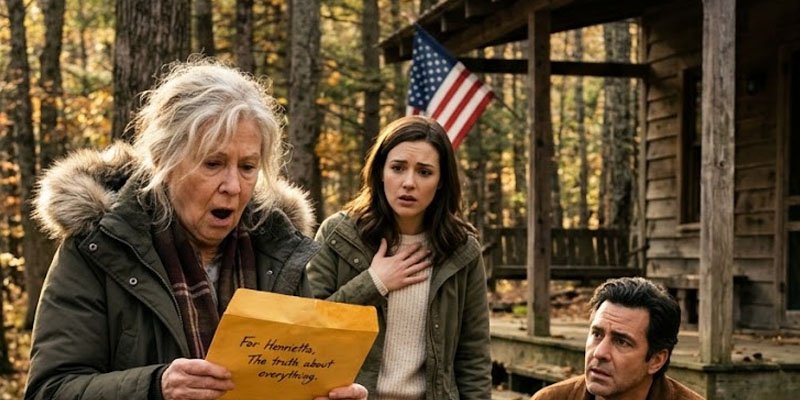
Miguel opened a plastic storage box and took out a large, thick envelope made of manila paper.
My name was written across the front.
The handwriting belonged unmistakably to Randall.
For Henrietta: The truth behind everything.
I couldn’t keep my fingers steady.
The envelope seemed unusually weighty when Miguel placed it in my hands.
It held a letter Randall had written three months before his death.
I started speaking the words aloud.
The letter began by addressing me as Randall’s dearest Henrietta.
He wrote that finding the message would mean his fears about Andre and Melissa had been justified.
They would have tried to deprive me of my inheritance by presenting a fraudulent will that Randall himself had intentionally created to test them.
I couldn’t continue reading.
Tears filled my eyes until the writing became impossible to see.
A fraudulent will.
A deliberate test.
Carmen led me over to a fallen tree trunk that Miguel had turned into a temporary work surface.
She settled beside me and urged me to keep reading.
After taking a moment to regain control of my breathing, I returned to the letter.
Randall explained that for over a year, he had been aware that Andre viewed me as an obstacle between himself and the money he expected to inherit.
My husband had personally heard our son discussing how to make sure I received the smallest possible share once Randall was gone.
Apparently, Melissa had offered some especially imaginative ideas.
According to the letter, Randall’s concerns began when he overheard a telephone discussion about what they planned to do with his estate.
Following that incident, he placed a concealed digital recording device inside his office and began secretly preserving conversations from their visits.
The fake will, which assigned me nothing but the cabin, had been created to expose what Andre and Melissa truly intended.
If they acted on their dishonest plan, and if I continued behaving with the same kindness and generosity that had originally drawn Randall to me, the hidden letter would guide me toward the inheritance he actually wanted me to receive.
My pulse raced as I reached the concluding sections.
Randall had moved his genuine wealth into accounts beyond Andre and Melissa’s reach.
Inside the cellar were records of his finances and recordings that revealed their plans to cheat me.
More than anything, Randall wanted me to understand that he had never lost faith in the woman he chose as his wife.
He believed I would succeed in his test because kindness was deeply rooted in who I was, even when I had very little left to offer.
I let the letter rest in my lap.
My hands were still trembling.
I asked if the recordings mentioned in the letter had actually been found.
Miguel answered with a grave nod.
He said they had discovered hours of recorded conversations, as well as financial records for accounts holding millions of dollars that Andre’s supposed estate documents had never mentioned.
Carmen continued:
“We also found letters exchanged with another attorney. His name is James Patterson. It looks like your husband was working with him to make sure your real inheritance stayed protected.”
Sophia had been quietly organizing the papers a short distance away.
Now she looked toward me.
She wanted to know if I was feeling sad.
I paused to think about my answer.
There was certainly sorrow inside me.
I was overwhelmed by the elaborate steps Randall had taken, and the full depth of my son’s treachery was devastating.
But another emotion was beginning to rise beneath the shock and grief.
“No, sweetheart,” I answered truthfully. “What I’m feeling is anger.”
I surprised myself by admitting it.
Until then, I had scarcely given myself permission to be furious.
Simply getting through each day had demanded all my energy.
My thoughts had been occupied by finding somewhere to sleep, obtaining enough to eat, and somehow surviving another day.
Now I realized Randall had foreseen Andre’s heartlessness and had continued making arrangements to protect me even as his own life was ending.
The magnitude of the betrayal became almost impossible to bear.
Andre and Melissa had taken far more than my financial security.
They had robbed me of the time I needed to mourn.
Instead of grieving peacefully for the man I had loved for thirty-nine years, I had spent the first weeks after his death terrified of having no money and nowhere to live.
Miguel took a second envelope out of the storage box.
Inside were banking details, directions for reaching an attorney, and written permission allowing me access to a bank safe-deposit box.
This time, my fingers were steadier as I examined the contents.
Among the papers was a business card identifying James Patterson as an attorney.
His practice was located in Hartford.
Another note, written personally by Randall, was attached.
It explained that James had been keeping my genuine will in escrow.
The required password was Beacon Falls gift.
Randall instructed me to get in touch with him.
Quietly, I said the password to myself.
Beacon Falls gift.
At last, I understood why Randall had repeated Beacon Falls as his life drew to an end.
It wasn’t the medication making him speak nonsense.
He had been desperately trying to direct me toward the secret.
Carmen rested a comforting hand on my shoulder and asked what I planned to do next.
I turned my gaze toward the Rodriguez family.
They had received my final possession with sincere appreciation.
They had restored the neglected cabin, made it a welcoming place to live, and uncovered information capable of transforming my future.
They could easily have concealed what they discovered.
They might have used it for their own advantage.
Instead, their first thought had been to telephone me.
In only fourteen days, they had shown more integrity and faithfulness than my own son had displayed throughout the hardest month of my existence.
I told Carmen I would begin by calling James Patterson.
After that, I intended to ensure Andre and Melissa fully understood the consequences of what they had done.
Suddenly, Sophia began clapping excitedly.
She asked whether her family could continue living in the house with the talking floor.
Her innocent question startled me.
In the excitement surrounding Randall’s hidden documents, I had momentarily overlooked how the discovery might affect their future.
If I really had inherited several million dollars, I certainly had no reason to take back an old cabin with cold drafts.
My eyes moved toward the flowers Carmen had arranged near the front door.
Then toward the porch Miguel had repaired with such care.
Then toward the papers Sophia had organized so neatly.
And suddenly, I understood that the situation was about much more than getting even or becoming wealthy.
It concerned the true meaning of family.
Family wasn’t always determined by shared ancestry.
Sometimes, it meant people who supported each other without expecting something in exchange.
I bent down until my face was level with Sophia’s.
Then I asked whether she would like to remain in the cabin forever, not as someone borrowing it, but as one of its rightful owners.
Her eyes opened wide.
She asked if I really meant forever and ever.
I promised that I did.
Forever and ever.
But when I glanced down at Randall’s letter again, one final warning sent a shiver through me.
He had written that discovering the message meant Andre and Melissa had tried to take everything, just as he had feared.
My next stop would be the office of James Patterson.
His legal practice filled the entire fifteenth story of a contemporary glass tower in central Hartford.
It was nothing like the small, old-fashioned office where Robert Sterling had informed me of the inheritance I supposedly deserved.
I noticed the difference the moment I arrived.
Instead of offering a stiff, artificial greeting, James’s receptionist welcomed me with genuine friendliness.
The reception room was pleasant and comfortably furnished.
There was no sense that the surroundings had been arranged to make visitors feel small or intimidated.
James came out of his office and offered his hand.
“Mrs. Hathaway,” James Patterson greeted me, stepping forward with his hand extended.
He appeared to be around fifty years old. Gray threaded through his hair, and his eyes seemed both perceptive and understanding.
He told me he had anticipated my arrival, though he had wished we could have met under more fortunate conditions.
Without wasting time, I asked if he had been aware of the fabricated will.
He acknowledged that he had assisted Randall in preparing it.
My husband, he explained, had given very precise instructions.
Randall wanted to know whether Andre and Melissa would actually carry out their intentions.
If they did, he wanted me equipped with the financial means and proof necessary to protect my rights.
James invited me into his private office.
It was a large room, though nothing about it felt ostentatious.
Shelves filled with law books covered the walls, with family pictures displayed between the volumes.
A substantial file folder lay on his desk, marked with my name.
The writing on its cover described it as confidential information relating to Randall Hathaway’s estate.
Before showing me what was inside, James cautioned me about the things I was about to learn.
He said Randall had adored me, but his feelings toward our son had become filled with bitter disappointment.
Some of the recorded discussions, he warned, would be painful to hear.
I straightened my posture.
The difficult weeks I had endured in the cabin and later at the shelter had uncovered a resilience I never realized I had.
I assured James that I wanted the complete truth.
He opened the folder and took out a compact electronic recording device.
For roughly six months, Randall had secretly captured discussions that took place inside his study.
He had installed the recorder after hearing Andre and Melissa refer to me as their inheritance problem during a family meal.
James started the playback.
In an instant, the familiar atmosphere of Randall’s study returned to my imagination.
I could almost see the leather armchairs, detect the faint scent of pipe tobacco he had never entirely given up, and listen to the grandfather clock marking each second.
But the voices emerging from the recorder weren’t sharing fond family stories.
Their words were disturbingly cold.
They spoke about me as though I were a problem that had to be eliminated.
Andre was the first person I heard.
He observed that his father couldn’t live indefinitely and argued that they needed to stop me from taking charge of the family’s wealth.
Melissa answered with open disdain.
She accused me of spending my entire married life enjoying Randall’s earnings without ever doing a worthwhile day’s work or helping him establish his success.
In her opinion, I had only acted the part of a loving homemaker.
My stomach twisted.
So this was how they discussed me when I wasn’t around.
Perhaps those opinions had been hidden behind their smiles for many years.
Andre went on to express concern that Randall’s love for me might cause him to leave the whole estate under my control.
He called that possibility a foolish expression of loyalty.
Melissa declared that they had to make Randall face the facts.
She described me as an aging woman who couldn’t be trusted with serious financial decisions.
She even argued that giving me a large inheritance would be unkind, since it would supposedly force me to manage responsibilities beyond my abilities.
James stopped the audio.
He told me the conversation had been recorded eight months before Randall passed away.
Then he asked if I wanted him to continue.
I indicated that I did.
Although every sentence was painful, I couldn’t turn away from what I needed to know.
The voices began again.
Melissa said she had been studying laws concerning older adults.
She believed that if they could establish Randall had been mentally impaired or improperly influenced while preparing his will, they might contest any arrangement that left me a substantial share.
Andre wondered aloud whether they could claim his father had lost his ability to make decisions.
Melissa explained that alleging undue influence would probably work better.
After all, nobody spent more time with Randall than I did.
She proposed creating a story in which I had pressured my husband to alter his will as his physical condition deteriorated.
Such accusations, she believed, might give them a legal basis to dispute his decisions.
I drew in a sharp breath.
They weren’t satisfied with taking my money.
They were prepared to ruin the way others saw me.
Their intention was to portray me as a scheming wife who had taken advantage of her husband while he was dying.
Andre responded eagerly to her suggestion.
He proposed describing their actions as an effort to defend Randall’s true intentions against someone exploiting his failing health.
Melissa supported the idea.
Once people accepted that version of events, any testament that benefited me could be treated with suspicion.
They would argue that a mentally capable Randall would naturally have left most of his fortune to his children.
James switched off the recording once more.
He assured me that Randall had been mentally sound when both versions of the will were created.
Three separate doctors had examined him, and his mental condition had been thoroughly recorded.
I looked at James in confusion.
Both versions?
He clarified that one was the counterfeit document Andre had used, while the other was Randall’s authentic will naming me as the beneficiary.
From the folder, James removed a legal document I had never laid eyes on.
It was my husband’s genuine final will, complete with the proper signatures and witnesses.
According to its terms, I was entitled to the entire estate.
And its estimated worth was $8.7 million.
Eight million, seven hundred thousand dollars.
For a few seconds, I couldn’t attach any meaning to that amount.
It was simply beyond my ability to imagine.
Andre thought he had seized an estate worth $2.5 million.
He had no idea his father had safeguarded an additional $6.2 million.
James explained, however, that concealing the additional fortune was only one element of Randall’s strategy.
My husband had also carefully preserved evidence of the discussions and dishonest plans involving Andre and Melissa.
James moved ahead to another section of the audio.
This time, I heard a third person speaking with them.
The man introduced himself as Robert Sterling.
The name was immediately familiar.
He was the same lawyer who had faced me across that dreadful conference table and explained, without any apparent concern, why I was supposedly entitled to almost nothing.
In the recording, Sterling stated that he had examined the testament Andre presented and believed it could serve their purposes.
He advised them to focus on Randall’s experience as a businessman.
They should argue that someone with his financial knowledge would naturally understand that employed children supporting their own families needed more resources than a widow whose personal requirements were relatively small.
Andre asked what they should expect if I decided to fight the will.
Sterling brushed aside the concern with complete confidence.
“She isn’t going to challenge it,” Sterling said firmly.
“She can’t afford a lengthy legal dispute, and the paperwork looks entirely authentic. Before she manages to organize any serious opposition, you’ll already have sold off most of the property and investments.”
Melissa added her opinion.
“Besides, we understand her personality. She doesn’t stand up for herself. She’ll take whatever we decide to leave her and probably thank us for it.”
Then the audio stopped.
The room became completely silent.
I remained in my chair, struggling to connect the child I had brought into the world with the calculating adult whose words I had just listened to.
What they had planned went beyond ordinary greed.
It was cruelty carried out with intention.
They had examined my weaknesses, predicted how I would respond, and built their entire strategy around the belief that I would be powerless to resist.
After a long pause, I asked James whether I was allowed to keep the audio files.
He told me that the recordings were mine, just like the rest of the property Randall had left behind.
Then he mentioned that something else remained.
He reached into the file and brought out one more envelope.
Randall had written my name across it.
Unlike the urgent-looking letter hidden under the cabin, this envelope was made from thick, high-quality stationery.
“Please read it,” James said softly. “These are the last words he wanted you to receive.”
My fingers trembled as I opened the folded pages.
Randall began by calling me his beloved Henrietta.
He wrote that arriving at James’s office would mean I had succeeded in the greatest test of personal character he could imagine.
I had surrendered the only possession I had left in order to assist strangers who were suffering.
Rather than clinging to my own safety, I had acted with compassion. Rather than protecting my remaining property, I had chosen to be generous.
Randall said I was still the same woman he had fallen in love with four decades before.
And that woman, he believed, was worthy of being entrusted with everything we had created together.
He doubted Andre would ever recognize what he had sacrificed by valuing riches more highly than affection.
Our son saw financial wealth as a source of control.
But Randall understood that I knew real strength came from recognizing what mattered to you and remaining faithful to those principles.
He expressed regret that he hadn’t been able to spare me the suffering while he was still alive.
His declining health had made him too frail to confront Andre and Melissa in person.
Nevertheless, he had taken every step within his power to reveal their intentions and make sure I received justice.
He asked me to handle my inheritance thoughtfully.
And he wasn’t speaking only about the money. He also meant the knowledge I had gained about which people were truly worthy of my love and confidence.
The final thought he left me was straightforward.
I had endured more than enough pain.
The time had come for me to live without fear.
I folded the letter with great care.
A change took place somewhere deep inside me.
I wouldn’t call it peace.
Finding peace would take longer.
But at last, I was certain about what had to be done.
I asked James how quickly we could take action.
He gave me a kind smile, the first genuinely warm expression I had received from a lawyer in many months.
He said the legal proceedings were already underway.
Earlier that morning, he had submitted an application to freeze the assets Andre had obtained through the deceptive will.
By the time my son learned about the action, he would have almost no chance to hide what he had taken.
James was preparing to give Andre exactly what Andre had forced upon me.
The truth.
And it would arrive without compassion.
I thought about the icy certainty in Andre’s recorded voice.
He had declared that once Randall was dead, they would make sure I ended up with nothing.
Now those very statements would be used as proof of his wrongdoing.
Six months passed before I found myself standing at the entrance to my Maple Ridge house, watching a removal truck drive away carrying the last of Andre and Melissa’s possessions.
Federal criminal charges had been brought against them.
Their financial holdings had been placed under restrictions.
Their lawyer had recommended agreeing to a plea bargain instead of facing the uncertainty of a courtroom trial.
The agreement required eighteen months of imprisonment in a minimum-security facility, followed by five years under probation supervision and repayment of everything they owed.
But the punishment imposed by the courts wasn’t what hurt them most.
My refusal to speak was.
Since the meeting in James Patterson’s office where everything came to light, I had not held a direct conversation with Andre.
I let his calls go unanswered.
Any correspondence he sent through legal representatives was dealt with by James.
Once, before his sentence was due to begin, Andre showed up at the cabin.
Miguel politely but firmly told him he had to go.
I never shouted at my son or made threats against him.
I refused to engage in the emotional confrontations he seemed to anticipate.
Instead, I made one simple decision: he would no longer have a place in my daily life.
Not in any way.
Moving back into Maple Ridge was an unusual experience.
The building itself was almost exactly as I remembered.
Its polished marble flooring continued to gleam.
When sunlight struck the chandelier, tiny bands of rainbow colors still danced over the walls.
But the feeling inside the house had changed completely.
While Randall was approaching the end of his life, those same rooms had felt empty and unwelcoming.
Now a sense of comfort had returned.
One Sunday, I was busy preparing our evening meal when Carmen came into the kitchen.
Sharing dinner every Sunday had become a regular custom for us.
The Rodriguez family had officially become the owners of the Beacon Falls cabin.
Their names appeared on the property deed, and there were no debts or obligations attached.
Nevertheless, they traveled to Maple Ridge every Sunday to eat with me.
Sophia always arrived with fresh artwork she was eager to share.
Carmen told me that everything was arranged in the dining room.
She had put on an apron, even though I had repeatedly reminded her that she was visiting as family, not working as my housekeeper.
She also mentioned that Miguel had just finished fixing a board that had come loose on the front porch.
I smiled as I looked outside.
Through the window, I could see Miguel teaching Sophia the proper way to handle a screwdriver.
Now nine years old, she was developing a real enthusiasm for woodworking under her father’s instruction.
I reminded Carmen that her family didn’t have to keep doing maintenance jobs around my property.
They weren’t responsible for looking after my house.
Carmen chuckled.
She explained that Miguel felt a personal responsibility to look after those who had once helped his family.
Before I could respond, someone rang the doorbell.
I recognized the silhouette visible through the cloudy glass.
It was Andre.
He seemed to have lost a noticeable amount of weight.
The pressure of the court proceedings had clearly affected him.
He kept transferring his weight from one foot to the other, exactly as he had done as a little boy when he knew he was in trouble.
Carmen’s face grew serious.
She offered to tell him to go away if that was what I preferred.
I thought about her suggestion.
It had been six months since the meeting in which we confronted him.
Three months had passed since the court pronounced his sentence.
Until now, he had never attempted to come to Maple Ridge in person.
The phone calls had ended several weeks earlier, and the letters James had been intercepting had stopped arriving as well.
I had assumed Andre finally understood that our connection had ended.
“No,” I answered after a moment. “I’ll hear what he has to say.”
I pulled open the front door.
But I made no gesture inviting my son into the house.
Although Andre was only thirty-seven, he appeared considerably older.
His cheeks had become hollow, and the costly outfit he wore no longer fitted his thinner body.
He was scheduled to enter prison the next month.
The knowledge of what awaited him seemed to burden his every movement.
“Mom,” he murmured. “Could you please just talk to me?”
“We can speak out here,” I told him, walking onto the porch while keeping the door open behind me.
I wanted him to notice the welcoming light coming from inside.
I wanted him to hear Sophia’s cheerful laughter drifting in from the backyard.
And I wanted him to recognize that family was about something greater than ownership and money.
“I understand that I haven’t earned your forgiveness,” he started.
The words tumbled out, sounding like a speech he had practiced repeatedly.
“I know Melissa and I did something terrible. I know you might never forgive us. But I’m still your son, and I’m going to prison soon. I just need to believe that maybe, after I come home, we could have another chance.”
I watched his face closely.
I hoped to find real regret rather than simple terror about the punishment ahead.
I asked him to explain what he thought he had done wrong.
He appeared bewildered by the question.
He said that he and Melissa had used a counterfeit will to steal the inheritance that belonged to me.
I explained that he was describing the act itself.
What I wanted to hear was whether he understood why it was morally wrong.
He looked at me without answering.
At that moment, everything became clear.
Even though he was facing imprisonment, Andre still understood his wrongdoing only in terms of financial fraud.
He had never fully considered what he had done to his own mother.
I kept my voice calm.
I explained that taking my inheritance was only part of his betrayal.
When Randall died, Andre had thrown me aside.
During the period when my grief was at its worst and I needed the comfort of my family more than ever, my son had treated me as though I had no value.
He had taken possession of the house where I brought him up.
He had deprived me of the financial protection his father had arranged.
And instead of compassion, he had shown me nothing but disrespect.
Andre hurried to say that he understood and was deeply sorry.
I asked if his regret came only from being discovered.
Had we never uncovered the papers beneath the cabin, had Randall not arranged such careful safeguards, Andre would still be living in my house.
He would still be enjoying the money that belonged to me.
And he would probably be praising himself for how cleverly he had resolved the so-called inheritance problem.
At last, his controlled expression gave way.
He demanded to know what else I expected him to do.
His home was gone. So were his career and his good name.
Melissa had begun divorce proceedings the month before.
And he was about to lose his freedom.
What more could I possibly want?
I responded in a low, steady voice.
There was nothing I wanted him to give me.
That was the truth he had never been able to comprehend.
I had never demanded his money, his property, or any great personal sacrifice.
All I had ever wanted was to be loved by my son.
And he had demonstrated beyond doubt that he wasn’t prepared to give me that love.
From inside the house, Miguel’s voice carried through the open doorway as he called Sophia to come in for supper.
In a little while, the dining room would be full of people enjoying one another’s company.
They would exchange stories.
They would laugh out of genuine happiness.
They would offer encouragement rather than finding satisfaction in someone else’s suffering.
I told Andre about some of the women I had encountered at St. Mary’s shelter.
A number of them had been left without family support because their children were struggling with substance dependence, psychiatric difficulties, or severe money problems.
Those were complicated situations in which families sometimes faced hardships beyond what they could reasonably manage.
Then I met Andre’s eyes.
He couldn’t offer any comparable explanation.
He had abandoned me because doing so suited his interests.
Because Melissa had persuaded him that I was the obstacle preventing them from enjoying the comfortable future they imagined.
Because he had decided that material possessions were more important than human relationships.
“I really can become a better person,” he pleaded.
He promised that his experience in prison would change him and that, once released, he would demonstrate how different he had become.
I gently stopped him.
I was sixty-three years old.
Life had offered me another chance at contentment, and I wasn’t willing to waste that opportunity waiting for Andre to become the loving son I had always wanted.
I started back toward the doorway but hesitated for a moment.
I reminded him that Randall had left that message for a purpose.
Andre had been given a choice.
And his decision had been to pursue money.
With that, I said farewell.
It meant more than simply ending the discussion.
I was finally letting go of a relationship I had struggled for years to hold together.
Without slamming it, I shut the door.
From the window, I could see Andre remaining on the porch for several minutes.
Maybe he was waiting for me to change my decision.
Eventually, he walked to his car and drove off.
When I returned to the dining room, Carmen, Miguel, and Sophia had already gathered around the large mahogany table.
For a long time, that table had been the setting for uncomfortable dinners filled with stiff conversation.
This evening, it held Carmen’s freshly made enchiladas, a salad Miguel had prepared with care, and the latest picture Sophia had drawn.
Her artwork featured four stick people outside a house with a bright red door.
Miguel raised his head as I came to sit down.
“Are you doing okay?” he asked.
“Everything is exactly as it should be,” I answered.
And I truly believed it.
Later that night, after the Rodriguez family had driven back to Beacon Falls, I walked slowly through the rooms of Maple Ridge.
For the first time in many months, I felt capable of seeing the house for what it really was.
These walls had witnessed the life Randall and I created together.
They had sheltered the son I raised and continued loving despite the mistakes he made.
And within them, I had ultimately discovered how dangerous unquestioning trust could be, as well as how precious freely offered loyalty truly was.
When I reached my bedroom, I opened the jewelry case where I kept Randall’s last letter.
James had handed it to me on the day Andre was confronted with the evidence.
I had returned to those pages countless times.
Yet on that particular evening, one sentence seemed more meaningful than ever.
You have endured enough suffering. The time has come to live freely.
To live freely.
Inheriting $8.7 million had certainly provided more financial protection than I could ever have dreamed of.
But the freedom Randall spoke about was far greater than never worrying about bills again.
He wanted me to release the belief that I had to continue offering my affection to people who consistently refused to show me any in return.
He wanted me to stop feeling guilty for recognizing cruelty instead of pretending it was kindness.
And he wanted me to abandon the idea that only people related by blood could truly be family.
I had welcomed the Rodriguez family into my life.
And they had welcomed me into theirs.
Together, we had formed something Andre and Melissa had never learned to appreciate.
A bond founded on appreciation, respect for one another, and sincere concern for each other’s well-being.
The ringing telephone interrupted my reflections.
I didn’t recognize the incoming number.
But as soon as I answered, a drowsy yet enthusiastic little voice greeted me, filling me with happiness.
Sophia was calling.
She explained that she had forgotten to share something very important earlier.
I asked her what she wanted to tell me.
Her mother had said that I was her abuela now.
That was the Spanish word for grandmother.
Sophia wanted to make sure I didn’t mind being called that.
My eyes grew wet.
But this time, the tears came from joy.
I told her that becoming her grandmother was not merely something I accepted.
It was something wonderful.
Sophia seemed pleased and reassured.
She then excitedly told me she had made another drawing that belonged on my refrigerator.
The new picture showed our whole family sitting together for Sunday dinner.
Only this time, she had drawn a much bigger table so there would be room for everybody.
When the conversation ended, I walked into the kitchen.
Sophia’s pictures occupied almost the entire front of my refrigerator.
Some depicted cheerful families standing beside their houses.
Others showed unusual flowers that would leave a professional botanist scratching their head.
And there were simple stick figures that somehow conveyed more genuine warmth than even the finest painted family portrait.
I decided that the next morning, I would call James Patterson.
I wanted his advice about setting aside money for Sophia’s future college education, as well as for any additional children Miguel and Carmen might someday welcome.
I also intended to assist Miguel in getting more advanced instruction in carpentry.
Years earlier, Carmen had hoped to study nursing, but the cost of obtaining a degree had always stood in her way.
I wanted to give her the opportunity to follow that dream.
Not out of any feeling that I was indebted to the Rodriguez family.
But simply because helping them was something I wished to do.
That, to me, was what being a family meant.
Each person contributing whatever was within their means.
Standing together when life became difficult.
Creating a future together that none of them would have been able to build separately.
In one respect, Andre had been right.
I wasn’t too old to learn something new.
I had discovered that real prosperity could never be calculated solely by looking at the amount in a bank account.
True wealth came from sharing your life with people who understood your value.
I had also come to realize that forgiveness could mean freeing yourself, rather than feeling required to excuse someone who had caused you suffering.
And perhaps the most important lesson was that sometimes, the people you choose to call family are the very people you need most.
When I turned off the downstairs lights and made my way toward my bedroom, I felt something I hadn’t known for many years.
A complete sense of peace.
It wasn’t the fragile quiet that exists when people refuse to address their disagreements.
It was the deep, enduring comfort of understanding myself and being certain that the people who mattered to me appreciated me for who I truly was.
Andre would complete his prison term.
Maybe he would find a way to put his life back together afterward.
Maybe he would not.
His future depended on decisions he would have to make himself.
Those responsibilities no longer belonged to me.
Six months before, after walking out of that heartbreaking meeting room, I had begun making a different choice for my own life.
And I had never once wished I had chosen otherwise.
At last, I was free.
Now I’d like to hear from everyone who has followed my story.
If you had been in my situation, what decision would you have made?
Has anyone you trusted ever betrayed you in a similar way?
Tell me what you think in the comments below.
And when you reach the end screen, you’ll see two more stories loved by our audience that might leave you just as surprised.




