By the time my father cleared his throat during my birthday dinner, nearly an hour had passed with everyone around the table reminding me, in one way or another, how little they thought of my career.
We were seated in a private dining room inside an elegant Manhattan restaurant, tucked away at the end of a quiet corridor where thick carpeting absorbed every footstep. Gentle jazz floated through the air while servers glided silently between tables carrying champagne and gleaming silver platters.
Twenty-six members of my family had arrived looking as though they had stepped straight out of a luxury magazine photo shoot.
Custom-tailored suits.
Strings of pearls.
Designer watches.
Flawless smiles.
My mother raised her champagne glass toward me.
“Happy birthday, sweetheart. Thirty already. I still remember bringing you home from the hospital.”
I smiled.
“Thanks, Mom.”
For just a moment…
The celebration felt sincere.
Then my older brother Daniel adjusted his tie and wore the familiar smile he always used before wrapping an insult inside something that sounded supportive.
“Thirty is when real adulthood starts, Sophia,” he said. “Maybe it’s time to think seriously about where your life is heading.”
Emma let out a soft laugh.
“Maybe that means leaving the nonprofit world behind and getting a real career.”
Several relatives chuckled.
Not out of cruelty.
Which somehow hurt even more.
To them, it wasn’t an insult.
It was simply a fact.
I was Sophia Reed.
The daughter employed by a small environmental nonprofit.
Driving an old Honda.
Living in a modest apartment in Brooklyn.
The family member everyone believed had no real ambition.
Daniel negotiated multimillion-dollar corporate acquisitions.
Emma consulted for luxury brands and served on prestigious charitable boards.
Dad built skyscrapers throughout Manhattan.
I spent my days writing grant proposals, attending community meetings, and walking polluted shorelines with muddy boots.
Whenever Dad spoke about my job, he always described it the same way.
“It’s sweet.”
Never meaningful.
Never impressive.
Only…
Sweet.
Aunt Margaret smiled at me with encouragement.
“She’s making a difference.”
Uncle Robert lifted his wineglass.
“And besides, she’ll have that trust fund before long. Sophia’s future is already secure.”
My father gently placed his glass on the table.
The sound was almost inaudible.
Yet everyone noticed.
Richard Reed had always possessed a remarkable ability to make silence command attention.
At fifty-eight, he still carried himself as though every room naturally belonged to him.
He glanced toward Uncle Robert.
Then turned to me.
“Actually…”
His voice remained calm.
“That reminds me.”
My mother’s smile disappeared at once.
She instinctively reached for the pearls around her neck.
“Richard,” she said quietly.
“Not tonight.”
He paid no attention.
“She deserves to know.”
Every conversation stopped.
I folded my hands beneath the table.
Years ago, I learned that the first person to react usually surrendered control of the conversation.
“What do I deserve to know?”
Dad released a slow, measured sigh.
“The Riverside development has encountered major problems.”
“Environmental lawsuits.”
“Construction setbacks.”
“Unexpected expenses.”
“Permitting complications.”
“We’re currently short by about twenty million dollars.”
Uncle Robert slowly set down his fork.
Daniel leaned forward.
“That serious?”
Dad gave a single nod.
“If we can’t cover the difference…”
“The company won’t survive.”
Emma looked nervously toward our mother.
I stayed silent.
Dad finally met my eyes.
His tone softened.
“Sophia… we had to make a difficult decision for the good of everyone.”
A cold weight settled in my chest.
“What decision?”
Mom stared down at her untouched plate.
Dad answered.
“We liquidated your trust fund.”
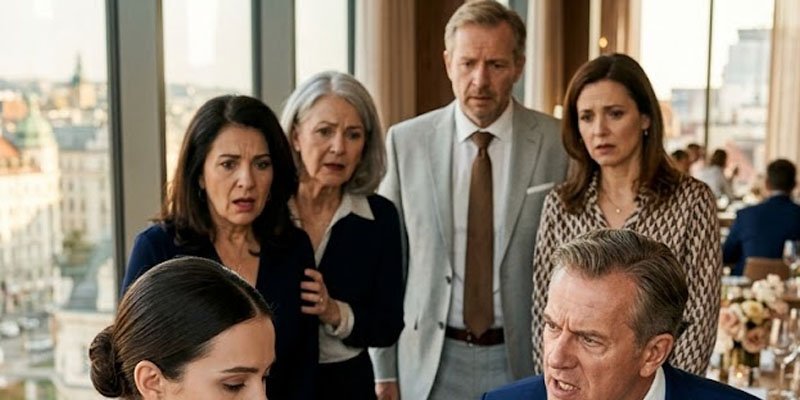
The room froze.
Emma gasped.
Daniel’s face changed instantly.
Aunt Margaret looked unable to breathe.
Dad continued speaking with complete confidence.
“It was the only responsible choice.”
“The paperwork was completed yesterday.”
I lowered my eyes to the untouched champagne beside my plate.
Tiny bubbles continued rising to the top.
“My entire trust fund?”
Dad nodded.
“One account was worth sacrificing if it meant protecting everything your grandfather spent his life building.”
My grandfather.
The only member of the family who ever cared about my dreams instead of measuring them against everyone else’s.
Daniel slowly shook his head.
“That money was meant to protect Sophia.”
Dad answered without hesitation.
“She has plenty of time to recover.”
Recover.
He said it so casually.
As though telling my entire family that he had spent my future without asking permission was something I would eventually thank him for.
I picked up my champagne.
Took one slow sip.
Then reached into my handbag.
I placed a leather portfolio onto the crisp white tablecloth.
For the first time that evening, uncertainty crossed Dad’s face.
I rested my hand on the folder.
“That’s interesting,” I said quietly.
His forehead tightened.
“What is?”
I opened the portfolio.
“Because you can’t sell something that never legally belonged to you.”
The Thing He Missed
No one moved.
Not even the servers.
One waitress had just entered carrying a tray of halibut and stood frozen, looking as though she had accidentally stepped into the wrong performance.
Dad stared at the documents without reaching for them.
Daniel leaned forward first. His mouth opened, then closed again. He looked at me—truly looked at me—which almost never happened unless I happened to be standing in his way.
“What is this?” he asked.
“Transfer records,” I replied.
My father let out a quiet laugh through his nose. A small, familiar sound filled with contempt.
“Sophia, if this is some confusion over beneficiary arrangements, this isn’t the time.”
“It wasn’t beneficiary arrangements.”
I slid the first document toward him.
“It was a private assignment from Granddad’s holding company. Signed eleven years ago. Witnessed. Notarized. Properly filed.”
Mom’s fingers froze against her pearls.
Eleven years ago.
The words landed exactly as I intended.
Because eleven years earlier I had been nineteen—awkward, frustrated, and naïve enough to believe that when my father called me “idealistic,” it was just a stage we’d someday laugh about.
Granddad had known better.
Dad studied the first page.
Then the second.
When he was angry, he rarely blinked.
He simply became perfectly still.
“That holding company was dissolved years ago,” he said.
“No,” I answered. “Most of it was.”
I tapped the labeled divider.
“This portion wasn’t.”
My Grandfather’s Favorite Secret
My grandfather, Frank Reed, had two habits my father absolutely hated.
He treated me like my opinions mattered.
And he documented everything.
Not heartfelt journals or sentimental letters. Legal memos. Yellow legal pads. Sticky notes attached to storage boxes. The man even labeled extension cords. He trusted paperwork more than people—which, if I’m honest, was one of his smartest habits.
When I was nineteen, he drove me to Staten Island in an old Lincoln that always smelled of peppermints and worn wool. He never explained where we were going. He simply said, “Put on boots,” and nothing more.
We drove beyond chain-link fences, piles of crushed concrete, and water that never looked clean, no matter the weather.
The property sat squeezed between two neglected industrial lots near the river. It didn’t look like much back then. Bent fencing. Concrete overgrown with weeds. Rust-stained pavement. An abandoned loading dock.
Granddad stood beside me in the wind and said, “Everyone in this family spends so much time looking at tall buildings that they forget what’s underneath them.”
I was in my first year of studying environmental policy. At the time, I assumed he was giving me one of his usual cryptic old-man lessons.
He wasn’t.
That narrow piece of land, just under three acres, possessed one feature that made it incredibly valuable while remaining overlooked by almost everyone.
Riparian access.
It provided a legally protected route to shoreline utility entry along a stretch of waterfront where access rights had been divided and sold off piece by piece over four decades by owners who were either careless or in too much of a hurry to map everything correctly. On paper, it appeared completely unremarkable. In reality, anyone hoping to develop the neighboring parcels on a large scale would either need that access or spend years fighting in court trying to work around it.
Granddad had purchased it through one of his private companies in 1987.
Dad dismissed it as a worthless strip of land.
Granddad called it patience.
Two weeks after that drive, he asked me to visit him at his office. It was a tiny room tucked into the back corner of the building, with an old radiator that clanged constantly as though someone was trapped inside the walls. He pushed a folder across the desk and said, “I’m giving you the shoreline parcel.”
I laughed because I thought he was joking.
He didn’t smile.
“Why me?” I asked.
He looked at me over the top of his glasses.
“Because Richard would sell his own kidneys to build another tower. You’d ask what it would do to the water first.”
That was how he gave compliments.
He had me sign paperwork confirming that I understood exactly what the property was—and what it wasn’t.
Not money to spend.
Not something to boast about.
Not a toy.
A lever.
“A quiet one,” he said.
So I kept it quiet.
Mostly because no one in my family ever cared enough about what I was doing to stay and hear the answer.
Riverside
Three years ago, Reed Urban officially broke ground on Riverside.
Glass towers.
A retail promenade.
Luxury apartments.
Public green space featured in every brochure, even though the amount of “green” kept shrinking every time updated plans found their way into the public.
The development stretched along the East River across land assembled from five separate parcels and one long-term lease agreement with the city.
Every newspaper described it as Richard Reed’s masterpiece.
Every community organization I worked with described it as a flood-risk vanity project backed by polished public relations.
The first time I saw the site plans, I recognized the footprint immediately.
Not because of the buildings.
Because of the boundary.
There was a missing section within the legal access route required for utility and emergency shoreline entry. It was small enough that the average person would never notice, but significant enough that any experienced environmental attorney certainly would.
My parcel.
The so-called worthless strip.
The patience.
I sat at my kitchen table in Brooklyn with a chipped coffee mug beside me and three years of meeting notes spread across the table. A chill ran over my skin. I pulled the old property records from the fireproof box beneath my bed.
The parcel identification number matched.
The boundaries matched.
The transfer matched.
By then, Granddad had been gone for seven years.
Either my father had completely forgotten the parcel existed, or he believed he could deal with it later.
That was the problem with men like him.
Once they decided something had no value, they stopped seeing it altogether.
I told no one.
Not my coworkers.
Not Daniel.
Not Mom.
Instead, I hired a discreet real estate attorney in Queens named Len Barlow. He always had mustard stains on his tie and a habit of saying “mm-hm” for nearly ten seconds before giving an answer. He reviewed every document.
Twice.
Then a third time, because he said wealthy people tended to become unusually creative whenever they were cornered.
The title was clear.
Mine.
Not held in trust.
Not controlled by Dad’s board.
Not owned by Reed Urban.
Mine.
Len asked whether I wanted to sell it.
I said no.
He asked whether I wanted to challenge the project’s permit disclosures.
I said not yet.
He looked over his glasses and asked, “Then what exactly do you want, Miss Reed?”
I remember scratching the chipped edge of my mug before answering, “I want to see just how desperate they become.”
Back at the Table
Dad reached the final page and placed it carefully on the table.
“Where did you get this?”
It wasn’t really a question.
It was an accusation disguised as one.
“From my files,” I replied. “Where else?”
“That property was part of the family holdings.”
“No. It belonged to Granddad’s side company before it was transferred directly to me.”
“Without my knowledge?”
I almost smiled.
“Yes.”
Uncle Robert let out a quiet sound that resembled someone choking on his own pride.
Daniel took the documents from Dad and studied the parcel map. He had inherited our father’s ambition, though not his patience, but he was far from foolish.
His expression changed immediately.
“Jesus,” he muttered.
Emma whispered, “What?”
He looked directly at Dad.
“You built Riverside without securing shoreline access?”
Dad answered sharply.
“We secured everything we needed.”
Daniel laid the map flat on the table.
“No.”
“You believed you had.”
My mother closed her eyes for a brief moment.
Something shifted inside me.
It wasn’t pity.
Not exactly.
It felt more like an old exhaustion settling into a familiar place.
Because she knew.
Maybe she didn’t know every financial detail.
Maybe she had never seen the parcel number.
But she understood exactly what kind of man he was.
The kind who would announce that he had taken my trust fund over birthday dessert as casually as commenting on the weather.
Dad turned back toward me.
“If you knew about this, why didn’t you say anything?”
I laughed.
A quiet, bitter laugh.
I couldn’t stop it.
“Why would I?”
“So you could tell me my work was sweet and then take this too?”
Aunt Margaret quietly whispered my name.
I never looked at her.
Dad folded his hands together.
“You’ve made your point.”
“No,” I said.
“I haven’t.”
What He Sold
The conversation about the trust fund unraveled quickly.
Because the moment everyone realized my father might never have had the authority to touch one asset, they naturally began questioning the other.
Daniel asked first.
“What exactly did you sell?”
Dad’s jaw tightened.
“Daniel.”
“No. Answer me.”
He didn’t.
So I did.
“The trust wasn’t simply a pile of cash sitting somewhere,” I said. “It contained a mix of securities, municipal bonds, and a minority interest in Granddad’s former infrastructure fund.”
Emma stared at me.
“How do you know all of that?”
I looked at her.
“I actually read my statements.”
That ended the conversation.
Six months earlier, Len had quietly walked me through the trust’s structure after I became uncomfortable with some unusual valuation language. At first, it was completely off the record. He explained that there were legal restrictions.
Fiduciary obligations.
Required timelines.
Mandatory notice provisions.
Apparently, my father treated those the same way he handled neighborhood objections.
As inconveniences that only mattered until he decided they didn’t.
“I never received any notice of liquidation,” I said.
“No request for consent.”
“No accounting.”
Dad interrupted.
“Emergency authority applies when the trust’s stability is at risk.”
“Because of the company you’re trying to rescue with it?” I asked.
Silence.
Then Mom spoke.
Quietly.
Yet everyone listened.
“Richard,” she said while staring into her water glass.
“Did you borrow against it before you sold it?”
Something subtle crossed his face.
Barely noticeable.
I caught it anyway.
Daniel saw it too.
“Dad.”
He said nothing.
Daniel pushed back his chair so quickly that its legs scraped loudly across the floor.
“Did you already borrow against Sophia’s trust?”
Uncle Robert muttered a string of curses beneath his breath.
Emma looked as though she wished she could disappear beneath the table.
Finally, my father spoke.
“Temporary bridge financing was arranged.”
Daniel stared at him.
“With what collateral, if the trust wasn’t sold until yesterday?”
He never finished.
Nobody needed him to.
Mom completed the thought.
“With hers.”
The Turn
This was the one part I never saw coming.
Not that he stole from me.
Looking back, that fit his pattern almost perfectly.
The real surprise was Daniel.
My brother—the same one who had spent years acting as though I was an overeducated raccoon wandering through civic problems for entertainment—looked straight at our father and said,
“You used Sophia’s trust as collateral without telling her, then announced it during her birthday dinner because you thought humiliating her would stop her from fighting back.”
Dad stood up.
“I won’t be spoken to that way.”
Daniel rose as well.
“Then sit back down and answer me the way you would if I were sitting on your board.”
The room seemed to lose all its air.
Because Daniel had been chasing a seat on that board ever since he was twenty-six. He wanted it with the kind of desperate determination some people spend their lives searching for love. Yet our father had always kept it just out of reach—close enough to tempt him, never close enough to claim.
Dad’s expression hardened.
“This is a family issue.”
“No,” I said. “It’s a legal issue.”
The server carrying the halibut still hadn’t moved.
The poor woman looked completely overwhelmed.
I turned toward her.
“You can put it down.”
She nearly sighed with relief.
The plates touched the table.
Silverware clinked softly.
No one ate.
My father looked at me the same way he had looked at city inspectors, bankers, former business partners, and once even a mayoral aide who believed he held leverage.
Cold.
Then warm.
Then cold again.
“What do you want, Sophia?”
There it was.
Not an apology.
A price.
That was how his mind worked.
Every wound had a value if someone waited long enough.
I closed the folder.
“I want Riverside suspended until an independent panel completes a full environmental review.”
He let out a sharp laugh.
“Absolutely not.”
“I want the shoreline parcel licensed—not sold. Limited in duration. Revocable if the agreement is breached.”
“You have no idea what you’re talking about.”
“I know exactly what I’m talking about.”
I leaned closer.
“I also want my trust restored in full. Every single dollar. And I want a forensic accounting of every asset used to keep your company alive.”
A vein pulsed near his temple.
“You think you can extort me in front of your family?”
I shrugged.
“You chose the location.”
The Other Folder
Dad was still glaring at me when Len walked into the room.
Yes.
He walked in.
The only people who knew he was coming were the restaurant manager and, two hours earlier, my grandfather’s longtime assistant, Jean, who had retired to Connecticut but still enjoyed a little well-aimed gossip.
Len wore a dark suit that fit him like it had never quite agreed to cooperate. He carried another folder beneath one arm and glanced around the room with mild annoyance at all the candles.
“Sorry,” he said.
“Traffic on the FDR was terrible.”
Under different circumstances, I probably would have laughed.
Instead, my chest was wound too tight.
Dad stared at him.
“Who the hell are you?”
“Leonard Barlow. Counsel for Ms. Reed.”
He nodded politely in my direction.
“Happy birthday.”
Then he handed my father the second folder.
Inside were draft legal filings.
A petition requesting a freeze on any additional encumbrance of trust assets.
A notice disputing beneficial ownership.
And a letter prepared for Riverside’s lenders informing them of a title defect involving shoreline access, along with notice of an impending legal challenge if the company attempted to claim rights it did not legally possess.
Daniel swore.
Emma turned pale.
Aunt Margaret whispered, “Dear God.”
Dad flipped through the pages too quickly, then started over and read them more carefully.
“This is nothing but a stunt,” he said.
Len scratched his chin.
“Not exactly.”
“It’s more of a sequence.”
That was one of the reasons I liked him.
My mother quietly pushed her chair back from the table.
Everyone looked at her.
She stood, straightened her dress, then turned to Len.
“If she moves forward tonight, can he transfer anything before morning?”
Len looked briefly toward me before replying.
“Not if we act quickly.”
Mom nodded once.
Then she reached into her handbag and pulled out her phone.
Richard’s voice sharpened.
“Helen.”
She met his eyes.
“You told me you were moving reserves.”
“You told me it was temporary.”
Her hand trembled for a brief moment before becoming steady again.
“You lied to me too.”
He stepped toward her.
“Don’t do this here.”
She looked back calmly.
“Where would you rather do it?”
“In a courtroom?”
Silence settled over the room again.
This time it felt harsher.
More dangerous.
Mom tapped her screen.
“I need Warren Pike’s number,” she said to Daniel.
Dad’s outside attorney.
Daniel gave it to her.
Just like that.
The Shape of Him
People imagine moments like this come with shouting.
Broken plates.
Someone storming dramatically out of the room.
Sometimes they don’t.
Sometimes a man simply sits back down because he suddenly understands three things at the same time.
His trick failed.
The audience changed.
And the daughter he had always treated as harmless arrived carrying evidence.
Dad sat down.
Really sat down.
Some of the performance drained out of him.
For the first time all evening, he looked older.
Cruelly enough, I noticed the loose skin along his jaw.
“What happens,” he asked me, “if the company collapses and takes your brother with it? Your mother. The employees. The contractors. Everyone connected to it?”
It was the first completely honest thing he had said that night.
Because it came from fear.
So I answered honestly.
“Then you should have thought about them before risking things that never belonged to you.”
He slowly rubbed his thumb along the stem of his water glass.
“You’d let everything burn.”
“No,” I replied.
“I just won’t let you keep building on top of everyone else.”
He looked at the folder.
Then at me.
For just a second, maybe he saw Granddad.
Not in my face—we never resembled each other.
But in my refusal.
He hated that.
“What if I agree?” he asked.
Daniel turned toward him.
“You don’t get to act like you’re doing her a favor.”
Len raised one hand.
“Let’s avoid making this up as we go.”
Good advice.
So we didn’t.
Past Dessert
By 10:40 that night, the private dining room looked like the aftermath of a perfectly bloodless coup.
Uneaten fish.
Champagne gone warm.
Phones in everyone’s hands.
Uncle Robert had disappeared into the hallway, muttering profanity into the carpet while talking to someone on the phone.
Emma was crying in the restroom.
Not because of me, I think.
More because the expensive floor beneath her feet had turned out to be an illusion.
The first draft of a term sheet was written on restaurant stationery before being typed properly and emailed around.
An interim standstill on the shoreline parcel.
No additional borrowing against assets connected to my trust.
An independent review of Riverside’s environmental compliance and shoreline access representations.
A complete accounting within ten business days.
And one final condition, added by me while my father silently glared through the flower arrangements.
A permanent conservation easement covering the shoreline strip, guaranteeing public emergency access along with restoration benchmarks.
Dad read that clause and muttered,
“You smug little fool.”
I met his eyes.
“Sign it.
Or don’t.”
He signed.
Not because he had changed.
Because he knew the lenders would receive the filings at nine o’clock the following morning.
His signature looked even angrier than usual.
Sharper.
As though the pen itself had somehow wronged him.
When he finished, he shoved the papers aside.
Daniel signed as a witness.
Then Mom.
Len collected every document, reviewed each page carefully, and returned everything to the folder.
Done.
Not over.
But done for one night.
The Last Thing
People always ask what victory feels like.
I didn’t feel victorious.
I felt thirty.
Exhausted.
And strangely hungry.
I ate three bites of cold halibut while my cousin Neil tried very hard not to stare at me as though I had transformed into an entirely different person.
As I stood to leave, Dad spoke one last time.
“Sophia.”
I slipped on my coat without answering.
He continued.
“He never trusted me with that parcel because of you.”
I looked at him then.
Maybe he intended it as blame.
Maybe it was a confession.
With him, those two things had always blended together until nobody could separate them.
“He trusted me because of me,” I replied.
The words landed.
You could see it.
Mom walked with me to the elevator.
She didn’t cry.
She didn’t apologize for him.
She simply stood beside me while the floor numbers above the doors counted downward.
In the lobby, she gently touched my arm.
“I didn’t know about the collateral,” she said.
I believed her.
“I know.”
She nodded once.
Then, almost in a whisper,
“Your grandfather would have been proud of you tonight.”
I nearly told her he already had been.
Years earlier.
Standing together on a windy piece of land beside dirty water while my boots sank into cracked ground.
But before I could speak, the elevator doors opened.
I stepped inside.
As they slowly closed, I caught one last glimpse through the narrowing gap.
My father was still sitting alone at the long white table, one hand resting beside the empty champagne glass, as though he were trying to stop something from slipping away.
If this story stayed with you, share it with someone who will understand why.
For more family drama, read My Father Cut Me Off at Graduation in Front of Everyone or My Brother Landed a Helicopter in My Mother-in-Law’s Yard.