
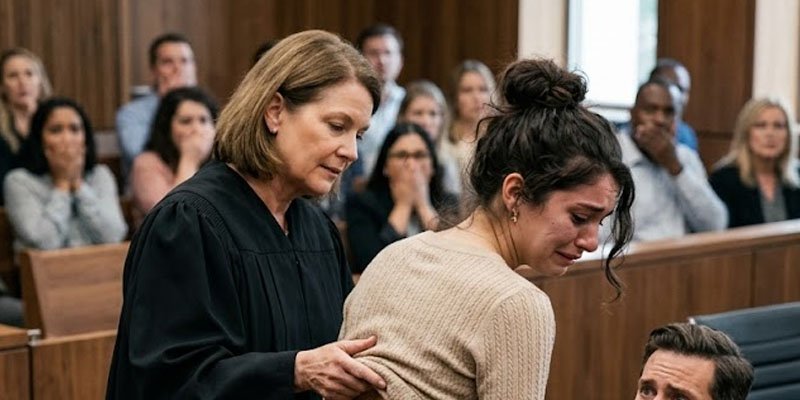
She hurriedly pulled her sweater over her body and pleaded, “Mom… please don’t do anything. My husband is a lawyer. He says no one will ever believe me.”
I met her gaze without looking away and replied in the calmest voice I could manage.
“Then we’ll let a courtroom decide how confident he feels after striking the daughter of a federal judge.”
The very first bruise caught my eye before she even realized I was standing in the doorway.
Then I noticed another.
And another.
Deep purple bruises fading into yellow spread across her shoulder blades, disappearing beneath the top of her jeans. A narrow scar ran across the center of her back, while older marks along her ribs made one thing painfully clear.
This hadn’t happened only once.
It had happened again and again.
Clara turned around so fast she nearly stumbled.
“Mom!”
She snatched the sweater from the bed and pulled it over her head with shaking hands.
“It’s nothing.”
I said nothing in return.
I only looked at her.
After a lifetime of reading people, I knew one truth.
Fear reveals itself long before someone speaks.
“What happened?” I asked gently.
She dropped her eyes.
“I slipped.”
“Try again.”
Silence.
Rain tapped softly against the windows of my home in Alexandria, Virginia. Downstairs, the grandfather clock ticked through another second while neither of us moved.
At last, her shoulders slumped.
“Daniel loses his temper.”
Her voice was so quiet I almost missed it.
“Afterward he always apologizes.”
She hesitated again.
“He tells me it’s my fault.”
Those words struck me harder than I expected.
Just that morning she had arrived carrying a single overnight bag, insisting she only needed a quiet weekend away.
No wedding ring.
No makeup.
A smile that never reached her eyes.
Now I finally understood.
I stepped closer.
“Has he threatened you?”
Tears filled her eyes immediately.
“He says if I ever leave, he’ll convince everyone I’m mentally unstable.”
She swallowed.
“He already has custody papers ready.”
“And Sophie?”
Clara’s breathing grew uneven.
“He says he’ll take her away from me.”
My granddaughter was only four years old.
The moment she said those words, everything changed.
Fear vanished.
Something much colder settled in its place.
For over twenty years, I had watched polished professionals enter my courtroom convinced that expensive suits, polished arguments, and legal knowledge placed them above consequences.
Daniel sounded exactly like those men.
Confident.
Comfortable.
Untouchable.
I didn’t raise my voice.
I didn’t call him.
I didn’t make threats.
Very few people outside the courthouse knew what I did for a living.
To Daniel, I was simply Evelyn Cross…
…his widowed mother-in-law.
He had no idea that every weekday I wore a federal judge’s robe instead of ordinary clothing.
He had no idea my full name appeared on opinions issued throughout the Eastern District of Virginia.
For years, I had protected my family’s privacy by using my maiden name in my professional career.
Daniel had never realized the two names belonged to the same woman.
I took Clara’s hands.
They were ice cold.
“We’re leaving.”
She looked terrified.
“He’ll report Sophie as kidnapped.”
“No.”
I gently squeezed her hands.
“We’re going to handle this exactly the way the law requires.”
“No shortcuts.”
“No mistakes.”
“And no chance for him to twist the facts.”
Within an hour, we were at the emergency department.
A forensic nurse carefully photographed every injury.
Every bruise.
Every scar.
Every fading fingerprint.
A victim advocate stayed beside Clara while she described three years of intimidation, isolation, financial control, and violence that had gradually become her everyday reality.
Every statement was documented.
Every photograph cataloged.
Every injury carefully measured.
By late afternoon, local officers had completed their report.
An emergency protective order was granted.
Before sunset, Sophie was safely reunited with her mother during a supervised police exchange.
For the first time in years, Clara held her daughter without constantly looking over her shoulder.
That evening, at exactly 8:13, my phone rang.
Daniel.
I answered without saying a word.
His voice was calm.
Almost amused.
“You’ve made a serious mistake.”
“You took my wife.”
“You took my daughter.”
“I’ll have both of them back before the weekend.”
I placed the call on speaker.
The recording app on my desk quietly began capturing every word.
Clara looked at me anxiously.
I nodded once.
Then I spoke.
“Daniel.”
He chuckled.
“And who exactly are you supposed to be?”
I glanced at the glowing recording icon before replying.
“I’m the person reminding you that the woman you’re threatening is protected by a court order.”
He scoffed.
“You think that frightens me?”
“No.”
A faint smile crossed my face.
“I think what happens after you continue talking probably will.”
He Kept Talking
There was a faint click on the line, the sound someone makes when switching a phone from one ear to the other.
Then Daniel let out a sigh, already sounding bored that I hadn’t reacted the way he expected.
“You older women always do this,” he said. “You hear one version of the story, create your own little drama, and suddenly think you’re the hero.”
Clara flinched beside me.
I raised one finger.
Wait.
He continued.
“Let me save you some time. Clara is unstable. Postpartum issues, anxiety, medication, wine… all of it. If she told you I hit her, she’s lying.”
He delivered every word smoothly, as though he had rehearsed the speech while tying his necktie.
I asked, “Are you denying that you ever laid a hand on her?”
“I’m saying that if she has bruises, she got them the same way she gets everything else. By being careless.”
A small sound escaped Clara’s throat.
Half sob.
Half choke.
Daniel heard it.
“Clara?” His tone changed immediately. Softer. Smoother. Somehow even more disturbing. “Baby, come on. Tell your mother to stop. You’re making a fool of yourself.”
She kept staring at the floor.
I said, “From this point forward, all communication needs to go through legal counsel.”
He laughed again.
“I am legal counsel.”
Then, just as men like him often do, believing the longer they speak the more convincing they become, he continued.
He said the judge who signed the protective order “must’ve been asleep.”
He claimed the local police were on his side.
He insisted family court judges dealt with “crazy mothers every day.”
He declared Sophie would be back home before preschool on Monday.
He warned that if Clara failed to return that night, he would make sure she “never saw a clean custody schedule in her life.”
I let him keep talking.
A long leash reveals exactly what kind of animal you’re holding.
When he finally paused to catch his breath, I said, “Thank you.”
That stopped him.
“For what?”
“For making your position perfectly clear.”
Then I ended the call.
The Name He Knew, The Name He Didn’t
Clara turned toward me quickly. “Was that enough?”
“It was useful.”
“Useful isn’t enough.”
Her voice broke on the final word, and in that instant she was no longer thirty-two, no longer a mother, no longer a woman who had hidden years of misery behind polite smiles and carefully chosen holiday cards. She was twelve again, standing in the kitchen after falling off her bicycle, angry with herself for crying.
I placed the phone on the desk and uploaded the recording to two secure locations.
Then a third.
Technology has a habit of failing when you need it most, and I’ve never believed in relying on luck.
“It’s a beginning,” I said.
She walked to the window, then back again. Sophie, finally asleep in the guest room across the hallway, had insisted on going to bed wearing one pink rain boot and one sock. Her stuffed rabbit rested beneath her chin.
Clara covered her face with both hands.
“He’s going to file something first thing tomorrow. He always files first. He says the person who files first gets to control the story.”
“That strategy works on frightened people and careless attorneys.”
She lowered her hands. “Mom.”
I almost told her not to worry.
I didn’t.
There’s no comfort in saying that to someone who has every reason to be worried.
Instead I asked, “Who helped him prepare the custody paperwork?”
She blinked.
“I’m not sure. Maybe his law partner? Maybe someone he knew from law school? He never left the papers where I could really read them.”
“Did he ever mention a name?”
She paused.
“Brent. Or Brett. Something close to that.”
The name settled somewhere in the back of my mind and stayed there.
At 8:41, I called one of my former law clerks, who now worked for the U.S. Attorney’s Office. Brilliant woman. Efficient in every way.
At 8:56, I contacted a family law attorney in Fairfax whom I trusted enough to recommend to my own daughter.
At 9:12, I called in a favor I never enjoy asking for.
By 10:30, Clara had already spoken with her attorney. By 11:00, the hospital advocate had arranged contact with a domestic violence shelter anyway—not because we needed somewhere to sleep that night, but because women in Clara’s position need more than a secure home and a supportive parent.
They need systems.
Plans.
Backup.
I made tea that nobody touched.
The house carried the scent of chamomile and damp wool. Clara’s coat rested by the front door, its hem stained with mud.
Just after midnight she quietly said, “I should’ve left the first time.”
I was standing at the sink rinsing untouched mugs.
“Maybe,” I replied.
Then I turned to face her.
“But you left now.”
She cried after that.
Softly.
She had always cried that way.
The Part He Didn’t Count On
Saturday morning started with cereal bowls on the coffee table and cartoons playing louder than usual. Sophie seemed to understand, in the straightforward way children often do, that something wasn’t right. Every few minutes she reached out to touch her mother’s sleeve, as if making sure she was still there.
At 9:07, Daniel’s attorney called.
Not Daniel.
A man named Brent Waller.
So Clara had remembered correctly.
His voice carried that carefully polished country-club roughness some men cultivate on purpose, as though they want to sound ordinary while charging by the quarter hour.
He asked to speak with “Mrs. Cross regarding the unauthorized retention of a minor child.”
I answered, “You may speak with Ms. Porter. She represents my daughter.”
Then I gave him her number.
There was a pause.
“Ms. Porter is not currently counsel of record in any custody matter.”
“Give her an hour.”
He didn’t appreciate that response.
Men like him rarely do when circumstances stop unfolding the way they expect.
At 10:15, Clara’s attorney filed first after all.
Emergency custody.
Protective relief.
Temporary support.
Exclusive use of the marital residence.
The filing packet was thick enough to snap a cheap stapler.
Hospital photographs.
Police reports.
Nursing notes.
An affidavit.
A detailed timeline.
Copies of text messages Clara had secretly stored in an email folder Daniel didn’t know existed.
Forty-three screenshots.
I read several while Clara sat at the dining room table signing each document where she was instructed.
If you make me look bad, you’ll regret it.
No judge is going to hand a child to a woman who can’t keep herself together.
You bruise easily. That isn’t my fault.
Then I reached one message that made my hands stop over the paperwork.
Remember who your mother is. You think that helps you? It only makes you look protected and spoiled.
I read it twice.
Then a third time.
He knew enough to resent me.
Just not enough.
By noon, another development came.
A patrol car drove slowly past my house.
Then it came by again.
Ordinarily that wouldn’t have meant anything on a Saturday in our neighborhood.
Unless you knew what to watch for.
At 12:18, my neighbor, Janice Pruitt, called from next door.
“There’s a silver BMW parked three houses away,” she said without bothering to say hello, because Janice believed introductions wasted valuable time during emergencies. “There’s a man inside. Expensive haircut. He keeps watching your house.”
“Did he get out?”
“No. But he looked like the sort who would.”
Janice had once chased away a package thief with nothing but a garden rake.
I thanked her and called the number listed on the protective order.
An officer arrived about twenty minutes later.
Daniel had disappeared before the patrol car reached the house.
Naturally.
Cowards often mistake good timing for intelligence.
Court Starts Long Before Court
Monday arrived gray and cold. Clara wore one of my old navy blazers because she had fled with almost nothing. The shoulders were slightly too broad for her, and somehow it made her appear younger.
We drove to the courthouse without speaking.
Not my courthouse.
That would have been both impossible and inappropriate in every respect.
The case had been assigned exactly where it belonged, before a state judge in a neighboring jurisdiction, because that is how family court functions—and because rules matter most when you’re most tempted to ignore them.
Outside the courtroom, Daniel stood with Brent Waller and another attorney I didn’t recognize.
Tan overcoat.
Red tie.
Phone in hand.
Already irritated that he had to wait in a hallway like everyone else.
He noticed me.
Gave a single nod.
Dismissive.
He truly had no idea.
Then his eyes found Clara, and his expression shifted little by little.
First came charm.
Then annoyance.
Then calculation.
He started walking toward us.
The bailiff stepped in before I needed to.
“Sir, not today.”
Daniel smiled at the bailiff as though they were sharing a private joke.
“I only want to speak with my wife.”
The bailiff didn’t budge.
Daniel turned his attention to Clara.
“You’re only making this worse.”
She turned pale but didn’t move.
Good.
Her attorney, Andrea Porter, arrived carrying two banker’s boxes and a cup of coffee so awful I could smell it from six feet away. Andrea was in her fifties, wore practical shoes she could probably run in, and had her hair pinned up with the same pen she was currently writing with.
She acknowledged Daniel with the same level of interest someone might give a dripping faucet.
Inside the courtroom, the hearing moved quickly in the strange way emergency proceedings always do—every minute packed with activity, yet somehow feeling painfully slow.
Daniel’s legal team came out swinging.
They portrayed Clara as unstable.
Manipulative.
Controlled by an overbearing parent.
Brent Waller repeated the phrase “strategic allegations” so many times I almost wanted to write it across his forehead with a permanent marker.
Then Daniel took the stand.
That’s usually when men like him become overconfident.
He denied ever hitting Clara.
Denied ever threatening to use Sophie against her.
Denied driving past my home.
Denied controlling the finances.
Denied knowing anything about the bruises.
Then Andrea introduced the hospital photographs.
The forensic nurse’s affidavit.
The police report.
The text messages.
He shifted in his seat, though only slightly.
Then she played the recording.
His own voice echoed through the courtroom.
It wasn’t loud.
It didn’t have to be.
You took my wife.
You took my daughter.
I’ll have both of them back before the weekend.
Then came the rest.
The part about her being “unstable.”
The part about “embarrassing yourself.”
The confidence.
The contempt.
You could almost feel the air grow heavier.
Judges hear angry people every single day.
What captures their attention is entitlement.
The belief that the law is simply another tool money can pressure until it bends.
Daniel’s attorney objected twice.
Both objections were overruled.
Then came the moment I doubt Daniel ever expected.
Andrea called not only the forensic nurse, but also the former office manager from Daniel’s own law firm.
Her name was Sheila Dobbins.
She was in her late sixties, with a steel-gray bob haircut and a cardigan buttoned unevenly, as though she had dressed in a hurry and hadn’t cared enough to fix it.
She had retired six months earlier.
Officially, by choice.
“If you ask me,” she later joked, “before I ended up in county.”
She testified that she had seen Daniel arrive at work on several Mondays with unexplained scratches.
She also described hearing him in his office, door closed, speaking to Clara on speakerphone more than once.
She remembered statements such as, “You want me to make the kid issue difficult? Keep pushing.”
Then she revealed the one thing that drained every bit of color from Brent Waller’s face.
She had brought copies.
Not of confidential client files.
Of expense reimbursement requests.
Hotel bills.
Gift receipts.
Meal expenses.
Daniel had been charging a family law consultant through his firm under a false case code while preparing for what he described as “possible domestic complications.”
Premeditation doesn’t always wear a ski mask.
Sometimes it moves quietly through the accounting department.
Brent stood so quickly that his chair scraped loudly across the floor.
He requested a recess.
It was granted.
Out in the hallway, Daniel finally looked at me as though I were more than another piece of furniture.
“Did you arrange all of this?” he asked.
“No,” I answered.
“You did.”
Even then, he still hadn’t figured out who I really was.
Not completely.
Not yet.
The Moment His Face Changed
When the hearing resumed, one side returned with noticeably less confidence than before.
Judge Harold Benton wasn’t known for dramatic courtroom performances.
He had spent enough years on the bench that the edges of his voice had worn smooth.
Judges like that can be the most formidable.
They don’t display outrage.
They document it.
He asked Daniel three straightforward questions.
Had he threatened custody in order to control his wife?
No.
Had he prepared separation paperwork before Clara had ever initiated one?
Only as a precaution.
Had he fully complied with the protective order and avoided all contact?
Yes.
Andrea rose.
“Your Honor, permission to approach with supplemental evidence.”
Granted.
She presented photographs taken that Saturday by Officer Len Murphy.
They were unmistakably clear.
Daniel’s BMW parked on my street.
Timestamp included.
License plate plainly visible.
Then Janice Pruitt took the stand.
God bless Janice.
She told the truth with the crisp confidence of a woman who had survived twenty years on a PTA board and had absolutely no fear of men wearing loafers.
She identified Daniel without hesitation.
She described watching him sit outside my home.
She explained that he drove away as soon as police were called.
Daniel looked toward his attorney like a man realizing far too late that the walls around him were lined with nails.
Before the lunch recess, Judge Benton awarded temporary custody to Clara.
Daniel was granted supervised visitation only.
No direct communication.
All firearms were to be surrendered before the end of the business day.
The protective order remained in effect.
Discovery would proceed on an expedited schedule.
And, without raising his voice, the judge warned that any future attempts at intimidation would be viewed “in the harshest possible light available to this court.”
The day should have ended there.
It didn’t.
Out in the hallway, as everyone drifted toward the elevators, their phones, and cups of stale coffee, Daniel caught up with us near the security checkpoint.
He wasn’t yelling.
That would have been easier.
Instead, he stepped in close—far too close—and spoke through clenched teeth to Clara.
“You really think this is over?”
Security reacted immediately, but not before he added,
“Your mother can’t protect you.”
That was when I answered.
Not loudly.
Just loud enough.
“My daughter doesn’t need protection from me, Mr. Mercer. She needs protection from you.”
He turned.
Actually turned.
For the first time, he truly looked at me.
Not as his mother-in-law.
Not as an older woman interfering where he believed she had no place.
His eyes caught the name the security officer quietly used when addressing me.
He noticed the subtle shift in the people around us.
Andrea had gone still.
About twenty feet away, Judge Benton paused at the end of the corridor after hearing my voice. He recognized it from another courthouse, another bench, another corner of the legal system Daniel had never imagined would intersect with his own problems.
“Judge Cross,” the officer said.
That was all it took.
The color drained from Daniel’s face so quickly it almost looked painful.
He opened his mouth.
Then closed it again.
For one perfect moment, he had no prepared response.
No charm.
No polished lawyer’s confidence.
Nothing.
Only the unmistakable reality of fear.
I stepped a little closer, close enough to watch understanding spread across his face.
The hospital records.
The recorded phone call.
The carefully prepared filings.
The absence of even a single mistake.
The reason we had taken no shortcuts.
He had believed Clara had simply run home to hide behind her widowed mother.
He never realized she had come to the home of a woman who had spent twenty-three years watching dishonest people unravel from ten feet away.
“You said no one would believe her,” I said quietly.
The security officer placed a hand on Daniel’s arm.
Daniel didn’t resist.
He really couldn’t.
His eyes stayed locked on mine as they escorted him back toward the courtroom because threatening someone protected by a court order—in a courthouse hallway, surrounded by witnesses—is an astonishingly foolish decision.
And men like Daniel always believe they’re far too intelligent to make foolish decisions.
Until they make one.
After
By the time we arrived home that evening, Sophie had fallen asleep in her car seat with cracker crumbs scattered across her coat and a purple marker streak on one cheek.
Clara carried her upstairs.
I remained alone in the kitchen for a moment, resting one hand on the counter while looking at the same two mugs that had been sitting there since that first night.
I had never moved them.
Thin brown rings had dried at the bottom of each cup.
When Clara came downstairs again, she found me lifting one from the sink.
“Mom.”
I looked up.
She wore the strange expression people have after surviving an impact—when the pain hasn’t disappeared, but the force causing it has finally stopped.
“He really had no idea,” she said.
“No.”
A small laugh escaped her.
Not joyful.
Not entirely.
“He used to brag at parties about how carefully he researched everyone.”
I set the mug back down.
“Apparently, he missed someone.”
She nodded and glanced toward the staircase where Sophie was sleeping peacefully.
Then she crossed the kitchen and wrapped her arms around me.
For a brief moment, she held me the way she had when she was twelve years old, with scraped knees and tears she tried to hide.
I held her just as tightly.
Outside, the rain began falling once more, gently tapping against the windows.
And upstairs, in the old bedroom at the end of the hallway, my daughter was finally home—and finally safe enough to sleep.
If this story stayed with you, consider sharing it with someone who might need to read it.
For more stories about complicated family relationships and unexpected betrayals, check out I Left Before Sunrise, Let the Truth Wake Them Up, My Father Smirked at Me Across the Wedding Ballroom, and My Husband Was on My Flight With Her.