
# The Lake House I Bought Alone
I bought my house by the lake on a September Tuesday, with no one beside me.
That small fact carries more significance than you might think.
Alone.
I’m not saying I felt lonely, and I’m not trying to portray independence as a remarkable accomplishment. It is simply what happened to a woman who worked for twelve years, gave up precious time, and endured inconvenience to secure something that belonged only to her.
That afternoon in September, I walked into an attorney’s office and signed a deed with a single name on it.
Mine.
The entire closing took forty minutes.
Harris, my attorney, had spent thirty years practicing property law. He had the calming professionalism of a man who could hear something without needing to offer an opinion.
He never remarked on the fact that I was purchasing the place by myself.
He never asked why there was no second signature.
Once the paperwork was finished, he congratulated me and passed over the keys.
I headed straight for Lake Norman.
I unlocked the entrance, walked into the living room, and stood still.
Expansive windows faced the water. A stone hearth filled one wall, while the cedar-paneled interior glowed in the lovely September sun.
That exact quality of light had stayed in my thoughts since I first toured the house.
Late in the day, the sun bounced off the lake and crept across the timber walls, as though you could actually watch time passing.
I stood there for a full twenty minutes.
Afterward, I walked out and took a seat on the dock.
As evening approached, the water grew dark and glassy, broken only by little ripples touching the wooden supports.
I remained there until I could no longer see the far bank.
I spent that first night on a bare mattress in the primary bedroom, since none of my things had arrived yet.
The next morning, I awoke with a feeling I could not mistake.
At last, I had found a place where I belonged.
I’m Claire Sutton.
I’m thirty-eight, and medical device sales has been my career for twelve years.
I started at twenty-six, stepping into a profession of overnight flights, relentless quarterly quotas, and meeting after meeting where listening to others mattered.
The job required technical expertise as well as emotional restraint.
Over time, I excelled at it.
I didn’t just learn to look capable; I learned to manage the duties people actually placed in my hands.
Eventually, genuine ability starts to feel effortless. Instead of trying to demonstrate your worth, you concentrate on doing the job well.
In those twelve years, I was promoted twice.
I also missed birthday celebrations, ate more meals than I could count in hotel meeting rooms, and surrendered nights others enjoyed with loved ones.
I saved money, of course, but I also gained a sharper sense of what I wanted.
One ambition stood above the rest.
I dreamed of owning a home on Lake Norman, roughly forty minutes north of Charlotte.
It would give me a place to truly unwind.
Until that point, nearly everything expensive I bought had been chosen for practical reasons.
My apartment made commuting easy.
My vehicle was reliable.
My clothes were appropriate for professional meetings.
But the lake property was another matter.
I owed nobody an explanation for wanting it.
It was what I desired.
And so I made it mine.
My relatives liked to joke that I had no idea how to take a break.
There was some truth in that teasing, although it missed an essential point.
Resting wasn’t beyond me.
I had simply never owned a retreat where no one would disturb me.
Above all, I needed one place nobody else could assume was theirs to use.
I hadn’t explained this wish to my family.
I had just made it happen.
For the next nine months, my lakeside home was everything I had imagined.
I spent weekends there whenever my schedule allowed.
My evenings passed watching the lake from the dock; now and then friends stayed over, and I made full meals I almost never cooked back in Charlotte.
Occasionally, I even managed to sleep past six.
After years of putting other things first, I finally had a place meant solely for my pleasure.
Then a text from my father appeared one Thursday morning in June.
I was barefoot on the chilly kitchen floor, coffee in hand.
His message was six words long.
Your vacation house is perfect for the family reunion. We’re coming next month.
It wasn’t phrased as a question.
Before I could fully absorb it, Mom phoned.
She wanted to know whether Dad had told me what they were arranging.
She added that Melissa’s sons would likely stay at the property for much of the summer.
She discussed the coming months casually, like someone making plans for a house she owned.
What followed makes more sense once you know what my family is like.
They were not unkind people.
I have no wish to cast them as villains just because this is a story about personal limits.
My mother and father were warm, giving people who had always supported their extended family.
To them, family meant sharing what you had.
When one person needed help, everyone offered whatever was possible.
At times, they gave their time.
At other times, their money.
Sometimes it meant lending a room or an item.
This attitude had kept our relatives close and made mutual support a normal part of life.
The problem was that the sharing rule did not apply to everyone in the same way.
Daniel, my older brother, had a wife, two kids, and a house in the suburbs.
No one presumed they could use his place.
My sister Melissa was married too, and her home received much the same respect.
I, however, was single.
Under our family’s unwritten code, that made me an exception.
They didn’t openly treat me as something the whole family owned.
Still, my things were never granted the privacy my married siblings could count on.
After Melissa’s car transmission broke, she used my vehicle for five weeks.
When Mom’s craft room became crowded, boxes and bins ended up in my spare bedroom.
Whenever my parents came through Charlotte, they stayed in my apartment without paying.
Their logic was always the same.
I had no roommate or spouse.
So, apparently, I must have had extra space.
My lakeside retreat was supposed to be the exception.
I had settled that in my own mind.
Then came Dad’s text.
When Mom rang, I replied with just one word.
Sure.
She took it as approval, just as I knew she would.
In the background, I heard her tell Dad she had known I would be sensible about it.
Reasonable.
The word lingered in my mind.
For years, my relatives had called me tolerant, flexible, and laid-back.
On the surface, those were compliments.
In practice, they usually praised my habit of saying nothing when other people decided how to use my things.
People who profit from another person’s cooperation can become experts at dressing it up as a virtue.
This time, though, I started putting my own plan into motion.
## Part 2 — The Preparations Nobody Knew About
My first call was to Wade.
He was sixty-three and had worked as a contractor for thirty years.
Although technically retired, he went on accepting practical projects because he enjoyed working with his hands.
He helped maintain my property whenot once business kept me in Charlotte.
Wade approached problems directly.
He wanted to know what needed doing, not listen to unnecessary explanations.
I explained to him I needed the entire access system changed.
He asked what I meant by everything.
I made it clear that I hoped new exterior locks, garage access, smart-entry settings, gate code, and Wi-Fi administrator credentials.
He asked whether I expected trouble.
I explained to him I expected family.
He laughed in a way that made it clear he grasped.
By Sunday evening, he had completed the work.
Every exterior lock had been replaced.
The smart-entry system was reset.
Old garage remotes no longer worked.
The gate had a new code, and the Wi-Fi and security systems had been updated.
I could monitor the cameras and gate activity from my phone.
I also kept the home closing documents together in a folder.
That couple of days, I made a different call.
My friend Patricia had been a family-law attorney since we finished college.
She possessed the ability to identify the central issue in a complicated situation without becoming distracted by unnecessary details.
I was not seeking representation yet.
I hoped to grasp my rights.
I asked what legal limits applied when parents repeatedly used an adult child’s property without consulting me first.
Patricia explained that ownership and access rights were clear under North Carolina law. Being related did not automatically entitle a person to enter a different person’s private property.
She asked whether I expected to need legal assistance.
I explained to her I preferred to know where I stood before anything happened.
She reminded me that the home was mine.
After that, her tone changed.
She asked whether I was certain I hoped to handle matters this way.
I asked what she meant.
She described my approach as quiet and prepared, rather than confrontational.
I said that was intentional.
Patricia pointed out that direct confrontation was also an option.
I was aware.
But before confronting anyone, I hoped to establish whether my suspicions were accurate.
She guessed that I expected my relatives to attempt moving in.
I explained to her they probably had not decided how long they would stay.
Their decision, I suspected, would depend on how much resistance they encountered.
Patricia observed that I was preparing the resistance before they could make that choice.
I regarded it a way of providing information they did not yet possess.
After twelve years in sales, strategy was not unfamiliar territory.
She agreed to remain available if I needed her.
Over the following three weeks, our relatives gathering expanded.
Initially, it was supposed to last a couple of days.
Then the proposed stay became ten days.
Soon it stretched toward two weeks because Uncle Ron would be traveling from Tennessee.
Melissa messaged me about leaving her sons’ fishing equipment at the home throughout the summer season.
Dad called to discuss Uncle Ron bringing his boat and using my dock.
Mom invited three cousins.
When describing the home, she repeatedly used the word we.
That word bothered me.
Not because I believed she was intentionally trying to steal my property.
Rather, she already regarded the home as a thing the whole family could use.
Her choice of language reflected an presumption she had not once needed to question.
I listened.
I responded politely and gave them the impression that plans could be worked out.
I had not clearly authorize their plans.
But I allowed them to assume I had.
That distinction would soon become important.
On the first Friday in June, I was sitting at my Charlotte office, halfway through a quarterly report, when my phone displayed a notification.
Motion detected.
Lake Norman. Front Gate.
Before opening the camera feed, I already suspected what I had find.
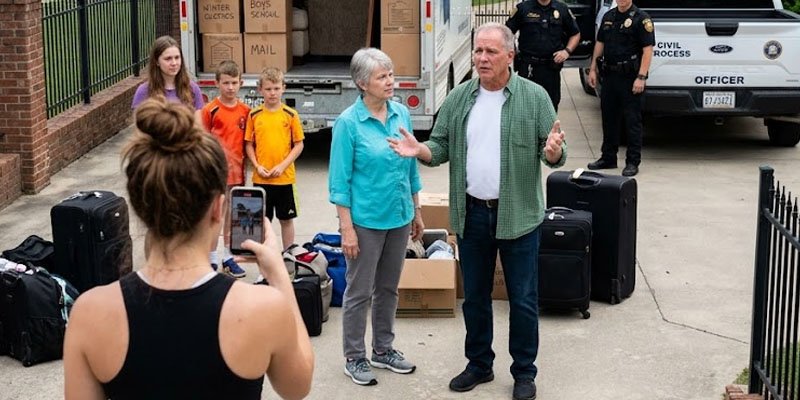
Dad’s SUV was parked beside the entrance gate keypad.
Melissa’s minivan waited behind him.
And attached to the vehicles was a U-Haul trailer.
I studied the image.
The trailer was packed.
Plastic storage bins.
Bicycles.
Folding chairs.
Coolers.
Fishing rods.
Duffel bags.
Two patio loungers secured with orange straps.
And suitcases.
Far more luggage than I had ever brought to my lakeside home for a normal stay.
This had beenn’t preparation for a family gathering.
It looked like a temporary relocation.
Dad climbed from his SUV with the confidence of a person who had not once seriously considered that he might be denied entry.
He approached the keypad and entered the old code.
A red light appeared.
He frowned and tried again.
Another red light.
Meanwhile, Melissa’s sons climbed out of the minivan, already arguing over who would get the upstairs bedroom.
My upstairs bedroom.
Mom stepped outside and examined the entrance gate.
After that, she looked toward Dad.
Then back at the entrance.
My phone rang.
Dad.
I let the call go unanswered.
Mom called next.
Then Melissa.
Each left a voicemail.
Dad called again.
Through the camera, I watched him enter the code for a fourth time.
Another failure notification appeared.
He stepped backward and looked directly at the security camera.
He told me to open the entrance gate.
Mom followed his gaze.
She removed her sunglasses.
And I watched her grasp what had happened.
Not simply that the access code had changed.
She realized I had known they were coming.
I had updated the security system.
And I was watching them arrive with their packed trailer, luggage, and be ownedings.
I had been aware of their plans all along.
I leaned back in my office chair.
For three weeks, I had considered what I hoped to say.
I had not want to speak merely because I was angry.
Anger can produce truthful statements, but it also allows the listener to focus on the emotion instead of the facts.
I hoped clarity.
Clear statements don’t require the other person to agree before they become true.
I pressed the intercom.
Before anyone unloaded a different item, I told them they needed to hear what I had discovered about the U-Haul.
The speaker crackled.
Dad lowered his hand from the keypad.
Mom put her sunglasses back on, a familiar gesture she used whenot once she wanted to regain control of her expression.
Melissa directed her boys back toward the minivan.
After that, I clarified what I was aware.
The trailer was rented under Dad’s name.
Its reservation covered three weeks.
Two days earlier, Dad had accidentally included me in a family group message containing the rental confirmation.
He removed me from the conversation almost right away.
Apparently, he had not realized I had already saved the relevant information.
I told them that I grasped they were not planning an ordinary couple of days stay.
Mom accused me of being dramatic.
I noted that I could see the patio loungers.
She clarified they were intended for the pier.
I explained to her I grasped perfectly.
After that, I asked all of us to listen with care.
Dad interrupted, demanding that I open the entrance gate.
I explained to him there were things I needed to explain first.
He reminded me that the people standing outside were my family.
I accepted that.
After that, I started with the most basic fact.
## Part 3 — The Conversation at the Gate
I had purchased the home the previous September.
My name was the only one on the deed.
The purchase price was $680,000, and I had made a twenty-percent down payment using savings accumulated over twelve years.
The house had not been bought jointly.
No relative had contributed to the purchase.
There had not once been an grasping that the home would serve as a communal family vacation home.
I clarified those details because an presumption had gradually developed without anyone acknowledging it.
Mom repeated that we were family.
I explained to her I grasped what family meant to her.
She had consistently believed in making things available resources and helping relatives.
I respected that history.
But the same expectation had been placed on me in ways it had not once been placed on Daniel.
A silence followed.
I noted that Daniel owned a house, yet no one had ever announced a reunion there without consulting him.
Melissa owned a house too.
From the minivan, she objected that her situation was different.
I said she was right.
It felt different.
And I had spent years trying to grasp why.
Daniel’s wife and children seemed to make his house a protected family unit.
Melissa’s marriage gave her home a similar status.
But I was single.
Somehow, that meant my property was considered available.
There was no husband whose approval needed to be respected.
No spouse who might object.
Just Claire, who lived alone and was expected to share.
No one answered.
I clarified that I was not accusing them of consciously deciding to discriminate against me because of my marital status.
The pattern had developed gradually.
I had not once challenged it, so no one had been forced to reconsider.
But I was challenging it now.
Dad insisted I was turning a family stay into an unnecessary conflict.
I questioned him to look at the rented trailer.
There was enough fishing equipment, outdoor furniture, and luggage for six people to remain for weeks.
That had beenn’t an ordinary stay.
He called it a vacation.
I asked whose vacation.
He answered that it was our relatives’s.
After that, I asked whose house they intended to use.
He hesitated.
I repeated the question.
Finally, he admitted it was mine.
Exactly.
Mine.
Yet I had not been asked whether I hoped to host that vacation.
I had merely received a six-word announcement without even a question mark.
The silence grew longer.
I went on.
During the previous three weeks, I had reviewed my property documents and spoken with an attorney.
I hoped all of us to grasp the legal position.
I owned the home.
I controlled access.
The locks, keys, and gate credentials was owned to me to manage.
The real issue was not legally complicated.
Mom complained that I was speaking to them as though they were strangers.
I explained to her I was speaking to people who had showed up at my home with a U-Haul without obtaining approval.
After that, I reminded Melissa about borrowing my car four years earlier.
When her transmission failed, she used my vehicle for five weeks.
I rented a different car and personally covered that expense.
Next, I mentioned the storage containers from Mom’s craft room that had occupied my guest bedroom for two years.
I also brought up how my Charlotte apartment had regularly been used as free lodging whenot once my parents stayed.
I was not demanding repayment.
I hoped them to see a pattern.
My time, space, and possessions had repeatedly been treated as available because I was unmarried and rarely objected.
That presumption was ending.
From the minivan, I heard one of Melissa’s boys ask why the entrance gate would not open.
She told him to wait.
He complained that they had already been there forever.
Melissa repeated her instruction more sharply.
After that, I addressed her directly.
I loved her sons.
I hoped them to stay the lake, enjoy the home, and make memories there.
I was their aunt, and I cared about them.
But I was not willing to have their be ownedings stored there for the entire summer season.
They could not occupy the upstairs bedroom as though it permanently was owned to them.
And they could not spend months at the home without prior agreement.
A couple of days would be possible.
Perhaps a longer couple of days.
The difference was that we would arrange it together.
Melissa said the boys had been excited for weeks.
I was aware.
She reminded me how much they had talked about fishing.
I accepted their disappointment and said I was sorry they were discovering the change this way.
But she had asked about leaving their equipment all summer season without first checking whether that plan was acceptable.
It felt not.
Melissa said Mom had assured all of us I had approved the plans.
I made it clear that Mom had heard what she had expected to hear.
Mom right away objected.
I noted to her that I had said sure, not explicitly agreed to the full plan.
She considered that a strange distinction.
For years, though, I had used precisely that distinction to avoid arguments.
I had given people responses they wanted to hear without fully committing myself.
And I had allowed them to interpret those responses as approval.
I was no longer willing to do that.
Dad at last asked what I hoped to accomplish.
I made it clear that I intended to open the entrance gate.
But everything in the U-Haul needed to return home.
Uncle Ron’s fishing boat would also have to go back.
Afterward, we would discuss what staying my house could look like.
Dad wanted to know whether I truly intended to allow them inside.
I answered yes.
He seemed confused about whether I hoped them to unload.
I explained to him to listen to the rest of what I had to say first.
After that, I spoke about a thing more important than property.
I loved my family.
I loved Dad, and I grasped the sacrifices he had made over decades of difficult work so his children could have opportunities.
I grasped that Mom treasured family gatherings.
I was aware the reunion had been organized because she wanted all of us together, not because she deliberately wanted to exploit me.
And I grasped why Melissa wanted her sons to enjoy a beautiful summer season beside the lake.
Their intentions were not necessarily bad.
But every one of those intentions had been combined with an presumption.
My house was available.
Nobody had thought it necessary to ask.
That had been what needed to change.
Good intentions did not excuse taking a person else’s approval for granted.
For fifteen years, my family’s expectations had treated my resources as flexible because I lived alone.
I had allowed that pattern to continue because I disliked causing conflict.
Now I was putting an end to it.
Mom insisted no one believed my be ownedings were unimportant.
I noted to her about the U-Haul.
She said Dad had spent months planning the reunion.
Without asking me.
She believed he had presumed I would be pleased to host all of us.
Perhaps he would have been right.
I honestly did not know.
That had been the point.
Whether I might have agreed was not the issue.
The real issue was that no one had given me the opportunity to decide.
My answer should have mattered.
For a long moment, no one spoke.
Then Dad said a thing simple.
They should have asked.
No excuses followed.
He did not try to qualify the apology or explain it away.
He simply admitted that they had been wrong not to consult me.
Mom quickly clarified that he was not admitting anyone had intentionally taken advantage.
I said I grasped.
But they had not asked because, somewhere in their minds, they had already considered my home available.
Mom had even spoken of the home as though our relatives collectively possessed its rooms.
She answered that she had meant the whole family.
I explained to her that was precisely the problem.
The conversation became quiet again.
After that, I proposed a solution.
I had open the entrance gate.
They could drive inside.
The trailer would remain attached.
We’d sit together on the veranda and discuss what future stays should involve.
Afterward, the rented trailer would be came back to the rental company.
Dad wanted to know what would happen next.
I made it clear that we would plan a proper stay.
Someone would telephone.
We’d choose a suitable couple of days.
They could drive to Lake Norman, and I had prepare dinner.
We’d sit on the pier and enjoy the home together.
But there would be no U-Haul.
Dad accepted that.
I said I hoped Uncle Ron to stay in time.
And Melissa’s boys.
Mom wanted to know whether I was excluding our relatives from my life.
I assured her I was not.
I was changing the expectations.
Instead of assuming my possessions were available, they needed to ask.
That had been the entire adjustment.
After that, I opened the entrance gate.
Dad drove through.
Melissa followed.
The trailer entered behind them.
They parked in the circular driveway in front of the home.
I left work early.
Forty minutes later, I showed up at Lake Norman.
It felt one o’clock.
## Part 4 — My Father’s Apology
Dad was sitting on the front steps with his hands resting on his knees.
He glanced like a person who’d been following a familiar habit for decades and had suddenly been forced to examine it from a different perspective.
He stood when I climbed out of my car.
He said my name.
I answered him.
After that, he apologized.
There was no excuse attached.
He told me about a work shed his father had owned when Dad was growing up.
My grandfather had built it himself.
He spent evenings there repairing things, making things, and working on personal projects.
It felt his private space.
Nobody entered without consulting me first.
Dad explained that he had consistently grasped and respected that boundary.
He knew it mattered to his father.
And he should have saw that my lake house mattered to me in the same way.
I said she was right.
He called the home my version of the shed.
That description felt precisely right.
He apologized again for failing to grasp.
I accepted that he was genuinely sorry.
Then we went indoors.
Through the wide living room windows, the familiar afternoon sunlight shimmered across the lake.
It felt precisely the view that had convinced me to buy the home.
Mom was in the cooking area.
She had found the coffee supplies and brewed a fresh pot.
Making coffee was a thing she did almost automatically whenot once she entered a kitchen.
It felt her way of settling into a space.
I had not criticize her for it.
She handed me a cup.
After that, she told me the home was beautiful.
I said she was right.
She said I had done well.
Again, I said she was right.
Mom looked at me for a moment.
After that, she admitted she had been thinking that over the years.
She had saw how much I had accomplished, but had not said it aloud nearly enough.
I explained to her that was true.
After that, she explained a thing I had not once expected.
Part of her had been afraid that openly acknowledging my success would mean admitting I no longer needed my parents.
I assured her that I consistently needed them.
She said I rarely seemed to.
I made it clear that being independent was not the same as no longer needing family.
Mom considered that.
Finally, she agreed.
Melissa joined us from the veranda.
Her boys were down by the pier, supervised by her husband’s brother.
He’d driven separately and had wisely waited in the driveway until the situation became clearer.
Melissa warned me that the boys would be disappointed.
I was aware they would.
Ryan had spent weeks talking about fishing.
I noted to her that he could still fish there.
She asked when.
I said we would arrange a stay.
She wanted to know whether we truly would.
Of course.
If she called and asked, we could choose a suitable couple of days.
She wondered whether I had agree.
I made it clear that I hoped her and the boys at my house.
I just had not agreed to hosting them for an entire summer season without discussion.
Melissa wanted to know what would have happened if they had requested approval.
I admitted I had not know.
Perhaps I would have offered a week.
Perhaps a different plan.
What mattered was that asking would have allowed us to decide together.
She acknowledged that they should have asked.
After that, she looked toward the window.
She remembered borrowing my car for five weeks.
And admitted that she had not truly asked approval properly then either.
She had presumed I could accommodate her because I consistently seemed flexible.
She struggled to find the right description.
I supplied the familiar words.
Easygoing.
Patient.
She agreed.
After that, she said a thing I had wanted my family to grasp over the years.
They’d mistaken generosity for an unlimited willingness to give.
Those were not the same thing.
I said she was right.
Melissa looked around the sitting room.
After that, she complimented the home.
This time, her words were not followed by a request.
She simply meant what she said.
I expressed my thanks.
She clarified that she wanted to stay.
Properly.
I explained to her she would be welcome.
Later, the four of us sat on the veranda.
Dad, Mom, Melissa, and me.
The boys were fishing from the pier.
The afternoon light reflected softly off the lake.
Everything around us looked as peaceful as it had the first day I stayed.
Dad suggested coming back the following month.
I said she was right.
He gave his word to call first.
And ask.
Then, with a faint smile, he requested instructions.
What precisely should he say?
I gave him an example.
He could tell me they wanted to stay for a couple of days and ask whether the dates worked.
After that, I had check my calendar.
He asked whether I might at times decline.
I answered yes.
Not every couple of days would be convenient.
Dad considered that.
After that, he said he could accept it.
He came back to the story of his father’s shed.
Nobody had questioned Walter’s right to keep that space for himself.
It had simply was owned to him.
Dad admitted he had forgotten that I deserved the same freedom.
I was entitled to have a thing completely mine without that becoming a family problem.
He did not know when he had lost sight of that principle.
Neither did I.
But he grasped it now.
After that, I explained to him I was glad they had come.
He appeared taken aback.
He asked whether I meant it.
I did.
I just had not wanted them arriving with a U-Haul.
That almost made him laugh.
He agreed the rented trailer had been a mistake.
Despite everything, I was happy they were there.
The lake house was owned to me, but that did not mean I hoped to keep my family away from it.
I hoped Mom to sit in the cooking area, make coffee, and enjoy the view.
I hoped Melissa’s sons to fish from the pier.
I hoped Dad to spend evenings on the veranda listening to the water moving around the pilings.
All I had ever wanted was to be asked first.
Dad nodded.
After a different quiet moment, he acknowledged that my request was reasonable.
They had made it seem much more difficult than it actually was.
And he apologized for that too.
## Part 5 — A Family Dinner by the Lake
Evening showed up gradually.
The lake darkened, and the light on its surface reminded me of those September evenings when I had first begun sitting on the pier.
Mom prepared dinner using the limited ingredients in my refrigerator.
I had not expected company, so there was not much food available.
But after forty years of cooking for a family, she knew how to improvise.
Somehow, she turned what I had into a meal for all of us.
We ate together on the veranda.
The boys came back from fishing.
Ryan had caught a small bass and released it.
He described the experience three times.
With each telling, the fish became slightly larger.
I regarded that completely acceptable for a twelve-year-old boy.
Dad sat at the end of the table, looking out over the water.
After that, he remarked that Walter would have loved the place.
Walter was his father, my grandfather, who’d died fifteen years earlier.
I had not known him as well as I wished.
I asked Dad to describe the work shed again.
He clarified that it was small and made of cedar.
Walter had built it himself.
There was a window facing north because he believed northern light was better for working.
Inside stood a workbench, tools, and whichever project he had been concentrating on.
Dad remembered his father coming inside for dinner smelling of sawdust and machine oil.
The family knew not to interrupt him in the shed unless a thing important required his attention.
Walter had not needed to establish that rule through arguments.
Everyone simply respected that the shed was owned to him.
Dad became quiet.
After that, he said again that he should have remembered that when thinking about my house.
I said she was right.
He gave his word he would remember from then on.
After a different pause, he asked whether he could return.
I explained to him yes.
He gave his word to telephone before the next stay.
And ask approval.
And leave the U-Haul behind.
We agreed.
Everyone stayed on the veranda until darkness settled over the lake.
Mom washed the dishes with unusual thoroughness.
I grasped the gesture.
Cleaning was at times her way of apologizing without having to repeat the words.
Melissa helped her sons settle into the guest bedroom for the night.
They argued briefly about which beds to use, then quieted down.
Afterward, she came back to the veranda.
Ryan had asked whether he could come back.
He wanted a different opportunity to catch the enormous bass from his story.
The same bass that had grown considerably with every retelling.
I told Melissa he was welcome.
She could call me, and we would find a couple of days that worked.
She said he had be excited.
I was aware.
After that, she thanked me for not closing the door on our relatives.
I explained to her I had not once wanted to shut anyone out.
I had only wanted the right to establish the terms of my own hospitality.
She said that was fair.
More than fair, actually.
She acknowledged they should have been asking approval all along.
And she promised to change.
Not just concerning my lakeside home.
The car.
The storage space.
Every other situation in which she had presumed I would automatically accommodate her.
She acknowledged that their past behavior had not been right.
After that, she apologized.
I believed her.
## Part 6 — The Morning Everything Felt Different
The following morning, Dad came back the U-Haul trailer.
He drove it back to the rental company himself.
Mom prepared coffee before leaving.
At the door, she hugged me for a long time.
After that, she told me a thing simple.
The house was mine.
She was not saying it reluctantly.
She was not conceding an argument.
She was recognizing a fact that should not once have been in dispute.
I said she was right.
After that, she looked around and said the home was beautiful.
I expressed my thanks.
She said it reminded her of me.
I asked what she meant.
Mom explained that the home was strong and quiet.
It had good bones.
And it represented twelve years of work.
She said it was worth every bit of effort I had put into it.
After that, she left.
I stayed standing in the doorway for a while.
The morning sunlight reflected sideways across the water, making the entire landscape appear ungenerally clear.
Eventually, I walked down to the pier.
The lake was doing what it had consistently done.
Existing without a word.
Stretching beyond the shore.
Belonging to itself.
And the home beside it was owned to me.
Gentle waves struck the wooden pilings.
I thought about the twelve years that had brought me here.
The overnight flights.
The hotel conference rooms.
The quarterly sales targets.
The missed celebrations.
The slow accumulation of savings and experience.
Every uncomfortable journey and long working day had contributed to the life I had built.
After that, I thought about Walter’s shed.
Cedar walls.
A north-facing window.
The smell of sawdust and machine oil.
A small space that all of us had grasped was his.
I recalled Mom’s description of my lakeside home.
Strong.
Quiet.
Good bones.
Twelve years of work.
She was right.
I lowered my feet into the lake.
The water was cold.
Not unpleasantly cold.
Exactly as cold as I hoped it to be.
Behind me stood my house.
My own house.
And that peaceful morning was owned to me as well.
I sat on the pier until I felt ready to go inside.
After that, I came back to the cooking area and made coffee.
At the table, I imagined the telephone call Dad would make the following month.
He would tell me our relatives wanted to spend a couple of days at Lake Norman.
He would ask whether that worked for my schedule.
And I would probably say yes.
I had known that from the beginning.
I had not objected to loving my family.
I had not objected to making things available beautiful moments with them.
And I had not once wanted my lakeside home to become a place they were forbidden to stay.
I had simply wanted them to see that my willingness to share was a thing I could choose, not a thing they were entitled to demand.
The answer had consistently been there.
Yes.
But the question had not once been asked.
Now it would be.
And that changed everything.




