
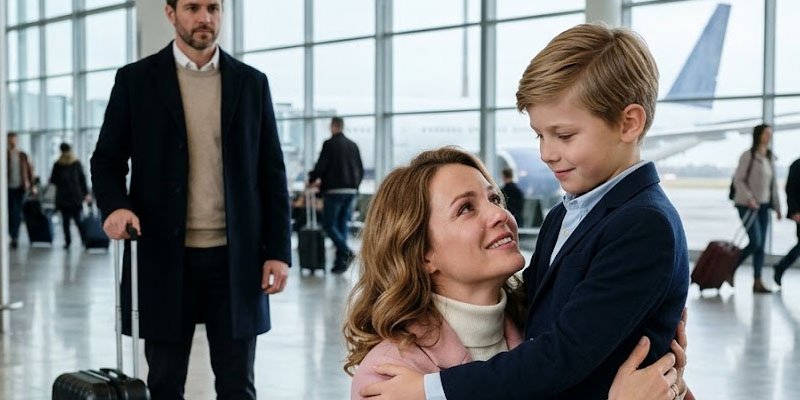
Seven days after I lost custody, I stood inside the airport fighting back tears as my young son prepared to depart with his father.
Just before passing through security, he wrapped his arms tightly around me and secretly tucked an unfamiliar black bank card into my pocket.
“Promise you’ll trust me,” he whispered.
A few minutes later, I received a message from him warning that, no matter what happened, I should never give his father that card.
I had no idea the mysterious card was linked to $3.8 million—or that my former husband was hiding something far more threatening than a financial secret.
## Part 1 — The Son I Thought I’d Lost
My eight-year-old boy sat in a leather armchair in the judge’s private chambers, met her gaze, and declared, “My mother can’t provide the future I need.”
On the opposite side of the room, his rich father wore the pleased expression of a businessman who had just finalized a profitable deal.
Seven days later, Owen hugged me at the airport and murmured, “Please don’t cry, Mom. Just wait for me.”
Then he quietly slipped a black card into my jacket pocket.
I’m Rachel Mercer, thirty-nine years old. Until that painful week, I’d spent eight years convinced that steady love and a secure home could make up for the luxuries I couldn’t provide.
My ex-husband, Grant Whitaker, had never known what it meant to struggle financially.
His relatives owned luxury hotels, commercial real estate, and investment businesses across Virginia and the surrounding states.
When our marriage ended five years before, Grant kept the grand mansion, high-end cars, and almost every valuable asset he’d controlled while we were together.
I moved into a small rented townhouse near Fairfax and earned my living as an administrative coordinator.
Owen spent the majority of his time living with me.
I packed his school lunches, showed up for school activities, guided him through assignments, and sat beside him through sleepless nights whenever he was sick.
We didn’t have the money for lavish vacations, but the familiar rhythm of our lives made him feel loved and safe.
Then Grant filed a petition requesting a different custody arrangement.
He argued that living with him would give Owen greater advantages, such as exclusive schooling, overseas adventures, and guidance from well-connected mentors.
His attorneys displayed pictures of his sprawling property alongside an elaborate proposal outlining our son’s future.
I provided educational reports, healthcare documents, and proof of the dependable household I’d built for Owen.
Unfortunately, Grant had one advantage I found nearly impossible to overcome.
Owen seemed to support his father’s position.
At the closed hearing, my little boy sat next to Grant in a navy-blue blazer I’d never seen before.
When the judge kindly asked which parent he preferred to live with, Owen refused to meet my eyes.
“I’d like to stay with Dad,” he answered softly.
My chest constricted.
Then he spoke the sentence that would haunt me.
“Mom can’t provide the future I need.”
His words sounded practiced, almost as if someone had carefully rehearsed them with him beforehand.
Grant’s lips curved into a smile.
Every part of me wanted to demand an explanation from Owen, but I said nothing as the judge weighed his preference against the remaining evidence.
The final ruling authorized Grant to take Owen overseas for a lengthy stay, provided he followed specific conditions.
I persuaded myself that my son had preferred his father’s glamorous, privileged world to the simple life we shared.
The possibility shattered me.
A week afterward, I traveled with them to Dulles International Airport.
Grant was dressed in a costly dark-gray suit and kept looking down at his phone.
Owen said very little.
He repeatedly glanced toward Grant, then looked elsewhere whenever I attempted to catch his attention.
As we approached the security checkpoint, Grant declared that they needed to go.
“Tell your mother goodbye, Owen.”
My boy moved toward me hesitantly.
I expected nothing more than a stiff wave or a brief hug without much feeling.
Instead, he rushed forward, wrapped both arms around my middle, and clung to me.
“Please don’t cry, Mom,” he murmured.
I fought to prevent my voice from shaking.
“I’m doing my best, sweetheart.”
His arms tightened around me.
“Just wait for me.”
I pulled away enough to see his face.
“What are you talking about?”
Owen’s eyes darted toward Grant.
A second later, he slipped an object into my coat pocket.
“Just trust me, please,” he whispered.
Before I could ask another question, Grant shouted for him.
Owen let go and walked after his father into the security area.
I continued watching until neither of them was visible.
Only afterward did I reach into my pocket.
My fingers closed around a simple black bank card with no printed name.
I examined both sides, utterly confused.
Suddenly, my phone buzzed.
Owen had recorded an audio message using the children’s tablet his grandfather had bought him.
His voice was low and rushed.
“Mom, that card has three point eight million dollars on it. Your birthday is the PIN. Don’t believe anyone who works with Dad. I’ll tell you everything when I get a chance.”
I listened to the recording three separate times.
My fingers began shaking.
How could a child of eight have control over millions of dollars?
Why had he kept the card hidden from Grant?
And what made him afraid of the people connected to his father?
As I stood close to the terminal doors, a second message appeared.
“Dad believes Grandpa Walter got rid of everything before he passed away. He has no idea I discovered it.”
Walter Whitaker, Grant’s father, had passed away four years before.
I’d always believed his inheritance had been folded into the family’s existing companies.
But Owen apparently knew something I didn’t.
## Part 2 — Walter’s Hidden Instructions
Without waiting, I tried calling Owen’s tablet.
There was no response.
When I called again, it went straight to voicemail.
Moments later, another message appeared on my screen.
“Mom, no matter what happens, never let Dad have that card.”
I remained motionless, staring at his words.
My boy hadn’t simply abandoned me for his father’s wealth. He had gone into Grant’s life while guarding a secret, and he’d chosen me as the person responsible for protecting part of it.
I couldn’t decide whether that realization brought comfort or fear.
Instead of returning to my house, I reserved a room at a hotel close to Dulles.
Once inside, I locked the door, laid the black card on the writing desk, and played Owen’s recordings over and over.
At precisely 11:40 that evening, another audio message reached me.
It lasted only a short time, and the sound of a closing door could be heard behind him.
“Mom, I’m safe. I’m hiding in the bathroom. Dad believes I’m cleaning my teeth. Grandpa Walter recorded a video for me. It’s saved on the tablet. The password is the dinosaur’s name, the one you bought me. I can’t send you the video, but I can explain where Grandpa said he put the document.”
I held my phone even closer to my ear.
“Grandpa told me the document is inside the lighthouse. You’ll understand.”
Then the audio stopped.
As I sat on the hotel mattress, a memory of Walter’s office from four years earlier came rushing back.
He’d been a quiet, stern gentleman who seldom showed a smile, although he’d always treated Owen with warmth.
On top of his desk sat a little lighthouse made of brass.
Nobody except Owen was allowed to handle it.
The last time I’d seen that decoration, Owen was only four years old. Walter had placed it into his small hands and told him, “When you’re old enough to protect a secret, this will belong to you.”
At the time, everyone considered it nothing more than a loving moment between a grandfather and grandson.
Now I questioned what Walter might have known was coming.
Sleep never came that night. I spent the hours before sunrise wondering how a man approaching death could have entrusted such a perilous secret to a four-year-old for years.
The next morning, I reached out to Priya Natarajan, a lawyer who’d previously helped me resolve a small dispute involving my rental home.
She was the one attorney I felt I could rely on.
I told her about the custody decision, what happened at the airport, the unexplained bank card, and the voice messages Owen had sent.
She paid close attention before giving me her advice.
“Rachel, you mustn’t use that card,” she warned. “Not even a single time. Don’t try looking up the balance, either. If those funds are what I suspect, every activity involving that account can be traced, and someone dangerous might use it to locate you. Are you able to visit my office today?”
I wanted to understand what she was thinking.
“What exactly do you believe it is?”
“My suspicion is that your father-in-law was trying to keep something protected,” she replied cautiously. “And your son may have been the only individual he believed he could trust.”
I promised to come in.
## Part 3 — The Investigation
Priya worked on the ninth floor of an unremarkable office building in Tysons Corner.
She’d canceled her other appointments.
When I stepped into the conference room, an unfamiliar man was already sitting at the table.
He looked about fifty, with a slender build, a weary expression, and a gray file folder resting in front of him.
Priya made the introductions.
“Rachel, meet Tomas Beck,” she explained. “He’s a special agent assigned to the FBI’s financial crimes division. I contacted him yesterday evening after our conversation.”
My pulse began racing.
I faced Priya in disbelief.
“You warned me against using the card,” I told her. “And I haven’t touched the money. But why would he…”
“Because he’s spent the past four years hoping someone would contact him,” she explained.
Beck unfolded the gray folder.
“Several months before Walter Whitaker passed away, he approached our department,” Beck began. “He claimed to have uncovered evidence that somebody within his company was laundering money through the family hotels for a dangerous criminal organization. Walter was extremely cautious. He wanted additional time to collect proof and refused to identify anyone until his evidence was solid. Unfortunately, he suffered a fatal heart attack, and afterward, the financial evidence disappeared.”
A sick feeling settled in my stomach.
“Who was Walter trying to shield?” I asked, even though I already suspected the truth.
“His own son,” Beck replied quietly. “He couldn’t determine how much Grant actually knew. Walter wanted to believe his son had been forced into participating rather than willingly helping. That uncertainty kept him from identifying Grant.”
I lowered my eyes to the tabletop.
Beck went on speaking.
“The people associated with Grant are genuine criminals,” he explained. “One is a man named Victor Lang. He transfers funds using shell corporations, and he has no tolerance for failures. Roughly six months ago, we began noticing signs that Grant had lost control of a situation. Walter’s documents have vanished, and Grant has been attempting to recover them ever since.”
All at once, the custody battle took on a horrifying new meaning.
“The custody hearing,” I murmured.
“It’s possible Owen wasn’t the real reason for it,” Priya answered softly. “At least, not in the way you assumed. Grant required a lawful excuse to bring your boy into the family property. If Walter concealed evidence and Owen discovered it…”
“Grant would need Owen near him,” I finished. “So he could learn what Owen knew.”
I thought about the unnatural way my son had spoken in front of the judge.
Maybe those heartbreaking statements hadn’t reflected his true feelings.
“He wasn’t being truthful,” I said, slowly understanding. “He was putting on a performance. He chose to go because he was trying to protect the secret.”
Priya gave a small nod.
“Children of eight can be surprisingly convincing actors, particularly when someone close to them has shown them how.”
Then Owen’s clue about his grandfather’s keepsake returned to me.
“The lighthouse,” I blurted out. “Owen told me the document was hidden in the lighthouse.”
Beck leaned forward in his chair.
“Do you know where that object is?”
“In the family mansion, inside Walter’s office. It was on his desk when I last saw it.”
Beck explained why retrieving it wouldn’t be simple.
“We can’t simply enter Grant Whitaker’s residence without a search warrant,” he told me. “And we need evidence to secure that warrant, but the evidence we’re looking for is already inside the property.”
Silence filled the conference room.
Then my phone vibrated again.
A fresh recording had been delivered from Owen’s tablet at 9:12 that morning.
The moment I played it, I sensed trouble.
This time, he made no attempt to whisper.
“Mom, Dad discovered the video,” he said in a strained, frightened voice. “He’s taken my tablet away. I said I was only watching cartoons, but he knows that isn’t true. We’re meeting Mr. Lang later today. Please hurry, Mom. Please.”
The message cut off.
I sprang up so quickly that my chair slammed against the wall.
“Where have they taken him?”
Beck was reaching for his phone.
“Rachel, sit down,” he instructed as he began dialing. “Please. Tell me where their flight was headed.”
“They didn’t leave,” I answered.
A sudden thought hit me.
“They never actually went overseas. Grant said they were flying to New York, but…”
I remembered a conversation with Owen during a drive the week before.
“Owen mentioned that his dad owns another house in Middleburg. He told me there are horses there, and that Grant keeps the place secret from Grandma.”
Beck paused before completing the call.
“Middleburg,” he repeated. “There’s a residence in Middleburg connected to one of Lang’s front companies. Our team has been watching that location for fourteen days.”
He immediately stood and moved toward the exit.
“Priya, contact the county sheriff and the FBI field office. Rachel, you need to remain here.”
“I won’t,” I replied.
“Mrs. Mercer…”
“He’s my child,” I said, sounding steadier than I felt. “If an unfamiliar person approaches him, he’ll be terrified. But if he sees his mother, he’ll understand that help has arrived.”
Beck watched me for several seconds.
Eventually, he consented, but with a strict requirement.
“You will remain inside the vehicle,” he insisted. “Regardless of what happens, you do not get out.”
It took seventy minutes to reach Middleburg.
I felt every passing minute.
## Part 4 — The Brass Lighthouse
At the far end of a gravel lane stood a wide, single-story farmhouse constructed from stone.
An unoccupied horse paddock was enclosed by white wooden fencing.
Three black SUVs were parked near the building.
By the time we reached the property, two patrol cars from the sheriff’s department and four unmarked law-enforcement vehicles had taken discreet positions along the roadway.
Priya sat next to me in the rear seat of Beck’s vehicle as we waited.
I kept my hands tightly folded across my knees.
Looking through the glass, I could barely make out the agents quietly taking positions among the surrounding trees.
I found myself praying more desperately than I had at any time since I was a little girl.
Then the front entrance of the farmhouse swung open.
Grant stepped outside ahead of everyone else.
His suit jacket was gone, his tie hung loosely around his neck, and his complexion had turned ashen.
Behind him walked a broad-shouldered man dressed in an expensive custom-made overcoat.
I knew immediately that the man was Victor Lang.
One of his hands rested firmly on Owen’s shoulder.
My boy moved stiffly, holding his head high and keeping his gaze straight ahead.
Both his hands were occupied with the small brass lighthouse.
Somehow, after our goodbye at the airport, he’d found an opportunity to visit Walter’s study and take the ornament.
“Hand that over, young man,” Lang instructed in an almost friendly tone.
“No,” Owen answered.
“Owen,” Grant snapped through clenched teeth. “Do what he says.”
“Grandpa told me I shouldn’t.”
Lang came to a halt.
“Your grandfather isn’t alive anymore,” he said quietly.
Although Owen sounded frightened, he refused to move.
“He explained what I should say if you told me that,” my son replied, his voice quivering without losing its determination. “He said I should tell you that he sent another copy already.”
Every person standing there went still.
“Another copy of what?” Lang demanded.
“The one Grandpa sent to the man who wears a badge,” Owen answered, meeting his eyes. “He mailed it four years ago.”
The expression on Lang’s face shifted.
At that instant, the federal agents moved in.
My memories of getting out of the car are blurred.
I cannot recall running across the gravel driveway.
All I can remember is hearing Beck call out to me while another voice shouted, “FBI! Down on the ground!”
And then Owen spotted me.
He released the lighthouse, letting it fall onto the lawn, and sprinted toward me with his arms wide open.
He crashed into my embrace so hard that I nearly lost my balance.
“I told you to wait for me,” he cried against my jacket. “I promised you I’d come back.”
I wrapped my arms around him and refused to let go.
“I’m right here,” I whispered as I held him. “I’m here, sweetheart. I’m not leaving you.”
A short distance behind us, Grant stood in handcuffs, watching our reunion.
“Owen,” he began, his voice breaking. “I never meant to…”
My boy turned to face him.
He wasn’t shedding tears anymore.
“You told me Mom couldn’t give me a future,” Owen said, looking directly at his father. “But you were wrong. She already gave me a future. It just wasn’t the one you wanted.”
Grant looked down at the ground.
When the investigators inspected the brass lighthouse, they found a concealed space beneath its base.
Hidden inside were a miniature key and a folded piece of paper covered in Walter’s recognizable handwriting.
The key opened a safe-deposit box in a bank located in Richmond.
Among the documents was a private letter Walter had written specifically for Owen.
Another sheet was titled “To whoever finds this” and listed bank account details, information about shell corporations, important dates, and the identities of three men.
Grant’s name did not appear on that list.
The paperwork also revealed the truth behind the $3.8 million.
The money represented Walter’s personal fortune, which he’d discreetly separated from his business before passing away.
He had deposited it into a custodial account established for Owen through a trust that Grant knew nothing about.
Walter’s directions left no room for misunderstanding.
Only Owen’s mother could receive the funds, and that could happen solely when Owen decided it was safe.
Priya reviewed the documents afterward.
“Your grandfather prepared for practically every possibility,” Priya remarked as she examined the paperwork. “But there was one thing he had no power to guarantee.”
“What was that?” I asked.
“That a young boy would find the courage to follow through.”
## Epilogue — The Future He Really Needed
The following spring, Grant entered a guilty plea.
Because he assisted the investigation, and because Walter’s documents demonstrated that threats had gradually pushed him into the criminal scheme, the court gave him a lighter sentence.
He was transferred to a federal prison located approximately two hours from where we lived.
I struggled to decide what his punishment meant to me.
Even today, my feelings remain complicated.
Victor Lang, along with two other men, was found guilty of money laundering and racketeering.
The hotel businesses were handed over to court-appointed administrators, which helped numerous employees who had done nothing wrong keep their positions.
The same judge who had handled our custody dispute personally reopened the proceedings.
She spent considerable time speaking privately with Owen, who told her the entire story.
Following that conversation, she restored primary custody to me.
Her written decision contained a short passage that I still preserve in one of my drawers.
The court expresses gratitude for this child’s bravery and regrets the circumstances that made such bravery necessary.
The $3.8 million was transferred into a trust benefiting Owen, and I was named its trustee.
I didn’t rush out to buy a giant mansion or begin living like a wealthy socialite.
Instead, I cleared the mortgage on our humble townhouse and set aside the greater part of the remaining money for Owen’s schooling.
I created another, smaller fund to support a cause that mattered deeply to him.
One night, after taking a bath, he told me what he wanted while standing wrapped in a towel.
“Grandpa Walter always said money ought to help people,” he explained that evening, still bundled in his bath towel. “I want to do something for children who have nobody looking after them.”
Together, we set up a modest charitable organization.
Owen proudly chose its name: The Lighthouse Fund.
The foundation provides school supplies, warm winter jackets, and extracurricular programs to children from families facing financial difficulties.
Owen makes a point of reading each letter of thanks himself.
Occasionally, I help him sound out an unfamiliar word, but he always insists on completing the letter without me taking over.
While incarcerated, Grant started mailing Owen a thoughtfully composed letter once each month.
For quite a while, Owen chose not to answer.
But as his ninth birthday approached, he eventually requested a pencil.
Using large, uneven letters, he wrote:
I’m not angry with you now. But I’m still waiting for you to find your courage.
Whether Grant understood the meaning behind those words, I cannot say.
I believe I understood perfectly.
On a chilly autumn evening, Owen and I were sitting on the back steps of our townhouse, sharing slices of apple.
The trees had begun changing into their autumn colors.
Somewhere farther down our street, a neighbor was gathering fallen leaves with a rake.
“Mom?” Owen said.
“What is it, sweetheart?”
“When I said to the judge that you couldn’t give me the future I needed, I wasn’t telling the truth.”
“I understand.”
“I only wanted Dad to believe that I agreed with him.”
I drew my son nearer.
“I understand that as well,” I answered, resting him against my side. “Nobody in that courtroom was braver than you.”
He slowly chewed another bite of apple.
After thinking for a moment, he spoke again.
“Was it difficult?” he finally asked. “Having to wait?”
I raised my eyes toward the orange evening sky stretching above our neighborhood rooftops.
My mind returned to Dulles Airport, that strange black bank card, and the dreadful week when I was convinced my boy had willingly walked away from me.
“Nothing I’ve ever experienced was harder,” I told him. “But you asked me to have faith in you, and that’s exactly what I did.”
He turned his face toward mine.
“And you never spent anything from the card.”
“Not a penny.”
A broad smile spread across Owen’s face.
For a fleeting second, his expression reminded me of Walter’s calm, confident smile.
“Grandpa would’ve told you that you passed his test,” Owen said.
“What kind of test?”
“The kind where someone hands you everything, but you wait until there’s a good reason before using it.”
I gently kissed the top of his head.
Throughout the first eight years of Owen’s life, I’d trusted that a mother’s devotion and constant presence could make up for all the things her money couldn’t buy.
What happened afterward proved that I’d been right all along.
The future my son truly needed had never depended on sprawling mansions, prestigious schools, or a fortune worth millions.
It existed in a mother who was prepared to wait.
And in a little boy who never doubted that she would.




