
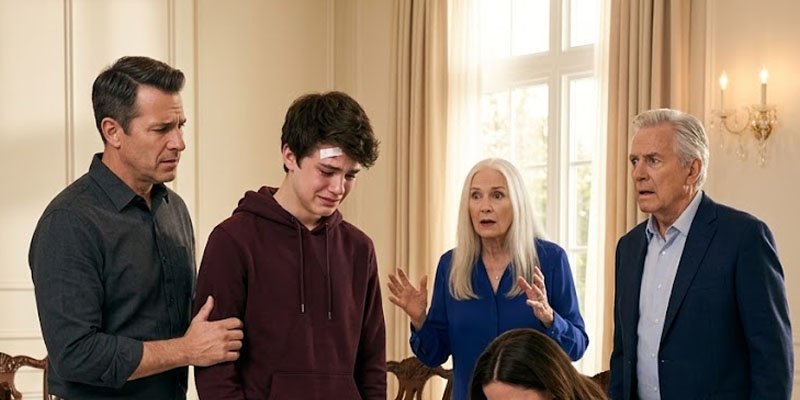
The call came at 9:17 on a rainy Friday night.
My father, Richard, told me there had been an accident outside Springfield, Missouri. His voice was oddly calm.
“Evan’s hurt,” he said. “But don’t panic.”
Evan was my sixteen-year-old son.
I was already reaching for my keys.
“What happened?”
There was a brief silence.
Then Dad said, “Your sister was driving.”
My stomach sank.
My younger sister, Melissa, had lost her license six months earlier because of a DUI. She wasn’t legally supposed to be behind the wheel.
I drove toward County Road 14 while calling 911. Dispatch told me that no accident had been reported.
That made no sense.
Twenty minutes later, I reached the scene. My parents’ SUV was sitting at an angle beside a drainage ditch. The entire front passenger side had been crushed.
Evan was lying on the wet grass.
One side of his face was covered in blood.
He was barely conscious.
“Dad,” he whispered when he saw me.
I dropped down beside him.
His breathing sounded abnormal.
My mother, Diane, was standing near the SUV with Melissa.
Neither one was doing anything to help him.
“What the hell are you doing?” I yelled.
Mom crossed her arms.
“Keep your voice down.”
“Why didn’t you call an ambulance?”
Melissa began crying.
Dad walked toward me. “We needed some time to figure this out.”
I stared at him.
“Figure out what?”
Mom answered.
“If the police show up now, Melissa goes to jail.”
I looked at my son bleeding in the rain.
Then I looked back at her.
“And that matters more than Evan?”
Mom let out a brief, bitter laugh.
“Let him bleed. One less problem for this family.”
For several seconds, no one moved.
Even Melissa went silent.
My mother appeared to realize what she had just said, but she offered no apology.
I called 911 again and switched the phone to speaker.
Dad’s face turned pale when the dispatcher said officers were already on their way.
A truck driver passing by had witnessed the wreck from the highway and reported it.
Melissa suddenly grabbed my arm.
“Daniel, please. Tell them Dad was driving.”
I pulled my arm free.
“No.”
Mom moved closer.
“You don’t understand what this will do to your sister.”
I looked down at Evan.
His eyes were beginning to close.
Then I saw something beside the crushed passenger door.
A phone.
Evan’s phone.
The screen was cracked, but the device was still recording.
A red timer continued to run.
My mother followed where I was looking.
Her expression immediately changed.
She understood.
Everything she had just said had been captured.
And through the rain, blue lights appeared in the distance.
The first ambulance arrived less than three minutes later.
Two paramedics hurried over to Evan while a sheriff’s deputy instructed everyone else to move away from the SUV.
I remained beside my son until one of the paramedics gently moved me back.
“We need some space, sir.”
Evan had a fractured collarbone, two broken ribs, a deep wound above his ear, and indications of internal bleeding. The paramedics stabilized his neck and placed him onto a stretcher.
I rode with him to the hospital.
Behind us, I saw Melissa speaking with Deputy Harris while my father stood close beside her.
Mom kept staring at Evan’s phone in my hand.
She looked terrified.
At the hospital, doctors rushed Evan into surgery.
A trauma surgeon told me his spleen had ruptured.
He said another thirty minutes without medical treatment could have changed the outcome completely.
I sat alone in the waiting room, my son’s blood still covering me.
At 11:06 p.m., Deputy Harris arrived.
He asked if we could speak privately.
I handed him Evan’s phone.
“There’s a recording on it.”
He listened without saying anything.
The video had begun shortly before the crash because Evan had been recording himself while complaining about Melissa’s driving.
Her voice could clearly be heard.
“You’re such a baby. I’m barely over the limit.”
Then Evan said, “You don’t even have a license.”
Melissa answered, “Mom said nobody cares.”
A few seconds later, the vehicle swerved.
Screaming.
Impact.
The screen went dark.
But the recording continued.
For the next twenty-seven minutes, it captured every conversation taking place around the wreck.
My father telling Melissa to move away from the driver’s side.
My mother telling Dad to wipe down the steering wheel.
Melissa asking whether Evan was going to die.
Dad saying, “He’ll be fine. We need to protect you first.”
And finally, Mom.
“Let him bleed. One less problem for this family.”
Deputy Harris stopped the recording.
His expression was completely different now.
“Did you know they were trying to stage the scene?”
“No.”
He slowly nodded.
“Your father told the first officer who arrived that he had been driving.”
I gave a single laugh, even though there was nothing funny about it.
The lie lasted less than an hour.
The truck driver who reported the accident had a dashboard camera.
His footage showed Melissa getting out through the driver’s door.
By 1:30 a.m., Melissa had been arrested on suspicion of driving while revoked, reckless driving causing serious bodily injury, and leaving an injured person without reasonable assistance.
My father was questioned for giving a false statement.
Mom refused to answer questions without a lawyer.
At 3:12 a.m., the surgeon finally came out.
Evan had survived.
He was going to recover.
But the doctor warned me that emotional healing could take much longer.
When I entered his room the next morning, Evan looked smaller than I had ever seen him.
He opened his eyes.
“Did Grandma really say that?”
My chest tightened.
He had heard everything.
He had lain conscious on the ground while they debated whether protecting Melissa mattered more than saving him.
“Yes,” I said.
Evan turned his eyes toward the window.
After a long silence, he whispered, “I don’t want to see them again.”
“You don’t have to.”
That afternoon, Mom called seventeen times.
I ignored every one.
Then she sent a text.
You’re destroying this family over one mistake.
I stared at the message.
One mistake.
Melissa driving illegally.
The crash.
The delay.
The lies.
Staging the scene.
Leaving Evan bleeding.
Mom laughing while he lay there.
That wasn’t a single mistake.
It was a chain of decisions.
And for the first time, I decided my parents would have to face the consequences of their choices.
Evan remained in the hospital for nine days.
During those nine days, my parents went from being frightened to believing they were the ones who had been wronged.
Mom began sending long messages.
She told me I was “letting anger cloud my judgment.”
She said Melissa had always been fragile.
She reminded me that my sister had struggled after her divorce, lost her job, drank too much, and had already endured enough after her DUI.
Not once did she ask how Evan was doing.
Not once.
Dad took a different approach.
He called me from a number I didn’t recognize.
When I answered, he immediately said, “Before you hang up, just listen.”
I almost hung up anyway.
“Daniel, your mother said something horrible. Nobody is defending that.”
“You both left Evan on the ground.”
“We were in shock.”
“You weren’t in shock when you wiped down the steering wheel.”
Silence.
It was the first time I had confronted him directly about what the recording contained.
Dad sighed.
“I made a bad decision.”
“You made several.”
“I was trying to keep Melissa out of prison.”
“And if Evan had died?”
“He didn’t.”
Those two words changed something inside me.
He didn’t.
As though that somehow erased everything they had done.
As though surviving meant their cruelty could simply be dismissed as a misunderstanding.
I ended the call.
A week later, investigators told me they had uncovered additional evidence.
Melissa’s phone records showed messages between her and Mom less than an hour before the crash.
Melissa: I’m taking Dad’s SUV. Don’t tell Daniel.
Mom: Just be careful.
Melissa: If I get stopped I’m screwed.
Mom: You won’t.
That destroyed Mom’s claim that she had not known Melissa was driving.
She knew.
Worse, she had encouraged Melissa not to worry.
There were also photographs taken after the crash.
The truck driver who stopped was Aaron Bell. He had parked roughly sixty yards away because the shoulder was too narrow.
Before walking toward the wreck, he took several pictures with his phone.
One showed Dad leaning into the driver’s side of the SUV.
Another showed Melissa standing several yards away with Mom.
A third showed Evan lying alone on the ground.
The timestamps were important.
They had been taken eleven minutes before I arrived.
Eleven minutes.
Eleven minutes while my son was seriously injured and, as the surgeons later explained, every minute of delay increased the danger that his internal bleeding could become fatal.
Aaron eventually contacted me.
He didn’t apologize because there was nothing for him to apologize for.
Instead, he said, “I wish I’d gotten there faster.”
I told him the truth.
“You’re the reason the police came.”
He had spotted the wrecked SUV from the highway and contacted emergency services before approaching the scene.
My parents had no idea.
That call may have saved Evan’s life.
Three weeks after the crash, Evan came home.
He moved carefully.
He needed assistance when showering.
He slept downstairs because climbing the stairs was too painful.
At night, he sometimes woke up breathing heavily.
He rarely talked about the accident.
But one evening at dinner, he asked me something.
“Why does Grandma hate me?”
I put my fork down.
“She doesn’t get to decide what you’re worth.”
“That’s not what I asked.”
He was right.
He deserved an honest answer, not a speech.
“I don’t think this started with you,” I said.
Evan watched me closely.
I continued.
“Your grandmother has spent years protecting Melissa from consequences. She protected her when she skipped school. When she stole money from Grandpa. When she was arrested for shoplifting. When she got her DUI. Eventually, protecting Melissa became more important than treating everyone else fairly.”
“Even me?”
“Yes.”
It hurt to say.
But lying would have hurt more.
Evan nodded.
“Okay.”
That conversation forced me to confront something I had spent years avoiding.
Melissa had always been the center of our family.
When we were children, I was expected to be responsible because Melissa was “sensitive.”
If she broke something, I was supposed to have watched her.
If she insulted someone, she was simply upset.
If she borrowed money and never gave it back, she was struggling.
When I married my wife, Rachel, Mom complained that I was abandoning the family.
When Evan was born, my parents loved being grandparents, but somehow even that still revolved around Melissa.
If Melissa needed help moving, Evan’s birthday dinner could wait.
If Melissa needed money, my parents suddenly couldn’t afford Christmas presents.
I accepted it for years because maintaining peace seemed easier.
Rachel saw things more clearly.
She died from breast cancer when Evan was twelve.
A few months before she died, she told me something I never forgot.
“Your parents don’t keep peace, Daniel. They keep Melissa comfortable.”
At the time, I thought Rachel was being too harsh.
Four years later, standing beside my injured son, I finally understood exactly what she had meant.
The criminal case moved slowly.
Melissa’s lawyer initially claimed the crash had caused panic and confusion.
Then prosecutors introduced Evan’s recording.
The defense changed its strategy.
Melissa eventually accepted a plea agreement.
She pleaded guilty to felony driving while revoked resulting in serious injury and reckless operation.
The additional charges for failing to provide timely assistance were reduced under the agreement.
At sentencing, Melissa cried.
She told the judge that she loved Evan.
She said she had made “the worst mistake of my life.”
Evan chose not to attend.
I did.
Mom sat behind Melissa.
Dad sat beside her.
Neither one looked at me.
The prosecutor played part of the recording.
Not Mom’s statement.
The judge had already reviewed all the evidence.
Instead, the prosecutor played Melissa saying, “Don’t call anyone yet. Please.”
Then Dad saying, “We need a story.”
The courtroom fell completely silent.
Melissa received a prison sentence followed by supervised release.
It wasn’t the maximum sentence.
It wasn’t the minimum either.
When deputies led her away, Mom began sobbing.
For the first time, she turned toward me.
“Are you happy now?”
I didn’t respond.
There was nothing I could say that mattered.
Outside the courthouse, Dad approached me.
He looked ten years older.
“Your mother wants to see Evan.”
“No.”
“Daniel.”
“No.”
“She’s still his grandmother.”
“That doesn’t give her access to him.”
Dad lowered his voice.
“She regrets what she said.”
“She regrets that it was recorded.”
He flinched.
Maybe that was unfair.
Maybe it wasn’t.
Either way, I no longer cared about arguing over what she intended.
Evan was the one who had been lying in the rain.
Evan was the one who had listened while adults debated whether his life was an inconvenience.
Evan had earned the right to decide who would be part of his life afterward.
Several months passed.
His ribs healed.
His collarbone healed.
The scar beside his ear changed from angry red to a pale pink.
The emotional injuries took longer to heal.
He began therapy.
At first, he hated going.
Then one afternoon he came home and said, “I think I understand something.”
“What?”
“I kept thinking Grandma said that because I did something wrong.”
My throat tightened.
“And now?”
“Now I think she said it because something is wrong with how she thinks about family.”
I nodded.
“That sounds possible.”
He looked at me.
“I still don’t want to forgive her.”
“You don’t have to decide anything right now.”
That became our rule.
No forced forgiveness.
No forced reconciliation.
No pretending.
Almost ten months after the accident, Mom came to our house.
She hadn’t called beforehand.
I saw her standing outside through the living room window.
She was holding a large envelope.
Evan was upstairs.
I went outside and closed the door behind me.
“You need to leave.”
“I brought something for him.”
“What?”
She handed me the envelope.
Inside was a letter.
Eight pages long.
I didn’t read it.
“I’ll tell him you brought it.”
Her eyes filled with tears.
“Daniel, I know what I said.”
“Yes.”
“I hear it in my head every night.”
I said nothing.
She looked toward the house.
“I didn’t mean it.”
“You said it.”
“I was angry.”
“At a bleeding sixteen-year-old?”
She looked down.
“No.”
“Then who were you angry at?”
She remained silent for several seconds.
“You.”
That surprised me.
“Why?”
“Because you were going to call the police. Because I knew you wouldn’t protect Melissa.”
There it was.
Not confusion.
Not shock.
Not panic.
A belief.
Protecting Melissa was a responsibility.
I had violated that responsibility by choosing my son.
Mom wiped her eyes.
“I realize how insane that sounds now.”
I studied her.
For the first time, she wasn’t trying to defend herself.
But regret didn’t automatically rebuild trust.
“I hope you mean that.”
“Can I see Evan?”
“No.”
Her face tightened.
“Not even for five minutes?”
“No.”
“When?”
“That’s his decision.”
She slowly nodded.
Then she left.
That night, I told Evan that she had come.
I handed him the unopened letter.
He stared at it.
“You didn’t read it?”
“No.”
“Why?”
“Because it’s addressed to you.”
He turned the envelope over.
Then placed it in a drawer.
Weeks went by.
He didn’t open it.
Months passed.
It remained unopened.
On the anniversary of the crash, Evan asked to visit the site.
I didn’t understand why, but I agreed.
County Road 14 looked completely ordinary in daylight.
There was no wrecked SUV.
No police tape.
No blood.
Only grass, asphalt, and a shallow drainage ditch.
Evan stood near the place where he had lain.
He was seventeen now.
Taller.
Stronger.
He stared at the ground.
“I remember hearing Grandma.”
I waited.
“I remember thinking you weren’t coming.”
“I was coming.”
“I know.”
He looked toward the highway.
Then he gave a faint smile.
“That truck driver came.”
“Yes.”
“And you came.”
“Yes.”
He exhaled.
“That’s enough.”
Three months later, he opened Mom’s letter.
He read it by himself.
Then he came downstairs and handed it to me.
“You can read it now.”
I did.
Mom apologized.
Not perfectly.
In some parts, she still explained too much.
She wrote about being afraid for Melissa.
About panic.
But halfway through, she finally admitted something I had never heard her say before.
I chose Melissa over you.
There is no excuse for that.
Evan told me he wasn’t ready to see her.
He might never be.
But he wanted to write back.
His response contained only four sentences.
Grandma,
I survived.
I remember what you said.
I’m building a life where I don’t have to prove I deserve to be protected.
If I ever want contact again, I’ll be the one to decide.
He mailed it himself.
After that, my parents stopped visiting.
Dad occasionally sent birthday cards.
Mom sent nothing.
Melissa remained in prison.
Relatives told me she blamed me for “turning everyone against her.”
I didn’t respond.
There was nothing left to argue about.
Evan graduated high school the following spring.
At the ceremony, he crossed the stage while I stood in the crowd, clapping until my hands hurt.
Rachel should have been there.
I thought about her.
About that rainy road.
About how close I had come to losing the last person in the world who carried a piece of her with him.
After the ceremony, Evan found me outside the stadium.
He was still wearing his graduation gown.
He hugged me.
“Dad?”
“Yeah?”
“You know what I remember most about that night?”
I expected him to mention my mother.
Instead, he said, “You showed up.”
For a moment, I couldn’t speak.
He smiled.
“That’s what matters now.”
We walked toward the parking lot together.
Behind us, families were taking pictures, laughing, and calling out names across the crowd.
Life hadn’t gone back to the way it was before the crash.
It never would.
But maybe that wasn’t the point.
The point was to build something better than what had existed before.
Something where love wasn’t measured by who could be shielded from consequences.
Something where being family didn’t require accepting betrayal.
Something where Evan would never again have to question whether his life mattered.
And that began on the night everyone else chose silence—
and I chose my son.




