
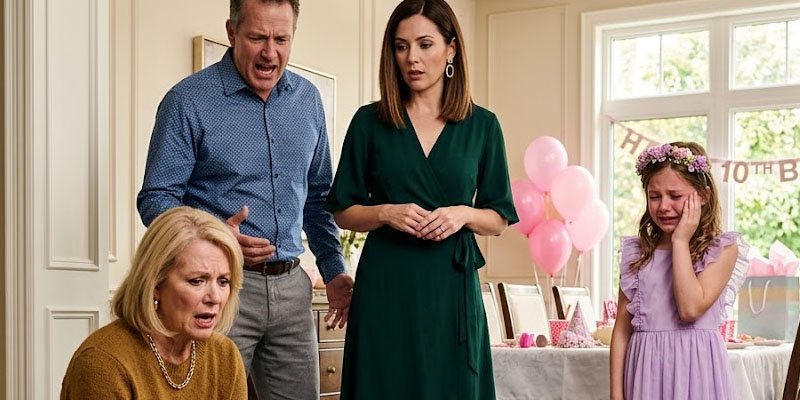
After my MIL slapped my daughter and sent her birthday cake crashing to the floor, she said, “No son, no celebration.” What stunned me even more was hearing my husband side with her. I didn’t fight. I didn’t cry. I simply said, “Okay.” Neither of them realized what that calm response truly meant.
My mother-in-law slapped my daughter on her tenth birthday.
The sharp sound cracked through our suburban Ohio dining room so suddenly that every conversation stopped.
Emma stood motionless beside the table, one hand still reaching toward the pink-frosted cake I had spent most of the morning decorating. Her grandmother, Diane Mercer, stood over her, one hand still lifted.
“Don’t touch it,” Diane snapped.
Tears instantly welled in Emma’s eyes.
“Grandma, it’s my cake.”
Diane’s face became even harder.
Then she seized the cake stand with both hands and threw it onto the hardwood floor.
Glass shattered underneath the table.
Pink icing splattered across the lower cabinets.
Ten small candles rolled beneath the chairs.
“No son, no celebration,” she said.
For several seconds, I genuinely questioned whether I had heard her correctly.
My husband, Mark, stood by the kitchen entrance. His father, Richard, looked down at the floor. Mark’s sister Claire appeared deeply uncomfortable but said nothing.
Emma held one hand against her cheek.
I turned toward Mark.
“Mark?”
I expected anger from him.
Instead, he gave a slight shrug.
“She’s right.”
The entire room became unnaturally quiet.
For twelve years, Diane had made it completely obvious that she believed the Mercer family needed a grandson.
After Emma was born, she repeatedly asked when Mark and I intended to “try properly.”
When our second daughter, Lily, was born four years later, Diane hardly bothered coming to see us at the hospital.
Mark always defended his mother.
“She’s old-fashioned.”
“She doesn’t mean anything by it.”
“That’s just Mom.”
But this time was different.
Emma wasn’t a baby who couldn’t understand the conversation.
She was ten years old.
And she understood every single word.
Mark crossed his arms.
“Mom bought most of the gifts anyway. Emma needs to learn she can’t always be the center of attention.”
“It’s her birthday,” I said.
Diane laughed.
“And one day she’ll marry and take another man’s name. What exactly are we celebrating? Another Mercer name disappearing?”
Emma looked at me.
That expression changed everything.
She wasn’t wondering why her grandmother disliked her.
She was wondering if I was going to let this happen.
I didn’t yell.
I didn’t strike back at Diane.
I didn’t beg Mark to behave like a father and protect his own child.
Instead, I knelt down, picked up one of the candles from the floor, placed it on the counter, and looked straight at my mother-in-law.
“Okay.”
Diane smiled because she thought she had prevailed.
Mark actually appeared relieved.
“Good,” he said. “Maybe now we can stop making everything dramatic.”
I nodded.
“Absolutely.”
Then I took Emma’s hand, called Lily in from the living room, grabbed my purse, and walked toward the front door.
Mark frowned.
“Where are you going?”
“Out.”
“For how long?”
I looked at him once.
I already knew the answer.
He didn’t.
Diane had no idea that my attorney had emailed divorce documents three days earlier.
She didn’t know the house wasn’t Mark’s.
She had no idea who owned the building his company operated out of.
And she certainly didn’t understand what that single word—“okay”—was about to cost her.
I drove Emma and Lily to my sister Rachel’s house, roughly twenty minutes away.
Neither girl said anything during the drive.
Once we arrived, Emma sat on the couch with a bag of frozen peas Rachel had given her pressed against her cheek.
Lily, who was only six, kept asking whether Grandma was angry because they were girls.
That question nearly broke me.
I sat between them and carefully chose my words.
“Grandma believes something cruel and stupid. That has nothing to do with your value.”
Emma kept looking down at the floor.
“Dad believes it too.”
I couldn’t lie to her.
“Yes.”
She nodded once.
Somehow, that tiny gesture hurt more than if she had begun crying.
Rachel eventually took the girls upstairs to watch a movie while I called Melissa Grant, the attorney I had quietly consulted earlier that week.
I hadn’t originally planned to file right away.
Mark and I had been coming apart for almost two years. He monitored our household spending, mocked my career, and increasingly permitted Diane to interfere in decisions that should have been between the two of us.
I had begun documenting everything after discovering that Mark had moved $38,000 from our joint savings into an account that only he could access.
Melissa had prepared divorce paperwork as a precaution.
After what happened to Emma, that precaution became my course of action.
I told Melissa about the slap.
Her tone immediately changed.
“Did anyone witness it?”
“Five adults.”
“Photograph Emma’s cheek. Write down exactly what happened while it’s fresh. And Laura, if Diane contacts you, do not argue with her.”
That part was simple.
Diane called nine times that evening.
I ignored all of them.
Mark decided to text instead.
You embarrassed me.
Mom says you owe her an apology.
Bring the girls home.
Forty minutes later, another message arrived.
Stop acting crazy.
Then finally:
If you don’t come back tonight, don’t bother coming back at all.
I stared at that final message for a long time.
Then I typed one word.
Okay.
The following morning, Melissa filed the paperwork.
Mark was served at his office on Monday.
That was when he learned the first thing his mother had never bothered to discover about me.
The house where we had lived during our marriage had been purchased through my grandmother’s trust before Mark and I married. When my grandmother died, ownership passed exclusively to me.
Mark had spent years calling it “his house.”
Legally, it had never been his.
His name wasn’t on the deed.
By Tuesday afternoon, my phone wouldn’t stop ringing.
“You’re seriously divorcing me over a birthday cake?”
“No,” I said.
“You’re divorcing me because Mom lost her temper?”
“No.”
“Then what?”
I stood by Rachel’s kitchen window watching Emma and Lily play outside.
“I’m divorcing you because when your mother hit our daughter, you stood beside her.”
Silence.
Then Mark laughed.
“You won’t survive without me.”
That almost made me smile.
Mark had forgotten something else.
Before I became “Mark Mercer’s wife,” I had been Laura Bennett, a commercial property manager.
Five years earlier, I had used part of my inheritance—money Mark repeatedly complained was “wasted sitting around”—to buy a small industrial property through an LLC.
Mark’s landscaping company leased half of that building.
He knew his landlord only as Bennett Holdings.
He had never bothered asking what Bennett meant.
His lease was valid, and I had no intention of illegally forcing him out.
I didn’t need to.
The lease expired in four months.
Six weeks earlier, Mark had rejected the renewal offer after Diane convinced him he could pressure the landlord into lowering the rent.
He intended to renegotiate later.
There would be no later.
On Wednesday, I instructed the property manager to notify Mercer Outdoor Services that the unit had already been committed to another tenant beginning the day after Mark’s lease expired.
His company now had four months to relocate twelve employees, trucks, equipment, and inventory.
Then Diane finally left a voicemail.
“You vindictive little witch. You’re destroying my son over one spoiled girl.”
I saved it.
So did Melissa.
Because Diane still hadn’t understood the most important thing.
This wasn’t about me anymore.
It was about what she had done to Emma.
And I intended to make sure the people responsible finally faced the consequences.
Diane had always mistaken anger for authority.
Apparently, throughout most of Mark’s life, the two had been almost interchangeable.
She called, and people answered.
She demanded something, and people changed course.
She criticized someone, and eventually that person apologized.
Her children grew older, but the pattern continued.
Richard avoided conflict.
Claire gave in before arguments really began.
And Mark had spent forty-one years calling obedience to his mother “respect.”
I had participated in that system as well.
Admitting that wasn’t comfortable, but it was necessary.
For twelve years, I had tried to maintain peace with Diane because every disagreement ended with Mark telling me that challenging his mother only created unnecessary problems.
So I learned to pick smaller battles.
When Diane criticized Emma’s clothes, I changed the subject.
When she declared that girls were “naturally less ambitious,” I disagreed but didn’t pursue the argument.
When she gave our nephew $500 for Christmas while Emma and Lily received matching twenty-dollar craft kits, I convinced myself that my daughters were too young to notice.
Emma had noticed.
Children notice nearly everything adults wish they wouldn’t.
Three days after filing for divorce, Melissa helped me request a temporary parenting order.
I wasn’t trying to prevent Mark from seeing his daughters.
Whatever had happened between us, he remained their father.
But I wanted one condition clearly included in the arrangement: Diane could not have unsupervised contact with Emma or Lily while the incident was being reviewed.
Mark exploded when he learned about it.
That evening, he arrived at Rachel’s house and repeatedly rang the doorbell.
Rachel opened the front door but kept the storm door locked.
“I want my kids,” he said.
“They’re inside.”
“Then send them out.”
“They don’t want to go with you tonight.”
“I didn’t ask what they want.”
I stood several feet behind Rachel.
That statement confirmed more than Mark understood.
I stepped forward.
“Leave.”
His expression changed when he saw me.
“You did this.”
“Yes.”
“You turned them against me.”
“No, Mark. Your mother slapped Emma. You defended her. Emma formed her own opinion.”
“My mom barely touched her.”
I pulled out my phone.
“Would you like to repeat that?”
He stared at the phone.
Melissa had advised me to document every interaction I could legally record.
Mark lowered his voice.
“You’re enjoying this.”
“No.”
“You always hated my family.”
“No.”
“You’re trying to take everything.”
That accusation almost deserved an answer.
Instead, I said, “Your attorney can speak to mine.”
He stepped closer to the door.
Rachel raised her phone too.
Mark looked at both of us, muttered something under his breath, then turned and walked back toward his truck.
Only after the door closed did I notice Emma standing at the top of the stairs.
“Did Dad come for us?”
“Yes.”
“Did he say Grandma was wrong?”
I hesitated.
“No.”
Emma quietly disappeared into the guest bedroom.
That was when Mark lost something no judge could ever order returned.
Trust.
The Investigation
The slap resulted in only minor swelling, but photographs taken shortly afterward clearly showed redness across Emma’s cheek.
More importantly, several adults had seen what happened.
Rachel encouraged me to make a police report, and after discussing it with Melissa, I did.
I provided the facts exactly as they had happened.
No exaggeration.
No emotional speech.
Claire initially refused to become involved.
Richard said he had been looking in another direction.
Mark insisted Diane had only “tapped” Emma because Emma was being disrespectful.
Then Diane made things even worse for herself.
She called again.
This time, after confirming Ohio’s consent laws with Melissa, I answered and legally recorded the conversation.
“You’re really involving police?” she demanded.
“Yes.”
“For a slap?”
“Yes.”
“My mother slapped me. I survived.”
“That isn’t relevant.”
“She was mouthing off.”
Emma had not been mouthing off.
She had merely asked whether she could cut her own birthday cake.
But I allowed Diane to keep talking.
That was one of her weaknesses.
Whenever she believed she was in control, she talked too much.
“A grandmother has a right to correct a child,” she said.
“You threw her cake on the floor.”
“It was my money.”
“You said there should be no celebration because she wasn’t a boy.”
There was a pause.
Then Diane said:
“And?”
One word.
No denial.
No attempt to claim I had misunderstood.
No effort to say I had taken her words out of context.
Just:
And?
I sent the recording to Melissa.
After that, Claire became far more cooperative.
Perhaps she finally understood that remaining silent was no longer neutral.
Maybe she was simply afraid Diane would pull the entire family even deeper into the situation.
Whatever the reason, Claire gave a statement confirming that Diane had deliberately slapped Emma and thrown the cake.
Eventually, Richard admitted the same thing.
The legal consequences were nowhere near as dramatic as television makes these situations appear.
There were no officers rushing into Diane’s home and dragging her away in handcuffs.
But there was now an official case.
There were attorneys.
Hearings.
Legal bills.
And there was a judge who was unimpressed by Diane’s attitude.
For several months, she was prohibited from having direct contact with Emma while the matter continued.
That restriction infuriated her.
Not because she suddenly missed her granddaughter.
Because someone had finally told Diane Mercer no.
Mark’s Business Problem
At the same time, another problem was growing around Mark.
His business lease.
He called Bennett Holdings and demanded an extension.
My property manager, Stephen Cole, answered professionally.
“The unit has been committed to another tenant.”
“Then uncommit it.”
“That isn’t possible.”
“I’ve rented there for six years.”
“Correct.”
“I’ve never missed rent.”
“Also correct.”
“Then why wouldn’t you renew?”
Stephen reminded him that Bennett Holdings had offered a renewal.
Mark had rejected it.
The offer expired.
Another company had since signed a letter of intent for the space.
Nothing about the situation was personal.
At least not legally.
Mark had made a business decision assuming the other side would simply remain available until he decided what he wanted.
It was remarkably similar to how he had handled our marriage.
When he finally discovered that I owned Bennett Holdings, he drove directly to my house.
By then, under the temporary parenting arrangement, the girls and I had moved back home.
Mark stood in the driveway staring at me as though he had just discovered he had been married to a stranger.
“You own the building.”
“Yes.”
“For how long?”
“Five years.”
“You’ve been collecting my rent?”
“My company has.”
“You lied to me.”
“I never lied.”
“You never told me.”
“I did, actually.”
His jaw tightened.
I remembered the conversation perfectly.
Five years earlier, I had told him I planned to use some of my inheritance to purchase a commercial property.
He had been watching football.
“Whatever you want, Laura,” he said.
A couple of months later, I mentioned that the building had tenants.
“Sounds boring,” he replied.
Then, when Mercer Outdoor Services needed more space, I told him Bennett Holdings had a suitable unit becoming available.
He toured it with Stephen.
He signed the lease after barely reading anything beyond the financial terms.
He never once asked who owned the LLC.
Now his own lack of interest had somehow become my deception.
“You’re kicking me out.”
“No. Your lease is ending.”
“Same thing.”
“No, it isn’t.”
“Extend it.”
“No.”
His face turned red.
“You’re going to put twelve people out of work because you’re angry at me?”
“You have months to relocate.”
“Commercial space costs almost twice what I’m paying.”
“That sounds like something you should have considered before rejecting your renewal.”
“You offered me a twenty-percent increase!”
“Because you were significantly below market.”
“Because I’m your husband!”
I looked at him.
There it was.
Mark believed marriage entitled him to unlimited loyalty from me while demanding very little loyalty from himself.
“You wanted business,” I said. “This is business.”
He pointed toward the house.
“And this? You think this is yours too?”
“It is mine.”
“I paid bills here for twelve years.”
“You paid household expenses while living here. That doesn’t put your name on a premarital property deed.”
“I renovated the basement.”
“And your attorney can raise whatever financial claim he believes you have.”
For once, Mark said nothing.
Then he changed his approach.
His shoulders loosened.
His voice became gentler.
“Laura, what are we doing?”
I almost laughed.
Not because anything was amusing.
Because that question had come years too late.
“We’re getting divorced.”
“Over Mom?”
“Stop saying that.”
“What?”
“This isn’t a divorce over your mother. This is a divorce over you.”
His eyes moved toward the windows.
“Can I see the girls?”
“Emma doesn’t want to see you today. Lily is willing to come outside for a few minutes.”
“She’s ten. She doesn’t decide.”
“She gets to have feelings.”
“Those feelings came from you.”
“No. They came from watching you agree with the woman who hit her.”
Mark flinched.
Finally.
A real reaction.
I couldn’t tell whether the words had actually reached him or whether he was only beginning to realize how terrible his behavior would sound in front of a judge.
I never found out.
Diane Tries to Win
Diane’s next move was completely predictable.
She attacked my reputation.
She told relatives that I was deliberately destroying Mark’s finances.
She told neighbors that I had manipulated Emma.
She told anyone willing to listen that I had always hated carrying the Mercer name.
Eventually, she made the mistake of putting some of those thoughts online publicly.
One Facebook post said:
Some women destroy entire families because they cannot accept traditional values. Sons carry families forward. That is biology and history, not hatred.
Claire convinced her to remove it.
Unfortunately for Diane, screenshots had already been taken.
Another post complained that grandparents were being “criminalized for discipline.”
That one stayed online long enough for several parents from Emma’s school to understand exactly which situation Diane meant.
I never answered publicly.
There was no reason to.
Diane was ruining her own reputation more effectively than I ever could.
Mark begged her to stop.
For perhaps the first time in their relationship, Diane ignored him too.
“You should be defending me,” she told him.
“I’m trying to keep custody of my children.”
“You wouldn’t be in this position if Laura weren’t vindictive.”
“Mom, you hit Emma.”
“She was disrespectful.”
“She asked for cake!”
Claire later told me about the argument.
Apparently, Diane simply stared at Mark in disbelief.
It may have been the first time her son had openly confronted her.
But I didn’t believe courage was what had finally motivated him.
By then, Mark was losing things.
His marriage.
Daily access to his daughters.
His inexpensive commercial lease.
Thousands of dollars in legal fees.
And increasingly, the respect of friends who had discovered what had happened.
Consequences had finally accomplished what conscience had not.
The Divorce
The divorce took eleven months.
There was no dramatic confession in court.
No judge gave a passionate speech before bringing down a gavel.
Real divorces are generally far less cinematic.
They are paperwork.
Financial disclosures.
Emails.
Negotiations.
Legal invoices.
Weeks of waiting.
And exhausted people sitting across conference tables trying to calculate the price of ending something that took years to build.
Mark fought hardest over money.
I fought hardest over our daughters.
Eventually, we reached a parenting agreement.
Mark received regular parenting time.
Diane received none unless Mark was physically present and Emma agreed to see her.
For the first several months, Emma refused.
Lily followed her older sister.
Mark tried more than once to convince them.
The first time he pushed Emma too hard, she looked directly at him.
“You told Grandma she was right.”
Mark became quiet.
“I was angry.”
“At me?”
“No.”
“Then why did you say it?”
He had no answer.
By then, Emma no longer needed one.
That was the difference.
She had stopped waiting for adults to explain away something she had personally witnessed.
Eventually, Mark apologized.
His first attempt was awful.
“I’m sorry everything got so out of control.”
Emma said nothing.
His second apology was somewhat better.
“I’m sorry you were hurt.”
Again, Emma remained silent.
Months later, during a counseling session, Mark finally said what she needed to hear.
“I was wrong. Grandma hit you, and I should have protected you. I didn’t.”
Emma cried afterward.
She still didn’t forgive him immediately.
I never asked her to.
Trust isn’t something that instantly returns because someone finally says the right sentence.
Mark had to rebuild whatever could still be repaired.
Diane’s Cost
Diane never gave Emma a genuine apology.
That surprised absolutely nobody.
She paid legal expenses.
She lost unrestricted access to both of her granddaughters.
Her relationship with Claire deteriorated after Claire gave an honest statement about what she had witnessed.
Richard, who had spent decades avoiding confrontation, eventually moved into his brother’s home for several months after Diane accused him of betraying her.
But perhaps the greatest change was that Mark finally began telling his mother no.
Not constantly.
Not perfectly.
But enough for her to notice.
When she criticized his parenting agreement, he ended the conversation.
When she demanded that he bring the girls to Thanksgiving despite Emma refusing to attend, Mark told her no.
When Diane called me a manipulative liar in front of Lily, he immediately took Lily home.
For decades, Diane had created a family structure in which everyone revolved around her temper.
One slap cracked it.
Not because that slap was the only cruel thing she had ever done.
But because it was the first cruel act everyone finally stopped pretending hadn’t happened.
Mark’s company survived, although the move was expensive.
He found a smaller facility on the other side of town for nearly forty percent more than he had previously paid.
He sold two trucks, reduced his equipment inventory, and eventually managed to stabilize the business.
I never celebrated his financial difficulties.
I simply stopped protecting him from the consequences of his own decisions.
That distinction mattered to me.
One Year Later
We celebrated Emma’s eleventh birthday in our backyard.
Rachel arrived early.
Claire brought balloons.
Richard came alone and stayed for roughly an hour.
Mark came too.
He stood beside the grill, quieter and more uncomfortable than he used to be.
Diane wasn’t invited.
Emma had chosen the guest list herself.
This year, the cake was chocolate with strawberries.
Nothing extravagant.
No expensive decorations.
No enormous party.
Just the people Emma actually wanted around her.
Before we lit the candles, Mark walked over to her.
“You sure Grandma can’t call you later?”
Emma immediately stiffened.
I looked at him.
Mark lifted both hands.
“Okay. Sorry. I shouldn’t have asked.”
Emma watched him for a moment.
Then she nodded.
“Maybe someday.”
“Whenever you’re ready.”
It was one of the first times I had seen Mark accept a boundary without attempting to negotiate around it.
That mattered too.
We lit eleven candles.
Everyone gathered around the cake.
Emma closed her eyes.
Someone asked what she had wished for.
She laughed.
“If I tell you, it won’t happen.”
After she blew out the candles, Lily demanded the biggest strawberry.
Rachel jokingly complained that adults deserved strawberries too.
Claire took photographs.
Richard helped cut the cake.
It was ordinary.
And ordinary was exactly what I wanted.
Later that evening, after everyone had gone home, I found Emma sitting on the back steps with her knees pulled up against her chest.
“Good birthday?” I asked.
“Yeah.”
I sat beside her.
For a moment, she didn’t say anything.
Then:
“Mom?”
“Yeah?”
“Do you remember last year?”
“I do.”
“When you said ‘okay’?”
I looked at her.
“Yes.”
“I thought you were agreeing with Grandma.”
My chest tightened.
“I know.”
“But then you took us away.”
“Yes.”
She leaned against my shoulder.
“I was really scared.”
“I know.”
“Were you scared?”
For a moment, I considered lying.
Parents sometimes convince themselves that being brave means acting as though fear never existed.
But Emma deserved the truth.
“Very.”
“You didn’t look scared.”
“That doesn’t mean I wasn’t.”
She thought about that.
Then a small smile appeared.
“I want to be like that.”
“Like what?”
“Scared but still leaving.”
I wrapped my arm around her.
For the first time since that birthday, I understood what that moment had truly cost.
Not just Diane.
Me.
It cost me a marriage I had spent years trying to save.
It cost Mark the belief that his wife would tolerate anything simply to keep a family together.
It cost Diane her place at the center of everyone else’s decisions.
It cost Emma some of the trust she once had in the adults who were supposed to protect her.
But that one quiet word also bought something.
A boundary.
A beginning.
A home where my daughters didn’t have to earn the right to be celebrated simply because they had been born girls.
Three weeks later, a letter arrived addressed to Emma.
The return address belonged to Diane.
Emma handed it to me unopened.
“What do you want me to do with this?” I asked.
“Is Grandma allowed to send letters?”
“Yes.”
“Do I have to read it?”
“No.”
Emma stared at the envelope for several seconds.
Then she shook her head.
“Throw it away.”
So I did.
No ceremony.
No dramatic tearing.
I dropped it into the kitchen trash beneath used coffee grounds and an empty cereal box.
Emma went upstairs to finish her homework.
And life went on.
That was the part Diane had never understood.
She believed winning meant being the loudest person in the room.
She believed family meant people who could never walk away.
She believed my silence meant weakness.
And on the afternoon she slapped my daughter, destroyed her birthday cake, and watched her son stand beside her, Diane believed she had finally put me in my place.
She smiled when I said, “Okay.”
She had no idea I wasn’t surrendering.
I was finished negotiating.
And sometimes the most expensive word a person can hear isn’t “no.”
It’s the quiet “okay” spoken by someone who has finally realized they no longer need your permission.