
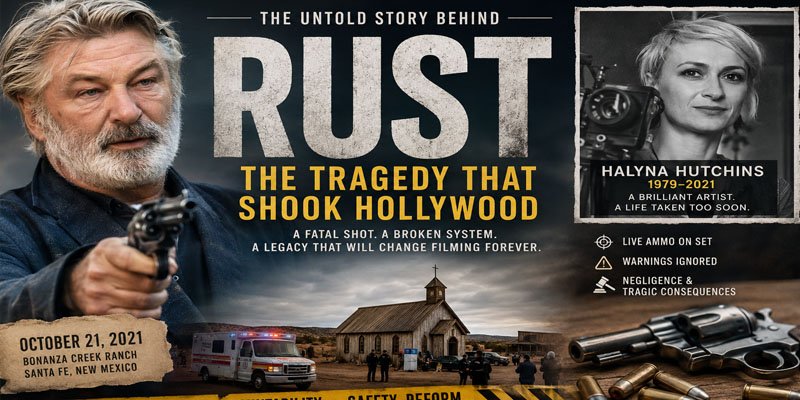
The Rust Tragedy: The Day a Film Set Became a National Safety Reckoning
Few moments in Hollywood history have forced the entertainment industry to confront questions of safety, responsibility, and accountability as intensely as the tragedy on the set of Rust. What began as an ordinary day of production in New Mexico in October 2021 ended with the death of cinematographer Halyna Hutchins, injuries to director Joel Souza, and a legal battle that continued for years.
The incident became far more than a tragic accident on a movie set. It raised difficult questions about how firearms were handled during filmmaking, who was responsible for verifying their safety, whether production pressures had contributed to dangerous conditions, and how much responsibility should ultimately fall on the people handling or overseeing a weapon during a scene.
A Film Set in New Mexico
On October 21, 2021, the cast and crew of Rust were working at Bonanza Creek Ranch near Santa Fe, New Mexico. The independent Western starred Alec Baldwin as Harland Rust, while Baldwin was also one of the film’s producers.
Inside a small church building on the ranch, the crew was preparing for a scene involving Baldwin’s character. Cinematographer Halyna Hutchins and director Joel Souza were working on the positioning and framing of the scene when a firearm being used during production discharged.
The weapon had been represented to those on set as safe for filming. Instead, it contained live ammunition.
The discharge struck Hutchins and Souza. Hutchins was transported to a hospital in Albuquerque, where she died from her injuries. Souza survived.
The loss immediately sent shockwaves through Hollywood.
Who Was Halyna Hutchins?
For many people who followed the case, the name Halyna Hutchins became inseparable from the tragedy. But before October 2021, she was already building a respected career as a cinematographer.
Born in Ukraine, Hutchins eventually moved to the United States and pursued filmmaking after studying journalism. She graduated from the American Film Institute Conservatory and worked on a growing number of film and television projects.
Colleagues described her as ambitious, creative, collaborative, and deeply passionate about cinematography. Her work had earned recognition within the industry, and she was regarded as a filmmaker with significant potential.
Her death at the age of 42 therefore represented not only an unimaginable loss for her family, but also the loss of an artist whose career was still developing.
For Hutchins’ husband, Matthew, and their young son, the consequences were permanent. No courtroom decision, settlement, or change in film-industry policy could reverse that loss.
How Could Live Ammunition Reach a Film Set?
That became one of the central questions of the entire investigation.
Professional film productions have long developed procedures intended to distinguish ammunition used for filming from live ammunition. The purpose is straightforward: scenes may require the appearance or sound of gunfire, but the people working around the equipment must be protected from actual ammunition.
In the Rust investigation, attention increasingly focused on how a live round ended up in a firearm that was being used during production.
The film’s armorer, Hannah Gutierrez Reed, was responsible for firearms and ammunition used on the production. Prosecutors later argued that she had failed to properly perform duties connected with firearm safety and ammunition control.
The investigation also examined the conduct of other crew members and the wider working environment on the production.
Concerns About the Production
As investigators examined what had happened, reports emerged about problems on the Rust set before the fatal incident.
Some crew members had reportedly raised concerns about working conditions, long hours, and safety. Camera department workers had also left the production before the shooting.
These details became important because the tragedy was increasingly viewed not simply as the result of one isolated mistake, but as a possible culmination of multiple failures.
That distinction mattered.
A safe production environment depends on several layers of protection. Equipment must be properly maintained. Responsibilities must be clearly assigned. Safety procedures must be followed consistently. And anyone who believes something is unsafe must be able to stop the process without fear of delaying production.
When several safeguards fail at once, the consequences can become catastrophic.
The Legal Battle Begins
The tragedy quickly moved from the film set into the courtroom.
New Mexico prosecutors charged armorer Hannah Gutierrez Reed with involuntary manslaughter and accused her of failing to properly maintain and control the ammunition on the production.
In February 2024, a jury found Gutierrez Reed guilty of involuntary manslaughter. She was subsequently sentenced to 18 months in prison.
Assistant director Dave Halls, who had been involved in handling the firearm before the shooting, had previously pleaded no contest to a charge of negligent use of a firearm and received a suspended sentence and probation.
The legal proceedings demonstrated that responsibility for safety on a film set could extend beyond the person physically holding a firearm.
Alec Baldwin’s Case
The most closely watched legal battle, however, involved Alec Baldwin.
Baldwin was charged with involuntary manslaughter in connection with Hutchins’ death. Prosecutors argued that his conduct in handling and firing the firearm was criminally negligent.
Baldwin maintained that he had not knowingly used a firearm containing live ammunition and disputed the prosecution’s account of what happened.
His case eventually took a dramatic turn.
During his 2024 trial, Baldwin’s defense argued that critical evidence concerning the firearm had been mishandled and that the prosecution had failed to establish the charge properly. The judge ultimately dismissed the case with prejudice after determining that the state had failed to disclose evidence concerning the ammunition and firearm.
That meant Baldwin was not convicted of the charge.
The development became one of the most consequential moments in the entire Rust legal saga and intensified the debate over accountability, evidence handling, and the responsibilities of performers on film sets.
The Question of Responsibility
Perhaps the most difficult question raised by Rust is also the simplest:
Who is responsible when a safety system fails?
A film set is a highly collaborative environment. Actors perform. Directors control creative decisions. Cinematographers design images. Armors and other specialists handle technical responsibilities. Producers oversee budgets and production operations.
When something goes wrong, responsibility can become complicated.
The Rust case demonstrated why safety cannot depend on assumptions or informal assurances. Every person involved in a potentially hazardous scene must understand their responsibilities, and specialized safety duties cannot be treated as secondary to production schedules.
The tragedy also sparked a broader discussion about whether performers should ever be expected to rely solely on verbal confirmation that a firearm is safe.
Hollywood Rethinks Firearms on Set
The consequences extended far beyond the Rust production.
Filmmakers, performers, unions, safety professionals, and production companies renewed discussions about whether real firearms should be used at all when safer alternatives can create convincing results.
Modern filmmaking provides numerous ways to produce the appearance of gunfire without exposing cast and crew to the same risks associated with functioning firearms.
Digital visual effects, nonfunctional replicas, and other controlled production techniques can often create the required cinematic effect without placing a live weapon in the hands of an actor.
The exact procedures vary from production to production, but the central lesson has become increasingly difficult to ignore: no visual effect is worth compromising human safety.
A Tragedy That Changed the Conversation
The Rust shooting also changed the way audiences viewed the behind-the-scenes machinery of filmmaking.
For decades, moviegoers have watched actors handle weapons on screen without thinking about the extensive safety systems that are supposed to exist behind the camera.
The tragedy exposed how quickly those systems can fail when communication breaks down, responsibilities become blurred, or established procedures are not followed.
It also demonstrated that the glamour associated with Hollywood filmmaking can conceal very ordinary workplace risks.
A movie set may look like a fantasy world on screen, but behind the cameras it is still a workplace. People have a right to expect that workplace to be managed safely.
Halyna Hutchins’ Legacy
Although the legal battle surrounding Rust attracted enormous attention, the story ultimately returns to the person at the center of the tragedy: Halyna Hutchins.
She was not simply a name in a headline or a figure in a court case. She was a cinematographer, mother, wife, daughter, colleague, and artist.
Her death ended a promising creative career and left a family to live with an irreversible loss.
In the years since the shooting, discussions about filmmaking safety have repeatedly returned to the same principle: productions must never allow deadlines, budgets, assumptions, or creative pressures to outweigh the lives of the people working on them.
The Lasting Lesson of Rust
The Rust tragedy remains one of the most painful reminders that safety procedures exist for a reason.
The incident was followed by investigations, criminal proceedings, public debate, and renewed scrutiny of firearm practices within the entertainment industry. But the most important lesson does not belong to any single courtroom.
It belongs to the entire filmmaking community.
Safety must be built into every stage of production. Responsibilities must be clear. Specialized professionals must be trusted to perform their duties. Concerns must be taken seriously. And when something is uncertain, production must stop until the uncertainty is resolved.
A movie can be delayed.
A scene can be rewritten.
A production can be restarted.
A human life cannot.
Halyna Hutchins’ death permanently changed the conversation surrounding safety on film sets. Her legacy can therefore be measured not only through the films she helped create, but also through the continuing effort to ensure that the circumstances surrounding her death are never repeated.