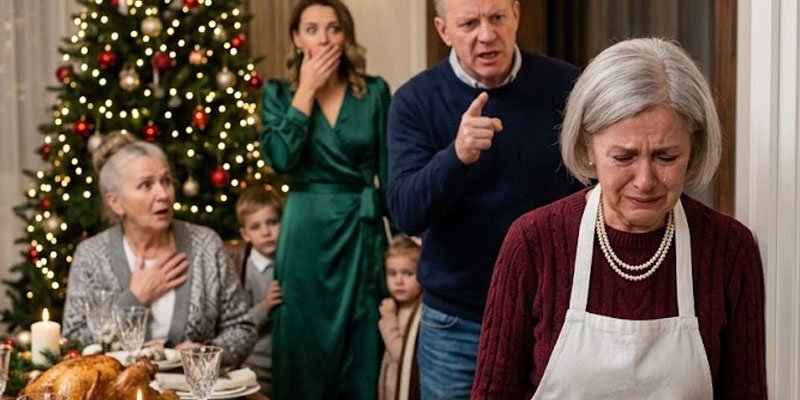
“You can’t sit here.”
My son-in-law, Brandon Whitaker, spoke softly enough that the children gathered in the living room couldn’t overhear him, yet loudly enough for everyone seated around the dining table to fall into complete silence.
The chair he pointed toward was mine.
Not because anyone had officially assigned it to me. There certainly wasn’t a plaque with my name attached.
Even so, it was the seat at the head of the table in the house my late husband and I had bought thirty-one years earlier—the very place where I had served Thanksgiving dinners, birthday celebrations, graduation parties, and every Christmas meal ever since my daughter Claire was six years old.
I shifted my eyes from Brandon’s hand to his face. He was wearing the brand-new navy sweater I had given him, the fabric around the collar still looking crisp.
Behind him, his mother, Donna, gently lowered her wineglass, wearing a polite expression of discomfort that looked strangely practiced.
“Excuse me?” I asked.
Brandon smiled, though there was no warmth in it. “Mom’s sitting there. It’s only fair. She’s the guest of honor this Christmas.”
Claire stood near the kitchen doorway, her face drained of color, gripping a bowl of mashed potatoes with both hands. She met my eyes for only a brief second before looking down at the floor.
In that instant, everything became clear.
This had all been planned.
Every chair around the table was already taken. My grandchildren, Lily and Owen, sat squeezed between their cousins.
Brandon’s brother and his wife occupied seats along one side.
Donna remained comfortably seated at the head of the table, her crimson-painted nails wrapped around the stem of her wineglass while pretending she wasn’t enjoying the situation.
I had spent two full days preparing that meal.
I had paid for the prime rib, baked the desserts, bought every gift beneath the Christmas tree, purchased the wine Donna always claimed she preferred, and even picked up the toys Brandon had remarked were “a little expensive this year.”
I had welcomed everyone because Claire had quietly pleaded, “Please, Mom. Just one peaceful Christmas.”
Yet there I was, standing in my own dining room while a man who had entered my daughter’s life like a storm calmly informed me there wasn’t a place for me at my own table.
“Brandon,” Claire said softly.
Without raising his voice, he turned toward her. “Don’t start. Your mother always makes everything about herself.”
Something inside me suddenly became perfectly calm.
Not angry.
Not loud.
Simply still.
I carefully placed the gravy boat in the center of the table. The crystal made a soft click against the wooden surface, and every person at the table noticed it.
“You’re right,” I said.
Brandon frowned. “What?”
“I can’t sit here.”
Claire’s head lifted immediately.
I untied my apron, folded it neatly once, and placed it beside my plate.
Then I picked up my purse from the sideboard, took my coat from the hallway closet, and walked toward the front door.
“Mom?” Claire called after me.
I looked back only one time.
“The meal is finished,” I said. “The house is not.”
Then I opened the front door, stepped into the icy Ohio evening, and left every one of them sitting behind me.
I didn’t go very far.
At seventy-two, I no longer believed in dramatic exits that ended with someone crying on the side of the road. Instead, I drove six blocks to the small café beside the library, the only place in town still open on Christmas because its owner, Mrs. Patel, believed loneliness never took a holiday.
She noticed me through the window before I even reached the entrance.
“Eleanor?” she asked, hurrying out from behind the counter. “Are you okay?”
“I am,” I replied, although my hands were shaking. “I just need a cup of coffee.”
She guided me to a booth in the back overlooking the snow-covered street illuminated by the glow of the streetlights. I wrapped both hands around the warm mug she placed in front of me and watched my reflection quiver faintly in the dark window.
My phone buzzed three times before I finally reached into my purse.
Claire.
Then Claire again.
Then Brandon.
I ignored Brandon’s call.
I answered Claire’s.
“Mom, where are you?” she asked quietly.
“At Patel’s.”
“Please come back.”
“Are you asking because you truly want me there,” I asked, “or because Brandon is em.bar.ras.sed?”
Silence.
Inside that silence, I heard years of memories.
I remembered Claire telling me Brandon didn’t like me stopping by without calling first, even though I still had a key for emergencies. I remembered her explaining that Brandon thought I spoiled the children too much. I remembered how she laughed too quickly whenever he corrected her in front of other people. And I remembered how, with every passing December, her voice seemed to grow just a little quieter.
“Mom,” she finally whispered, “he didn’t mean it that way.”
“Yes, he did.”
I heard her breathing change. “The kids are upset.”
“So am I.”
“I know.”
“No,” I replied gently. “You don’t. Not yet.”
Across the café, Mrs. Patel pretended to polish the same already-clean counter while quietly watching me from the corner of her eye. I lowered my gaze to my hands. My wedding ring had become loose over the years. Age had thinned my fingers, but I never stopped wearing it because Thomas had loved that house, that table, and the loud, joyful life we built there.
After he passed away, I made myself a promise that I would keep the family together.
Somewhere along the way, though, keeping the family together had turned into letting Brandon decide where I belonged.
“Claire,” I said, “I’m not coming back tonight.”
She let out a soft sigh, as if she had expected that answer but had still been hoping for another.
“Tomorrow morning,” I continued, “you and the children are welcome to come over if you want to talk. Brandon is not.”
“Mom—”
“I’m serious.”
“He’s my husband.”
“And I’m your mother. I’m also the owner of that house, the one who paid your car insurance twice this year, the one who covered Owen’s dental bill when Brandon said it could wait, and the one who stayed silent because I believed my silence was protecting you.”
Another pause settled between us.
This one wasn’t empty.
It was full of truth.
When Claire finally spoke again, her voice cracked. “I don’t know what to do.”
“For tonight?” I answered. “Feed your children. Put them to bed. Then ask yourself why your husband felt so comfortable humiliating your mother inside her own home.”
After I hung up, I stayed in that booth until the coffee in my mug had gone completely cold.
At exactly 9:14 p.m., a text from Brandon appeared on my phone.
You overreacted. You ruined Christmas.
I read it once.
Then I read it again.
Finally, I replied:
No, Brandon. I simply ended the performance.
And for the first time in six years, I didn’t feel guilty.
I felt sure.
The next morning, I returned home at 7:30.
Only my own car sat in the driveway. Snow had gathered along the edges of the front steps, and the Christmas wreath on the door hung slightly crooked after the night’s wind. For a brief moment, with my keys resting inside my gloved hand, I felt like a stranger standing outside my own life.
Then I unlocked the door.
The first thing that greeted me was the smell: cold prime rib, extinguished candles, spilled wine, and the faint scent of pine from the Christmas tree. The dining room looked almost exactly as I had left it—only messier. Some plates had been partially cleared away. Napkins lay crumpled over chair backs. Someone had spilled cranberry sauce onto the rug and simply covered it with a paper towel instead of cleaning the stain.
Donna’s wineglass still rested at the head of the table.
In my chair.
I stood there for a long time, looking at it.
Then I picked it up, carried it into the kitchen, and washed it carefully by hand.
Not because Donna had earned that kindness.
Because I had.
I cleaned the house slowly, without hurrying. I packed the leftovers into containers. I threw away the food that had dried out. I wiped down the dining table my husband had refinished twice after children carved initials into it and left scratches from years of homework. When everything was finally in order, I made myself a cup of tea and sat beside the Christmas tree in the living room.
At 10:03, there was a knock on the door.
Claire hadn’t used her key.
That single choice said more than words ever could.
When I opened the door, she stood on the porch with Lily and Owen. Lily was ten, observant and quietly protective, just as her mother had once been. Owen was seven, still young enough to carry a stuffed dinosaur tucked beneath one arm.
Claire looked worn out. She wore no makeup. Her hair had been pulled back carelessly. Even her coat was buttoned unevenly.
“Hi, Mom,” she said.
I stepped aside.
“Come in.”
The children rushed straight toward me.
“Grandma, why did Dad say you couldn’t sit there?” Lily asked before she had even taken off her coat.
Claire flinched.
I bent down as far as my knees allowed and gently touched Lily’s cheek.
“Because sometimes adults forget what respect looks like.”
“Did you leave because you were angry?” Owen asked.
“I left because I was hurt,” I answered. “And because if I had stayed, everyone would have learned that it was acceptable to hurt me.”
Lily looked at me with the kind of serious judgment only children can have.
“Dad said you were being dramatic.”
“I know.”
“Were you?”
“No.”
She nodded thoughtfully, as though placing that answer somewhere she intended to remember.
Claire sent both children upstairs to the guest room, where I kept board games and the wooden train set they always insisted they had outgrown. After the sound of their footsteps faded, she sat on the couch.
I chose the chair across from her instead of sitting beside her.
She noticed immediately.
Her eyes filled with tears.
“I’m sorry,” she whispered.
I folded my hands calmly in my lap.
“For what?”
She looked startled.
“Mom…”
“No,” I interrupted gently. “Say it plainly. Not because I want to punish you—but because you need to hear yourself say it.”
Claire pressed her palms together. Her wedding ring caught the light.
“I’m sorry I didn’t stand up for you. I’m sorry I let him speak to you like that. I’m sorry I made you believe you had to accept it just so Christmas wouldn’t be ruined.”
I gave a single nod. “Thank you.”
Then she began to cry—quietly, angrily—brushing the tears away before they could roll down her cheeks.
“He isn’t always like this,” she said.
I stayed silent.
She gave a bitter little laugh. “I know how that sounds.”
“Yes.”
“He’s under a lot of pressure. Work has been difficult. And his mother only makes things worse. She fills his head with the idea that he has to be the man of the house.”
“This is my house,” I replied.
Claire lowered her eyes.
“He hates that,” she admitted. “He hates that we’ve had to rely on your help. He says you use money to control us.”
I felt the familiar ache rising in my chest, but I kept my voice steady.
“Have I ever tried to control you?”
“No.”
“Have I ever told you how to raise your children?”
“No.”
“Have I ever asked you to choose me instead of him?”
“No.”
“Then what he resents,” I said, “isn’t control. It’s proof.”
Claire slowly looked up at me.
I continued, “Proof that he isn’t providing what he insists he provides. Proof that the woman he dismisses is the one preventing parts of his life from falling apart. Proof that kindness can appear to be weakness—until the person everyone thought was weak finally stands up.”
For the first time that morning, Claire held my gaze without looking away.
“He told me last night that I had to choose,” she said.
My stomach tightened.
“Between us?”
She nodded. “He said that if I came here today, I shouldn’t bother coming back home.”
The house suddenly felt incredibly quiet.
“And you came anyway,” I said.
Her lips quivered.
“I didn’t know where else to go.”
That was the moment I moved to sit beside her.
She leaned into me like she had when she was a little girl. For several minutes, we stayed like that—her head resting against my shoulder while my hand gently stroked her hair. I never said, “I told you so.” I didn’t remind her of every warning sign I had quietly noticed over the years. Some truths arrive like storms. Once they’ve swept through the house, there’s no point explaining the weather.
When she finally calmed, I said, “You and the children can stay here for as long as you need.”
She leaned back.
“I can’t just move in.”
“You can.”
“Brandon will lose his mind.”
“Brandon is responsible for Brandon.”
“He’ll come here.”
“Then he’ll stay outside.”
She searched my face.
“You really mean that.”
“I do.”
At exactly 12:40 p.m., Brandon arrived.
He didn’t knock.
He pounded on the door.
“Claire!” he shouted from outside. “Open the door!”
Lily appeared at the top of the staircase, her face pale with worry.
I looked up at her.
“Go back into the room, sweetheart. Close the door.”
She hesitated.
“Now,” Claire said, her voice shaking but firm.
Lily obeyed.
Brandon pounded again.
“Eleanor, I know she’s in there.”
I walked to the front door but made no move to open it.
“You may speak through the door.”
“This is ridiculous,” he snapped. “My wife and kids are coming home.”
Claire stood directly behind me. I could feel the fear radiating from her.
I answered calmly, “They are safe. They are welcome here. You will not come inside while you are yelling.”
“I’m not yelling.”
“You are.”
There was a brief silence.
Then his voice returned, quieter but colder.
“You always wanted this. You always wanted to turn her against me.”
“No, Brandon,” I replied. “You accomplished that yourself.”
He slammed the side of his fist against the door.
Claire flinched.
That single sound changed everything.
Not for me.
I had already changed.
For Claire.
She stepped forward and spoke loudly enough for him to hear.
“Brandon, go home.”
Silence.
“What did you say?” he asked.
“I said go home.”
“Claire, open this door.”
“No.”
The word was soft.
But it marked a beginning.
Brandon let out a bitter, humorless laugh. “Fine. Stay with Mommy. Let’s see how long that works once I cancel the credit cards.”
Claire closed her eyes.
Without saying another word, I took out my phone and began recording.
“Would you mind repeating that?” I said.
Silence followed.
A moment later, I heard his boots crunch through the snow. His truck door slammed. The engine roared to life, and he backed out far too quickly, leaving dark tire marks stretching across the white driveway.
Claire slowly sank onto the staircase as though all the strength had drained from her body.
“I can’t believe this is my life,” she whispered.
I sat down beside her.
“It’s your life today,” I said. “It doesn’t have to be your life forever.”
The week that followed was filled with practical decisions rather than drama. There was no revenge, no emotional spectacle—only the work that needed to be done.
With help from a family lawyer recommended by Mrs. Patel’s nephew, Claire began taking the first legal steps. She opened a bank account in her own name.
Together, we gathered everything we needed: birth certificates, tax records, school documents, insurance paperwork, and screenshots of messages Brandon had sent over the years—messages Claire had quietly saved inside a folder labeled “receipts,” because some part of her had always known they might matter one day.
Day by day, I watched my daughter slowly become herself again.
She laughed with the children more often. For the first time in months, she slept through the night. At first, she apologized constantly—for borrowing towels, eating a bowl of soup, or crying in the hallway. Every single time, I reminded her, “You live here now. You’re not a guest.”
Brandon tried every strategy he could think of.
First came anger.
Then blame.
Then flowers.
After that came a long voicemail in which he cried, blamed Christmas stress, claimed his mother had pressured him, and insisted he had never wanted to hurt anyone. Claire listened to it once without showing any emotion, then saved it for her attorney.
Three days before New Year’s, Donna called me.
I almost let it ring.
“Eleanor,” she said stiffly, “this has gone on long enough.”
“Has it?”
“You’ve interfered in their marriage.”
“No,” I answered. “I simply opened my front door.”
“Claire is emotional. Brandon says things he doesn’t really mean.”
“That seems to be a family habit.”
She inhaled sharply.
“You think you’re better than us because you own that house.”
I looked around my kitchen—the old cabinets, Thomas’s favorite chipped mug, and the refrigerator covered with children’s artwork held up by magnets.
“No,” I replied. “I simply know I’m safer than you because I understand what a home is meant to be.”
Donna ended the conversation.
By the middle of January, Claire officially filed for legal separation.
Brandon reacted first with anger, then disbelief when the temporary custody arrangement failed to give him the control he expected.
The court wasn’t interested in whether he felt humiliated on Christmas.
It cared about consistency, paperwork, school routines, financial records, and the fact that Claire had been the children’s primary caregiver while Brandon spent much of his time traveling for work and spending money to maintain appearances.
The first weekend Lily returned after visiting Brandon, she sat beside me while I folded laundry.
“Dad says you broke our family,” she said.
I calmly folded another towel.
“What do you think?”
She stayed quiet for a moment.
Then she said, “I think he was mean before Christmas too.”
I nodded.
“Sometimes I still miss him,” she added.
“That’s okay.”
“Even though he was mean?”
“Yes. People are complicated. Your feelings are allowed to be complicated too.”
She leaned gently against my arm.
“I like living here.”
I kissed the top of her head.
“So do I.”
That year, spring arrived slowly.
The snow disappeared from the gutters. Buds began appearing on the maple tree in the front yard. Claire found a part-time position at a pediatric clinic, then gradually increased her hours once Owen’s school schedule allowed it. She bought a used blue Honda using money from her own bank account and a small loan that I co-signed only after she insisted she would make every payment herself.
One Saturday in April, she carried the dining chairs outside to polish them.
I watched from the porch as she worked on the chair at the head of the table.
My chair.
She ran her hand over a rough spot on one armrest before looking over at me.
“Mom,” she called, “when Dad refinished this, did he use walnut stain?”
“Cherry,” I answered.
She smiled.
“Of course. He always liked everything a little warmer than necessary.”
I laughed.
The sound surprised both of us.
By the following Christmas, the house felt different.
Not because we had renovated it—we hadn’t. The same Christmas tree stood beside the window. The same stockings hung over the mantel, although two new ones had been added for Claire and the children to use every year if they wished. The same dining table stretched across the room, polished and set with my grandmother’s china.
But something else had changed.
No one whispered in corners anymore. No one measured every word before speaking. No one watched Brandon’s face to decide whether happiness was allowed.
Claire prepared the mashed potatoes. Owen scattered the forks unevenly across the table. Lily placed handwritten name cards at every seat. Mrs. Patel joined us because her nieces had gone to Florida, and she insisted she had only stopped by “to inspect the pie.”
When dinner was ready, everyone gathered around the table.
Out of habit, I walked toward the chair at the head.
Then I stopped.
Claire noticed.
“Mom?”
I looked at the chair, then back at my daughter.
Over the past year, that seat had come to symbolize humiliation, dignity, and finally survival. Yet looking at Claire standing taller than she had in years, I realized the chair had never truly been the issue.
The real question was whether I believed I deserved a place at the table.
I did.
But so did she.
I pulled out the chair at the head of the table and rested one hand on its back.
“Claire,” I said, “sit here tonight.”
Her eyes widened.
“No, Mom.”
“Yes.”
“That’s your seat.”
I smiled.
“It’s my table. Which means I decide where everyone belongs.”
The room fell quiet again.
This time, there was no fear.
Only love.
Claire slowly sat down, covering her mouth with one hand. Lily smiled from ear to ear. Owen immediately asked if that meant he could have the head chair next Christmas, making everyone burst into laughter.
I took the chair beside Claire on her right.
Before anyone started eating, Lily lifted her glass of sparkling cider.
“To Grandma,” she announced.
I shook my head.
“To all of us.”
Claire looked at me with tears shining in her eyes, though none of them fell.
“To all of us,” she repeated.
After dinner, once the dishes had been cleared away and the children were sprawled across the rug surrounded by new books and candy wrappers, Claire and I stood together at the kitchen sink washing plates.
“Do you ever regret walking away that night?” she asked.
I looked through the doorway toward the dining room, at the polished table, and at the chair where my daughter had sat like someone who had finally realized she deserved to take up space.
“No,” I answered. “I only regret waiting so long.”
She carefully dried another plate.
“I think about that sentence all the time.”
“Which one?”
“‘The meal is finished. The house is not.’”
A small smile crossed my face.
“I didn’t plan those words.”
“They sounded like you did.”
“At my age, dear,” I said, “some sentences spend years preparing themselves.”
Claire laughed softly.
Outside, snow began to fall once more—slow, quiet flakes that made the streetlights glow and the whole world seem clean for just a little while.
My thoughts drifted to Thomas.
Not with overwhelming grief, but with the quiet ache of wishing he could have seen the house full again.
Not perfect.
It had never been perfect.
But honest.
A home isn’t built by making sure every chair is occupied.
A home is built by knowing when to pull out a chair, when to offer someone a seat, and when to stand up and walk away before anyone convinces your family that love requires humiliation.
That Christmas night, Brandon believed he had taken away my place at the table.
What he never understood was that he had given me back my voice.