The hotdog had already gone cold.
It sat on a thin paper tray that looked strangely out of place beside crystal stemware, gleaming silver utensils, and sizzling cast-iron plates spread across the private dining room.
My son, Noah, looked at it silently.
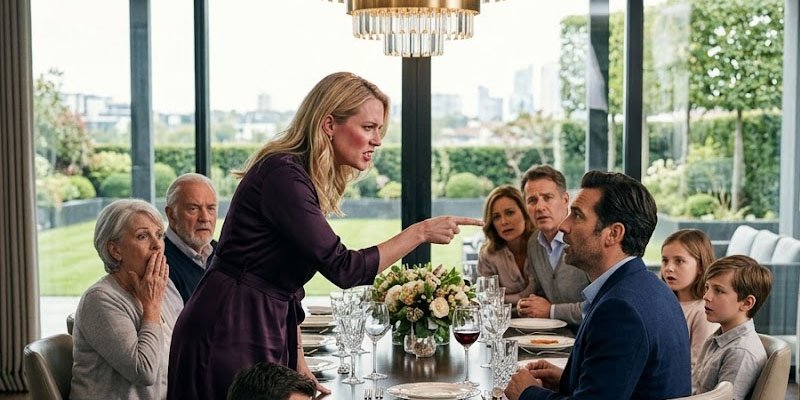
Across the table, his two cousins had just received thick-cut prime steaks, filling the room with the rich aroma of butter, roasted garlic, and fresh herbs. Their father—my older brother, Eric—watched proudly as the waiter carved each steak before setting it in front of them.
Then his eyes shifted toward Noah.
“Oh,” he said casually. “We didn’t order anything for your boy.”
He reached over to the side station, picked up a hotdog from the children’s menu, and placed it in front of my son.
“There you go.”
Noah lowered his eyes to the paper tray.
Then he looked at his cousins’ expensive meals.
Then at me.
He forced a small smile.
“I’m okay, Mom.”
Before I had a chance to respond, my mother spoke as if everything happening was completely normal.
“Claire, honestly, you know Noah is a picky eater. You should’ve brought something for him from home.”
Her words hit even harder than Eric’s thoughtless gesture.
She wasn’t uncomfortable.
She truly believed I was the one at fault.
For a brief moment, the room went completely silent.
Then Eric’s wife let out a quiet chuckle behind her wineglass.
My father suddenly seemed deeply interested in the restaurant’s wine menu, turning another page instead of meeting his grandson’s eyes.
The younger children kept eating.
Only Noah remained motionless.
He folded his hands carefully in his lap, trying not to make anyone feel awkward.
That was the moment something inside me cracked.
I recognized that expression.
Children don’t learn to make themselves invisible in a single day.
They learn it through one humiliation after another.
I gently rested my hand on his shoulder.
“You don’t have to eat it,” I whispered.
Eric leaned back in his chair, wearing the same smug grin he’d had since we were teenagers whenever he wanted to remind me of my place in the family.
“Oh, come on,” he said. “He’s eight years old. Kids love hotdogs.”
“It’s not a big deal.”
Mom nodded without hesitation.
“Exactly.”
Then she turned and looked straight at me.
“Your brother has already spent enough money tonight.”
Enough money.
I nearly laughed.
This entire dinner had been arranged to celebrate my father’s retirement.
Eric picked the most expensive restaurant in town.
He booked the private dining room.
He upgraded everyone to the premium tasting menu.
He ordered bottles of wine that cost more than many families spent on groceries in an entire week.
Before anyone had even arrived, he proudly announced, “Don’t worry, everyone. We’ll just put it on the family account.”
The family account.
Hearing those words made my stomach knot.
Because despite what everyone called it…
…it wasn’t really the family’s account.
Three years earlier, after my mother’s surgery, I quietly opened an emergency fund so there would always be money available if someone genuinely needed help.
Every month, I transferred part of my paycheck into it.
Eric never added a single dollar.
Dad never contributed either.
Mom occasionally withdrew money and jokingly called it repayment for everything she’d sacrificed while raising us.
Nobody ever questioned it.
Whenever costly dinners, vacations, or unexpected luxuries came up…
…my savings somehow became everyone’s financial cushion.
But when it came to showing my son the smallest amount of kindness…
…suddenly I was the one expected to prepare better.
Noah leaned closer to me.
His voice was barely more than a whisper.
“I’m really not hungry.”
I knew that wasn’t true.
He had been excited about this dinner all week.
That morning, he carefully buttoned his blue shirt because Grandpa always said family celebrations deserved nice clothes.
He had even made Grandpa a retirement card by hand, decorating it with colored pencils and writing, “Congratulations, Grandpa. I’m proud of you.”
Now he was pretending a cold hotdog was enough because he didn’t want anyone arguing because of him.
I gently squeezed his shoulder.
“You don’t have to pretend.”
Just then, our waiter returned carrying another bottle of Eric’s favorite reserve wine.
I watched him walk toward the table.
Then I slowly stood up.
Twenty-two relatives turned to look at me.
Eric smiled confidently.
He was clearly expecting another polite toast.
Instead, I looked directly at the waiter.
“Before dessert comes out,” I said calmly, “I’d like to make one small adjustment.”
The room became completely quiet.
“Please split the bill.”
The waiter blinked in surprise.
I continued before anyone else could interrupt.
“My son and I will only pay for what we ordered.”
I paused.
“Everything else should be charged to the person who organized this dinner.”
Eric’s smile vanished.
Then I added one final sentence.
“And while you’re updating the account…”
“…please remove my payment information from the family account permanently.”
A silence settled over the room so completely…
…that even the waiter stopped writing.
The First Person to Speak Wasn’t Eric
It was my mother.
Of course it was.
“Claire,” she said in that quiet warning tone she used when I was twelve and had embarrassed her in public by crying too much after falling off my bicycle. “Sit down. You’re making a scene.”
I kept my attention on the waiter.
He looked young—probably in his mid-twenties. Crisp apron, anxious expression. The kind of face restaurant staff wear when they realize a family dinner is only one awkward moment away from turning into complete chaos.
“Can you do that?” I asked him.
He looked at Eric, then back at me. “Yes, ma’am. I can split the bill.”
Eric let out a quick laugh, but it sounded forced. Tense.
“Don’t be ridiculous.”
“I’m not.”
“Claire.” He placed his napkin on the table. “This is Dad’s retirement celebration.”
“And Noah is Dad’s grandson.”
That statement hit the room.
Not because it was particularly clever, but because no one sitting there could argue with it.
My father finally lifted his eyes.
He didn’t speak.
He simply looked at the hotdog.
This Wasn’t New
This is the part people usually misunderstand when they hear a story like this.
They assume the hotdog was the entire issue.
It wasn’t.
The hotdog was simply the first time Eric pulled something like this in front of enough people, with enough money involved, and enough ugliness gathered in one place that I could no longer convince myself I was imagining it.
Eric had been doing different versions of this my entire life.
When we were children, he got a brand-new baseball glove while I was warned not to touch it because I’d “ruin the shape.” When I made the honor roll, Mom smiled briefly, then spent the next twenty minutes telling relatives all about Eric’s junior varsity football game. When I bought my first car with money I earned working at the pharmacy, Dad asked if I could drive across town to pick Eric up because his truck was being repaired. No offer for gas money. No thank-you. Just the expectation that I would do it.
When I married Noah’s father, David, my parents complained that our wedding wasn’t fancy enough.
When David walked away two years later, Eric said, “Well… men usually don’t leave unless they’re unhappy.”
He said it while opening a bottle of beer in my kitchen.
I still remember the sound of the cap striking the countertop.
My mother stayed silent that time too.
That was her specialty.
She could watch someone get hurt right in front of her and simply call it family tension.
So no, none of this began with a cold hotdog sitting on a paper plate.
It had started decades before.
The hotdog just happened to have ketchup on it.
The Waiter Knew Before My Family Did
He gave a small nod and wrote something on his pad.
“Certainly, ma’am.”
Then, because sometimes life sends unexpected kindness dressed in black slacks and restaurant shoes, he asked the question out loud.
“Would you also like me to remove the reserve wines and tasting upgrades from your portion of the bill?”
My brother’s expression immediately changed.
“Her portion?” Eric snapped. “Everything’s going on the account.”
The waiter remained calm.
“I was instructed to separate the bill.”
I answered, “Yes. Please remove every shared charge assigned to me. I only want to pay for my lemonade, the grilled salmon I ordered, and whatever my son actually chooses to eat. If he decides not to eat the hotdog, don’t include it.”
Noah looked up at me then.
Really looked at me.
My mother opened her mouth.
Closed it.
Then opened it again.
“Claire, for heaven’s sake.”
Eric’s wife, Dana, set her wineglass down with enough force to make it clink loudly.
“This is unbelievably childish.”
I turned toward her.
“Your children are eating steaks that cost more than Noah’s winter coat. Don’t lecture me about being petty.”
Color rushed into her face.
Across the table, one of Eric’s sons, Mason, asked, “Dad, why can’t Noah have steak?”
Dana quickly hissed, “Eat your food.”
That’s what children do.
They say the things everyone else is trying not to say.
My father rubbed his forehead as if a headache were beginning.
Good.
Then the Numbers Started Coming Out
Eric changed tactics.
His voice became softer.
Reasonable.
Or at least he tried to sound that way.
“Claire, you’re blowing this out of proportion. It was just a joke.”
“You allowed your nephew to sit without a proper meal while everyone else was served.”
“He had food.”
I looked down at the paper plate.
There was one slightly crooked hotdog inside a split bun, with a line of mustard slowly slipping into the fold.
“He had the leftovers of your dignity.”
I hadn’t planned to say that.
The words simply came out.
My cousin Janice made a small sound that suggested she wished she could disappear beneath the table. My Aunt Bev suddenly became very interested in asking for more ice water. Everyone seemed much more horrified by the way I spoke than by what had actually happened moments earlier.
Eric’s expression hardened.
“Real classy. Starting this during dinner.”
“Yes.”
I looked directly at him.
“That’s where you chose to do it.”
Then I turned back to the waiter.
“Could you please bring my son a full menu?”
“Of course.”
He walked away before Eric had the chance to object.
My mother leaned toward me.
“You’re humiliating your brother.”
I replied, “No. He behaved shamefully. Those are two completely different things.”
That was the moment she realized the old tactics no longer worked on me.
Her eyes narrowed.
I could almost see her reaching for the familiar routine.
First guilt.
Then the importance of family.
And tears if the first two failed.
“After everything this family has done for you.”
I actually laughed.
One short, sharp laugh.
I couldn’t stop it.
The entire table went still.
“For me?” I asked. “Tell me exactly what this family has done for me.”
She looked completely caught off guard, as though someone had taken away the script she always relied on.
I continued.
“When David left, who paid my rent for four months?”
No one answered.
“When your insurance deductible after surgery was more than Dad wanted to take from his retirement savings, who paid the difference?”
Still silence.
“When Eric needed bail after that DUI ten years ago because he was ‘too embarrassed’ to ask his in-laws, who transferred the money at eleven o’clock that night?”
That made several heads snap around.
Dana turned sharply toward Eric.
“What?”
He replied, “It only happened once.”
I looked at her.
“You didn’t know?”
Apparently, she had no idea.
That was the first major shift.
My Sister-in-Law Learned a Few Things
Dana slowly placed her palm flat against the table.
“Bail money?”
Eric muttered, “It was taken care of.”
“By who?”
No one answered.
So I did.
“By me. Technically, it came from the account… which was really my money.”
Dana blinked several times, looking as though the ground had suddenly shifted beneath her.
“You told me your father paid for that.”
My father let out a strange little sound that could almost have passed for a cough if someone wanted to be charitable.
Eric turned toward me.
“Why would you bring that up now?”
I shrugged.
“Because we’re talking about who pays for what.”
He leaned closer.
“You don’t get to throw things like that in people’s faces.”
That was almost funny.
“I never held it over you,” I replied. “I paid it, kept quiet, and never mentioned it for ten years. You’re the one who turned my son into the evening’s joke. That’s why we’re having this conversation.”
The waiter returned carrying a full dinner menu and, to his credit, placed it directly in front of Noah as though nothing unusual had happened.
Noah rested two fingers lightly on the edge of the menu.
“What would you like to order, buddy?” the waiter asked.
Noah looked at me first.
I smiled.
“Anything you want.”
His eyes slowly scanned the menu.
He wasn’t trying to choose the most expensive item.
Somehow, that hurt even more.
“Can I have the same steak Mason has?” he asked.
The entire room seemed to tense.
The waiter smiled warmly.
“Yes, sir.”
“And mashed potatoes?” Noah added.
“Absolutely.”
Eric let out a dry, humorless laugh.
“So now we’re buying him a hundred-dollar steak just to prove a point?”
I never even looked in his direction.
“No.”
“I’m buying dinner for my son.”
My Father Finally Opened His Mouth
The waiter walked away, and silence settled over the table.
In the dining room next door, silverware clinked softly.
Somewhere farther down the hallway, a woman burst into loud laughter.
Inside our private room, every sound suddenly felt strangely amplified.
Then my father cleared his throat.
He looked older than he had a few minutes earlier.
Not weak.
Just exhausted in a way I had never really allowed myself to notice.
“The account,” he said, avoiding my eyes.
“How much is in it?”
Some questions reveal exactly how people see you.
Not Claire, are you okay?
Not Noah, sweetheart, are you hungry?
Not even Eric, what on earth were you thinking?
Just…
How much is in it?
I answered anyway.
“This morning, it had a little over forty-two thousand dollars.”
Every fork froze in midair.
My Aunt Bev actually spoke first.
“Forty-two?”
Mom turned toward me so quickly that one of her earrings snagged in her hair.
“You never told us that.”
“You never asked.”
Eric muttered a curse beneath his breath.
“Jesus Christ.”
And there it was.
The second surprise no one at the table had seen coming.
All of them had treated that account like a convenient family fund.
As if it somehow refilled itself.
As if it quietly absorbed whatever expense happened to come along.
A dinner here.
A deposit for a beach house there.
A plane ticket so Mom could visit her cousin in Tampa.
Emergency dental treatment for one of Eric’s kids that somehow became three extra nights at a resort because, as they put it, “we were already there.”
Forty-two thousand dollars.
Because I worked weekends.
Because I passed up things I wanted.
Because after David walked away, I learned one lesson the hard way:
No one was coming to rescue me.
If disaster ever arrived, I needed money in the bank—not empty promises.
My mother placed a hand against her chest.
“Claire, that’s family money.”
“No,” I answered.
“It was emergency money.”
“You all simply got comfortable pretending those were the same thing.”
Dessert Never Came
Eric shoved his chair backward so hard it screeched across the floor.
“Fine. Fine. If this is how you want to handle it, we’ll pay tonight’s bill ourselves.”
“You absolutely will.”
His expression darkened.
He knew he had lost the room.
“You always do this,” he snapped. “You act like you’re above everyone else because you earn good money and keep track of every little thing.”
Some lies get repeated within a family so many times that eventually everyone accepts them as truth.
I didn’t respond immediately.
Then I said, “I started keeping score the day Noah began apologizing for existing.”
That silenced him.
Because Noah really had started doing that.
Little things.
Saying sorry when he asked for a juice box at his grandparents’ house.
Offering to sit on the floor if there weren’t enough chairs.
Giving his cousins the larger cookie before even picking one for himself.
For a long time, I thought he was simply being kind.
Then one afternoon, after a birthday party at my parents’ house, he asked me in the car, “Mom… are we the extra family?”
I nearly drove through a red light.
Children know.
They understand long before the adults are willing to admit the truth.
That was when my mother started crying.
Real tears.
Perfectly controlled ones.
“I’ve always loved Noah.”
I looked at her and, just for a moment, wished I could believe those words enough for them to matter.
“Love that lets a child sit in front of a cold hotdog while everyone watches doesn’t mean much to me.”
After that, no one even reached for the dessert menus.
The restaurant staff must have sensed what had happened because they wisely stayed out of the room.
Some relatives began doing that familiar awkward routine of pretending none of it involved them.
Coats were collected.
Phones suddenly became fascinating.
My cousin Janice silently mouthed call me as she slipped away.
She wouldn’t.
People like Janice never actually call.
They only like standing close enough to watch the fallout—as long as none of the ashes land on them.
Then Noah’s steak arrived.
Served on a hot plate.
A real plate.
Real silverware.
A small cup of sauce beside it.
Steam rising gently from the meat.
The waiter carefully placed it in front of him.
“Is there anything else I can get for you, sir?”
Noah straightened in his seat.
“No, thank you.”
He cut into the steak.
His first bite was too large.
He glanced at me, embarrassed.
I gently took the knife from him.
“Here.”
My hands trembled once.
Only once.
Then I cut his steak into smaller pieces.
The Part I Didn’t Say Until the Parking Lot
Eventually the bill was sorted out.
There was plenty of muttering.
Eric argued with Dana in a tense whisper.
My mother kept repeating my name as though it were something she could erase.
My father signed the receipt without even reading it.
Typical.
I paid for my grilled salmon.
Noah’s steak.
One lemonade.
The tax.
The tip.
And I tipped that waiter generously enough that he could enjoy a pretty good weekend.
Then I took Noah’s hand and we walked out.
No dramatic exit.
No slammed doors.
No final speech in the dining room.
Just the hallway.
The soft carpet beneath our feet.
The hostess deliberately avoiding eye contact.
The heavy glass doors opening onto the parking lot where the cool night air smelled of rain on pavement.
Noah looked up at me.
“Am I in trouble?”
That question hurt more than anything else that happened all evening.
I crouched in front of him so quickly my heel slipped against the painted curb.
“No.
Baby, no.”
“Because I wanted the steak?”
“Noah.”
I rested both hands on his shoulders.
“You could ask me for the moon, and you still would never be in trouble for being hungry.”
He nodded.
But only halfway.
Then, very carefully, he asked,
“I didn’t want Grandpa to think I was greedy.”
I closed my eyes for a single second.
When I opened them, my mother was walking out through the restaurant doors.
Of course she was.
The Last Thing She Expected
“Claire, wait.”
I stood.
She walked toward us wearing her good navy coat—the one she always wore when she wanted the world to see her as respectable, dependable, and above any family drama.
Her lipstick remained flawless.
Her eyes were damp.
She had always been remarkably good at looking graceful while suffering.
“Don’t do this,” she pleaded.
That moment had already passed.
She turned toward Noah.
“Grandma loves you.”
Noah moved closer against my side.
Nothing dramatic.
Pure instinct.
That seemed to affect her more than anything else.
She lowered her voice.
“You can’t cut your family off over one misunderstanding.”
I answered,
“Watch me.”
Her expression shifted.
Not hurt.
Not at first.
Panic.
Because beneath all her talk about forgiveness, unity, and keeping the peace, she understood exactly what my walking away meant.
No more account.
No more quiet daughter paying the bills.
No more dependable person smoothing everything over while taking the blame for whatever went wrong.
She reached toward my arm.
I stepped back.
“Claire, be reasonable.”
“No.”
“You’re going to turn Noah against us.”
I looked down at him.
His small hand was wrapped tightly around two of my fingers.
“You already did that yourselves.”
My father came outside a moment later.
More slowly.
He stopped near the restaurant entrance instead of coming closer.
“Claire,” he said.
I waited.
He had fifty years of being my father and only one sentence to spend.
He chose,
“Maybe we can talk tomorrow.”
Maybe.
Not I’m sorry.
Not I should have spoken up.
Just…
Maybe.
I nodded once.
I was simply too exhausted to do anything more.
“Maybe.”
Then I opened the back door of the car, helped Noah climb inside, and buckled his seatbelt while he hugged Grandpa’s retirement card against his chest.
Somewhere during all the confusion, he had remembered to bring it with him.
I hadn’t.
That realization hurt.
I climbed behind the wheel and started the engine.
My mother still stood beneath the yellow glow of the parking lot lights, her arms folded now that crying hadn’t accomplished what she wanted.
As we drove away, Noah spoke from the back seat.
“Can we stop somewhere before we go home?”
“For what?”
He was quiet for a moment.
“Can we buy Grandpa another card?
The other one feels strange now.”
I swallowed and kept my eyes on the road.
“Yeah,” I said.
“We can do that.”
We stopped at the twenty-four-hour drugstore on Maple.
We picked out a blank card with a fishing boat on the front because Noah said Grandpa liked boats, even though he always got seasick.
Sitting in the car beneath the dome light, Noah carefully printed the words:
Happy retirement. I hope you learn how to be nice when you have more free time.
I didn’t ask him to change a single word.
If this story struck a nerve, share it with someone who will understand.
If you enjoy emotional family stories, you may also like reading about why one simple name brought a grandson to tears, or the time an entire family arrived with a moving truck on someone’s eighteenth birthday. And if you’re in the mood for something different, take a look at Janet Jackson’s BET Awards outfit inspired by 1990s fashion.