
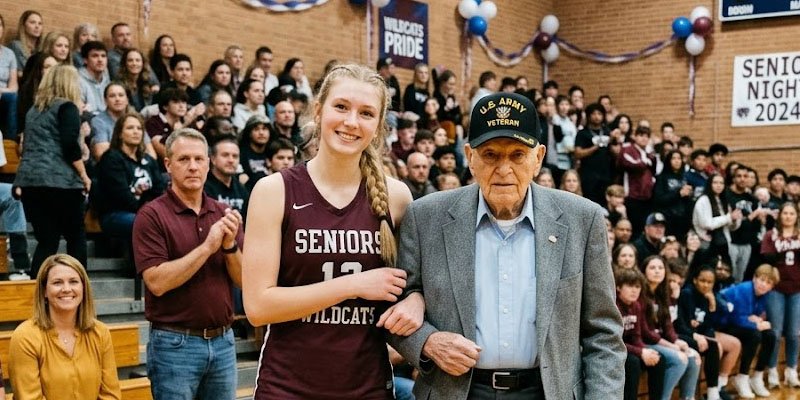
My husband told my daughter senior night was meant for “real dads”—so my 79-year-old father escorted her onto the court with his cane
“That privilege is reserved for real fathers, Kaylee.”
Those were the words my husband, Travis, spoke to my seventeen-year-old daughter just two days before her high school senior night. For nine years, he had helped raise her, attended every volleyball match, and cared for her as though she were his own. But when she invited him to accompany her onto the court, he turned her down.
Kaylee didn’t protest. She quietly said, “Okay,” before heading upstairs.
What Travis didn’t realize was that I had decided to call my seventy-nine-year-old father, a man who struggled to get around without his cane.
And when Grandpa entered the gymnasium that Thursday night, what unfolded brought hundreds of people to their feet and left my husband struggling to hold back his tears.
I’m Jodi Brandt, forty-one years old, and I work as a dental hygienist in a small Minnesota community roughly forty minutes outside Mankato.
That October Tuesday evening started like countless others. I’d made tater tot hotdish, a favorite in our household. Travis sat opposite me, our eight-year-old son Mason was focused on his food, and Kaylee appeared more anxious than usual.
She was finishing her final year of high school, had become an accomplished volleyball player, and was among six graduating athletes scheduled to be recognized during Thursday’s last home match.
During the ceremony, each senior would enter the court with family members, be acknowledged for their accomplishments, and have pictures taken.
Kaylee had eagerly anticipated that moment for several weeks.
Midway through our meal, she looked across the table at Travis.
“Would you walk out onto the court with me Thursday evening?”
He set his fork down next to his plate.
“Kay, I’m not sure that would be right.”
Her eyebrows drew together.
“How come?”
“Because that’s something your actual father should do. I wouldn’t feel right stepping into a role that doesn’t belong to me.”
An uncomfortable silence settled over the kitchen.
Kaylee looked at him in disbelief.
“But you’re at all my games.”
“I know, honey. And I’ll be watching Thursday, too. But if your biological dad ever bothers to come around, he’s the one who ought to be standing beside you.”
I saw the hurt spread across my daughter’s face.
For an instant, it seemed she might challenge him.
But she merely gave a small nod.
“Whatever.”
She got up, brought her dinner plate to the sink, placed it inside the dishwasher, and went upstairs.
Her bedroom door closed without a bang.
For some reason, that quiet response hurt even more.
Mason glanced up at me, ketchup smeared across his chin.
“Mom?”
I had no words.
Every part of me wanted to confront Travis right then. I wanted to list all the ways he’d been there for Kaylee and make him see how deeply unfair his response had been.
But I understood something about the man I’d married.
If I insisted that he accompany her, he would do it.
Travis was reliable and almost always followed through when his family needed something.
And that was exactly what bothered me.
I didn’t want my daughter entering the court with a man who was standing beside her only because someone had instructed him to.
I needed Travis to make that choice himself.
After sharing nine years as a family, I wanted him to realize that the role was already his.
So I said nothing.
In hindsight, I’m uncertain whether staying quiet was the right decision. Maybe I should have confronted him immediately.
At that moment, though, I wanted him to reach that understanding on his own.
And to appreciate why, you first need to understand Kaylee’s history with her biological dad.
His name was Ryan.
I married him at twenty-two, when I was still young enough to think being in love could overcome nearly every difficulty.
When Kaylee was four, Ryan took a position working in North Dakota’s oil fields. The money was wonderful, but living so far apart slowly damaged our family.
Initially, he returned every couple of weeks.
Later, his visits stretched to every few months.
Eventually, the visits stopped entirely.
He called less and less. Her birthdays came and went without a word. Promises he made were left unfulfilled.
Kaylee last heard his voice on the day she turned eleven.
He had assured her he’d be present for her confirmation.
He didn’t come.
That had been six years earlier.
Although Kaylee kept his number in her phone, she hadn’t dialed it since she was in middle school.
His contact was saved under Ryan.
Not Dad.
Travis became part of our family when Kaylee was seven.
He sold soybean and seed corn products from a warehouse just outside our town. Our paths crossed when he visited the dental office because he’d broken a molar.
For almost two years, he continued booking appointments before he finally worked up the nerve to invite me out for dinner.
He later confessed that he occasionally scheduled cleanings sooner than he really needed them, simply for another chance to see me.
During our second date, he brought up the possibility of meeting Kaylee.
“I don’t want to get involved in your world if your little girl isn’t comfortable having me around,” he told me.
That consideration meant far more than any costly present ever could.
The first time Travis came to our home, Kaylee sat him down at the kitchen table and questioned him.
“Have you got a dog?”
“Nope.”
“Do you know how to braid hair?”
“Not at the moment.”
“Are you a Minnesota Twins fan?”
“When they’re playing well.”
Kaylee burst out laughing.
Later that summer, Travis quietly began teaching himself to braid by practicing with orange baler twine fastened to a cupboard handle at his warehouse.
One afternoon, I caught him in the middle of practicing.
His face turned red when he noticed me standing there.
We got married the next year.
Kaylee was eight years old.
She called him Travis back then, and even at seventeen, that was still what she called him.
Neither seemed bothered by the arrangement.
I figured it was simply the natural shape of their relationship.
Yet in every practical sense, Travis behaved like a loving father.
He took Kaylee to volleyball practices, even when driving there and back meant spending two hours on the road. He constructed a training net out of discarded fence posts and cargo netting. He never missed a match and always arrived carrying a clipboard filled with statistics that no one had requested.
He could recite her performance figures almost as accurately as her volleyball coach.
Whenever school assignments required extra help, he stayed awake into the night.
When illness kept her in bed, he delivered soup and monitored her fever.
When she felt anxious about her first school dance, he remained nearby until she wanted to leave.
Despite all that, he never described himself to anyone as her dad.
I’d always assumed he was trying to honor the connection she had with Ryan.
It never occurred to me that what began as consideration had slowly turned into insecurity.
After Tuesday’s dinner, Travis headed to the warehouse, saying there was inventory he needed to inspect.
I climbed the stairs and tapped gently on Kaylee’s bedroom door.
“Come on in.”
She lay stretched across her bed, watching the ceiling fan turn.
I took a seat next to her.
“You don’t need to say anything unless you feel like it.”
“Great, because I really don’t.”
I stayed there quietly.
After a while, she finally broke the silence.
“He has a point, Mom.”
“What do you mean?”
“He’s not the man who gave birth to me.”
I took her hand.
“That doesn’t make him any less a member of this family.”
Her gaze remained fixed above us.
“I understand. I just figured we’d moved past caring about that.”
Her words grew softer.
“But clearly he hasn’t.”
A painful heaviness settled in my chest.
“Kaylee, if you could choose anyone, who would you want beside you on Thursday?”
She thought about it for a moment.
Then she rolled toward me.
“Would Grandpa be able to?”
My dad, Duane Ostrem, was seventy-nine.
For over five decades, he’d operated a dairy farm on the outskirts of town. When my mother died, he sold his cattle but continued living on the farm.
Every morning, he was still awake before the sun came up.
Two winters before, he’d needed a hip replacement, and ever since that operation, he’d depended on a wooden walking cane.
His steps had become slower, but he’d lost none of his stubborn resolve.
Kaylee absolutely loved her grandfather.
As a little girl, she’d spent endless summer days trailing him around the farm. When she was eleven, he even taught her to steer his aging Ford pickup through an open field.
That happened during the same year Ryan disappeared from her life.
“You know Grandpa can’t move very quickly anymore,” I told her.
“I know that.”
“And there’s a lot of ground to cover in that gym.”
“That doesn’t bother me, Mom.”
She met my eyes without looking away.
“He’s who I want.”
Then she made another request I hadn’t expected.
“Could it be only him and me? Just Grandpa walking with me?”
I felt a lump in my throat.
A part of me had hoped to accompany her myself.
But the evening belonged to her, not to me.
“Absolutely, sweetheart.”
The next morning, I contacted Mrs. Larson, the school’s activities director.
On the original senior-night paperwork, I’d listed myself and Travis as the two people accompanying Kaylee.
That information now had to be updated.
“Who would you like me to list?” Mrs. Larson asked.
“Her grandpa, Duane Ostrem.”
She hesitated briefly.
“Oh, that sounds wonderful.”
Then, in a softer tone, she asked:
“Jodi, are things all right with your family?”
“Yes. Kaylee just really wants her grandfather there.”
I wasn’t lying.
I simply wasn’t explaining everything.
On Wednesday night, I phoned Dad.
As usual, it took four rings before he picked up.
I told him the entire situation.
What Kaylee had asked.
How Travis had turned her down.
What he’d said about real fathers.
My dad let me finish without saying a word.
He didn’t say anything negative about Travis afterward.
Instead, he wanted to know just one thing.
“Does Travis have any idea you’re talking to me?”
“No.”
Dad remained quiet for several moments.
Finally, he answered:
“Then tell me when I need to show up.”
I almost broke down.
“They’re starting at about six forty-five. Would you be able to get there by six?”
“Count on it.”
“Dad, you’ll have to cross a pretty big gym. And you’ll need that cane.”
He gave a little laugh.
“Jodi, I’ve trudged through deeper snow than you can imagine just to get to my barn. Walking across a gym for my granddaughter shouldn’t be much trouble.”
I kept our plans from Travis.
Deep down, I realized I probably ought to tell him.
But I feared that if he discovered Dad was coming, he’d volunteer to take over just to avoid being embarrassed.
I wanted him to recognize what he’d done wrong without being pushed.
At last, Thursday came.
I stayed at the dental office until four, then went to collect Mason.
He’d created a poster for Kaylee, complete with an enormous orange volleyball that looked remarkably like a pumpkin.
“That’s supposed to be a volleyball,” he explained before I could say anything. “There wasn’t any white left.”
We got to the high school gym shortly after five.
Travis arrived straight from his job, dressed in the fleece vest and work boots he wore almost every day.
He took a seat next to me toward the front of the bleachers.
The air carried the scent of popcorn mixed with freshly buffed floors. Gold and maroon decorations hung from the railings, while oversized pictures of the six graduating volleyball players were displayed near the scorer’s table.
In Kaylee’s photograph, she’d been captured mid-jump, ready to hit the ball, with her long blonde braid swinging behind her.
Nearby stood a container filled with red roses.
The senior-night custom was for each graduating player to hand a rose to the family member who accompanied them.
I caught Travis glancing toward the flowers.
A moment later, he looked down.
With his hands clasped between his knees, he anxiously rubbed one thumb against the other.
“You doing okay?” I asked him.
“Yeah. Fine.”
It sounded painfully similar to Kaylee’s answer on Tuesday.
While the junior varsity game carried on, I kept checking the side doorway.
The clock reached six.
Then five minutes passed.
I began to fear Dad might have run into some difficulty during the drive.
Finally, at 6:12, the side entrance swung open.
There stood my father.
He was dressed in his beige Sunday jacket, freshly pressed white shirt, shiny shoes, and the green seed-company baseball cap he loved wearing.
His familiar hickory cane was gripped in his right hand.
Rather than coming up to sit with us, he headed straight for the graduating players assembling beside the court.
The instant Kaylee spotted him, her whole face brightened.
She rushed to meet him and hooked her arm around his.
I glanced toward Travis and saw him watching them from the stands.
His expression first showed puzzlement.
Then understanding.
He slowly faced me.
“Jodi?”
“Kaylee asked Grandpa to be her escort,” I said quietly. “She asked him after dinner on Tuesday.”
Travis turned his attention back to the court.
Kaylee was smiling and laughing at something my father had told her.
My husband said nothing.
He remained completely motionless in his seat.
When the junior varsity teams finished and left the playing area, the seniors formed a line along the sideline.
Mr. Halvorson, who’d been announcing school games for years, tested the microphone with a tap.
“Ladies and gentlemen, let’s recognize our graduating senior volleyball athletes and the families joining them this evening.”
The first senior entered accompanied by her mother and father.
The next came forward with her mom and stepdad.
A third walked out surrounded by relatives, one of whom was her grandmother using a wheelchair.
The audience applauded each group warmly.
Then Mr. Halvorson picked up the following announcement card.
“Wearing number seventeen, a four-year varsity letter recipient and middle hitter, Kaylee Brandt! Tonight she’s being accompanied by her grandfather, Mr. Duane Ostrem!”
A quiet buzz swept through the crowd.
Almost everybody in our small community recognized my father.
Some remembered buying dairy products from his farm. Others knew him through church, had worked with him, or had been acquainted with him since they were children.
Kaylee shifted her rose into her left hand, then wrapped her right arm around her grandfather’s.
Dad carefully set the tip of his cane against the shiny gym floor.
Together, they started forward.
At a slow pace.
Cane.
One step.
Another step.
Cane.
One step.
Another step.
Nothing about his movements was rushed.
Gradually, the noise in the gym faded as everyone watched the elderly farmer guide his granddaughter toward the middle of the court.
Mr. Halvorson kept announcing her accomplishments.
“Throughout high school, Kaylee has remained on the honor roll, belonged to the National Honor Society, and spent eight years exhibiting dairy heifers through 4-H…”
Then a spectator near the very top of the bleachers got to their feet.
Someone else stood next.
Then a third person rose.
In only a few moments, entire rows of spectators were standing.
People who’d known Dad for most of their lives applauded him.
Families sitting on the visiting team’s side joined in.
The opposing volleyball players started clapping as well.
Before long, almost the entire gymnasium was standing.
I pressed a hand over my mouth.
My eyes filled until everything looked blurry.
Dad, however, seemed completely unaware of the attention.
He continued studying the floor, giving every step his full concentration.
Kaylee stayed close, holding his arm with unmistakable pride.
That’s when I saw someone beside me move.
Travis was getting to his feet.
Initially, I figured he was standing to applaud with everyone else.
But he wasn’t clapping.
Both arms hung loosely by his sides.
His eyes were fixed on the court.
I watched his jaw grow tense.
Suddenly, he grabbed the handrail and began descending the bleachers.
My pulse quickened.
Four stairs separated our row from the gym floor.
I watched him take each one.
Still wearing his work boots, Travis stepped across the sideline and headed toward my father and Kaylee.
He caught up with them when they were roughly ten feet away from the middle of the court.
He moved alongside Kaylee, opposite Grandpa.
Then he held out his arm to her.
My daughter came to a halt.
She turned to face him.
For a few seconds, she stayed perfectly still.
I watched her shoulders lift as she drew in a breath.
Then she placed her available hand through his arm.
All three started walking forward side by side.
Grandpa stood to her left.
Travis walked on her right.
Cane.
One step.
Another step.
Travis slowed his stride so he could keep pace with my father.
The clapping became even more thunderous.
Beside me, Mason sprang up, shaking his handmade sign above his head.
“That’s my dad! Look, that’s my dad!”
After finishing the announcement of Kaylee’s accomplishments, Mr. Halvorson left his position near the scorer’s table.
He approached Travis and offered him the microphone.
My husband looked absolutely frightened.
He’d always been reserved, far more comfortable speaking privately with farmers than addressing a room full of strangers.
Now several hundred spectators were focused on him.
He brought the microphone toward his mouth.
I could see his fingers shaking.
“I’m Travis Brandt,” he said. “For the past nine years, I’ve been Kaylee’s stepdad.”
He stopped for a moment.
“On Tuesday evening, Kaylee invited me to accompany her out here. I turned her down.”
A hush fell over the gym.
“I told her that was something only real fathers should do.”
His gaze dropped toward the floor.
“I believed I was leaving room for someone else who had a greater right to be there. For nine years, I’ve been afraid I wasn’t entitled to think of myself as her father.”
He turned to look at Kaylee.
Emotion caught in his throat.
“I understand now that I got it wrong.”
He paused to steady himself.
“Kay, I’ve been beside you for nine years. I’ve acted as your father in every way that truly counts. But I was too afraid to actually admit it.”
His eyes were wet.
“I’m so sorry, honey.”
He returned the microphone.
Kaylee didn’t answer him with words.
She moved toward him and threw both arms around his body.
Travis pulled her into a close embrace.
Her long blonde braid rested against the back of his fleece vest.
Up in the stands, I couldn’t contain my tears.
Then my father made a gesture I’ll remember for the rest of my life.
When they arrived at center court, Kaylee had presented him with her red rose.
He’d been carefully carrying the flower alongside his cane.
As Kaylee released Travis from their hug, Grandpa reached out and offered Travis the rose.
My husband immediately shook his head.
“I can’t take that, sir. It belongs to you.”
Dad didn’t lower his hand.
“Go ahead and take it, son.”
Travis paused uncertainly.
My father smiled at him.
“I’ve already brought up my own daughter. Now it’s your turn with this one.”
Travis stood frozen for a moment.
Finally, he took the flower.
Dad gave Kaylee a small nod, straightened his baseball cap, and turned to begin the journey back across the floor.
One of the younger volleyball players approached and offered to help him.
He gave her a grateful smile but kept moving independently at his slow, steady pace.
Once he reached the stands, he carefully managed the four stairs and settled into the seat beside me.
His breathing was slightly heavier than normal.
I rested my head against his shoulder.
“Dad…”
He gently tapped my knee.
“Well,” he remarked, “I’d say that turned out all right.”
Despite my tears, I couldn’t help laughing.
Meanwhile, Kaylee and Travis were having their photograph taken on the court.
The rose was in his hand.
Her arm was linked through his.
Both looked overwhelmed with emotion.
Then Kaylee turned toward our section of the bleachers and beckoned.
“Mom! Grandpa! Mason! Get down here!”
Mr. Halvorson laughed into the microphone.
“Come on down, Jodi! Let’s get everybody in the picture!”
The audience responded with affectionate laughter.
And that’s exactly what we did.
Without a single complaint, Dad got up and carefully made his way down the stairs again.
The picture from that night remains attached to our refrigerator.
All five family members are gathered beneath the maroon-and-gold decorations.
Mason’s homemade volleyball sign is upside down in his hands.
We didn’t discover that detail until after the photo had been printed.
We chose not to change a thing.
There was very little conversation on our way home.
Mason was asleep before we’d even driven out of town.
Kaylee had gone to celebrate with her teammates over pizza.
Travis kept both hands firmly on the wheel.
The red rose lay across the dashboard.
We rode in silence.
After I tucked Mason into bed, I discovered Travis sitting alone at our kitchen table.
It was the very place where he’d rejected Kaylee’s invitation forty-eight hours earlier.
The flower rested on the tabletop in front of him.
I prepared some coffee and took the chair opposite his.
“I owe you an apology for keeping Dad’s visit from you,” I told him. “I should’ve told you what was happening.”
Travis slowly shook his head.
“If I’d known, I would’ve agreed to escort her because you were asking me to.”
His eyes stayed on the rose.
“I had to choose to do it because Kaylee needed me to.”
What he shared next was something he’d never mentioned during our entire nine-year marriage.
When Travis was twelve years old, his mother married for a second time.
Her new husband’s name was Dale.
Dale wasn’t an abusive man. He held a steady job, supported the family financially, and treated Travis reasonably well.
But he never viewed Travis as his own son.
That spring, Travis was playing Little League baseball.
At the season-ending awards dinner, every boy was expected to go forward with his father to collect his trophy.
Travis invited Dale to stand beside him.
Dale said no.
“That’s a job for your own father,” he’d told Travis. “I’m not about to act like someone I’m not.”
Travis’s biological dad didn’t come to the banquet, either.
So at twelve years old, Travis walked to the front alone, received his award, and went back to his chair.
After that evening, he never again invited Dale to attend an occasion with him.
Sitting at our table, Travis slowly rolled the rose between his fingers.
“I made a promise to myself that I’d never let a kid experience what I went through that night.”
I studied his face.
“So why did you end up telling Kaylee practically the same thing?”
His eyes became glassy.
“Because for nine years, I’ve been terrified of crossing a boundary.”
He pressed a hand against his forehead.
“Whenever I wanted to introduce her as my daughter, I thought about Ryan coming back someday. What if Kaylee got angry because I’d tried to replace him? What if I took a title she never intended to give me?”
He fell quiet for a moment.
“When I told her senior night belonged to real dads, it wasn’t because I doubted Kaylee. I was afraid that I didn’t qualify.”
I extended my hand across the table.
“Travis…”
He raised his eyes to mine.
“Then tonight I saw your seventy-nine-year-old dad making his way across that court. He wasn’t standing around wondering if he deserved to be there. Kaylee needed him, so he came.”
His voice trembled once more.
“And it finally hit me that I’ve been there for her for nine years, yet I’ve kept convincing myself that it still didn’t count.”
I wrapped my fingers around his hand.
We remained at the table together until almost eleven o’clock.
Then we heard the back door swing open.
Kaylee had returned from celebrating with her volleyball team. She still wore her warmup jacket, and her braid was partly coming loose.
She paused when she saw us sitting together.
Her gaze drifted toward the flower.
Then she crossed the kitchen, approached Travis, and settled onto his knee.
She hadn’t sat that way since she was a small child.
Now, at five feet ten, she was far too tall to fit comfortably.
Neither of them seemed to mind.
“People won’t stop sending me clips from tonight,” she told us. “Somebody uploaded a video of Grandpa crossing the gym, and now it’s everywhere on Facebook.”
Travis chuckled under his breath.
“Your grandfather probably couldn’t tell you what Facebook even is.”
“Exactly! That’s what makes it hilarious.”
After a moment, her expression grew thoughtful.
“Travis, I wasn’t really mad that you refused.”
He turned toward her.
“What hurt was thinking you didn’t actually want to stand beside me.”
His face softened.
“Kay, I’ve wanted that all along. I was just frightened.”
“Of what?”
He took a moment before responding.
“That one day you’d say I wasn’t your real father.”
Kaylee gave him a look as if he’d just said the most ridiculous thing she’d ever heard.
“Travis, who showed me how to braid my hair?”
A tearful smile crossed his face.
“That was me.”
“And who took me to volleyball practice whenever Mom had to work?”
“I did.”
“Who made that practice net for me?”
“Me.”
She leaned her head against his shoulder.
“So how could you possibly believe you’re not my dad?”
I got up and went over to the sink, unable to stop the tears streaming down my face.
The next morning, Dad phoned to find out whether we’d remembered to put the rose into water.
Travis promptly cut a little off the stem and placed it inside a glass jar on the kitchen windowsill.
The rose stayed fresh for nine days.
Dad thought that was an excellent lifespan for a flower in October.
Travis didn’t make any more speeches in public about being Kaylee’s father.
That simply wasn’t his personality.
Instead, I began noticing quiet but significant changes in what he did.
He started going inside for parent-teacher meetings rather than sitting outside in his pickup.
He spoke to Kaylee’s teachers himself, took an interest in her schoolwork, and became actively involved in preparing her for college.
When people called Kaylee his daughter, he stopped acting uncertain.
The Saturday after senior night, he went out to Dad’s farm and fixed a damaged latch on the equipment shed.
Nobody had asked him to repair it.
He just arrived carrying his tools.
My father later mentioned that the two of them exchanged hardly any words.
After repairing the latch, they sat on the back of Travis’s pickup and shared coffee from a worn-out thermos.
After some time, Dad remarked:
“That’s a fine girl you’ve got.”
Travis agreed with a nod.
“She certainly is.”
They said nothing else.
But for those two men, that brief exchange expressed everything they needed to say.
Kaylee’s volleyball season came to a close in November when her team suffered a painful defeat in the sectional semifinals.
She was upset for several days, but soon her attention shifted toward the excitement of graduating.
By the time April arrived, she was working on her graduation announcements.
One evening, she was sitting at the kitchen table using her laptop while Travis reviewed schedules for delivering seed.
I happened to be cooking tater tot hotdish once again.
Without offering an explanation, Kaylee rotated her laptop so that Travis and I could read what was on it.
She had opened the graduation announcement form.
In the space marked Parents, she’d typed three names.
Jodi Brandt.
Travis Brandt.
Duane Ostrem.
Travis looked at the display for a long moment.
Then he took off his reading glasses.
Several seconds went by without a word from him.
At last, he reached out and gently placed his fingertips against the laptop’s edge.
“You got the spelling of Ostrem right,” he said in a thick voice. “Grandpa’s going to appreciate that.”
Kaylee gave him an affectionate eye roll.
“Travis, I’ve been spelling Grandpa’s last name correctly since I was little.”
“I know, Kay.”
She grinned and clicked to submit the form.
Then she faced me.
“Mom, how much longer until we eat? I’m absolutely starving.”
I laughed.
“Give me five minutes.”
And before long, we were gathered around the table for another perfectly normal family dinner.
Our kitchen looked no different than it always had.
The same dining table.
The same set of chairs.
The same familiar casserole.
Yet something meaningful had shifted.
For so many years, Travis had been frightened to accept the position he’d already held in my daughter’s heart.
All it took was a seventy-nine-year-old grandfather, his wooden walking stick, and an extraordinary journey across a high school gymnasium for Travis to finally see the truth.
Fatherhood isn’t defined by blood alone. Sometimes, being a dad means being the person who consistently turns up, even when no one specifically asks you to.
And on that unforgettable Thursday evening, my daughter finally walked onto the court with the two men who had always been there when she needed them.




