
Sally Field: From Television Star to One of Hollywood’s Greatest Acting Legends
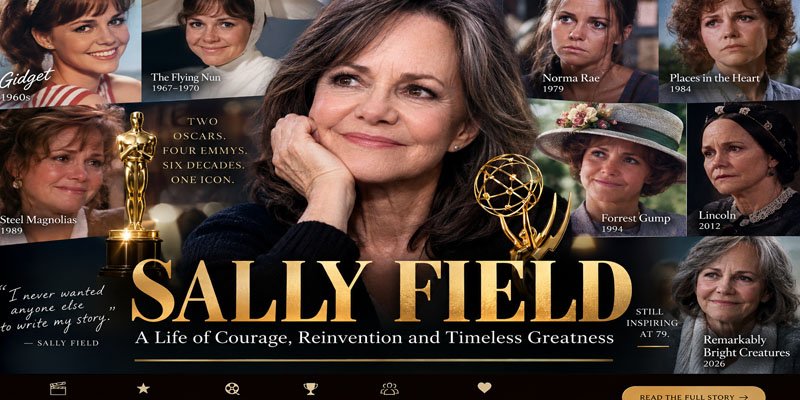
For more than six decades, Sally Field has built a career that few performers could ever hope to match. She began as a bright young television star, became one of Hollywood’s most respected dramatic actresses, conquered the biggest stages of American cinema, and continued reinventing herself long after many of her contemporaries had stepped away from the spotlight.
Now, at 79, Field has added another remarkable chapter to that extraordinary story. In September 2026, she won the Primetime Emmy Award for Outstanding Lead Actress in a Limited or Anthology Series or Movie for Netflix’s Remarkably Bright Creatures. The victory not only gave her a fourth Emmy but also made her the oldest actress ever to win in that category.
It was a fitting milestone for an actress whose career has repeatedly been defined by refusing to remain in one box.
From Gidget to The Flying Nun
Sally Field’s professional breakthrough came on television in the 1960s. She became widely known as Frances Elizabeth Lawrence in Gidget, which ran from 1965 to 1966, before taking on the unforgettable role of Sister Bertrille in The Flying Nun. The latter series made Field a familiar face to millions of American viewers.
But early fame came with a challenge. Field was initially associated with lighthearted television characters, and she understood that breaking away from that image would require taking significant creative risks.
Rather than allowing early success to determine the rest of her career, she pursued more demanding dramatic opportunities. That decision became one of the defining turning points of her professional life.
Sybil Changed Everything
In 1976, Field delivered the performance that dramatically altered the public perception of her abilities.
In the television film Sybil, she portrayed a deeply troubled young woman, giving a performance that demonstrated a level of emotional intensity far removed from her earlier sitcom roles. The role earned Field her first Primetime Emmy Award in 1977 and established her as a serious dramatic performer.
The success of Sybil opened the door to a new phase of her career—one in which she would increasingly choose complex characters and emotionally demanding stories.
Hollywood was about to discover that the actress audiences had known from television had an entirely different dimension.
Norma Rae and an Oscar-Winning Transformation
Field’s transformation reached another major milestone with Norma Rae in 1979.
Playing a factory worker who becomes involved in labor activism, Field gave a performance that combined determination, vulnerability and extraordinary emotional force. The role earned her the Academy Award for Best Actress, establishing her as one of the leading dramatic performers of her generation.
The achievement was not simply another award. It represented the culmination of Field’s effort to move beyond the television persona with which she had first become famous.
She had successfully changed the conversation around what audiences expected from her.
A Second Oscar for Places in the Heart
Just five years later, Field reached another extraordinary peak.
Her performance in Places in the Heart earned her a second Academy Award for Best Actress. Winning the same major acting prize twice in such a short period placed her among the most celebrated performers of her era.
Rather than being a brief period of success, however, the 1980s became another chapter in a career that continued to expand.
Field moved between serious dramas, comedies and character-driven stories with remarkable ease.
The Roles That Became Part of Popular Culture
For many viewers, Sally Field’s legacy extends far beyond awards.
She became part of the emotional fabric of several generations through films such as Steel Magnolias, Mrs. Doubtfire and Forrest Gump. She demonstrated that memorable supporting performances could be every bit as emotionally powerful as leading roles.
In Steel Magnolias, she brought enormous emotional weight to the role of M’Lynn Eatenton. In Mrs. Doubtfire, she balanced humor with the complicated emotions of a mother navigating the collapse of her marriage. And in Forrest Gump, she portrayed Mrs. Gump with warmth, humor and tenderness.
These performances helped ensure that Field was not simply respected by critics—she was deeply familiar to audiences around the world.
Television Became Part of Her Legacy Again
Field eventually returned to television with another series of major performances.
Her role on ER earned her another Primetime Emmy in 2001, demonstrating that her television career was far from a chapter of the past. She later joined the cast of Brothers & Sisters, portraying Nora Walker from 2006 through 2011.
That performance earned Field yet another Primetime Emmy in 2007. The role also introduced her work to a new generation of television viewers.
Her career had come full circle: the actress who had first become famous on television had once again become one of its most acclaimed performers.
From Mary Todd Lincoln to Superhero Cinema
Field continued accepting major film roles well into the 21st century.
In Steven Spielberg’s Lincoln, she portrayed Mary Todd Lincoln opposite Daniel Day-Lewis. The performance earned her an Academy Award nomination for Best Supporting Actress, adding another major recognition to an already remarkable awards history.
Around the same period, she also appeared as Aunt May in The Amazing Spider-Man and its sequel, introducing her to audiences who had grown up with an entirely different generation of popular cinema.
It was another example of Field’s ability to move comfortably between prestige dramas and mainstream entertainment.
A Career Beyond Acting
Field’s achievements have never been limited to acting.
She has also worked as a director, producer and writer, while her stage career added another dimension to her artistic résumé. Her accomplishments have been recognized far beyond individual performances.
Among her honors are two Academy Awards, multiple Emmy victories, Golden Globe recognition, a Screen Actors Guild honor, the Kennedy Center Honor and the National Medal of Arts. She was also elected to the American Academy of Arts and Sciences.
In 2023, she received the Screen Actors Guild Life Achievement Award, recognizing her extensive contribution to the acting profession.
The Remarkable Return at 79
Perhaps the most striking chapter of Field’s career arrived in 2026.
In Netflix’s Remarkably Bright Creatures, Field portrays Tova Sullivan, a widow whose life becomes unexpectedly connected to an aquarium and an unusually perceptive octopus. The film is based on Shelby Van Pelt’s bestselling novel and features Field alongside Lewis Pullman and Alfred Molina.
The performance brought Field back to the center of the awards conversation.
At the 2026 Primetime Emmy Awards, she won Outstanding Lead Actress in a Limited or Anthology Series or Movie. According to the Television Academy, it was her fourth Emmy victory, following her earlier wins for Sybil, ER and Brothers & Sisters.
At 79, she became the oldest winner in that acting category—a remarkable achievement that added a historic final chapter to a career already filled with milestones.
Six Decades of Reinvention
What makes Sally Field’s career particularly remarkable is not simply the number of awards she has collected.
It is the evolution.
She went from Gidget and The Flying Nun to Sybil. From Sybil to Norma Rae. From Oscar-winning dramatic performances to beloved family films. From television dramas to major Hollywood productions. From established star to respected character actress—and eventually to a historic Emmy winner at 79.
Each stage challenged the image created by the previous one.
That may be the defining feature of Sally Field’s legacy: she never allowed one version of herself to become the final version.
A Legacy That Continues
Sally Field’s career is ultimately a story about longevity, reinvention and artistic courage.
She has spent more than 60 years in the entertainment industry, yet her most recent achievement demonstrates that audiences and critics can still discover something new in her work.
Her fourth Emmy for Remarkably Bright Creatures did not erase the achievements that came before it. Instead, it added another remarkable chapter to a story that began with a young television actress in the 1960s and evolved into one of Hollywood’s most enduring acting careers.
From Gidget to The Flying Nun, Sybil, Norma Rae, Places in the Heart, Steel Magnolias, Mrs. Doubtfire, Forrest Gump, Lincoln and now Remarkably Bright Creatures, Sally Field has repeatedly shown that a long career does not have to mean repeating the same success.
Sometimes, the most enduring stars are the ones who keep surprising us.
And after more than six decades, Sally Field is still doing exactly that.