When my mother told me to keep my twelve-year-old daughter upstairs while forty guests celebrated directly below her bedroom, an unexpected calm settled over me.
“All right,” I said.
Mom mistook my response for surrender.
What she didn’t realize was that I intended to clear the farmhouse exactly as she had ordered.
By Friday evening, the folding tables my parents had kept in the barn had disappeared.
So had the anniversary decorations.
The champagne cases were gone, along with every piece of clothing they had left in the guest rooms.
I packed everything carefully and moved it into a rented storage unit registered under my father’s name.
Then I changed the gate code, replaced the exterior locks, and posted a signed no-trespassing notice beside the entrance.
The farmhouse was mine.
Not “the family’s.” Not my parents’ retirement getaway.
Mine.
Seven years earlier, I had bought it from my late grandmother for its full professionally appraised value.
My parents had refused to purchase it because they thought the plumbing was outdated and believed the surrounding twenty acres were practically worthless.
It was only after I renovated the entire property that they started calling it “our farmhouse.”
At nine Saturday morning, tires rattled loudly over the gravel road.
Three charter buses came behind my parents’ silver Cadillac.
A catering van, a florist, and a string quartet arrived behind them.
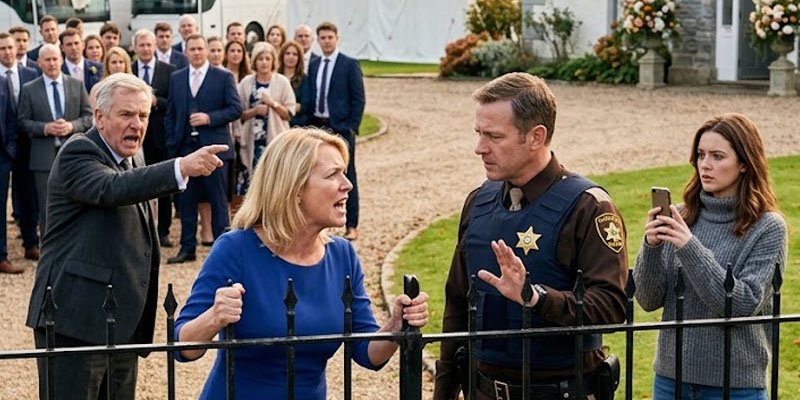
Sheriff Daniel Brooks was waiting beside the locked front gate.
Through the living-room window, I watched everything while Lily rested in the sanitized room behind me.
She had come home only eleven days earlier after a bone-marrow transplant.
Her doctors had warned us that even an ordinary infection could become dangerously serious.
My mother climbed out of the Cadillac in an ivory dress and headed straight for the gate.
“Why is the gate locked?” she demanded.
Sheriff Brooks lifted the trespassing notice.
“Mrs. Carter, the property owner has revoked permission for you and your guests to enter.”
“I’m her mother.”
“That doesn’t make you the owner.”
My father pointed toward the farmhouse.
“Emily agreed to clear the place.”
That was when I stepped onto the porch.
“I did,” I said.
“I cleared it of everything that belongs to you.”
Guests were already getting off the buses.
Mom looked at me through the iron gate, and then I saw the familiar smile I had known all my life—the expression that always meant she believed humiliating me in public would eventually make me give in.
“You’re embarrassing yourself,” she said.
“Open the gate.”
“No.”
She grabbed the iron bars and began arguing that family property couldn’t simply be taken away by an ungrateful daughter.
Sheriff Brooks calmly told her to step back.
Instead, she reached through the gate and entered the access code she had used for years.
Nothing happened.
Then I noticed movement upstairs.
Lily stood behind the window, pale and uncomfortable, her medical mask covering her face.
Mom looked up at her.
“See?” she called.
“She’s already upstairs.
There’s no problem.”
Even Sheriff Brooks fell silent.
I looked at Lily, then back at my mother.
For eleven days I had carefully considered every possible danger surrounding my daughter, trying to protect a body that had already endured more than any twelve-year-old should ever have to endure.
And my mother was standing outside as though Lily’s recovery were merely an inconvenience getting in the way of her anniversary celebration.
So I pulled out my phone.
There was one thing Mom didn’t know I had kept: the voicemail she left the night before.
I pressed play.
“If Emily resists,” my mother’s recorded voice said, “we’ll go through the kitchen.
She won’t make a scene in front of everyone.”
Sheriff Brooks turned slowly toward her.
For a long moment, nobody standing along that gravel road said anything.
Not the guests gathered near the buses.
Not the florist, who was holding a bucket of white roses against her hip as though she had suddenly forgotten what to do with it.
Not even the breeze that had been carrying maple leaves along the fence throughout the morning.
There was only my mother’s recorded voice, faint and metallic through the phone speaker, hanging in the cold air.
She won’t make a scene in front of everyone.
I didn’t end the recording there.
I had played it enough times the night before to know there was more, and I wanted everyone gathered around that gate to hear what came next.
“Richard, get the toolbox from the trunk, just in case,” my mother’s voice continued.
“It’s my mother’s house.
Nobody is going to keep me out of my own mother’s house.”
A click.
Then silence.
I lowered the phone.
My hand was still steady.
That surprised me a little.
“Mrs. Carter,” Sheriff Brooks said, speaking in the same calm tone he might have used when asking someone for a driver’s license, “is that your voice?”
My mother lifted her chin.
“That is a private message between a mother and her daughter.
It’s being played out of context.”
“Out of context.” He nodded slowly, as though carefully weighing the phrase.
“Ma’am, I’ve worn this badge for thirty-one years.
I can’t think of any context that makes ‘go through the kitchen’ mean something other than exactly what it sounds like.”
Someone near the buses quietly cleared his throat.
A man in a gray suit suddenly seemed fascinated by his shoes.
Sheriff Brooks lifted the notice again, this time making sure everyone gathered there could see it.
“Let me make this clear so nobody misunderstands later.
Thursday afternoon, I went to the county recorder’s office and pulled the deed myself.
Emily Carter is the sole owner of this property.
She has been for seven years.
Her name is the only one on it.
The notice posted on this gate is lawful and valid.
If anyone crosses this line without her permission, that is criminal trespass.
And if somebody were to climb through a kitchen window—” He glanced at the phone in my hand.
“—that would become considerably more serious than trespass.”
“You wouldn’t arrest a sixty-six-year-old woman in front of her friends,” my mother said.
“I’d prefer not to,” he answered.
“But I would.”
She stared at him.
I had seen my mother argue with waiters, contractors, school principals, and, once memorably, the woman running a church bake sale.
I had never seen her face someone who simply looked back at her without flinching.
“Diane,” my father said quietly.
“Let’s go.”
“Don’t you dare, Richard.”
That was how it had always been.
My father, tall, stooped, and gentle, had spent forty years confusing peace with silence.
He was the sort of man who apologized to furniture if he accidentally bumped into it.
In my entire life, he had never directly told my mother no.
I came down the porch steps and walked along the front path, stopping a full ten feet from the gate.
I was wearing a mask.
I hadn’t stood within arm’s reach of a crowd in more than two months, and I wasn’t about to start now.
I held a cream-colored envelope in my hand.
I gave it to Sheriff Brooks, who passed it through the iron bars to my father.
“Everything you left at the farmhouse is in Unit 214 at Harmon Road Self Storage,” I said.
“The unit is rented under Dad’s name and paid through next August.
The key is inside, along with a typed inventory.
Every box is labeled.
I put Mom’s coats on a garment rack so they wouldn’t wrinkle.
The champagne is against the north wall, in the shade, because I didn’t want it to spoil.”
My father opened the envelope.
He looked at the key, then the receipt, then the inventory—three neat, single-spaced pages.
He looked over the top of them at me, and an expression crossed his face that I couldn’t quite read.
“You did all this yourself,” he said.
“It was a long week.”
“You put our things in a storage unit,” my mother said, as though I had simply dumped them somewhere.
“I put them in a clean, dry storage unit with a roof and a lock, Mom.
I’m not trying to take anything from you.
I’m trying to protect Lily.”
“You planned this.”
“I planned for my daughter,” I said.
“You planned for forty guests. We were always going to end up in different places.”
My mother tightened both hands around the iron bars.
Her wedding ring tapped softly against the metal.
“Open.
This.
Gate.”
For my entire life, whenever my mother used that particular voice, I usually gave in.
I had been doing it since I was six. One afternoon I had asked why my brother Mark could leave the dinner table while I couldn’t, and she had answered, Emily, we don’t make scenes in this family.
It had practically become the Carter family motto, something worthy of being embroidered onto a decorative pillow.
Don’t make a scene. Don’t be difficult. Don’t be a burden.
Smile, pass the potatoes, and quietly swallow whatever you’re feeling until eventually it disappears.
But eleven days earlier, at three in the morning, I had stood in a hospital corridor listening to the quiet electronic chirping of a machine monitoring my child, and I had learned that there were two kinds of silence.
There’s the silence of someone who has stopped speaking up.
And there’s the silence of someone who has finally made a decision.
“No, Mom,” I said.
She turned toward the guests, producing the smile I had seen at countless dinner parties.
Bright, fragile, and aimed like a spotlight.
“Everyone, I’m so sorry about this.
Emily is under an enormous amount of stress.
She hasn’t been herself since Lily became sick.
We’ll sort everything out in a moment, and in the meantime, if everyone would just wait on the buses—”
“Mrs. Carter,” Sheriff Brooks said mildly, “with respect, your daughter is the calmest person on this road.”
Nobody laughed.
But I saw several faces twitch, as though people were working extremely hard not to react.
That was when my brother Mark came around the second bus carrying a garment bag over one arm.
He had flown in from Denver the night before.
Mom had told him to rest at a hotel and “let the women handle the setup,” which meant he had learned about the previous two weeks through the same source everyone else in our family had: my mother’s version.
He stopped when he saw the sheriff.
Then the gate.
Then me, ten feet away and wearing a mask.
“Em? What’s going on?”
“Ask Mom about Lily,” I said.
“Lily’s better.” He looked from me toward her.
“Mom, you told me she was recovering.
You said her doctors were thrilled.”
“She is recovering,” my mother replied.
“Mark.” I kept my voice even.
“Lily came home from the transplant unit eleven days ago.
Right now her immune system is about as strong as a newborn’s.
The doctors say it could take a year, maybe longer, to rebuild.
One cold from one of your guests could send her back to intensive care.
Or worse.”
The crowd shifted uneasily.
Someone near the back whispered, “Transplant?” as though it were a word they had previously encountered only on television.
A woman stepped forward from the middle of the group.
She was small and square-shouldered, with short white hair and a purse tucked beneath one arm like a football.
Bev Lindstrom.
She had sat two pews behind my mother at church for thirty years and had brought me a casserole when Lily was diagnosed.
“Diane,” she said.
“Tell me you didn’t.”
“I didn’t do anything, Bev.
Nobody was going near the child.
She would have stayed upstairs with the door closed, just like anyone with a sniffle.”
“A sniffle.” Bev lowered her voice, somehow making the words sound even more forceful.
“I spent thirty-four years working on a pediatric oncology floor.
Do you know what we did with visitors who had a sniffle? We turned them around at the elevator.
Every single time.
And you wanted to put forty people—half of them over sixty, several of them coughing—under the bedroom of a bone-marrow patient.”
“Nobody is coughing,” my mother said, precisely as someone among the guests coughed.
It was a tiny, dry, almost apologetic cough.
A man near the front, whose name I didn’t know, turned bright red all the way to his ears.
“Sorry,” he murmured.
“I’ve had this tickle since Wednesday.”
A young mother holding a toddler against her hip quietly took two steps backward, then two more, settling the child’s head against her shoulder almost protectively.
The man with the tickle looked around at everyone staring at him.
“I’ll, uh.
I’ll wait on the bus.”
“Nobody needs to wait on any bus!” my mother snapped.
“You’re all acting as though I meant to cause harm.
I wanted a celebration.
Forty years of marriage, forty years, and now I’m standing in a driveway being accused of—”
“I told her.” I spoke softly, but my words cut across hers with surprising force.
“I told you in July, Mom, when the transplant was scheduled.
I told you in August, from the hospital.
I told you eleven days ago on the phone, when you called and said you were holding your anniversary at my house.
I texted you the discharge instructions. I emailed you the transplant team’s letter. I said ‘she can’t be around crowds’ so many times that eventually the words barely sounded real anymore.”
“She did,” came a quiet voice.
Everyone turned.
It was my father.
He was still holding the envelope.
His shoulders, already slightly rounded, seemed to have dropped another inch.
“Emily did tell us, Diane,” he said.
“More than once.”
My mother stared at him as though the gate itself had suddenly begun speaking.
“Richard.”
“She did,” he repeated, and it was the first time in my life I had heard him finish that kind of statement without adding but.
The silence afterward seemed to press against my ears.
And inside that silence, somewhere above us, came the small, unmistakable click of a window latch.
Everyone looked up.
Lily had apparently been standing at the second-floor window the entire time.
She must have woken when the buses arrived.
Her old bedroom had the clearest view of the driveway, and I had spent the previous eleven days helping her move from bed to chair to bath without ever considering that a twelve-year-old in a mask, carrying a curious mind, might slowly make her way up the back stairs on unsteady legs, one hand against the wall, simply to find out what all the noise was about.
She looked incredibly small behind that window.
Her skin had the faint, delicate appearance it had developed after treatment.
Her mask came high beneath her eyes, and the knitted cap I had bought her sat crooked over the soft peach fuzz that was slowly, stubbornly growing back.
She wasn’t waving.
She was watching the crowd with an expression I recognized immediately—the cautious, observant look she had learned in the hospital.
It was the expression of a child who had learned that when adults became loud, someone usually ended up hurt or upset.
She disappeared from the window.
“Lily,” I whispered, although there was no way she could hear me.
“Where did she go?” someone asked.
A long minute passed.
My heart climbed toward my throat.
Then she appeared again, carrying her sketchbook.
Lily drew constantly—mostly horses, the barn cats, and lately a collection of small, determined owls.
She had used a thick black marker to write across the first page.
She pressed it against the window with both hands.
HI GRANDMA.
HI GRANDPA.
Someone among the guests made a quiet sound.
She turned the page.
In one corner she had drawn a crooked little cake covered in candles.
She had apparently tried to draw forty, I thought, but stopped around thirty-one and simply added a swirl of frosting instead.
HAPPY ANNIVERSARY!
Beside me, I heard Bev Lindstrom whisper, “Oh, honey,” in a voice that sounded almost breathless.
Lily turned another page.
This one took longer.
I could see her small, pale figure behind the glass, carefully forming large capital letters with the marker. When she finally lifted the page to the window, her hands trembled slightly from the effort of holding it there.
I’M SORRY I CAN’T COME DOWN. I WOULD IF I COULD.
I put my hand over my mask. I want you to understand something.
Lily had never heard the words lock her upstairs. I had made absolutely sure of that.
I had taken my mother’s call inside the pantry with the door closed, and I had never repeated those words—not even quietly to myself afterward.
So my daughter, who had endured needles, radiation, thirty-one nights in an isolation room, and treatment complications that had sometimes made swallowing difficult, had watched a line of buses arrive outside her home, understood on her own that there would be a celebration she could not attend, and decided the kind thing to do was apologize for it.
She turned to the last page.
There were no words.
It showed a single heart, colored deep red, with the marker pressed so hard that the ink had soaked through onto the next sheet.
Nobody spoke.
My father removed his hat.
He did it slowly, almost like someone entering a church.
Then he walked toward the iron bars, rested his forehead gently against them, and raised one hand.
Upstairs, Lily lifted her own hand and waved.
He waved back.
His shoulders trembled.
And my mother, who had apparently been about to speak, who had taken a breath as though another sentence were coming, suddenly went completely still.
Her mouth remained slightly open.
Her ivory dress seemed suddenly too bright and too formal, almost like a costume for a performance that had ended without her.
“Oh,” she said very quietly.
I had never heard my mother sound so small.
“She’s twelve,” she said, apparently to no one.
“She’s only twelve.”
“Yes,” someone behind her said.
“She is.”
Ruth Delaney was seventy years old and had never been intimidated by her younger sister.
She stepped out from the crowd in a navy dress and practical shoes, her silver hair pinned neatly back, while her husband Gene followed anxiously two steps behind.
She was my mother’s older sister, my Aunt Ruth, the woman who mailed birthday cards containing actual handwritten letters, the woman who had driven four hours to sit beside me in the hospital cafeteria during Lily’s first week there and said almost nothing, simply holding my hand until it stopped trembling.
“Diane,” she said.
“Look at me.”
“Ruth, not now.”
“Now.” Ruth reached forward and gently but firmly guided my mother’s chin until Mom had no choice but to face her.
“Do you understand what you did this week? Do you understand what you asked that child’s mother to do?”
“I asked her to make room for her family.”
“You asked her to keep a medically vulnerable twelve-year-old upstairs while forty people ate, drank, and celebrated beneath her.” Ruth never raised her voice.
She didn’t have to.
“Diane.
Diane. Forty people.
This house.
A twelve-year-old girl upstairs.”
Something slowly changed across my mother’s face, as though all her certainty had drained away at once.
“That isn’t the same,” she whispered.
“Isn’t it?”
“Ruth, don’t.”
“I’ve been saying don’t for fifty-four years,” Ruth replied.
“I’m finished.”
I didn’t understand.
I glanced at Mark, who could only shrug helplessly.
Then I looked toward my father. His eyes were closed, almost as if he were preparing himself for something he had expected for many years.
Ruth turned toward the crowd, then toward me, and drew a long breath.
“Our little sister was Annie,” she said.
“She was eight.
She had leukemia.
It was 1972, and doctors didn’t have much to offer a child with what she had.
She died in a hospital in Columbus that spring.
Mama brought her home afterward, and the funeral reception was held right here, in this house, in that front parlor.”
I felt the world shift beneath me.
“Forty people came.
Neighbors. Church people. Cousins.
They filled the kitchen, dining room, porch, and yard. There were casseroles covering every surface, and everyone was trying to be kind.
And Mama, overwhelmed and barely able to remain standing, with no idea how to comfort a grieving twelve-year-old when she could barely hold herself together, said to Diane, ‘Go upstairs, honey.
Stay in your room.
We don’t want to make a scene.’”
My mother made a small sound.
“She sat at the top of the stairs,” Ruth continued.
“For six hours.
I know because I checked on her.
I was sixteen and supposed to be helping, and I kept slipping away to look.
She sat there in her good black dress with her knees pulled against her chest, listening to forty people downstairs say her little sister’s name.
She never came down.
Nobody invited her.
She never cried in front of anyone again.”
The entire road had gone silent.
“I don’t think she’s cried since,” Ruth said.
“Not once.
I don’t think she remembers how.
And I think when she looked at Emily, at Lily, and at this house, she didn’t simply see a sick child.
She saw something she had never been allowed to face herself.
And she responded in the only way she had ever been taught.”
My mother lowered herself onto the running board of the Cadillac.
I hadn’t even noticed it happen.
One moment she had been standing, and the next she was sitting on the chrome step, her ivory skirt spreading across the gravel, both hands covering her mouth.
“I was twelve,” she said through her fingers.
“Nobody asked me.
Nobody ever asked.”
I stood behind the gate with the wind against my face and a hundred emotions pulling me in different directions.
I want to make something clear.
I didn’t feel victorious.
For five days I had imagined this moment, rehearsed what I would say, pictured myself standing firm while my mother finally understood what she had done.
None of those imagined versions had looked like this.
Small.
Gray at the temples.
Sixty-six years old, sitting beside the gravel in a beautiful dress, with the grief of a twelve-year-old girl finally surfacing fifty-four years later.
Every part of me wanted to open the gate and put my arms around her.
And I couldn’t.
Not because I wanted to punish her.
Because Lily was upstairs, because Lily’s blood counts were still fragile, and because what I finally understood while standing there was that someone’s old pain can explain their choices without making those choices acceptable.
Both things can be true at once.
Both have to be true, or neither means much.
“Mom,” I said.
She looked up at me.
Her mascara had started running.
“I’m sorry,” I said.
“I’m so sorry about Annie. I’m sorry about that day. I’m sorry nobody sat beside you on those stairs. If I could go back and sit next to that little girl, I would.”
She stared at me.
“But you don’t get to give Lily that same staircase,” I said.
“I love you.
And I won’t do that.
Not to protect the party, not to preserve the peace, not for anybody.
Not even you.”
The wind moved softly through the maple trees.
Somewhere among the guests, a woman quietly cried into a tissue.
My mother lowered her head, her shoulders beginning to shake, and for the first time in my life I watched the woman who had always told me we don’t make scenes finally have one, right there in front of forty guests, a sheriff, and three chartered buses.
It wasn’t a graceful scene.
It was raw and emotional, and it continued for quite a while.
And somehow, it was the most genuine thing I had ever seen her do.
The next hour felt strangely distant, as though I were watching it from somewhere far away.
My father knelt beside my mother on the gravel and put an arm around her. She turned her face into his shoulder while he simply held her.
He said nothing. He didn’t try to fix anything.
For a man who had spent forty years quietly leaving difficult rooms, seeing him stay was remarkable.
Sheriff Brooks discreetly stepped away, giving them the moment.
He walked toward his cruiser, spoke briefly into the radio, then came back holding his hat in both hands.
“Ma’am,” he said quietly to me.
“I’ll document what happened this morning.
The written trespass warning will stay in my file.
It’s a formality.
I don’t expect we’ll need it.”
“I don’t want to press charges,” I said.
“I never did.
I only wanted her to remain outside.”
“I know.” He gave me a small, tired smile.
“I figured.
That’s why I came personally instead of sending a deputy with a clipboard.”
Ruth was the one who organized the guests.
I think she had been waiting fifty-four years to become useful in exactly this way.
She clapped once, and the murmuring crowd fell quiet like a classroom full of children.
“All right, everyone.
Listen up.
There will be no party at this farmhouse today.
That’s settled.
But there are forty people standing on this road who traveled a long way to celebrate forty years of my sister’s marriage, and I’ll be darned if we let that trip go to waste.”
“Where?” someone called.
“The Maple Ridge Grange Hall on Route 9.
It has a full kitchen and enough room for a hundred people.”
“It’s booked most weekends,” Gene said uncertainly.
Sheriff Brooks cleared his throat.
“My wife is the Grange secretary.
If it’s available—and I’d bet a week’s pay that it is on a Saturday morning during the off-season—she’ll have those doors open in fifteen minutes.” He was already reaching for his phone.
The caterer had stayed beside her van through the entire ordeal, a broad-shouldered woman named Patrice with flour on her forearms and the patient expression of someone who had witnessed almost every kind of complicated family gathering.
She raised one hand.
“Ma’am, I have enough food in that van for sixty people.
It’s prepaid.
We can serve it wherever you want.”
“Sixty,” Ruth said thoughtfully.
“And how many people are here?”
“Forty-one, including the driver.”
“So we have plenty left.” Ruth turned toward me, and I recognized the question in her expression before she even asked it.
“Emily.
When Lily was in the hospital.
Where did you sleep?”
I blinked.
“In the family house across the street.
It’s a—it’s a place where parents stay.
There were a lot of us.
There’s a kitchen, bedrooms, and a large living room where everyone sits together at night.
For the first month, I mostly slept in a recliner near the transplant waiting area, and when I couldn’t manage that anymore, I stayed at the house.” My voice caught slightly.
“There was a woman who cooked every Wednesday.
I practically survived on her lasagna for five weeks.”
“Patrice,” Ruth said.
“Could you take twenty meals across the county line to the family house near the children’s hospital and leave them at the front desk with a note?”
Patrice’s eyes brightened.
“I can do that.
I’d be honored.”
“Then we’ll do that too,” Ruth said.
“Anything that doesn’t fit at the Grange can go to parents who might otherwise be eating vending-machine crackers tonight.” She turned.
“Diane? Is that all right with you?”
My mother, still leaning against my father’s shoulder, nodded once.
She didn’t lift her head.
But she nodded.
Something inside my chest, something old, tight, and exhausted, loosened just a little.
The guests slowly began heading back toward the buses.
Several stopped at the gate along the way.
Bev Lindstrom paused directly in front of me and, with her purse still tucked beneath one arm, said, “Emily, call me.
Any time.
Day or night.
I’m retired, I’m bored, and I know more about central lines than half the doctors I’ve met.” Then she gently patted the iron bar as though it were my hand before walking down the road.
The young mother carrying the toddler silently mouthed Thank you and gave me a small, uncertain smile.
A man I didn’t recognize murmured, “I’m so sorry,” before continuing on.
Then a young man in a black jacket carrying a violin case stopped near the fence.
He couldn’t have been more than twenty-five.
Three other musicians stood behind him with their instrument cases, all wearing the careful, uncomfortable expressions of people who had somehow wandered into the wrong scene of a play.
“Ma’am?” he said.
“I’m Theo.
We’re the quartet.”
“I remember,” I replied with a shaky laugh.
“You were supposed to play beneath my daughter’s window.”
His face turned red.
“That’s, um.
That’s actually what I wanted to ask about.
We’ve already been paid, and we’re supposed to go over to the Grange now, but—would it be okay if we played one piece? Just one.
For her.
From the road.
We’d stay well back.”
I looked at him.
Then I looked toward the cellist beside him, a gray-haired woman quietly wiping her eyes with the back of one hand.
“She’d love that,” I said.
They arranged themselves beside the road in the tall, dry grass.
No music stands. No chairs.
The cellist simply sat on her instrument case.
Theo tucked the violin beneath his chin, looked toward the second-floor window, and when he saw the small pale figure behind the glass, he gave a tiny bow.
They played “Simple Gifts.”
If you’ve never heard it—a simple old tune, older than the barn itself, a Shaker melody about humility and discovering where you belong—I can only describe it as music that sounds like sitting on a porch swing at the end of the day.
It drifted across the field, gentle, sweet, and unhurried.
I looked upward.
Lily had pressed her palm flat against the window.
She didn’t move.
She simply stood there with one hand against the glass and her forehead resting lightly beside it, and I understood that she was listening with her whole body, the way someone listens after spending a very long time quietly inside a small room.
The guests stayed along the roadside.
Nobody spoke.
Even the bus drivers had turned off their engines.
When the final note faded away, nobody applauded.
Somehow, applause didn’t seem right.
Instead, one by one, everyone standing along that road lifted a hand toward Lily’s window, held it there briefly, then lowered it.
Lily waved back with both hands.
And that was when I finally cried.
Ten feet inside my own gate, wearing a mask, with my brother’s arm around my shoulders and my father watching through the iron bars with an expression I knew I would remember for the rest of my life.
My mother stayed inside the Cadillac while the buses drove away.
I could see her through the window as they turned toward the road.
She wasn’t looking at me.
She was staring toward the farmhouse, toward the second-floor window, slowly lifting one trembling hand from the dashboard.
Lily noticed her.
And Lily waved.
I carried Lily downstairs before lunch, prepared a bowl of plain rice and a soft-boiled egg, and sat on the edge of her bed inside the sanitized room while she slowly picked at it.
“Are they mad?” she asked.
“Grandma and Grandpa?”
“No, sweetheart.”
“Grandma looked sad.”
“She was sad,” I said.
“But not because of you.
Not because of anything you did.
Grandma was remembering something painful from a very long time ago, when she was around your age.”
Lily moved her spoon through the bowl.
She was quiet for a moment.
Then she said, “I made the signs because of the hospital.”
“The hospital?”
“When I was in the isolation room, the people who couldn’t come inside would stand at the window and hold signs up.
Remember? Nurse Jenna’s kids made one.
And the girls from my class drew that big poster.” She nudged the rice with her spoon.
“It was the best part.
It’s weird, but it was.
Even though they couldn’t come in, I still felt like they were there.”
I couldn’t answer.
“So I thought maybe Grandma and Grandpa could feel that way too.” She looked up at me from above her bowl.
Her eyes seemed enormous in her thin face, dark as coffee and completely free of blame.
“You can still be together through a window, Mom.
It’s just slower.”
“Where did you learn to be so wise?” I whispered.
“From you,” she replied, then returned to her rice as if she hadn’t said anything extraordinary.
I stayed there for a long while afterward, holding a bowl containing cold egg and thinking about my grandmother.
Josephine Whitaker had lived in this farmhouse for sixty-one years.
I remembered her as a tiny woman with weathered hands and an endless supply of butterscotch candies.
Every evening during my childhood summers, she turned on the porch light at dusk, and every morning she switched it off again.
Whenever I asked why she left it glowing all night, she always gave me exactly the same answer.
“In case somebody needs to find their way home, Emmy.”
I had always assumed it was simply a habit.
Now, sitting there in the fading afternoon light, I wondered whether it had actually been something closer to a prayer.
She had sold me the farmhouse for its full appraised value, not a penny less, because she believed gifts came with strings and didn’t want anyone in the family claiming I had taken advantage of her.
My mother had wanted the farmhouse herself.
For years, I assumed it was simply about ownership.
It had never occurred to me that someone might desperately want a house because it held the only place where her little sister had ever lived.
At six that evening, as the setting sun turned orange beyond the north field, the porch light automatically switched on, just as it always did at dusk, and I looked through the kitchen window and saw someone standing outside the gate.
It was my father.
Alone.
He stood there in his shirtsleeves.
His tie was gone.
He held his hat in both hands, and for the first time I could remember, he looked like a man who had absolutely no idea what he was supposed to do with himself.
I put on a clean mask, took my phone in case the nurse called, and walked down the path.
I stopped ten feet from the gate.
“Hi, Dad.”
“Hi, sweetheart.” His voice was rough.
“Lunch went fine.
Everyone ate.
Bev cried through almost all of it, and Ruth made a toast.
The twenty meals went to the family house.
I drove them there myself, and the woman at the front desk cried too.
We all cried.
It was a very emotional lunch.”
I smiled beneath my mask.
“How’s Mom?”
“She’s staying at Ruth’s.
She hasn’t said much since the buses left.” He slowly turned his hat in his hands.
“Ruth put her in the guest room and left a sandwich outside the door.”
We stayed there.
The porch light hummed softly.
A barn owl called somewhere near the creek.
“Emily,” he said.
“There’s something I need to tell you, and I don’t want you to say anything until I’m finished.
Can you do that?”
“Okay.”
He drew a deep breath.
“In April, after Lily was admitted, I drove to the hospital.
By myself.
I didn’t tell your mother.
I told her I was going to the hardware store.”
I stared at him.
“I made it as far as the parking garage,” he continued.
“I sat inside the car for three hours.
I could see the building from there.
Sixth floor, the children’s wing.
I kept telling myself I would go upstairs.
I’d walk in, hug you, and tell you how proud I was of how strong you were being.” His jaw tightened.
“And I couldn’t make myself move.
Your mother told me that morning you were being dramatic.
That you were making too much of everything and that we would only make things harder by showing up.
And I believed her, or maybe I let myself believe her, because believing her was easier than going upstairs and seeing my granddaughter in a hospital bed.”
“Dad—”
“I’m not finished.” He wiped his face with his sleeve.
“Before I left, I stopped at the gift shop.
I bought a bear.
A brown one, wearing a little blue vest.
And on my way out, I walked to the nurses’ station and left it there with a card, and I never told anyone who had sent it.”
Everything around me suddenly seemed still.
“It said, Be brave.
Somebody is thinking of you.
A friend,” my father said.
“That was all I could manage.
God help me, that was all I could manage.”
I covered my mouth with one hand.
Because I knew that bear.
His name was Barnaby.
He had been beside Lily’s pillow for six months. He had stayed with her through treatment, the transplant, and the difficult weeks when she barely felt like talking.
She pressed him against her cheek every night.
She called him her anonymous friend.
She had believed he came from a hospital volunteer, some thoughtful stranger, and she desperately wanted to write that person a thank-you note.
I had promised her that eventually we would discover who it was.
I had studied that card fifty times.
The handwriting was careful block capitals, the same sort used to label every jar of screws in a garage.
I had known that handwriting throughout my childhood.
I simply had never connected the two.
“It was you,” I said.
“It was me.”
I stood beneath the humming porch light as dusk slowly turned blue around us and quietly cried, the way you cry when something damaged for years finally begins to mend around the edges.
“She named him Barnaby,” I said.
“She sleeps with him every night.”
My father bent forward there on the gravel and rested his forehead against the iron gate.
I don’t know how long he stayed that way.
I only know that when I finally moved, I didn’t walk toward the gate to unlock it.
I walked over, placed my hand through the bars, and he held it between both of his.
We stayed that way for a while, a father and daughter separated by a locked gate with something warm finally passing between them.
“I’m not asking you to forgive me,” he said.
“I haven’t earned that yet.
I just want to know what I’m supposed to do.
Tell me how to become someone she can be proud of.
Tell me what to do, and I’ll do it.”
I considered his words.
I gave the question the honest weight it deserved.
“Learn,” I said.
“Not for me.
For her.
Ask the transplant team what she needs.
Get every vaccine they recommend, and don’t visit if you have even the slightest scratchy throat.
For now, visits are outside only, and they’re short.
If Lily is having a difficult day, we cancel, and you don’t argue.”
“Yes.”
“And Dad,” I said.
“You can’t repair this with a check.
I know that’s sometimes how you show love.
It won’t work here.”
He gave a small, unsteady laugh.
“I don’t have a check large enough.”
“No,” I said.
“But you have Sundays.”
He looked toward me.
“If you want them,” I said.
“Come Sunday.
Bring a folding chair.
Sit outside in the yard, wearing your coat and mask.
Lily can sit on the porch swing if she feels well enough.
She likes crosswords.”
My father, sixty-eight years old and someone who hadn’t cried in front of me since my grandmother’s funeral, stood in my driveway and cried openly.
“I would like that very much,” he said.
He came the next Sunday, and the Sunday after that.
He arrived exactly at two o’clock, carrying a folding chair beneath one arm and a sealed thermos of cocoa beneath the other.
He had received his flu shot and booster and brought a letter from his doctor.
He had printed the transplant team’s visitor guidelines and highlighted sections in three different colors.
He placed his chair at the far end of the yard, a full twenty feet from the porch, and when Lily appeared wrapped in blankets, he waved like someone greeting a long-awaited ship returning home.
They worked on crosswords.
He read the clues from across the lawn and she called the answers back, while I listened through the kitchen window, drying dishes I had already dried, as my father’s voice grew steadier and hers gradually grew stronger.
By the third Sunday, she was correcting him.
“No, Grandpa, it’s eleven letters.
‘Steadfast.’ It can’t be ‘stubborn.’”
“Well, that’s just plain rude, kiddo.
I’ve been stubborn my whole life.
I’m an expert.”
“It’s unwavering, Grandpa.”
“Huh,” my father said.
“So it is.”
Meanwhile, my mother stayed away.
I waited for her.
I won’t pretend otherwise.
The first Sunday, I caught myself looking toward the gate every few minutes.
The second Sunday, I stopped pretending I wasn’t doing it.
By the third, that hope had settled into something quiet and uncomfortable, like a bruise you keep touching just to see whether it still hurts.
Then, on the fourth Sunday, my father unbuttoned his coat and pulled a thick envelope from an inside pocket.
“This is for Lily,” he said.
He held it toward me across the porch railing, keeping his arm fully extended, exactly as I had asked.
“From your mother.
She wrote it three times and threw away the first two.
She doesn’t know I’m bringing it.
Or maybe she does, and she simply pretended not to notice when I took it from the kitchen table.” He paused.
“Read it first if you want.
It’s your decision.”
I did read it first.
I sat on the bottom porch step with the pages in my gloved hands beneath the thin autumn sunlight while Lily slept inside.
It was four pages long.
My mother’s handwriting had always been elegant and almost forceful, but the writing on these pages was uneven, and there were places where the ink had blurred.
She didn’t start with an apology.
She started with a name.
Dear Lily,
I want to tell you about my sister.
She told Lily about Annie.
About a little girl with a gap between her front teeth and a laugh like a bird, who had taught my mother to whistle using a blade of grass.
She described the winter Annie became ill, the long drives to Columbus, and the sound of the screen door closing on the day the family came home without her.
She wrote about the funeral and the staircase.
I was twelve, she wrote.
The same age you are now.
I sat on the top step in my black dress, and I listened to everyone I knew tell my mother how sorry they were, and not one of them thought to come upstairs and ask how I was.
I decided that day that I would never become a burden to anyone, and I would never let anyone see me feeling sad.
I believed that was strength.
It wasn’t strength, Lily.
It was a locked door.
And I spent fifty-four years standing behind it.
Then I looked at you, so brave and going through so much, and I failed to see a little girl who needed protection.
I saw a staircase.
And I repeated the same mistake that had once been made with me.
I am not writing to ask for forgiveness.
That would be too easy, and you’re far too smart for easy.
I am writing because you deserve to know the truth, and because you told me, through that window with your black marker and your kind heart, that you were sorry you couldn’t come downstairs.
Sweet girl.
You have absolutely nothing to apologize for.
Nothing.
I was the one who should have climbed those stairs a very long time ago.
If you ever want to write back, I will read every word.
If you never do, I will understand.
Your Grandma Diane
I read the letter twice.
Then I folded it carefully and sat completely still, with the porch light not yet glowing and the autumn wind moving gently through the maple trees, thinking about a twelve-year-old girl sitting on a staircase who had waited fifty-four years for someone to finally sit beside her.
That evening, after Lily woke, I gave her the letter.
She read it carefully at the kitchen table, her mask lowered briefly because we had cleaned the pages beforehand, and I had decided she was old enough to choose what she was ready to hear.
She read every word.
Then she read it again.
Afterward, she went to get her sketchbook and her box of markers, and she sat there quietly for two hours.
What she wrote was short.
I’ll tell you exactly what it said, because she showed it to me afterward.
Dear Grandma Diane,
I’m sorry about Annie.
I would have liked her.
I think we would have drawn together.
You were twelve when it happened, and I’m twelve too, so I think we understand each other.
I want you to know I’m not mad.
I was scared, but I’m not now.
I think you were scared too, for a long time.
You can come see me when the doctors say it’s okay.
I’ll be on the porch.
I’ll wave first.
Love, Lily
P.S.
I drew you a picture of Annie.
I hope I got the gap in her teeth right.
She had.
I have absolutely no idea how.
But somehow, she had.
Attached behind the letter was a small pencil drawing of a smiling little girl with a gap between her front teeth, whistling through a blade of grass, sitting on the top step of a staircase beside a twelve-year-old girl in a black dress.
When my father collected it the next Sunday, he held the drawing between both hands for a long moment.
“I’ll take it to her,” he said.
His voice cracked slightly.
“I think she’s going to need to sit down.”
She came on a Wednesday.
Not Sunday. Not with my father, Ruth, or any kind of plan.
She came alone at six in the morning, wearing a plain gray coat, without makeup or pearls.
I noticed the Cadillac through the kitchen window, parked unevenly along the shoulder of the road.
Then I saw her, small and straight-backed, standing outside the gate.
She wasn’t touching the bars.
She had stopped about a foot away, her hands folded together in front of her and her chin lowered.
I put on my mask.
I didn’t hurry.
When I reached the gate, we looked at each other across ten feet of gravel, and for a long moment neither of us spoke.
She had lost some weight.
There were dark circles beneath her eyes, and her usually immaculate hair was pulled back with a simple clip.
“Emily,” she said.
“Mom.”
“I don’t want to come inside.” Her voice was raspy, almost as though she hadn’t used it much.
“I just want to say a few things, and I’d like you to let me finish them.
Is that all right?”
I nodded.
She inhaled.
“I called Dr. Okafor’s office,” she said.
“I told the receptionist I was Lily’s grandmother, that I had made a serious mistake, and that I needed to learn.
She connected me with the social worker.
I took the caregiver class on Tuesday evenings.
Three of them.
I was the only grandmother there who wasn’t actually a caregiver, and the only person who didn’t have to attend.
I sat in the back, and nobody knew who I was.” She took another breath.
“I learned what neutropenia means.
I learned what happens when the immune system has to rebuild itself.
I learned that even something that seems minor can cause serious complications for a child recovering from a transplant.
I learned—”
She stopped.
Her lips pressed together tightly, and for a moment I wondered whether she would manage to continue.
“I learned that I could have put her in terrible danger,” she said.
“That’s what I learned.
Not intentionally.
But I would have brought forty people into that house, and one of them could have carried something, and I could have been standing outside in my dress, pouring champagne, while my granddaughter ended up back in intensive care.”
“Mom.”
“Please let me finish.”
I closed my mouth.
“I’ve started seeing a counselor,” she said.
“Twice so far.
She’s a woman in Lancaster who works with people my age.
She asked what I wanted from our sessions, and I told her I didn’t know how to feel things anymore.
That I had shut something away when I was a girl, and I didn’t know how to find the switch again.” A short, watery laugh escaped her.
“She said that was a very good place to begin.”
The porch light was still glowing behind me, faint against the approaching dawn.
I hadn’t turned it off yet.
“I’m not going to pretend I was a wonderful mother,” my mother said.
“I wasn’t.
I was a mother so frightened of falling apart that I turned myself into a wall, and then became angry at everyone who couldn’t get through it.
You.
Your brother.
Your father.
I told myself it was discipline.
It was fear.
I don’t know how to repair forty years of that, Emily.
I don’t think I can.
But I can stop repeating it, starting today.
And I can begin again, slowly, if you’ll let me.”
Then she looked straight at me, and her eyes were wet.
“I’m not asking you to forgive me,” she said.
“I’m asking you to let me earn my way back.”
I stayed there for a while in the cold blue morning light.
Somewhere across the field, a mourning dove began its soft, repeating call.
I thought about my grandmother, her butterscotch candies, and that porch light glowing all night.
In case somebody needs to find their way home, Emmy.
“Mom,” I said.
“You came here alone at six in the morning, without even properly buttoning your coat, just to tell me the truth.”
She looked down.
She hadn’t noticed.
The top button was still undone.
“That’s not nothing,” I said.
“It’s actually everything.
It’s the only thing I ever wanted.”
Her mouth trembled.
“But I can’t open the gate,” I said gently.
“Not yet.
Lily’s numbers aren’t ready.
When the doctors say we can, I will.
And I want you to understand that when we do, it won’t be because you earned it like some kind of prize.
It will be because you’ve already begun doing the work, and I can see that.
Do you understand the difference?”
“I think so,” she said.
“It isn’t a test.”
“It’s not a test.
It’s a road.”
She nodded slowly.
Tears were running freely down her face now, and she didn’t wipe them away.
She simply let them fall, and something about watching her do that made my own throat tighten.
“Sunday,” I said.
“Two o’clock.
Dad will bring an extra chair.”
“I’ll bring the cocoa,” my mother said, and the smile she gave me was one I hadn’t seen since I was very young—gentle, crooked, and slightly uncertain.
Two months later, on a bright Saturday covered in hard frost the week before Thanksgiving, Lily reached her hundredth day.
If you’ve never heard of Day 100, I wouldn’t expect you to.
Before the transplant, neither had I.
It’s an important milestone for bone-marrow patients. It’s the first major checkpoint, when the most delicate early period has passed and the new cells have had time to settle.
It isn’t the end of the journey.
Lily’s doctors had made that very clear.
She would still need medication, regular monitoring, and careful living for at least another year.
But Day 100 meant something.
It meant she had made it this far.
Dr. Okafor gave us permission to hold a small outdoor gathering.
Thirty minutes.
No more than six guests.
Everyone fully vaccinated, completely symptom-free, masked, and remaining at least ten feet apart.
“You’re sure?” I had asked in her office when she gave us permission.
“Absolutely sure?”
“I’m sure,” she said.
“It’s a good day for it.
She’s earned a celebration.”
We spent the whole week preparing.
Lily wanted lanterns, so we made paper ones together around the kitchen table, dozens in every color, and my father hung them along the porch railing in one long, uneven, wonderful line.
Ruth sent a case of hand warmers.
Mark, who had flown in Thursday and slept on the sofa like a college student, spent Friday afternoon hanging a banner Lily had painted herself.
It read, in bright, crooked letters: HAPPY 40TH ANNIVERSARY (SORT OF!) AND HAPPY DAY 100 TO ME.
Sunday crosswords had gradually become Wednesday crosswords, then Thursday crosswords, and by then my father had visited the farmhouse fourteen times.
My mother had joined him for eleven of those visits.
Sometimes she sat beside him, quiet and straight-backed inside her coat, and sometimes she brought a book and read aloud to Lily from across the yard, using a slow, warm voice I couldn’t remember hearing when I was young.
Once, during the second week, she made Lily laugh so hard that Lily had to cover her mask with one hand.
I heard that laugh from the kitchen, bright, slightly rusty, and wonderful, and I had to set down the pot I was carrying and lean against the counter until my tears passed.
On the morning of the celebration, I woke before sunrise.
Everything was completely still.
Frost covered the north field, turning the remaining stubble silver.
I went downstairs, made coffee, and stood beside the kitchen window, watching the sky shift from black to gray and finally to the pale gold of a winter sunrise.
The porch light remained on, as always, a small warm circle against the dawn.
At one o’clock, an old Cadillac slowly came up the gravel road, followed by Ruth and Gene’s sedan and a small blue rental car driven by Mark.
Then a little van I didn’t recognize appeared, with a magnet on its side reading Bev’s Deli & Delivery.
“She retired last spring,” Ruth explained later.
“Bev got bored and started a catering side business.
Terrible for her cholesterol, wonderful for everyone else.”
I stood on the porch wearing my good wool coat and holding my phone.
Lily sat on the porch swing at the far end, wrapped in three blankets and wearing a knitted cap, with Barnaby resting in her lap in his little blue vest.
She wore a colorful mask.
She could barely contain her excitement.
The Cadillac stopped outside the gate.
My father stepped out first.
Then my mother, wearing a soft green dress beneath a wool coat, her hair loose around her shoulders for the first time in years.
She didn’t reach for a compact or adjust her collar.
She simply stood on the gravel road, looking toward the gate.
She hadn’t crossed through it since the morning Sheriff Brooks had stood there.
The gate was still closed.
It had remained closed for two months.
I lifted my phone and typed a short message.
I watched my mother’s phone light up in her hand.
She looked down.
She read the message.
Then she lifted her eyes toward me across the lawn, and I saw her lips form the words.
Are you sure?
I nodded.
I had changed the gate code four times since that Saturday morning.
It had stayed unchanged for two weeks, until Dr. Okafor finally said the words outdoor gathering, and then I changed it once more.
The message on her phone read:
The new code is the day of Lily’s transplant.
The day her new cells came home.
You know the date.
She knew it.
I could see it immediately in her expression.
My father had told me she had kept the date circled on a calendar in her kitchen since August.
She had never once mentioned it.
My mother slowly raised a trembling hand toward the keypad.
It was the same keypad she had angrily pressed that September morning, completely convinced she should be allowed inside, only to receive silence in response.
She entered the four digits carefully, one after another.
A quiet electronic chime sounded.
Then came the click of the lock and the low, gentle hum of the gate swinging inward, almost as naturally as breathing.
My mother remained there with one hand still suspended in the air.
She looked at the open gate.
Then at me.
And with a soft, astonished sound somewhere between laughter and tears, she called loudly enough for the wind to carry her voice across the entire yard:
“It works.”
“It works, Mom,” I called back.
“Come on in.”
My parents walked up the path together, side by side, my father’s arm linked through my mother’s.
Ruth and Gene followed, then Mark, and Bev carrying a foil-covered tray.
We had marked the safe distance across the yard with twelve little flags Lily had decorated, each painted with a tiny owl.
Everyone stopped exactly where they were supposed to.
My mother reached the final flag, the one closest to the porch.
She stopped there.
Ten feet from the swing.
Her eyes filled again.
Lily raised one hand and waved.
“I said I’d wave first,” she said, in the clear, confident voice of a girl who had learned how to communicate from behind glass.
“So.
Hi, Grandma.”
“Hello, Lily,” my mother whispered.
And then she did something none of us expected.
She sat down.
Right there on the cold, frosted grass, wearing her good green dress, in the middle of the front yard, ten feet from the swing.
She folded her legs beneath herself like a young girl.
She looked toward her granddaughter and said:
“I’ve been wanting to sit beside someone on a staircase for fifty-four years.
I hope the grass counts.”
Lily considered the question seriously.
“The grass counts,” she said.
My father lowered himself beside my mother.
Then Ruth, with a quiet “oof,” settled onto the grass while Gene helped steady her.
Mark sat down cross-legged.
Bev, still holding her tray, shrugged, set it on the ground, and sat too.
And I stood on the porch looking at my family, every one of them sitting in a loose, laughing circle across the frosted lawn, bundled in coats and masks, ten feet apart yet somehow closer together than we had been in forty years.
We had thirty minutes.
We used every one.
Bev’s deli tray held tiny sandwiches cut into perfect triangles and several thermoses of cocoa she had sealed herself, all still warm.
Mark handed everything around.
My father delivered Lily’s plate using a long-handled tray he had made from a garden tool and a cake pan, allowing her to reach it without anyone moving closer.
It was, honestly, the most ridiculous invention I had ever seen, and Lily laughed until tears filled her eyes.
“Grandpa, that is so dorky.”
“Thank you, sweetheart.
I built it in three afternoons.”
Theo had wanted to come too, but the doctor had limited us to six guests, so he did exactly what he had done before.
He stood beside the road, about thirty yards away, carrying nothing except his violin, and quietly played while we ate.
He began with “Simple Gifts,” and Lily smiled and waved toward him across the field.
Then he played something slow and warm, followed by something quick and playful that made Ruth clap along.
At ten minutes before two, my mother stood.
She brushed the frost from her skirt and turned toward the porch, and for a moment I expected a grand speech.
My mother had always liked a good speech.
Instead, she simply folded her hands in front of herself and spoke in an ordinary, unpolished voice.
“Forty years ago,” she said, “I stood inside a church and promised to love your grandfather in sickness and in health.
I said those words, and I believed I understood them.
I thought they meant bringing casseroles and remembering medication schedules.”
My father, sitting beside her, smiled crookedly toward the grass.
“It took a twelve-year-old girl to teach me what they really mean,” she continued.
“It means you show up.
Even when you’re frightened.
Even when you don’t know how.
Especially when you don’t know how.” Her voice trembled, and she let it.
“It means you don’t send someone upstairs.
And if somebody has already been sent there, you go looking for them.
You climb the stairs, sit beside them, and stay.”
She looked directly at Lily.
“You were the bravest person on that road that morning,” my mother said.
“You were braver than the sheriff and braver than I was.
You held up a sign saying you were sorry, and I had never felt so ashamed of myself or so proud of someone at exactly the same time.
I don’t know how I ended up with a granddaughter like you.
I don’t think I deserve you.
But I’m going to spend the rest of my life trying to become worthy of knowing you.”
There wasn’t a dry eye anywhere on that lawn.
Ruth was crying openly.
Gene handed her a handkerchief and, when she finished with it, pulled out another and kept it ready.
Mark had one sleeve pressed against his face.
Lily put down her cocoa.
She slowly stood, holding the porch railing for support, and adjusted her mask slightly higher.
“I have something,” she said.
“It’s not a speech.
It’s a drawing.”
She reached beneath the swing and pulled out her sketchbook.
She raised it, and something tightened inside my chest because I had never seen the drawing before.
It filled an entire page, carefully completed in colored pencil.
It showed our farmhouse.
She had captured everything—the white boards, green shutters, wraparound porch, the barn beyond it, and the maple trees lining the driveway.
In the second-floor window, a tiny girl was waving.
On the porch, a woman stood holding a glowing lantern.
Across the yard, six little figures sat together in a circle.
And above the door, drawn carefully in yellow, was the porch light.
Its long, warm beam stretched across the entire page, down the steps, over the lawn, through the open gate, and along the road until the road disappeared.
Underneath, in neat capital letters, she had written:
EVERYBODY GETS TO COME HOME.
For a long moment, nobody spoke.
My father removed his glasses and gently pressed the heel of his hand against his eyes.
Ruth had stopped even trying to stay composed.
And my mother, who had spent fifty-four years living behind an emotional locked door, stood on the frosted grass with both hands covering her mouth and finally allowed every feeling to come without trying to hide it.
I walked down the porch steps.
I went to the edge of the flagged boundary, ten feet from my mother, and stopped exactly where I was supposed to.
“Mom.”
She looked at me.
“Welcome home,” I said.
She opened her arms.
I couldn’t move closer, and she understood why.
So she simply kept her arms open, and I opened mine too, ten feet of cold, bright air separating us.
We stayed that way for a while, like two people embracing from opposite sides of a river.
It was, I think, the most complete hug we had ever shared.
The celebration ended at exactly two o’clock because that was what the doctor had instructed, and because all of us had finally learned that boundaries weren’t necessarily walls.
Sometimes they were simply the shape love took when love needed to be careful.
The guests began returning toward the gate in twos and threes.
My father lingered at the back of the group and turned for one last look at the farmhouse.
His eyes moved toward the second-floor window, then the porch swing, then the ridiculous banner still fluttering in the breeze.
“Emily,” he said.
“Yes, Dad?”
“Your grandmother would have liked this.”
“She would have brought butterscotch candies.”
“She would have,” he said.
“Fistfuls.”
I laughed.
He laughed too.
And I realized I couldn’t remember the last time we had laughed together like that.
Just two people who had somehow found each other again on the other side of something difficult.
After everyone left, I sat beside my daughter on the porch swing while the paper lanterns moved gently overhead.
The sun had dropped into the trees, turning the yard amber, while the deepening frost began sparkling in the fading light.
“Mom?” Lily said.
“Yes, sweetheart?”
“Are we going to keep the gate code the same?”
I thought about it.
“For now.”
“Good.” She gently rested her head against my shoulder, careful of her mask.
“Because I want Grandma to remember that she knows it.”
I wrapped one arm around her.
I stayed there for a long time in the final light, thinking about all the ways everything could have unfolded differently.
About a voicemail I had almost deleted.
About a sheriff who chose to come personally to the gate instead of sending someone else with paperwork.
About a violin playing beside a country road, a brown bear wearing a blue vest, and a twelve-year-old girl who had held up a sign through a window because she believed she was the one who needed to apologize.
I thought about my grandmother, who had kept a porch light burning every night of her life without ever fully explaining why.
Now I understood.
The farmhouse belonged to me.
I had purchased it, renovated it, and protected it, and nobody could take that away from me.
That was true, and it mattered, and I would never apologize for protecting what was mine.
Sometimes love means standing behind a locked gate with the deed in one hand and your child in your heart, saying no as many times as necessary.
But a deed is still only paper.
A house is still only wood and nails.
What turns a house into a home is the light you leave burning, the person willing to walk toward it with honesty, and the family that learns to sit beside one another on the stairs instead of leaving someone there alone.
At dusk, the porch light switched on automatically, exactly as it always did.
Lily had fallen asleep against my shoulder, one arm wrapped around Barnaby, her breathing soft and steady behind her mask.
Farther down the road, the Cadillac’s taillights were just disappearing beyond the hill.
I knew my mother was sitting in the passenger seat with my father holding her hand, and I knew, with a certainty I couldn’t have explained to anyone, that she was looking through the window toward the warm yellow porch light, watching it grow smaller and smaller behind her.
It would stay on all night.
It always did.
In case somebody needs to find their way home.