I never thought Thanksgiving dinner would be the moment I stopped looking at my husband the same way. My father-in-law glanced at my disabled son and said, “He should eat in the kitchen. Some guests aren’t comfortable.” I waited for my husband to defend him. Instead, he quietly passed the gravy. My son whispered, “Mom… did I do something wrong?” That was when I got to my feet—and what happened afterward changed our family forever.
## PART 1
By the time my father-in-law, Richard Bennett, suggested that my ten-year-old son should eat Thanksgiving dinner in the kitchen, I already knew the day was going terribly.
My son, Ethan, was born with a spinal condition and used a wheelchair, but he was independent, funny, and painfully aware whenever adults treated him differently.
We had driven two hours to Richard and Linda’s home outside Columbus because my husband, Mark, had promised that this Thanksgiving would be “peaceful.”
It wasn’t.
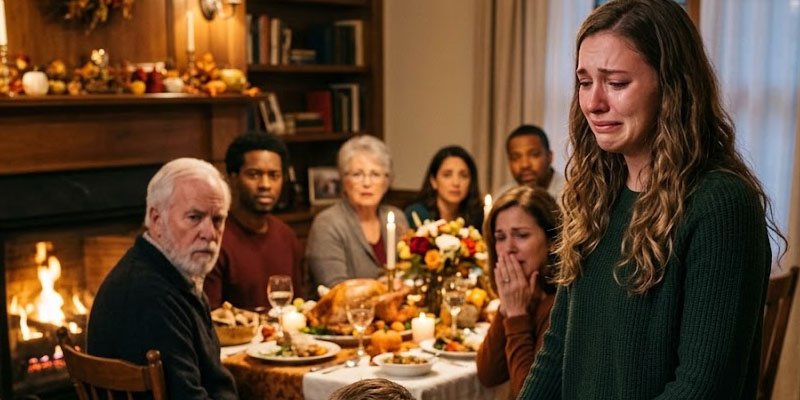
Dinner had just been served when Richard glanced at Ethan’s wheelchair and said almost casually, “Maybe he should eat in the kitchen. Some of the guests aren’t comfortable around disabled kids.”
For a moment, I wondered if I had misunderstood him.
I looked at Mark.
He had heard it too.
Instead of saying anything, my husband picked up the gravy boat and handed it to his sister.
Ethan’s expression changed instantly. He lowered his eyes to his plate and whispered, “Mom… did I do something wrong?”
That question hurt much more than Richard’s words.
I leaned closer to him.
“No, sweetheart. You didn’t do anything wrong.”
Richard sighed as though I were the one causing trouble.
“Claire, don’t make this into a scene. It’s only one dinner. He can still eat.”
“In a different room,” I said.
Linda kept her eyes away from me.
Mark finally muttered, “Can we just get through dinner?”
I stared at him.
“You want our son sitting alone in the kitchen so your father can feel comfortable?”
Mark lowered his voice.
“Not here.”
That was when I realized what everyone at the table wanted from me.
They wanted me to swallow the insult so Thanksgiving could stay pleasant.
I pushed my chair back and rose.
“Ethan, we’re leaving.”
Richard scoffed.
“Over this?”
I stepped behind Ethan’s wheelchair and turned him toward the hallway.
Mark didn’t come after us.
He didn’t apologize.
He simply stayed in his chair.
We were nearly at the door when Ethan stopped me.
“Mom,” he said softly, looking back toward the dining room, “Dad is coming too, right?”
I turned around.
Mark was still sitting there, fork in his hand.
Then Richard smiled.
“See? Even your husband knows you’re overreacting.”
I stared at Mark for several seconds, waiting for him to prove his father wrong.
He never got up.
So I opened the front door and wheeled Ethan outside.
The cold air immediately surrounded us.
Ethan remained silent while I helped him into the car.
Then he asked, “Does Grandpa not like me because of my chair?”
I crouched beside him.
“Your chair has nothing to do with who you are. Grandpa said something cruel because he was thinking about himself instead of you.”
Ethan nodded, but I knew those words couldn’t undo what had happened.
We drove to a small diner that was still open on Thanksgiving.
Ethan ordered pancakes and hot chocolate.
I ordered coffee and barely drank any of it.
About twenty minutes later, Mark called.
“Where are you?”
I almost laughed.
“Where do you think?”
“You embarrassed my whole family.”
“Your father humiliated our son.”
“He’s old-fashioned, Claire. He didn’t mean it the way you’re making it sound.”
I looked across the booth at Ethan, who was arranging sugar packets into little towers.
“He said disabled kids make people uncomfortable.”
Mark went quiet.
Then he said, “You know Dad gets anxious when things are different.”
That sentence changed something inside me.
For years, I had watched Mark excuse the little comments, inaccessible restaurants, family pictures where Ethan’s wheelchair was pushed toward the edge, and birthday parties held upstairs even after I reminded everyone that he couldn’t climb the stairs.
I kept telling myself Mark simply hated confrontation.
Now I realized that his silence had become a decision.
“I’m not coming home tonight,” I said.
“What?”
“Ethan and I are staying with Rachel.”
Mark’s voice became harder.
“You’re seriously blowing up our marriage over Thanksgiving dinner?”
“No. I’m finally seeing what our marriage has been teaching our son.”
Then I ended the call.
My sister Rachel lived forty minutes away.
When we arrived, she hugged Ethan first and asked whether he wanted some leftover pie.
She waited until he was watching a movie in the living room before asking what had happened.
I told her everything.
Rachel listened without interrupting.
Then she said, “Claire, this isn’t the first time you’ve called me crying because Mark wouldn’t stand up to his parents.”
I wanted to argue.
I couldn’t.
At 10:47 that night, Mark finally arrived.
He stood on Rachel’s porch carrying Ethan’s backpack.
“I’m sorry,” he said.
I opened the door halfway.
Then he added, “But you need to apologize to my dad too.”
And right away, I knew his apology wasn’t really an apology.
I stepped onto the porch and shut the door behind me so Ethan wouldn’t hear us.
“I will not apologize for taking our son away from a table where he was treated like a problem.”
Mark rubbed his forehead.
“Dad thinks you made him look terrible in front of everyone.”
“He did that himself.”
I told Mark to go home.
We could talk after Thanksgiving weekend.
He looked stunned, but I was serious.
Ethan and I stayed with Rachel for six days.
During that time, Mark called constantly.
At first, every conversation sounded exactly the same.
His father had been insensitive, but I had overreacted.
His mother was upset.
The family was divided.
Eventually, I stopped allowing him to make the conversation about Richard.
“This is about you,” I said. “Our son looked to you for protection, and you chose not to make your father uncomfortable.”
Mark had nothing to say.
Two days later, he asked to meet me alone.
We sat in a coffee shop, and for the first time, he didn’t defend his parents.
He admitted that he had spent his entire life avoiding confrontation with Richard.
Remaining silent had always felt safer than challenging him.
“But after you left, I watched Ethan’s face,” Mark said. “He wouldn’t even look at me.”
I told him that feeling guilty wasn’t enough.
If Ethan and I were going to come home, things had to change.
Our son would never again be expected to tolerate exclusion simply to protect someone else’s comfort.
Mark agreed to counseling.
Then he told his parents that we would no longer attend family gatherings unless Ethan was treated respectfully.
Richard immediately accused me of controlling him.
That was when Mark surprised me.
“No, Dad,” he said. “This is my decision.”
It was the first time I had ever heard him stand up to his father.
Our marriage wasn’t magically repaired that week.
Trust returned slowly.
Mark began therapy.
Months later, he apologized directly to Ethan without blaming Richard, me, or anyone else.
The following Thanksgiving, we hosted dinner ourselves.
Rachel came, along with friends, neighbors, and Ethan’s cousins.
Ethan sat right in the middle of the table, arguing with everyone over who deserved the last dinner roll.
Halfway through the meal, he leaned toward me.
“This Thanksgiving is better,” he whispered.
I smiled.
“Much better.”
I still think about the moment he looked at me and asked whether he had done something wrong.
No child should ever learn to make themselves smaller because adults refuse to make room for them.
And I learned something too.
Silence may keep a family dinner calm for a few hours.
But when that silence tells your child that someone else’s comfort matters more than their dignity, it stops being peace.
It becomes a choice.
If you had been sitting at that Thanksgiving table, would you have left with your child too—or handled it differently?