I was only eight when my parents left me by myself on Pine Crest Ridge near Aspen, Colorado.
It happened because I complained that my boots were rubbing my heels painfully.
My father, Richard Hayes, stopped on the trail, looked at me with the same irritated expression he used whenever I interrupted something involving my older sister, Claire, and said, “If she’s old enough to complain, she’s old enough to walk.”
My mother, Melissa, gave an uncomfortable laugh. Claire, who was eleven, rolled her eyes.
Then they continued down the trail without me.
At first, I thought they were punishing me. I believed they would wait around the next bend and come back once I had cried enough. I yelled until my throat hurt, but no one returned.
As evening arrived, the temperature dropped quickly.
I found an unlocked maintenance shed beside an old ski access road. Inside, there was a damaged shovel, several bags of salt, and a thin emergency blanket inside a cracked plastic cabinet. I wrapped the blanket around myself and spent the night listening to the wind slam against the metal walls.
At the same time, my parents were driving three hours back to Denver.
They never reported me missing.
From what I learned afterward, my father believed I would “find a ranger and learn a lesson.”
My mother asked him twice if they should return. He refused. Claire apparently said nothing.
The next morning, a county road worker named Daniel Ruiz noticed the shed door moving in the wind.
He found me inside, dehydrated, shaking, and barely able to stand because both of my heels were bleeding.
Daniel called 911.
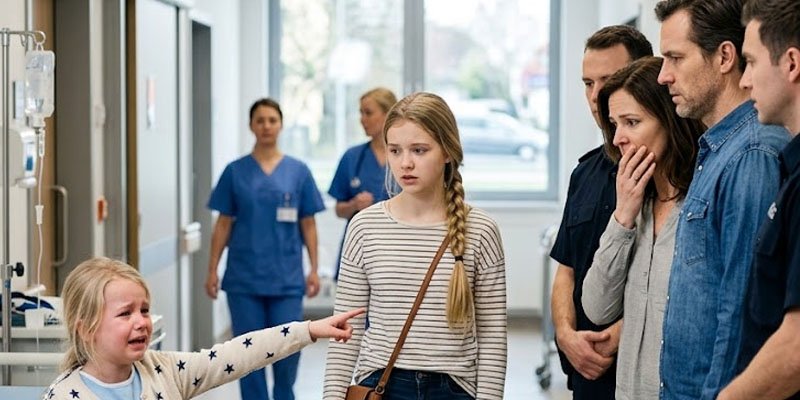
At the hospital, a nurse asked me several times for my parents’ phone number. I knew it by heart.
Nobody picked up.
Police officers were already outside my parents’ house when they finally came back from breakfast.
The most horrifying part was not simply that their daughter had spent a night alone.
It was what police discovered once they entered the house.
My parents had packed Claire’s bedroom for her upcoming transfer to a private school.
In the kitchen garbage, detectives found handwritten notes my mother had thrown away. One said, “Maybe after this weekend Emma will finally stop ruining every trip.”
Another read, “Richard thinks one night outside might scare the attitude out of her.”
Police also found my backpack in the garage.
My medicine, water bottle, sweater, and emergency whistle were still inside.
They had not merely forgotten me.
They had deliberately left behind the things that could have helped keep me safe.
And when my father opened the front door for two deputies, his first concern was not whether I was alive.
He asked, “How much trouble are we in?”
By the time my parents reached the hospital, I had already told the same story three separate times.
First, I told Daniel Ruiz, the road worker who found me. Then Deputy Karen Whitmore. After that, I spoke with Leah Morgan, a child-protection investigator.
Each time, I tried to make what my parents had done sound less cruel.
I said maybe they thought I was following them. I suggested Dad might have believed another family was still on the trail. I said Mom probably had not noticed that my backpack was still in the garage.
Leah never argued with me. She only asked, “Emma, did anyone tell you where to go after they left you?”
“No.”
“Did anyone tell you when they were going to return?”
“No.”
“Did they leave you food, water, a phone, or a jacket?”
“No.”
That was the moment I stopped trying to find excuses for them.
My mother arrived first. She rushed into my hospital room crying, but Deputy Whitmore stopped her before she could reach my bed. I remember looking at her costly cream-colored coat and wondering why she had brought that into the mountains while my sweater had stayed at home.
“Emma!” she cried. “Baby, we were terrified.”
Deputy Whitmore immediately asked, “When did you become terrified?”
My mother went completely still.
She could not give an answer that made sense.
My father came in several minutes later with an attorney already listening on speakerphone.
He wanted to know why officers had entered our home.
He claimed the notes were jokes that had been misunderstood and insisted they expected me to walk downhill toward the staffed visitor center.
There was just one problem.
The visitor center had been closed for renovations for six weeks.
A closure sign was posted near the parking area where my father had left the rental vehicle.
Police recovered surveillance footage from a gas station about forty minutes from the ridge.
The footage showed my parents, with Claire in the back seat, buying coffee and snacks less than an hour after leaving me. My mother purchased three bottles of water.
Not four.
That detail eventually became more important to me than the notes.
Three bottles meant they were no longer thinking of themselves as four people traveling together.
At least, not that night.
Child Protective Services temporarily placed me with my mother’s younger sister, Aunt Rebecca, who lived in Aurora. Claire was sent there as well, though she barely looked at me during the drive.
For three days, she barely spoke.
Then, late one night, she appeared in the doorway of the room where I was sleeping.
“I knew,” she whispered.
I sat straight up.
“Knew what?”
“That they were going to leave you.”
My stomach clenched.
Claire began crying before she could finish. She told me Dad had discussed the plan over breakfast that morning. He said I needed to “break the habit of making everything difficult.” Mom had objected initially, but only because she was worried someone might notice them.
Claire had been promised a new phone if she stayed out of it.
“Why didn’t you tell me?” I asked.
She wiped her cheeks with both hands.
“I thought they’d come back.”
It was not an apology. Not yet.
The criminal case moved quickly after Claire repeated those details to investigators while Aunt Rebecca and a child advocate were present. My parents were charged with felony child abuse and reckless endangerment. Their lawyers argued that they had made an awful parenting decision, not deliberately tried to cause me serious harm.
The prosecutors did not need to prove they wanted me dead.
They only needed to establish that two adults knowingly abandoned an eight-year-old child in dangerous circumstances without essential supplies.
For the first time, adults outside my family were treating what happened as something serious.
And for the first time, my parents could not decide what everyone else was allowed to call it.
The weeks after Pine Crest Ridge changed our family much faster than I could understand.
My parents were released on bond and ordered not to contact me directly.
They were allowed supervised visits with Claire because investigators found no evidence that she had been physically endangered, while Aunt Rebecca became my temporary guardian.
For the first time, I lived in a home where nobody compared my grades, clothes, appetite, or moods with my sister’s.
It should have felt peaceful.
Instead, I kept waiting for someone to send me back.
Whenever a car door shut outside, my body tensed. Any phone call after dinner made me wonder whether a judge had decided that what happened to me was not serious enough.
Aunt Rebecca noticed.
One evening, while making spaghetti, I asked, “If they apologize, do I have to go home?”
She turned off the stove before answering.
“No one is going to make that decision just because they apologize.”
“What if they tell the judge I’m difficult?”
“You’re eight,” she said. “You’re allowed to be difficult sometimes.”
I suddenly started crying, which embarrassed me.
Rebecca never told me to stop.
Eventually, my parents accepted plea agreements instead of risking a trial. My father pleaded guilty to felony child abuse resulting in serious risk of injury. My mother pleaded guilty to a reduced felony child-neglect charge after prosecutors concluded that Richard had created most of the plan, although she had knowingly taken part.
The judge examined photographs of my feet, that night’s weather report, the closed visitor center, the notes recovered from our kitchen trash, and the gas-station surveillance footage.
Then Claire took the stand.
She was twelve by the time the sentencing hearing occurred.
Her voice shook as she described what happened over breakfast on the morning of the hike.
“Dad said Emma always got attention by complaining,” she told the court. “He said if she complained on the ridge, we should keep walking. Mom asked how long. Dad said long enough to scare her.”
The prosecutor asked, “Did anyone say Emma would have a phone?”
“No.”
“Food?”
“No.”
“Water?”
Claire swallowed. “No.”
“Did you understand she could still be there after dark?”
Claire looked toward our parents.
“Yes.”
My father kept his eyes lowered toward the table.
My mother cried.
For years, I remembered that moment as the first time Claire had chosen me instead of them. As I grew older, however, I understood it in another way. She had been a child too. Our parents had rewarded her whenever she agreed with them and made her feel guilty whenever she questioned them.
Her testimony did not undo what she had done, but it was the first decision she made that genuinely cost her something.
My father was sentenced to eighteen months in county jail, followed by probation and mandatory parenting and anger-management programs. My mother received probation, community service, and required counseling.
My parents lost custody of me.
The exact sentences disappointed several people around us, particularly Aunt Rebecca, but the family-court consequences lasted much longer.
Rebecca became my permanent legal guardian.
Initially, my parents fought that decision aggressively. Dad accused Rebecca of manipulating me. Mom sent long letters through her attorneys about reunification and forgiveness. Some included apologies. Others were filled with explanations.
I learned to hate explanations.
Dad wrote that he had grown up with a strict father and believed fear built resilience.
Mom wrote that she had spent years trying to keep peace in the marriage.
Neither explanation answered the question that mattered most: why had maintaining peace with him mattered more than protecting me?
Therapy helped me stop asking that question as though there were some secret answer that could repair everything.
There was simply a choice.
They had made theirs.
Claire and I had a more difficult road ahead.
For almost a year, I hardly spoke to her unless I had to. We slept in neighboring rooms at Rebecca’s house because the court eventually approved Claire living there permanently too. Our parents’ legal troubles, the public attention, and their growing anger over her testimony had damaged their relationship with her as well.
One Saturday morning, I found Claire sitting on the back steps with the silver phone Dad had bought her after the trip.
She held it out toward me.
“I hate this thing.”
I did not take it.
“Then throw it away.”
“I tried.”
“Then why do you still have it?”
“Because I think I deserve to look at it.”
That response made me angrier than any excuse could have.
“You think feeling bad helps me?”
“No.”
“Then stop making this about how bad you feel.”
Claire flinched.
I had never spoken to her like that before.
She nodded and placed the phone beside her.
“What do you want me to do?”
“I don’t know.”
That was the truth.
I was nine years old. I did not understand forgiveness in any sophisticated way. I only knew I did not want another apology followed by pressure to make the person apologizing feel better.
So Claire stopped asking me to forgive her.
Instead, she began changing small things.
When relatives praised her while ignoring me, she redirected their attention.
When our grandmother said Dad had “gone too far but meant well,” Claire stood up at the dinner table and said, “He left an eight-year-old on a mountain.”
When classmates found old local news reports about our family and whispered about me, Claire never told me to ignore them. She simply walked beside me.
It took years before I could trust her without seeing the ridge in my mind.
By high school, we were close, although not in the effortless way sisters in movies always seemed to be. We had boundaries. She did not speak for me. I did not pretend our history had disappeared. If either of us was angry, we said so before resentment had time to harden.
Our parents remained together for another four years.
Then Mom filed for divorce.
Afterward, she began reaching out to me more cautiously, initially through Rebecca. Her messages became shorter. She stopped defending herself. When I was sixteen, I agreed to meet her at a coffee shop in Denver.
She looked older than I remembered.
For several moments, neither of us said anything.
Finally, she said, “I’m not going to ask you to call me Mom.”
I looked down at my hot chocolate.
“Okay.”
“I’m also not going to tell you your father made me do it.”
That made me look at her.
She continued.
“He planned it. I agreed to it. I could have stopped it before the hike. I could have turned around. I could have called the police when we got home. I did none of those things.”
I waited for her to say but.
She never did.
“I chose being afraid of conflict with him instead of protecting you,” she said. “That is the truth.”
I did not forgive her that day.
But for the first time, I believed her.
My relationship with my father never recovered.
He contacted me twice after finishing probation. The first time, he mailed a birthday card with a long letter about how the criminal case had ruined his career. The second time, when I was nineteen, he asked Claire for my email because he wanted to “clear up misconceptions.”
She refused to give it to him.
Years afterward, I learned he had moved to Arizona and remarried. I felt less than I had expected to.
The ridge remained with me in quieter ways.
For many years, I hated hiking. I checked locks repeatedly. I always kept water, a battery pack, and a small emergency kit in my car.
When friends changed plans without telling me, I sometimes felt panicked before my mind could catch up.
But Pine Crest Ridge did not become the ending of my childhood.
Rebecca made sure of that.
She taught me to drive. She attended parent-teacher meetings. She sat in the front row when I graduated from college with a degree in social work. Daniel Ruiz, the man who found me in the shed, attended that graduation too.
I had stayed in touch with him through birthday cards and occasional lunches.
After the ceremony, he handed me a small package.
Inside was an emergency whistle.
I laughed when I saw it.
“That’s dark,” I told him.
“I figured you could handle the dark.”
“I can.”
He smiled. “I know.”
At twenty-seven, I began working at a county child-advocacy center in Colorado. I did not take the job because I wanted to turn my life into a lesson. I chose it because I remembered how difficult it had been to tell the truth while still loving the people who had hurt me.
Children rarely describe their families in neat categories.
Neither had I.
Claire became an architectural engineer and moved to Seattle. We spoke every Sunday. She married at thirty and asked me to be her maid of honor. Before the ceremony, while we were alone in the dressing room, she held my hand.
“I used to think the worst thing I ever did was stay quiet on that mountain,” she said.
I said nothing.
She continued, “But the worst part was that I had learned to believe it was normal.”
I squeezed her hand.
“Yeah.”
“I’m glad we didn’t stay normal.”
That was probably the closest we ever came to summing up our entire childhood in one sentence.
My mother and I eventually formed a limited relationship. We saw each other several times a year. I never moved back into her home. I never called what happened a mistake, because a mistake is forgetting a lunchbox or choosing the wrong exit.
Leaving me was a decision made over and over.
It was decided at breakfast when my father announced his plan.
It was decided on the trail when my mother kept walking.
It was decided in the parking lot when nobody went back.
It was decided at the gas station when they bought three bottles of water.
It was decided again that night when they reached Denver and still failed to call for help.
That realization kept me from minimizing what happened.
It also kept the past from confusing me.
When people later asked what my parents saw after opening their front door the next morning, they expected one dramatic answer.
Police vehicles.
Deputies.
A search notice.
Evidence bags.
The possibility of prison.
All of those things were present.
But I believe what truly frightened them was something much simpler.
For the first time, the story no longer belonged to them.
For years, they had decided which daughter was sensitive, which was talented, which deserved patience, and which one needed to become tougher.
Then they abandoned me on a mountain.
A road worker opened the shed.
A deputy heard my story.
A nurse recorded my injuries.
My sister finally told the truth.
And suddenly, there were witnesses.
I was eight years old, freezing, frightened, and bleeding when Daniel Ruiz found me.
But once that shed door opened, I was no longer the child they could abandon and later explain away.
Someone had found me.
And this time, the adults who had walked away were the ones who had nowhere left to hide.