
My truck broke down in Amarillo, Texas, six weeks before my job contract was supposed to end.
The mechanic quoted a repair bill that was worth more than the truck itself, so I rented a car and drove straight back to Missouri without telling anyone I was returning early.
During the drive, I pictured my wife, Lauren, smiling in the kitchen, my thirteen-year-old son Tyler sprinting down the porch steps, and our old hound barking like he had been waiting for me every single day.
But when I pulled into the driveway, the porch was completely empty.
Lauren opened the front door with a smile that felt practiced instead of genuine.
Her hair was pulled into a ponytail, and she gripped her phone tightly in one hand.
“Where’s Tyler?” I asked.
Her eyes flicked toward the hallway. “He’s at an enrichment program.”
“What kind of enrichment program?”
“It’s a behavioral farm. Just for a little while. He needed some discipline.”
A cold feeling settled deep inside me. Tyler was kind, quiet, and always avoided trouble whenever he could. The biggest thing he had ever done wrong was leave cereal bowls in his bedroom.
“Where is it?”
Lauren hesitated for just a moment. “Calhoun County. It’s a well-respected place.”
I didn’t spend another second asking questions.
Before she could stop me, I grabbed her phone, searched through a conversation with a man named Garrett Voss, found the address, and drove an hour along winding back roads lined with endless soybean fields.
The so-called “program” was a fenced property with old barns, locked storage buildings, and a greenhouse baking beneath the scorching afternoon sun.
A woman standing at the entrance informed me that parents were not allowed inside without an appointment. I told her I was done making appointments just to see my own son.
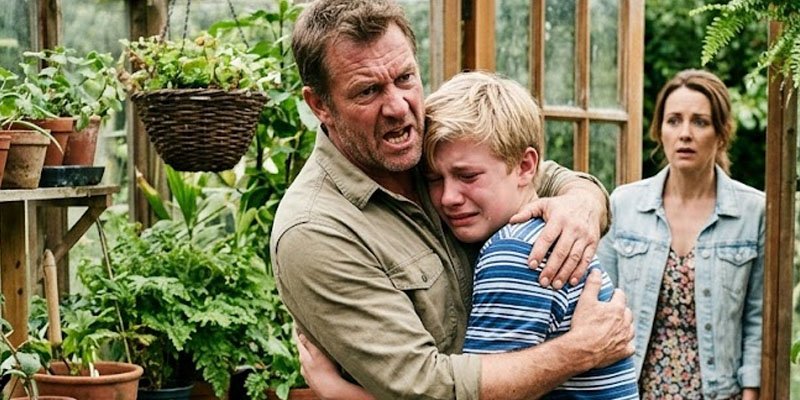
I found Tyler inside the greenhouse.
He was kneeling between rows of tomato plants, his shirt soaked with sweat while the corners of his lips were dry and cracked. His face looked hollow. Dark circles shadowed the skin beneath his eyes. He had lost so much weight that his collar hung loosely around his neck.
When he saw me, he didn’t run right away. He simply stared at me as if I were something his exhausted mind had imagined.
Then he stumbled toward me.
“Dad,” he whispered, clutching my shirt with both hands. “Please. They told me you signed papers giving me away.”
He had been trapped there for ten days.
Ten days of backbreaking work, restricted meals, no access to a phone, and punishment whenever he cried. Ten days while my wife slept peacefully in our home, convincing herself of whatever story made it easier to justify what she had done.
I picked him up even though he had been too big to carry for years, because in that moment he felt like he was five years old again.
Behind him, hidden beneath the shadow of a potting table, another young boy with dirt covering his face silently watched us.
Tyler’s voice shook against my shoulder. “Dad, there’s a little boy who wanted to know if you could take him too.”
I looked toward the child, then turned my eyes to the locked greenhouse door behind us.
The very next thing I did was call 911, park my rental car across the only exit, and shout the children’s names until everyone on that property heard my voice.
The young boy hiding beneath the potting bench didn’t move when I reached out my hand toward him. He looked about seven or maybe eight years old, wearing oversized boots and a faded T-shirt that read “Little Slugger.” Tyler told me his name was Mason Reed. He had been there even longer than Tyler. Nobody knew exactly how long because after the first few days Mason had stopped answering anyone’s questions.
“Sir, step away from the children,” Garrett Voss shouted from the greenhouse entrance.
He was a large man wearing khaki pants and a polo shirt embroidered with the farm’s logo across the chest: Voss Family Growth Center. Growth. Just reading that word made my stomach tighten.
“You locked my son inside a greenhouse,” I said.
“You signed the custody authorization.”
“I never signed anything.”
Garrett’s face became stern. “Your wife did.”
I slowly turned to face him. “Then you better hope that paperwork is authentic.”
Tyler’s legs suddenly gave out beneath him. I caught him before he collapsed onto the ground.
That was the moment my rage stopped feeling wild and became completely focused. I gently laid him on the grass, folded my jacket beneath his head, and asked him a few simple questions.
His full name. Today’s date. My middle name. He answered two of them before vomiting water and bile onto the dirt.
Mason crawled out behind him. He never said a word, but he sat beside Tyler as though my son was the only person in that place who still made him feel safe.
The woman at the entrance tried to close the gate before anyone else could arrive. I drove my rental car across the driveway, blocked the only exit, and stood in front of it with my phone recording. “Nobody is leaving,” I said.
Garrett laughed once, but the sound disappeared the moment the first sheriff’s patrol vehicle came over the hill.
Within twenty minutes, the property had stopped looking like a farm. It had become an active crime scene.
Deputies found nine children spread across the grounds. Three were inside a barn sorting heaps of scrap metal. Two sat inside a shed repeating “accountability statements.” One little girl lay on a cot beside a bucket, burning with a fever. Their parents had spent thousands of dollars hoping for discipline, confidence, faith-based resilience, or whatever polished promises Garrett advertised in his brochures.
Instead, what greeted them was terror wrapped in official forms.
An ambulance carried Tyler and Mason together because Tyler refused to let go of the other boy’s sleeve. I sat beside them on the narrow bench, one hand resting on my son’s ankle while the other clung to the metal rail as if the entire world could tilt without warning.
At the hospital, doctors confirmed Tyler weighed twelve pounds less than he had at his previous checkup. He was dehydrated. Undernourished. Both of his wrists showed stress injuries. There were no broken bones, but the physician met my eyes with the restrained expression of someone fighting to hide their outrage in front of a child.
“Can I go home?” Tyler asked.
“Yes,” I told him. “Not back to that house tonight. Home with me.”
A nurse asked about his mother.
Tyler simply shut his eyes.
That answer said everything.
I spent hours giving statements until my throat felt raw. I described Lauren’s lies, the messages recovered from her phone, and the document Garrett claimed carried a forged signature. Afterward, I stayed beside Tyler as he slept. Across the room, Mason lay curled around a carton of chocolate milk as though he feared someone might take it away.
Shortly before dawn, a caseworker named Angela Price arrived. She explained that Mason’s parents were out of state and could not be contacted. His placement had been arranged through a private referral network.
“What happens to him now?” I asked.
Angela looked so exhausted she seemed close to tears. “Emergency foster care, unless we can locate approved relatives.”
Mason opened one eye.
He had heard every word.
I looked over at Tyler. Even asleep, one hand remained stretched toward the small gap between the two hospital beds.
So I said the only thing that felt right.
“Start the emergency paperwork. He’s not spending another night with strangers.”
By sunrise, my life had split into two chapters: before and after.
Before, I was a man who spent endless weeks on the road, calling home from truck stops and gas stations, convinced that earning enough money could hold a family together even while I was away. Afterward, I found myself sitting in a hospital conference room with a sheriff’s deputy, a child welfare caseworker, a pediatrician, and two boys who looked like survivors of a storm nobody else had cared enough to notice.
Tyler sat beside me wearing borrowed sweatpants and a hospital sweatshirt. Mason sat on his other side with both hands wrapped around a paper cup of apple juice. He still had not spoken to a single adult—not the doctor, not the deputy, not even Angela Price.
But every time Tyler shifted, Mason quietly shifted too.
Angela outlined the emergency placement procedures. I was not an approved foster parent. I had no spare bedroom ready for another child. There was no legal process that could possibly be completed before noon. Even so, the county had the authority to make exceptions during emergencies, especially when a child had already experienced institutional neglect.
“You understand,” she said softly, “that this arrangement may only be temporary.”
“I understand it’s temporary,” I answered. “But I also know what it means to leave a child behind after he begged someone to rescue him. I’m not going to do that.”
Tyler lowered his eyes to his hands.
Mason silently stared into his cup of juice.
Deputy Hollis, a broad-shouldered man with silver hair and tired eyes, slid a plastic evidence bag across the table. Inside was a photocopy of a consent form. At the bottom was my signature.
It didn’t even look like mine.
“My name is Daniel Mercer,” I said. “I never write the letter D like that. I never use my middle initial. Whoever signed this clearly didn’t know how I write.”
“Your wife emailed it to us,” Hollis said. “She also included a copy of your driver’s license.”
My driver’s license had been sitting inside my desk drawer at home.
I closed my eyes and pictured Lauren’s carefully perfected smile again.
For fourteen years, I had explained away her sharpness as stress, her emotional distance as disappointment, and her controlling behavior as concern. She had never been warm toward Tyler, but I kept convincing myself that some parents simply loved differently. Some people struggled to express affection. Some mothers never baked cookies or kissed scraped knees, yet still protected their children from danger.
I had been completely mistaken.
Lauren called for the first time at 8:17 that morning.
I ignored it.
She called again at 8:21.
A third call came from an unfamiliar number.
Deputy Hollis glanced at my phone. “If you’re comfortable, you can answer on speaker.”
I accepted the call.
Lauren’s voice sounded cheerful, brittle, and carefully rehearsed.
“Daniel, thank goodness. You have no idea what you’ve done.”
Tyler’s shoulders instantly stiffened.
I kept my tone steady.
“I know exactly what I’ve done. I found my son.”
“You interrupted a treatment program.”
“He was dehydrated.”
“He exaggerates.”
“He lost twelve pounds.”
Silence settled over the room. Then her voice lowered even further.
“You always do this. You show up acting like the hero after I’ve been left to deal with everything alone.”
Deputy Hollis quietly jotted down another note.
I glanced over at Tyler. His face had gone pale, yet he was listening carefully to every single word.
“You told him I walked away from him,” I said.
“I told him what he needed to believe.”
Mason visibly recoiled when he heard those words.
Lauren spoke faster now. “Tyler needed consequences. He lies. He manipulates people. He spends all his time sulking around the house, making me look like some terrible monster. Garrett said boys like him only improve through strict separation.”
“He’s thirteen.”
“And that’s old enough to learn gratitude.”
I almost let my voice rise. I almost gave in to my anger. But Tyler was sitting beside me, and I knew he had already endured enough shouting to last a lifetime.
“You forged my signature,” I said.
“I had the authority as his mother.”
“Not the authority to sign my name.”
Another long pause followed.
Then, in a much quieter tone, she said, “Come home, Daniel. Bring him back. We can talk this through like adults.”
“No,” I answered. “You can have that conversation with the sheriff.”
I ended the call.
Tyler covered his face with both hands. At first I thought he was crying, but then I realized he was simply trying not to breathe too loudly, trying to make himself as invisible as possible even while he was hurting. I wrapped my arms around him.
“I should have come home sooner,” I whispered.
He shook his head against my shoulder. “I thought you already knew.”
“I didn’t.”
“They told me you didn’t want me anymore.”
“I never stopped wanting you.”
“They said Mom had finally told you the truth about me.”
I held him even tighter. “The truth is that you’re my son. That’s the only truth that matters.”
Mason’s paper cup crinkled slightly in his hands. When I looked over at him, silent tears were running down his dirt-stained cheeks.
Angela took charge from that point forward. She had the calm confidence of someone who had witnessed far too much suffering but still chose to help. By noon, she had arranged an emergency kinship-style safety placement through county supervision. Mason could stay with me for seventy-two hours while the court reviewed his case. Tyler was cleared to leave the hospital in my custody, but neither of us was allowed to return to the family home until law enforcement completed a welfare inspection and collected all the necessary evidence.
So we checked into a motel near the hospital.
Not home. Not yet.
Room 214 had two queen-sized beds, a humming air conditioner, and curtains that carried the faint smell of dust. To the boys, however, it felt like a palace. Tyler paused in the doorway as though he needed permission before stepping inside. Mason stood quietly behind him, small and silent.
“You can pick whichever bed you want,” I said.
Tyler looked over at Mason. “Do you want the one by the wall?”
Mason answered with a single nod.
I ordered soup, sandwiches, fries, bananas, and three bottles of blue sports drink. At first the boys ate carefully, but soon they ate with the restrained hunger that made my chest tighten. Mason cut his sandwich into four pieces before taking a bite, as if he felt the need to save some for later.
“You don’t have to save it,” I told him gently. “There’s plenty more.”
His eyes immediately flicked toward the door.
“No one from that farm is coming through that door.”
He didn’t say a word, but he picked up another piece and continued eating.
That evening, Deputy Hollis called. Garrett Voss and two members of his staff had been arrested. The farm’s records had been seized. Parents were being contacted. Some were furious with the farm. Others were angry with the sheriff. And some simply refused to believe what their money had truly been paying for.
“And Lauren?” I asked.
“She has already been questioned,” he replied. “There hasn’t been an arrest so far. The prosecutor is still reviewing the allegations involving forgery and child endangerment.”
So far.
That single phrase settled over the room like a weight.
Tyler pretended he wasn’t paying attention, but his eyes stayed fixed and alert.
When I hung up the phone, he quietly asked, “Are you going to divorce her?”
It was the first time he had voiced the question.
“Yes,” I said.
“Because of me?”
“No. Because of the decisions she made.”
“But all of this happened because of me.”
I sat on the edge of his hospital bed. “Tyler, I need you to hear me. Adults are accountable for their own actions. Not children. Not children who are exhausted. Not children who are scared. Not children who forget a bowl of cereal upstairs. She made her choices. Garrett made his choices. I made choices too, including spending too much time at work and trusting the wrong person to protect you. That responsibility is mine. None of this is yours.”
He continued looking down at the blanket.
From the other bed, Mason spoke so softly his voice was almost lost beneath the steady hum of the air conditioner.
“They always tell you it’s your fault.”
Tyler looked over at him. “Yeah.”
Mason pulled the blanket up to his chin. “They kept telling me if I behaved better, my mom would call.”
Silence filled the room.
I asked gently, “When was the last time you talked to her?”
Mason’s lips began to shake. “Before Christmas.”
It was June.
I wrote the date down because I no longer trusted myself to remember every detail. Everything mattered now. Every date. Every name. Every sentence those people had used to build invisible prisons around children.
The next morning, Deputy Hollis went back to my house with me.
Lauren was sitting neatly at the kitchen table, an untouched mug of coffee in front of her. She didn’t look frightened. She looked annoyed, as though she were dealing with an inconvenience.
“You involved the police in our home,” she said.
“You sent our son to a labor camp.”
She narrowed her eyes. “Don’t be absurd.”
Deputy Hollis walked past us toward my office. Lauren immediately stood up. “You need a warrant.”
Hollis stopped and answered, “We have one.”
It was the first time I saw real fear cross her face.
The deputies found a photocopy of my driver’s license still resting in the printer tray. They collected emails exchanged with Garrett Voss, payment records, intake paperwork, and a message Lauren had written that read: Daniel won’t agree if we ask him directly. Use the attached authorization. He’s away on business and hard to reach.
One of Garrett’s replies stated: Once the boy is admitted, we recommend no contact for at least thirty days. Opposition from the absent parent is common. We can handle it.
Handle it.
I pictured Tyler on his knees in the scorching heat, surrounded by soaked dirt.
I pictured Mason hiding beneath the table.
Lauren watched as the officers sealed the computer inside an evidence bag. “You’re destroying this family,” she said.
“No,” I answered. “I’m uncovering what had already been destroyed.”
By the end of the week, news of the case had spread across three counties. Television news vans crowded the courthouse parking lot. Reporters described it with careful phrases such as “unlicensed youth program” and “alleged mistreatment.” Parents gathered outside the courthouse—some crying openly, some covering their faces, and others insisting their children simply needed discipline and claiming the sheriff had been misled by exaggerated stories.
Then the children started sharing their experiences.
One after another.
A fifteen-year-old boy named Caleb described being made to carry buckets of rocks from one side of a fence to the other, then back again, as punishment for what staff called “defiance.” A twelve-year-old girl named Emma said employees would read her personal letters out loud while mocking her. Another boy explained the greenhouse punishment: they had to keep working in the intense heat until they apologized the right way. Not simply until they apologized—but until they apologized correctly.
Tyler gave his statement inside a child advocacy center with soft blue walls and shelves lined with stuffed animals. I watched from behind a glass window, my hands locked together so tightly that my fingers eventually went numb.
He told the interviewer everything. His voice shook, but he never once stopped talking.
At the end, she asked, “What went through your mind when your dad came in?”
Tyler wiped his nose with the sleeve of his shirt. “I thought maybe I was finally allowed to be myself again.”
Those words broke something deep inside me.
Mason still said very little, but he stayed close to us. The court extended his emergency placement with me. Then they extended it again. Eventually, his mother was found in Nevada. She explained that she had trusted a transport service after being told the farm was designed to help “strong-willed boys.” She maintained that she had planned to bring him home after three months. She claimed she had never known about the extreme heat, the forced labor, or the isolation.
Maybe she was telling the truth.
Maybe she wasn’t.
The court did not immediately send Mason back to her.
In the beginning, my rental house felt temporary: air mattresses on the floors, donated clothes in closets, and piles of county paperwork stacked beside empty pizza boxes. Little by little, it turned into a real home with familiar routines. Tyler chose the bedroom overlooking the maple tree. Mason picked the smaller room across the hall and slept with the lamp on for six weeks.
We went grocery shopping together. Tyler gained back five pounds, then another four. Mason started asking for pancakes every Saturday morning. The first time he laughed without holding back was when our old hound sneezed so violently that he scared himself.
One evening in August, Tyler found me sitting on the front porch.
“Dad?”
“Yeah?”
“Did you ever love Mom?”
Cicadas hummed through the evening air. Across the yard, Mason was drawing winding chalk roads along the driveway.
“Yes,” I answered. “Or maybe I loved the person I thought she was. Sometimes those are two completely different people.”
“Do you hate her?”
I looked at him. “I hate what she did. I’m still trying to understand how I feel about everything else.”
He nodded, perhaps comforted that I hadn’t given him an easy answer that explained nothing.
Lauren accepted a plea agreement in November. Forgery. Child endangerment. Cooperation with the investigation into Voss Family Growth Center. Garrett Voss refused every plea offer and went to trial the following spring.
By then, Tyler could sit inside a courtroom without shaking. Mason could introduce himself to people he had never met. I had a foster care license, a finalized divorce, and a home with two boys’ bicycles resting against the front porch.
At trial, Garrett’s attorney argued that the parents had willingly given their consent. He claimed the children had behavioral issues. He insisted that discipline often looked harsher than it truly was to outsiders. He argued that Garrett had dedicated his life to keeping families together.
Then Tyler walked to the witness stand.
He wore a navy button-up shirt and the sneakers he had picked out himself. Sitting in the witness chair, he looked so young, yet when the prosecutor asked him what happened inside the greenhouse, his voice echoed clearly throughout the courtroom.
“They told me my dad didn’t want me anymore,” he said. “They told me that if I worked hard enough, maybe I could earn a phone call. But the phone calls weren’t real. Food was something you had to earn. Rest was something you had to earn. Even being believed was something you had to earn.”
Garrett never lifted his gaze from the table.
Tyler faced the jury and spoke clearly. “Children shouldn’t have to prove they deserve to be believed.”
Mason did not appear on the witness stand. His recorded forensic interview spoke for him. As his soft, hesitant voice filled the courtroom through the speakers, complete silence settled over everyone present.
“They kept telling me I was bad,” Mason said in the recording. “But I was trying to be good without making any noise.”
The jury convicted Garrett on several counts, including child abuse, unlawful restraint, fraud, and child endangerment. I can still hear the foreperson reading each guilty verdict. I can still see Garrett’s face lose every trace of color. And I can still remember Tyler releasing a slow breath beside me, as if he had been holding it in for an entire year.
When the sentencing was over, we walked out into the bright afternoon sun. Reporters called after us from every direction, asking questions. I kept walking without answering. Tyler carried himself with quiet confidence. Mason never let go of my hand.
Then a woman standing near the courthouse entrance called my name.
It was Mason’s mother.
She looked far more worn than she had in the courtroom photographs. Her hair was pulled back, and her eyes were swollen from crying. She had come from Nevada to attend the sentencing, but she had waited until afterward before approaching us.
The moment Mason saw her, he instinctively stepped halfway behind me.
She noticed immediately and stopped where she stood.
“I’m not here to take him,” she said quickly. Her voice trembled. “I only wanted to tell him I’m sorry.”
Mason’s hand gripped mine even tighter.
I leaned down slightly and told him, “You don’t have to say anything if you don’t want to.”
He looked at her for a long, quiet moment before speaking.
“You didn’t come.”
She pressed a hand over her mouth.
“I know,” she whispered.
“You didn’t call.”
“I know.”
He gave a small nod, as though carefully placing those facts where they belonged in his mind. Then he quietly said, “I live with Daniel now.”
Her tears came even harder, but she never tried to argue with him.
That made a difference.
Two months later, Mason’s placement with me became permanent on a long-term basis. A year after that, with his mother’s full consent, I officially adopted him. Every year on his birthday, she mailed him a letter. Some birthdays he opened them. Other years he left the envelopes untouched. I always reminded him that either decision was completely okay.
By the time Tyler turned sixteen, he had grown taller than me. He still had days when he withdrew into himself. He still couldn’t stand greenhouses. Even while grocery shopping, he avoided the produce section if it felt too warm. But he joined his school’s robotics club. He learned to drive. He argued with me about curfew just like any other teenager, and every time he slammed his bedroom door, part of me quietly thanked God that he finally felt secure enough to express his anger.
Mason eventually became the catcher on his Little League baseball team. During his first season, he apologized every time a pitcher threw a wild pitch. By the second season, he was calling out encouragement from behind his catcher’s mask. By the third, he had become the loudest voice anywhere on the field.
People often ask why I chose to drive to that farm instead of waiting for Lauren to explain everything first.
I always give them the same honest answer.
Her smile didn’t feel right.
That was enough.
A smile that seemed out of place, a missing child, an address saved inside a phone, and a father who finally stopped assuming the people closest to him were always telling the truth.
The farm is gone now. The greenhouse was torn down. The county updated its reporting requirements for private youth facilities. More parents became cautious. Not every parent. Maybe not nearly enough. But at least some did.
As for our family, we created a very different kind of home.
A home where no door was ever locked from the outside.
A home where food was never treated as something that had to be earned.
A home where apologies were never forced into rehearsed speeches.
A home where a frightened child could wake from a nightmare at two in the morning and find the hallway light already waiting for him.
Even now, Tyler and Mason still talk about that day from time to time. Tyler remembers what it felt like when I wrapped my arms around him. Mason remembers the sound of my rental car stopping in front of the gate. I remember the unbearable heat, the scent of tomato vines, and two boys staring at me as if life itself had placed a choice in front of me.
Save one.
Or look again.
So I looked again.
And that changed everything.