
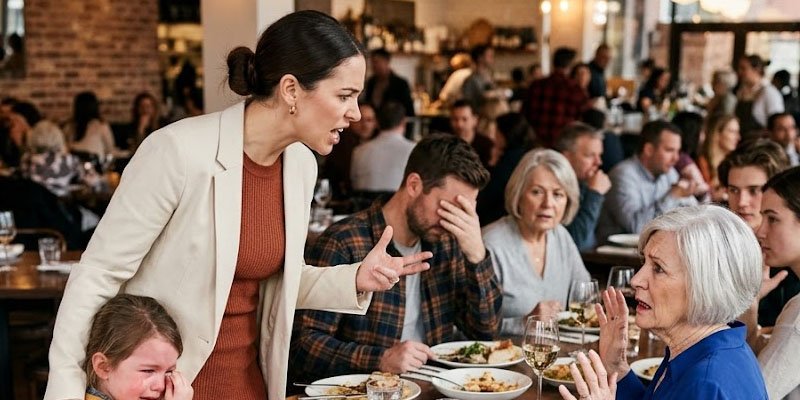
During what was supposed to be a family outing for my six-year-old daughter, my mother-in-law abandoned her in a parking garage for five hours while she took the other grandchildren on a “fun shopping” trip. Before leaving, she looked at my daughter and said, “Stay right here. Don’t move.” I never raised my voice or caused a scene. Instead, I walked into the restaurant, did one simple thing, and the entire family became speechless.
The moment I spotted my daughter standing alone beside a concrete pillar in that parking garage, I realized something inside me had changed forever.
Mia was only six years old, petite for her age, still wearing the yellow cardigan I had buttoned for her earlier that morning. Her face was red from crying. Her tiny hands were tightly clasped together, as though she believed even moving her fingers might mean breaking the instructions she had been given.
She didn’t run into my arms.
That was the first thing that completely broke my heart.
She simply looked at me and quietly said, “Grandma told me not to move.”
Cars continued driving past behind her. A delivery truck backed into the loading zone. People carrying shopping bags or talking on their phones walked by without realizing that a little girl had been standing there alone for five hours because a trusted adult had ordered her to stay put before disappearing.
My husband, Daniel, came to a stop beside me.
“Mia?” he said, his voice cracking with emotion.
Only then did she begin to move. She took three hesitant steps before freezing again, afraid she might have done something she wasn’t supposed to.
I sank to my knees, opened my arms, and gently told her, “Come here, sweetheart. You’re not in trouble.”
She threw herself into my embrace with so much force that I nearly lost my balance.
Her body felt icy cold. Her stomach rumbled with hunger as she sobbed into my shoulder. Over and over, she whispered, “I stayed. I stayed where she told me.”
Daniel’s face lost all its color.
We had believed it was simply a family shopping trip. My mother-in-law, Patricia Hayes, had insisted on taking all four grandchildren to the mall together. Mia had been excited because Patricia had promised they would visit the toy store. Instead, after Mia asked if she could use the restroom and have something to eat, Patricia apparently decided she was “too whiny.”
So Patricia pointed toward a pillar inside the public parking garage and instructed her, “Wait right here. Don’t move.”
Then she walked away with the other three children to enjoy their “fun shopping.”
I didn’t yell.
I didn’t make a scene in the parking garage.
I wrapped Daniel’s jacket around Mia’s shoulders, lifted her into my arms, and walked straight to the restaurant where Patricia had gathered everyone for dinner.
They were laughing when we walked in.
Patricia was seated in the middle of the long table, her sunglasses resting on top of her silver hair while shopping bags were piled beside her chair. My sister-in-law, Claire, was proudly showing off a new coat. The cousins were happily eating fries. No one looked remotely worried.
Then Patricia saw Mia in my arms.
The smile disappeared from her face.
I walked calmly to the opposite end of the table and gently placed Mia into the empty chair beside me. I pulled out my phone, pressed record, and set it in the middle of the table.
Then, in a steady voice, I said, “Patricia, explain to everyone why my six-year-old daughter spent five hours alone in the parking garage.”
Every fork froze in midair.
Daniel stood behind me, visibly shaking.
Patricia opened her mouth to speak, then immediately closed it again.
The entire family fell completely silent.
PART 2
For a few long moments, it felt as though no one at the table even remembered how to breathe.
Patricia looked from one face to another, seeming to expect someone to laugh, come to her defense, or brush everything aside as another harmless family misunderstanding she could dismiss with one dramatic sigh.
Nobody did.
Claire slowly rested the coat back onto her lap. Daniel’s younger brother, Mark, carefully placed his glass on the table. The three older cousins looked at Mia, and their expressions shifted one by one as they realized this was neither a joke, an innocent grandmother lesson, nor a small punishment.
At last, Patricia straightened in her chair.
“Oh, don’t be absurd, Emma,” she said. “She was right outside.”
“Right outside?” I echoed.
“That’s right,” Patricia replied coldly. “She was being difficult. She kept whining. I told her to stay put. Children have to learn to obey.”
Daniel took a step forward. “Mom.”
His voice remained calm, but there was an edge to it I had never heard before.
Patricia looked at him as though he had just slapped her.
“What?” she demanded. “Are you seriously going to pretend I abused her now? I raised three children. I know exactly what I’m doing.”
I adjusted my phone so the camera was aimed more directly at her.
“You left her by herself in a public parking garage,” I said. “Completely alone. No food. No water. No bathroom. No way to contact us. For five hours.”
Patricia’s expression hardened.
“She was perfectly fine.”
Mia flinched.
That tiny movement accomplished something all of Patricia’s excuses never could. In that instant, the entire table turned against her.
Claire spoke softly. “Mom… five hours?”
Patricia snapped back, “Oh, honestly. Don’t start.”
Mark stood up from his chair. “Where did you expect her to use the bathroom?”
Patricia said nothing.
Daniel knelt beside Mia. “Sweetheart, did Grandma ever come back to check on you?”
Mia gently shook her head. “I saw her once. She was really far away. I waved, but she didn’t see me.”
Patricia rolled her eyes. “She’s exaggerating. Children do that when they’re looking for attention.”
I looked at my daughter’s damp sleeves, her trembling legs, and the fragile little voice that had apologized over and over as we walked into the restaurant.
Then I turned back to Patricia.
“No,” I said firmly. “You do not get to call her a liar.”
A server walked toward the table, noticed the atmosphere, and quietly turned around.
Patricia shoved her chair away from the table. “I refuse to be embarrassed like this in public.”
“You embarrassed yourself,” Daniel replied.
The entire room suddenly felt smaller.
Patricia snatched up her handbag. “I’m her grandmother.”
“Not anymore,” Daniel said.
Those two words landed with far more force than anything I could have said myself.
Patricia stared at him in disbelief. “Excuse me?”
Daniel’s hands were clenched tightly at his sides. “You will never see Mia again. Not by yourself. Not with supervision. Not on holidays. Not on birthdays. Not until we believe you’re safe, and at this point, I honestly don’t know if that day will ever come.”
Silence settled over the table again, but this time it carried a different weight.
It was no longer disbelief.
It was condemnation.
Patricia turned toward Claire, but Claire refused to meet her gaze.
She looked at Mark instead. He slowly shook his head.
Finally, she looked at me, and I watched hatred settle into her eyes like a door locking shut.
“You planned all of this,” she accused.
I let out a short, humorless laugh. “You left a child alone in a parking garage, Patricia. All I did was make sure there were witnesses.”
PART 3
We never stayed for dinner.
Daniel carried Mia out to the car while I continued recording until all of us were safely inside. I didn’t trust Patricia not to follow us into the parking garage and start another confrontation. I also wasn’t sure I could keep myself together if she did.
Mia was asleep before we had even driven off the mall property. Her head rested against the car seat, her lips slightly open, one little hand still clutching the sleeve of Daniel’s jacket. Even in her sleep, her body stayed tense, as if a part of her was still waiting for someone to tell her she was allowed to move.
Daniel drove in complete silence for the next ten minutes.
Then he pulled beneath the brightly lit canopy of a gas station, parked the car, and gripped the steering wheel so tightly that his knuckles turned white.
“I’m sorry,” he said.
I turned to look at him.
His eyes were filled with tears, though none fell. Daniel had always been the type of man who buried fear beneath silence. He had grown up with Patricia. Remaining quiet had been how he survived her.
“I should have known,” he said. “I never should have let her take them.”
I reached across the center console and gently placed my hand over his.
“We both trusted family,” I said. “That’s what happened.”
He slowly shook his head. “No. I trusted my mother, even after spending years knowing exactly who she really was.”
It was the most honest thing Daniel had ever admitted about Patricia.
Over the years, our marriage had weathered countless smaller disagreements because of her. Patricia criticized the lunches I packed for Mia, the clothes I chose for her, and the fact that I encouraged her to express herself whenever she was upset. She called sensitivity “drama.” She called fear “manipulation.” In Patricia’s mind, children were supposed to obey immediately and never explain how they felt.
But her cruelty had always come in small enough doses that Daniel could explain it away.
“She means well.”
“She’s just old-fashioned.”
“She loves Mia in her own way.”
“She was strict with us too, and we turned out fine.”
That night, every one of those excuses fell apart.
When we finally got home, Mia woke up crying because she believed she was still standing in the parking garage. Daniel unbuckled her from her car seat and carried her inside while she wrapped her arms tightly around his neck.
I filled the bathtub with warm water, not because she needed a bath, but because she still couldn’t get warm. She sat curled up with her knees against her chest, barely disturbing the bubbles.
“Mommy,” she whispered.
“Yes, sweetheart?”
“Was I bad?”
I sat beside the tub, one sleeve soaked as I held her hand.
“No,” I told her. “You were never bad.”
“But Grandma said I ruined everything.”
A sharp ache spread through my chest.
“What exactly did she say?”
Mia lowered her eyes to the bathwater. “She said I was making everyone tired. She said if I couldn’t be happy, I could stay there until I learned.”
I closed my eyes for a single second.
That was the only moment I allowed myself.
Then I looked at her and said, “Grandma was wrong. Adults are supposed to protect children. She didn’t protect you.”
Mia studied my face carefully, as though she was deciding whether it was truly safe to believe me.
Daniel stood quietly in the doorway. He had heard every word.
His expression had changed once again.
It was no longer shock.
It was determination.
The next morning, he contacted mall security and put the call on speakerphone. A supervisor named Mr. Alvarez listened without interrupting while Daniel explained exactly what had happened. Once Daniel gave the approximate time they had arrived and identified the location where Mia had been left, the supervisor’s tone became much more serious.
“We can review the security footage,” Mr. Alvarez said. “I want to be clear that if the video confirms what you’re describing, we may be required to file an official report.”
“Do it,” Daniel replied.
I watched him as he spoke.
His voice never wavered.
After that, we called Mia’s pediatrician. Then we contacted a child therapist the doctor recommended. Finally, after standing silently in the kitchen for several moments, Daniel called the police non-emergency line.
He said, “I need to report child endangerment.”
The words echoed through our home like the ringing of a bell.
Patricia called twelve times before noon.
Daniel ignored every single call.
Her first message said:
You embarrassed me in front of everyone.
Then:
Your wife is turning you against your own mother.
Then:
Mia needs discipline. You’re raising her to be weak.
Finally:
I did nothing wrong.
Daniel read the last message before placing the phone face down on the kitchen table.
“She isn’t sorry,” he said.
“No,” I answered. “She’s sorry other people witnessed it.”
By that evening, members of the family had already started taking sides—but not the way Patricia had expected.
Claire called first, crying.
“I should have realized Mia wasn’t with the rest of us,” she admitted.
“You were busy looking after your own children,” I replied, completely drained.
Claire shook her head. “No. I should have noticed. Mom told me Mia was already with you and Daniel. I never questioned what she said.”
I immediately looked up.
“What?”
Claire drew in a shaky breath. “When we entered the mall, I asked where Mia had gone. Mom told me that you and Daniel had taken her home early because she was behaving like a spoiled child. It sounded strange, but she said it with such certainty that I believed her.”
Daniel was standing nearby. I repeated every word to him.
His expression hardened.
Patricia had done more than abandon Mia. She had invented a story to explain why a little girl was missing when everyone should have noticed.
Later, Mark called. He had spoken with his ten-year-old son, Ethan. Ethan told him Patricia had said, “Mia is learning a lesson,” after he asked why she was not coming with them into the toy store.
“He assumed another grown-up was with her,” Mark said. “He feels awful now.”
“He’s only ten,” I answered. “None of this is his fault.”
“I know,” Mark replied. “I just wanted you to understand that we’re not standing behind Mom.”
That evening, Daniel finally answered one of Patricia’s phone calls. Before they continued, he informed her that he was recording the conversation.
Keeping his voice steady, he said, “Mom, I’m recording this call.”
Patricia let out a dismissive laugh. “Of course Emma put that idea in your head.”
“No,” Daniel replied. “I learned that from you.”
A short silence followed.
“What exactly is that supposed to mean?” she demanded.
“It means I know how you rewrite the truth.”
Her voice immediately became sharper. “How dare you?”
Daniel closed his eyes for a moment but held his ground. “Tell me why you left Mia alone in the parking garage.”
“I didn’t leave her,” Patricia snapped. “I told her to stay where she was.”
“She’s six years old.”
“She’s old enough to follow simple instructions.”
“For five hours?”
“She was not there for five hours.”
“We have the parking records. We have the restaurant receipt. Security is reviewing the surveillance footage.”
Silence.
That single pause revealed more than any direct admission could have.
Then Patricia spoke in a much quieter voice. “You’re really bringing outsiders into this against your own mother?”
Daniel answered, “You put my daughter in danger. You caused all of this.”
Her tone changed again. The anger vanished and was replaced with something much more calculated.
“You’re making a terrible mistake, Daniel. When your wife leaves you, don’t expect to come running back to me.”
He ended the call.
For a long moment, he simply sat there without saying anything.
Then he quietly said, “I always believed she only talked like that because she was angry.”
I stayed silent.
Still staring at the dark phone screen, he continued, “Now I think she says those things because they get her what she wants.”
The police report did not end with an immediate arrest or dramatic confrontation. Real life rarely works that way. An officer came to our house, took our statements, and spoke gently with Mia for only a few minutes because we did not want her to become overwhelmed. The security footage confirmed everything: Patricia entered the parking garage with four children, left Mia beside the concrete pillar, walked into the mall with the other three, passed through the same area several hours later without stopping to check on her, and then continued on to the restaurant.
The officer explained that the report would be officially submitted for review. He also advised us to keep Patricia away from Mia and save every attempt she made to contact us.
Claire informed Patricia that the surveillance footage existed.
That was the moment Patricia changed her approach.
The following morning, she posted a long message in the family group chat.
I have been completely misrepresented. Mia was never in any danger. She was always within sight, and I was teaching her that tantrums have consequences. Emma has always disliked me and has been waiting for an opportunity to tear this family apart. Daniel is being manipulated. I hope everyone remembers who kept this family together before rushing to judge me.
For the first time, Daniel answered publicly where everyone in the family could read it.
Mom, Mia was left alone in a public parking garage for about five hours. The security footage confirms it. You told Claire that we had already taken Mia home with us. You told Ethan she was “learning a lesson.” You never called us. You never checked on her. You never gave her food or took her to the bathroom. This is not a misunderstanding. Do not contact us again unless it is through a lawyer or a therapist we have approved.
No one responded for eight long minutes.
Then Mark finally sent a message:
I believe Daniel and Emma.
A moment later, Claire replied:
I believe them too.
Patricia exited the group chat.
Two weeks afterward, a package arrived for Mia in the mail. Inside was a porcelain doll along with a card that read, Grandma forgives you.
Daniel opened the package before Mia had the chance to see what was inside.
He stood silently in the kitchen, holding the card. It was the first time since we discovered Mia in that parking garage that I saw him cry.
There was no yelling or emotional breakdown. He simply pressed one hand over his mouth as his shoulders trembled, while the small pink envelope lay on the counter like undeniable evidence of something deeply toxic.
I picked up the card and read the words myself.
Grandma forgives you.
Not, “I’m sorry.”
Not, “I hurt you.”
Not, “I was wrong.”
Instead, Patricia had twisted the entire situation, placing the blame onto the shoulders of a six-year-old child.
Daniel threw the doll into the trash. Then he photographed the card, kept the envelope as evidence, and blocked Patricia’s phone number.
The following week, Mia started therapy. At first, she refused to talk about what had happened in the garage. Instead, she communicated through drawings: a yellow square, a gray wall, and a tiny stick figure standing beside a black car. In the corner of every picture, she carefully wrote the same word.
Wait.
Her therapist, Dr. Helen Monroe, explained that healing would not happen in a straight line.
“She stayed because she trusted the adult,” Dr. Monroe told us. “That kind of betrayal is especially painful for a child. We don’t want to teach her to ignore adults. We want her to understand that her safety is always more important than obedience.”
So we practiced with Mia.
We taught her that if she ever felt frightened, became lost, got sick, or was left behind, she had permission to move. She could look for a trusted adult. She could ask for help. She could refuse. She could scream if necessary. She could break a rule whenever obeying it placed her in danger.
At first, she repeated those words so quietly they were almost impossible to hear.
Little by little, her confidence returned, and her voice became stronger.
By the end of the month, she could say with certainty, “I can move if I’m not safe.”
Daniel changed too.
He began seeing a therapist on his own. He stopped dismissing painful memories simply because they belonged to the past. Gradually, like removing splinters one at a time, pieces of his childhood surfaced: Patricia locking him outside for answering back, leaving him alone at church after he cried during a service, and telling him he was embarrassing whenever he became ill in public.
“I always believed that was normal,” he admitted one evening.
We were sitting together on the porch after putting Mia to bed. The evening air smelled of fresh rain and newly cut grass.
“I know,” I quietly replied.
He looked at me.
“I don’t want normal anymore if that’s what normal was.”
Three months after everything that happened in the parking garage, Patricia came to our house.
It was a Sunday afternoon. Mia was inside the living room building a blanket fort, while Daniel stood in the kitchen making grilled cheese sandwiches when I heard a car door close, followed by a firm knock at the front door.
The instant I saw Patricia through the glass, a wave of cold ran through my body.
As always, she looked perfectly put together. She wore a cream-colored blouse, pearl earrings, and lipstick applied with flawless precision. She carried no gift and offered no apology.
She had only brought herself, convinced as always that her presence alone should be enough.
Daniel walked to the front door but deliberately left it locked.
“Leave,” he said through the glass.
Patricia arranged her expression into a sad, gentle smile, as though she were starring in a documentary about a misunderstood mother.
“I came to see my granddaughter.”
“No.”
“I have rights.”
“You have a police report.”
The smile slipped from her face.
“Daniel,” she said quietly, “you are my son.”
He nodded once.
“And Mia is my daughter.”
For just a brief moment, genuine panic flashed across Patricia’s face.
I think she had expected anger. Anger was familiar to her. She knew how to transform anger into disrespect, disrespect into victimhood, and victimhood into control.