My mother announced that all 13 relatives would be spending two weeks at our beach house, even after my wife explained that our daughter was ill. My father insisted nothing would change. I replied, “Fine.” But when they arrived that Friday, they quickly realized I was no longer willing to let them walk all over me.
My mother wrote in the family group chat, “Friday. All 13 of us are staying at your beach house for two weeks. Make sure everything is ready.”
My wife, Emily, answered almost immediately. “Our daughter is sick. Please postpone it until next week.”
My father replied, “Nothing is changing.”
I looked at the messages while our six-year-old daughter, Lily, lay on the couch coughing, her cheeks burning with fever. That beach house was never meant to be a family vacation center. It was the only peaceful retreat we owned, bought after a decade of overtime, skipped holidays, and Emily taking freelance work late into countless nights.
My relatives behaved as though it were a shared holiday home that simply happened to be under my name.
I replied, “Fine.”
Emily looked at me as if I had completely let her down. “Fine?”
I leaned over, kissed Lily on the forehead, walked into the garage, and made one phone call.
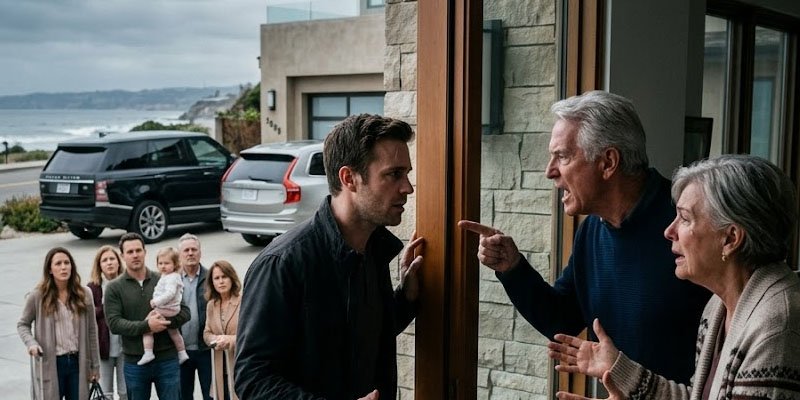
By Friday afternoon, three SUVs rolled into the driveway. My parents stepped out first, carrying themselves like retired nobility. My brothers followed with their wives, while seven energetic children began dragging coolers toward the house.
My mother, Patricia, didn’t bother knocking. She punched in the old keypad code.
The lock flashed red.
She entered it again.
Red.
My father, Richard, pounded on the front door. “Daniel!”
I opened it from the inside, dressed in jeans with a calm expression. Behind me, the house looked nearly vacant. No fresh towels waiting in the guest rooms. No refrigerator packed with groceries. No spotless bedrooms prepared for visitors.
My mother’s smile faded. “Why doesn’t the code work?”
“I changed it.”
Richard’s expression hardened. “Open the door.”
“I already have,” I answered. “For a conversation.”
My brother Mark stepped forward. “Quit being dramatic. The kids are exhausted.”
I stepped onto the porch and quietly shut the door behind me. “Lily has strep throat. Emily is upstairs taking care of her. Nobody is staying here.”
My mother laughed as though I had said something absurd. “We drove five hours.”
“And we told you not to come.”
Her eyes narrowed. “You said fine.”
“I did.” I pulled out my phone and tapped the screen. “Fine meant I was done arguing.”
A white van turned onto the street and parked behind their vehicles. Two men wearing navy shirts with the Seabrook Property Management logo stepped out.
My father looked from them back to me. “What is this?”
“The house is closed for maintenance,” I replied. “Plumbing inspection, pest control, roof repairs, and a deep cleaning. It all starts today.”
“That’s impossible,” my mother snapped.
One of the workers approached with a clipboard. “Mr. Carter? We’re ready to begin. During the treatment, no unauthorized guests are permitted on the property.”
My father opened his mouth, but nothing came out.
Then my mother noticed the security camera mounted above the porch, its small red light blinking.
“You’re humiliating us,” she said quietly.
“No,” I replied. “I’m protecting my family.”
PART 2
My mother stood perfectly still for three full seconds.
That was when I knew the explosion was about to happen.
Patricia Carter almost never shouted first. She preferred to calculate. She searched for the weakest point, found the person most likely to give in, and kept applying pressure until everyone adjusted to her demands.
This time, she turned toward the upstairs window where Emily was.
“Emily!” she shouted. “Come downstairs and explain why your husband is acting like he’s lost his mind.”
The curtains never moved.
I said, “Don’t yell at my wife.”
My father stepped closer until he was nearly chest-to-chest with me. Richard had used that tactic throughout my childhood. At six feet tall and still strongly built in his late sixties, he believed his size and silence alone commanded obedience.
“You’re going to let your mother inside,” he said in a low voice.
“No.”
Shock crossed his face. Even though I was thirty-eight years old, he still saw me as the little boy who apologized even when he had done nothing wrong.
Behind him, my sister-in-law Jenna shifted the beach bag on her shoulder. “Daniel, seriously, where are we supposed to stay?”
“At a hotel.”
Mark let out a scoff. “For thirteen people? In the middle of summer weekend prices?”
“That sounds like something you should have thought about before choosing to ignore us.”
My mother’s face flushed with anger. “You selfish little man.”
The property manager, a calm man named Luis, cleared his throat. “Sir, we do need the driveway cleared. The treatment crew will be here in about fifteen minutes.”
Richard turned sharply toward him. “We’re family.”
Luis glanced down at his clipboard. “Your names aren’t on the list of approved occupants.”
Those words landed harder than anything I could have said.
My mother immediately pulled out her phone. Seconds later, notifications from the family group chat began lighting up mine.
Patricia: Daniel locked us out of the beach house.
Aunt Carol: Seriously? After everyone drove all that distance?
Cousin Nate: That’s pretty harsh.
Mark: Apparently Lily is “sick.”
I typed a single response.
Daniel: Lily has strep throat. We asked everyone to postpone the visit. They refused. The house is unavailable.
Then I uploaded screenshots of Emily’s message, my father’s reply saying, “Nothing is changing,” and my own answer: “Fine.”
The group chat instantly went quiet.
The moment my mother saw the screenshots, she glared at me with unmistakable fury.
“So you think having proof means you’re right?”
“No,” I answered. “It just makes it a lot harder to lie.”
At that moment, Lily appeared behind the glass front door. She was still wearing her pajamas, clutching her stuffed rabbit. Her hair was messy, and her watery eyes made it obvious she still felt awful.
“Daddy?” she whispered through the glass.
Emily stood behind her, exhausted and pale, resting one hand gently on Lily’s shoulder.
My mother’s expression changed in an instant. She slipped into her public grandmother persona—soft eyes, quivering lips, and one hand pressed dramatically against her chest.
“Oh, my precious girl,” she called loudly enough for everyone to hear. “Grandma’s here.”
Lily quietly stepped back.
That single movement broke something inside me.
I faced my relatives and said, “Leave.”
Richard raised a finger toward me. “This isn’t finished.”
I nodded. “I know. It isn’t.”
PART 3
The first SUV drove away about ten minutes later.
They didn’t leave because my parents had suddenly learned to respect boundaries. Mark hadn’t developed any understanding, and not a single apology was offered.
They left because Luis had already called a towing company.
From the porch, I watched my father standing beside his SUV, talking sharply into his phone with the same cold, commanding voice he always used when he wanted to intimidate someone. My mother wandered from vehicle to vehicle, telling the children that Uncle Daniel was simply “having one of his moods” and assuring everyone that the situation would soon be fixed.
It wasn’t.
The family eventually checked into a roadside motel roughly twenty minutes inland. I knew because Mark texted me a photo of the motel sign with one short message.
Hope you’re proud.
I never replied.
Back inside the beach house, Emily had finally managed to get Lily back to sleep. I found my wife sitting quietly at the kitchen table, both hands wrapped around a mug of tea that she hadn’t taken a single sip from.
For a while, neither of us spoke.
Finally, she asked, “Did you really arrange all that work?”
“Yes.”
“When?”
“The moment after I sent ‘Fine.’”
Her exhausted face softened a little.
“Daniel.”
“I should’ve done it years ago.”
She lowered her eyes.
“I honestly thought you were going to let them in.”
“I know.”
“That frightened me more than Lily’s fever.”
Her words stung because they were true.
For years, Emily had watched me become a frightened twelve-year-old every time my parents showed up. I became overly accommodating, careful, and eager to please. I carried everyone’s bags. I gave up bedrooms. I covered restaurant bills. I laughed whenever cruel comments were disguised as jokes.
My mother called it family closeness.
My father called it respect.
Emily had a far more accurate description.
Surrender.
I took the seat across from her.
“I’m sorry.”
She slowly nodded.
“I don’t need you fighting everyone all the time. I just need to know that when it comes to Lily and me, you won’t disappear.”
“I won’t.”
I meant every single word.
That night, my phone rang twenty-seven different times.
I turned it off.
The next morning, while Emily and Lily were still asleep, I brewed coffee and opened my laptop. Dozens of unread messages were waiting. Some relatives accused me of being heartless. Others simply wanted to know what had really happened.
One message from Aunt Carol stood out.
Your mother is telling people Emily pretended Lily was sick just to keep the beach house to yourselves.
I stared at the message for a long time.
Then I did something I had never done before.
I posted in the family group chat.
Daniel: Since Mom is telling people Lily’s illness wasn’t real, here’s the urgent care discharge paperwork with the personal information removed. Diagnosis: strep throat. Instructions: rest, antibiotics, and avoid contact with others.
I attached the medical document.
Daniel: For years, Emily and I have opened this house because we were told that was our responsibility. This is not a family hotel. The beach house belongs to Emily and me. From now on, nobody stays here unless both of us personally invite them.
Mark answered first.
Mark: You’re seriously blowing up the whole family over one weekend?
Daniel: No. I’m finally responding to years of disrespect.
A moment later, my father entered the conversation.
Richard: Watch your tone.
I almost laughed.
Three simple words.
The same familiar instruction.
Watch your tone.
That phrase had followed me for as long as I could remember. It surfaced whenever I disagreed, tried to explain myself, or even cried. It was never really about being respectful.
It actually meant, “Stop making me uncomfortable by refusing to stay silent.”
This time, I responded with care.
Daniel: I am watching it. That’s why I’m speaking clearly instead of reacting with anger.
My mother called once more.
I let the phone continue ringing.
About a minute later, she sent a voice message. I didn’t play it. I saved it and answered instead:
Daniel: Whatever you want to say can be written here.
Patricia: You are tearing this family apart.
Daniel: No. I’m simply changing how available I am to be taken advantage of by it.
No one replied for the next six minutes.
Then my younger brother, Evan, messaged me privately.
Evan: I didn’t realize Lily was actually sick. Mom told us Emily just didn’t want visitors.
Me: Emily said in the group chat that Lily was sick.
Evan: Dad told us you always exaggerate whenever you don’t want to help.
I leaned back in my chair and stared at the screen.
That had always been their strategy.
My parents didn’t just make demands. They shaped the story beforehand so that any refusal would make me seem selfish or disloyal.
A second message from Evan appeared.
Evan: I’m sorry. We should have asked first.
It didn’t erase what had happened, but it was the first sincere apology anyone had offered me.
By midday, staying at the motel had become unbearable for them. The kids were restless. My nephews wanted to go to the beach. My mother hated the room, and Jenna was upset about how much it was costing.
So my father decided to try a different approach.
He came back by himself.
His SUV rolled into the driveway shortly after lunch. Emily was upstairs reading with Lily. I walked outside and met him before he could reach the front door.
He was wearing sunglasses despite the cloudy sky.
“Let’s talk like men,” he said.
“We can talk right here.”
His eyes shifted toward the security camera. “Turn that off.”
“No.”
His jaw tightened. “You’ve become paranoid.”
“I’ve become cautious.”
He took off his sunglasses and slipped them into his shirt pocket. “Your mother is heartbroken.”
“Lily was sick.”
“Your mother spent months planning this trip.”
“No. She announced it on Wednesday.”
“She shouldn’t need permission from her own son.”
I looked at him quietly for a moment. The ocean breeze drifted between us, carrying the scent of salt and sunscreen from nearby homes where families were actually enjoying their vacation.
“That sentence is exactly the problem,” I said.
He frowned. “What do you mean?”
“You believe being my parent gives you ownership. Over my time. My home. My wife’s work. My daughter’s space.”
He sneered. “Your wife’s work? She’s filled your head with all this therapy nonsense.”
I stepped a little closer—not in a threatening way, but enough to make it clear I wasn’t going to back away.
“Don’t blame Emily simply because I finally listened to what you’ve been saying.”
His expression hardened. “You’re choosing her instead of us.”
“I’m choosing my own household over your sense of entitlement.”
The word hit him as though it were an insult.
“Entitlement,” he repeated.
“Yes.”
“So now you think you’re better than us because you own a beach house?”
“No. I believe I have the right to decide who stays in it.”
He glanced past me toward the house. “You’ll regret this when we’re gone.”
There it was.
The last weapon.
Guilt.
The reminder of mortality.
The threat of future regret used to keep me under control.
For most of my life, those words would have worked. I would have pictured an empty chair at Thanksgiving, a hospital bedside, or a funeral. I would have questioned whether protecting the house—or standing my ground—had really been worth it.
But with Lily’s antibiotics resting on the kitchen counter and Emily’s exhausted face still fresh in my memory, I finally understood something.
Regret isn’t always about what you didn’t do for your parents.
Sometimes, it comes from failing to protect your own child.
“I have regrets about certain things,” I said. “But keeping a sick little girl away from thirteen visitors will never be one of them.”
For the first time, my father didn’t have an immediate response.
Then I heard the front door open behind me.
Emily stepped outside.
She looked exhausted in loose sweatpants and an oversized sweater, yet her gaze never wavered.
“Richard,” she said calmly. “You need to leave.”
A cold smile crossed his face. “This is between my son and me.”
“No,” Emily replied. “This concerns my home and my daughter, which means it concerns me too.”
He let out a short laugh. “You’ve always tried to isolate him.”
I felt my anger rising, but Emily subtly lifted one hand. She didn’t need me to defend her.
“I wanted him to have peace,” she said. “You confused that with isolation because you believe chaos is what keeps people connected.”
My father looked at her without speaking. Something flickered across his face.
It wasn’t guilt or understanding.
Maybe it was recognition—the uncomfortable realization of hearing himself described with complete accuracy.
He turned his attention back to me. “Last chance, Daniel.”
“No.”
“When you need help someday, don’t come looking for me.”
I almost smiled. “Help with what? Respecting my own boundaries?”
His face flushed. He slid his sunglasses back on, walked to his SUV, and slammed the door so hard that a gull flew off the neighbor’s fence.
As he drove away, Emily slowly let out the breath she had been holding.
I reached over and took her hand.
She let me keep holding it.
For the following three days, my relatives stayed in different hotels, argued through private group chats, and posted carefully selected photos from public beach access points, pretending that had been the plan all along.
My mother uploaded a picture of herself holding a paper coffee cup with the caption: Making memories despite challenges.
Aunt Carol reacted with a like.
Then Evan commented: The real challenge was ignoring a sick child and showing up without an invitation.
Within five minutes, the comment disappeared, but by then nearly everyone in the family had already read it.
That was the moment the narrative started to shift.
Jenna sent Emily a private apology. She admitted Mark had told her that we had originally agreed to the trip and then suddenly backed out.
Two of my cousins messaged me privately, saying they had been wondering for years why every family gathering seemed to depend on our house, our finances, or our effort.
Eventually, even Aunt Carol wrote, I didn’t know the whole story.
My mother never apologized.
Neither did my father.
When the week ended, they drove back home.
Two days later, a letter arrived in our mailbox.
It wasn’t handwritten. There was no apology inside, and it certainly didn’t offer peace.
Instead, it was an invoice.
My father had itemized motel expenses, restaurant bills, fuel costs, and even something he labeled “emotional distress inconvenience.” At the bottom he had written:
Total owed: $4,286.17.
Emily looked at the page before suddenly laughing.
Not an awkward laugh.
A real, uncontrollable laugh that left her covering her mouth and leaning against the kitchen counter.
I couldn’t help laughing too.
Lily, still looking pale but steadily recovering, walked into the kitchen and asked, “What’s so funny?”
Emily folded the letter and smiled. “Grandpa sent Daddy a very silly bill.”
Lily nodded thoughtfully. “Like when Max says I owe him five dollars because he dropped his own ice cream?”
“Exactly like that,” I replied.
That evening, I scanned the invoice and shared it in the family group chat with one simple message:
Daniel: We will not be paying this.
Mark replied with a laughing emoji before apparently thinking better of it.
Evan responded: That’s embarrassing.
My mother immediately left the group chat.
About an hour later, my father left as well.
The silence that followed felt unfamiliar.
At first, it wasn’t peaceful. It felt like stepping off a boat while still sensing the waves beneath your feet.
For weeks afterward, I expected some form of retaliation. An unexpected visit. Long messages. Relatives insisting I should apologize.
There were a handful of attempts, but every response from me remained exactly the same.
No.
No, we are not hosting anyone.
No, you may not visit without our permission.
No, Emily will not cook for fourteen guests.
No, Lily’s bedroom is not available.
No, “family” does not count as a reservation.
By the time autumn arrived, something surprising happened.
Our beach house finally felt like it truly belonged to us.
Emily painted the guest room a soft shade of blue and transformed it into a quiet reading room. Lily filled a low bookshelf with seashell collections and her favorite picture books. I replaced the old keypad lock with a smart lock and gave access to only two people: Emily and our neighbor, Mrs. Alvarez, who looked after the house whenever we were away.
One Saturday in October, Evan showed up by himself.
He asked if it was okay before coming.
He arrived carrying soup for Lily, flowers for Emily, and a six-pack for me. He spent the night on the pullout couch and stripped the bedding before he left.
During breakfast, he stared out at the dull gray ocean and quietly said, “I never realized how much noise Mom and Dad bring with them until it was gone.”
I replied, “Yeah.”
He slowly turned his coffee mug in his hands. “They’re really angry with you.”
“I know.”
“They’re confused too.”
“I know that as well.”
“No,” he said. “They’re confused because you never came back begging.”
I kept my eyes on the waves rolling in and disappearing again.
For years, I convinced myself that peace would only arrive when my parents finally understood me. When they admitted they had crossed the line. When they accepted Emily as my partner instead of treating her like an obstacle. When they recognized Lily as a little girl rather than a character in the family story they wanted to tell.
But peace didn’t come from them finally understanding.
It came from no longer needing them to.
We chose not to attend the big family Thanksgiving gathering.
Instead, we stayed at the beach house.
Emily cooked a small turkey. Lily made place cards for the three of us and another one for her stuffed rabbit, Mr. Button. After we finished dinner, we bundled up in coats and scarves and walked along the chilly shoreline while the wind painted our cheeks pink.
My phone buzzed once.
It was a text from my mother.
Patricia: Holidays are for family.
I glanced over at Emily.
She didn’t ask what I was going to do.
I typed:
Daniel: I’m with mine.
Then I put my phone back into my pocket and followed my daughter toward the water, where she giggled as the waves chased the tips of her boots.
Behind us, a warm glow spilled from the windows of the beach house.
For the first time since we had bought it, it looked exactly the way it was meant to.
Home.