PART 1
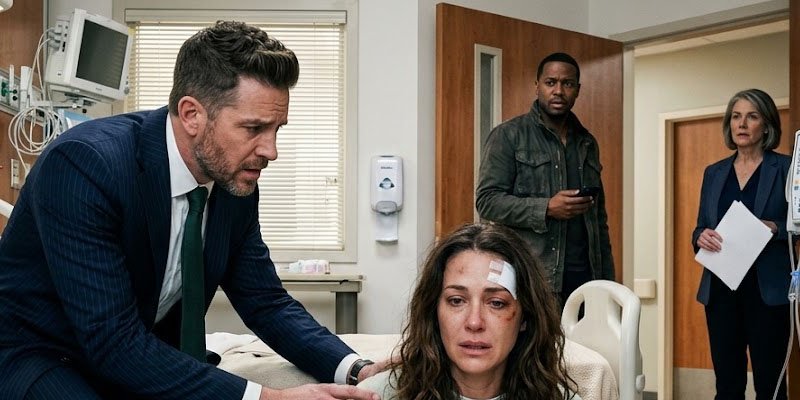
When I opened my eyes in the hospital, my husband was sitting beside me, holding my hand like a devoted man frightened of losing his wife.
His mother leaned toward the doctor and whispered, “Poor Evelyn. The accident has left her disoriented.”
I said nothing.
Because I remembered everything.
The brakes giving out.
My car going off the road.
The phone ringing after the crash.
And the words I heard through the speaker:
“Call us if she di3s.”
Grant and Celeste smiled warmly for the hospital staff while secretly preparing to seize control of my company, my money, and eventually my entire life.
So I smiled too.
Because the stranger who had pulled me from the wreck had brought them something they didn’t know existed.
Proof.
I kept my eyes unfocused and let the heart monitor do most of the speaking.
Grant Cross sat beside my bed in the same navy suit he had worn to our anniversary dinner.
It was flawlessly pressed.
No ripped sleeves.
No evidence that he had spent the morning desperately looking for his injured wife.
Celeste stood nearby, carrying the scent of her expensive gardenia perfume.
Under her arm was my leather document case.
“Evelyn?” Grant gently rubbed my bruised fingers. “Do you recognize me?”
I allowed my eyes to drift.
“My head hurts.”
For half a second, relief passed between Grant and his mother.
A nurse might have overlooked it.
I didn’t.
For eleven years, Grant had let everyone believe that he had built Crosswell Medical Design.
The reality was completely different.
I had established the company with money from my father’s life insurance.
I created and patented our modular medical clinics for rural communities.
And I controlled sixty-two percent of the voting shares.
Grant was chief operating officer because, once upon a time, I had foolishly trusted him completely.
Celeste had spent years referring to it as “the family company,” as though everything I had built automatically belonged to her son.
Now she pulled several documents from my case.
“The doctors need a few signatures,” she explained softly. “Nothing difficult. Insurance forms, payroll authorization, your medical proxy.”
But I immediately recognized the first page.
That wasn’t hospital paperwork.
It bore Crosswell’s corporate seal.
Below it was a voting-share transfer agreement.
I let my eyelids flutter.
“Maybe later.”
Grant tightened his hold around my injured hand.
Pain shot through my wrist.
His smile remained.
“The board meets tomorrow,” he said quietly. “You wouldn’t want two hundred employees to miss their paychecks because you’re too confused to sign something simple.”
Eventually, they left.
I counted slowly to sixty.
Then the closet door opened.
A large man in a rain-soaked delivery jacket stepped into the room.
In one hand, he carried a damaged phone.
In the other was a tiny memory card.
His name was Jonah Price.
He was the stranger who had discovered my car after it went over the ravine.
He had pulled me free before leaking fuel beneath the vehicle could become even more dangerous.
“My dashcam recorded something,” he whispered.
My heart started pounding.
Jonah turned his phone toward me.
The footage showed the hospital parking garage earlier that morning.
At 5:14 a.m., Grant appeared beside my car.
Then he crouched underneath it.
Jonah zoomed closer.
Something metallic caught the light in my husband’s hand.
Cutters.
“My camera caught him near your brake line,” Jonah said.
Then he played an audio recording.
After my crash, my phone had begun ringing.
Jonah had answered it on speaker while attempting to help me.
Celeste’s voice came first.
“Is she gone?”
Then Grant answered.
“Call us if she dies.”
My stomach went cold.
But Jonah had more.
He paused the footage on one frame.
Grant was looking directly toward the dashcam while cutting the brake line.
Then the handle of my hospital-room door began to turn.
Jonah vanished back into the closet.
Grant entered with my neurologist, Dr. Leah Morgan.
Celeste followed behind him.
This time, she was carrying a notary stamp along with the transfer documents.
“Evelyn,” Dr. Morgan said, “your husband tells me you requested an urgent competency evaluation.”
I widened my eyes.
“Did I?”
Grant answered immediately.
“She keeps forgetting things.”
So I gave him exactly what he wanted.
I looked straight at him and whispered:
“Graham?”
Celeste lowered her face to conceal a satisfied smile.
They believed I had suffered major memory loss.
Their plan was clear.
Have me declared mentally incompetent.
Transfer control of my shares.
Then seize Crosswell before I could recover.
Unfortunately for them, my father had never trusted easy shortcuts.
The Crosswell trust required two independent medical opinions, a formal board vote, and seventy-two hours’ notice before anyone could exercise my shares on my behalf.
Grant apparently remembered only the first requirement.
Dr. Morgan eventually told Grant and Celeste to wait outside.
The moment the door closed, I looked directly at her.
“My memory is fine.”
She froze.
“My brakes were deliberately cut. They brought forged transfer papers. And the witness is currently hiding in my closet.”
Jonah stepped out.
He gave her the memory card.
Dr. Morgan watched the footage once.
Then a second time.
Her expression became stern.
Within minutes, hospital security had been notified.
Detective Rosa Bennett entered through a service elevator twenty minutes later.
We immediately agreed on one thing.
Grant couldn’t know we were onto him.
Not yet.
If he panicked, he might destroy evidence inside Crosswell.
Using my hospital tablet, I canceled his access to the company network.
Then I sent our general counsel a seven-word message:
Freeze Grant. Preserve everything. Tell no one.
I also activated a succession safeguard Grant had always ridiculed as needless bureaucracy.
From that point onward, any transfer involving my shares required direct live verification from me.
Any attempt to bypass the safeguard would be recorded on a system outside Crosswell’s ordinary network.
Four minutes later, my general counsel sent me something.
Grant had arranged an emergency board meeting for nine the next morning.
Attached to the meeting materials was a certificate declaring me incapacitated.
It carried Dr. Morgan’s signature.
She stared at it.
“I never signed this.”
I almost smiled.
Grant’s arrogance was turning into evidence.
That evening, I kept pretending.
Grant spoon-fed me broth.
Celeste sat beside him, explaining documents to me as though I were a confused child.
“Just sign here, sweetheart. Grant will protect your little company.”
My little company.
I deliberately missed the signature line twice.
Then I scribbled something that resembled my name but was legally worthless.
They photographed the documents and left, convinced they had won.
Meanwhile, investigators examined my wrecked vehicle.
The brake hose had a clean diagonal cut.
Jonah’s dashcam metadata matched the parking-garage timestamps.
The audio clearly recorded both Grant and Celeste.
Then our general counsel uncovered another surprise.
Grant had moved $840,000 into a Nevada shell company controlled by his mother.
By the following morning, the trap was ready.
PART 2
Grant entered my hospital room looking furious beneath his carefully rehearsed expression of concern.
His company badge had stopped working.
The bank had frozen his transfer.
And three Crosswell directors had refused to attend his emergency meeting.
“You did something,” he said.
I blinked innocently.
Celeste quietly shut the hospital-room door.
Then locked it.
Grant dropped the documents onto my blanket.
“Sign your real name this time.”
What neither of them knew was that Jonah was waiting inside the bathroom.
Detective Bennett was listening from the adjoining room.
And my phone was recording beneath my pillow.
I stared directly into my husband’s eyes.
Then I stopped pretending.
“I remember the ravine.”
Grant’s face changed immediately.
Celeste recovered first.
“Memory after trauma can be unreliable,” she said quickly. “The doctors explained that.”
“I remember hearing your voice.”
Her expression tightened.
“You asked if I was dead.”
Grant snatched the documents from the bed.
“You’re confused.”
“Then explain something.”
I pushed myself slightly higher against the pillows.
“Why did your mother receive eight hundred forty thousand dollars?”
Neither of them answered.
“Why did you forge Dr. Morgan’s signature?”
Grant’s jaw tightened.
“And what exactly were you doing underneath my car at 5:14 yesterday morning?”
Silence.
Then the bathroom door opened.
Jonah walked out.
He raised his phone.
On the screen was Grant kneeling beside my sedan with cutters in his hand.
Celeste went pale.
“That’s fake!” Grant shouted.
Jonah remained composed.
“The original recording is already with the police.”
Grant suddenly lunged toward me.
He seized my wrist and tore the pulse sensor away.
My injured hip struck the bed rail as he pulled me closer.
I twisted myself free.
Grant shoved me.
I fell beside the hospital bed as my phone slid out from beneath the pillow.
It kept recording.
Then Grant screamed the sentence that destroyed whatever defense he might still have had.
“You were supposed to die!”
Celeste grabbed his sleeve.
“Grant! Stop!”
He lifted his arm again.
Jonah intercepted him.
The adjoining door immediately burst open.
Detective Bennett and two hospital security officers rushed inside.
They pulled Grant away from me, forced him against the wall, and handcuffed him.
He shouted that Crosswell belonged to him.
Celeste grabbed the transfer documents and headed for the door.
Detective Bennett stepped directly into her path.
Then she read Celeste her rights.
For the first time in eleven years, my mother-in-law had absolutely nothing to say.
But Grant’s arrest was only the beginning.
Investigators now possessed almost everything.
The dashcam showed preparation.
The severed brake hose established what had happened to my car.
The fraudulent transfer and forged medical documents established a financial motive.
And the hospital recording captured Grant admitting what he had intended.
After obtaining a warrant, investigators recovered Celeste’s messages.
Those messages completed the story.
They contained details about my driving route.
References to the ravine.
Conversations about taking control of Crosswell.
There was even a draft obituary describing Grant as my “devastated successor.”
Apparently, he had planned his grief before planning my funeral.
Confronted with the evidence, Grant eventually pleaded guilty to attempted murder, aggravated assault, wire fraud, and conspiracy.
He received twenty-four years in state prison, along with additional federal consequences connected to the financial crimes.
Celeste accepted a plea agreement for conspiracy and related financial offenses.
She received nine years.
Restitution consumed the lake house and several accounts she had once discussed as though they were already part of her inheritance.
But while their lives were falling apart inside courtrooms, I was dealing with a different battle.
I had to learn to walk normally again.
PART 3
Recovery lasted six difficult weeks.
At first, even walking across a hospital room without a cane seemed impossible.
Every movement reminded me how close Grant had come to getting exactly what he wanted.
But eventually, I walked back into Crosswell Medical Design.
There was no dramatic applause.
No employees lined up along the halls.
Just two hundred people doing the jobs Grant had once treated as pieces in his personal financial game.
And that was exactly what I wanted.
I promoted our controller to chief operating officer.
I expanded the board by bringing in independent directors.
And I changed our internal controls so that no spouse, executive, or family member could ever again gain the kind of unchecked access Grant had exploited.
Then I did something personal.
I established a fund for rural trauma units in Jonah Price’s name.
He hated the idea of publicity.
He refused interviews.
He wouldn’t let us put his photograph anywhere.
But eventually, he accepted one gift.
A new delivery van.
His old one had a habit of refusing to start during winter.
The first trauma clinic funded through the program opened near the county road where Jonah had found my wreck.
Its emergency treatment room faced east.
Every morning, sunlight poured into it.
I liked that.
Eighteen months later, I drove along that same road.
This time, I was driving a new car.
The brakes were factory sealed.
Sunlight stretched across the windshield.
Ahead was the ravine.
For a moment, I recognized the exact place where my old life had almost ended.
I kept driving.
I didn’t slow down.
Grant still sends letters from prison.
He insists that I ruined his future.
That I turned everyone against him.
That Crosswell should have belonged to both of us.
I never read beyond the envelopes.
They are returned unopened.
For years, Grant had treated my company, my money, and eventually my life as possessions he could claim simply because he was my husband.
Celeste believed the same.
They thought surviving the crash would leave me frightened enough to surrender.
Instead, surviving it reminded me exactly who I had been before I ever met Grant.
The woman who built Crosswell.
The woman who owned her choices.
The woman who didn’t need anyone else’s permission to control her future.
One evening, long after the trials were over, I sat alone in my house.
There were no documents waiting for my signature.
No carefully rehearsed voices telling me what was supposedly best for me.
No husband pretending to care while calculating what my death would give him.
For the first time in years, the silence felt peaceful.
That night, I slept without fear.
Because my company was mine.
My future was mine.
And most importantly—
my life finally belonged completely to me.