
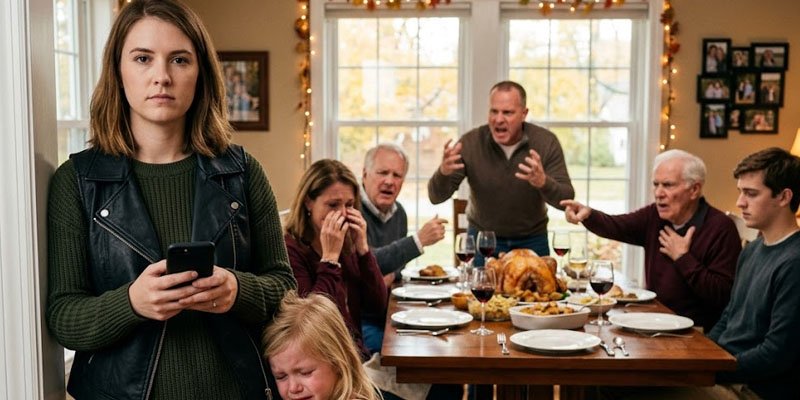
My family forced my five-year-old daughter and me to leave right in the middle of Thanksgiving dinner.
“Don’t come back,” my brother said.
“This holiday is better without you,” my father added.
I didn’t argue. I didn’t cry. I simply answered, “Then I’m sure you won’t object to what I’m about to do.”
Just five minutes later, they were pleading with me to reverse it.
The first jab came before the turkey had even reached the table.
My mother glanced at Lily’s colorful plastic hair clips and let out a sigh, as if my little girl had ruined her perfectly clean living room.
“Claire, couldn’t you have done a better job brushing her hair?”
Lily, only five years old and wearing the red dress I had spent half the night hemming, dropped her gaze to her plate.
I gently placed my hand on her shoulder.
“She looks beautiful.”
Across the table, my brother Mark chuckled under his breath.
He had arrived with his new wife, his two boys, and the same smug expression he had worn ever since inheriting Dad’s confidence without inheriting his self-control.
My father sat proudly at the head of the table, carving knife in hand, acting as though everyone gathered there owed him something.
I never wanted to come.
But Mom called me three different times.
“It’s Thanksgiving,” she kept saying. “Don’t make this into a big deal.”
So I came.
I brought a pie.
I brought Lily.
And I brought the folder tucked inside my purse that I intended to handle after the holiday.
Then Lily reached for a dinner roll before my father had finished saying grace.
Mark’s older son burst into laughter.
“Grandpa said wait, dummy.”
Lily immediately froze.
“She’s only five,” I said softly.
Mark leaned back in his chair.
“And you’re thirty-two, Claire. You’re still making excuses.”
The room slipped into the familiar silence our family always fell into whenever everyone waited to see if I would quietly accept another insult.
Dad set the carving knife on the table.
“Your brother’s right. You’ve always expected other people to deal with the consequences of your decisions.”
“My decisions?” I asked.
Mom quietly murmured, “Claire, not today.”
Dad paid no attention to her.
“You walk in here with a child, no husband, no stable life, and somehow expect everyone to feel sorry for you.”
Beneath the table, Lily’s tiny hand slipped into mine.
I stood up.
“We’re leaving.”
Mark laughed.
“Finally.”
I helped Lily into her coat while my mother kept staring silently at her folded napkin.
Not one person tried to stop us.
When we reached the front door, Mark followed us outside with his wineglass still in his hand.
“Don’t come back,” he said.
Behind him, Dad’s voice was even colder than the November air.
“This holiday’s better without you.”
I looked down at my daughter, who was doing everything she could to keep herself from crying.
At that moment, something inside me became completely calm.
I didn’t argue.
I didn’t raise my voice.
I simply said,
“Then I’m sure you won’t object to what I’m about to do.”
The smile disappeared from Mark’s face.
“What’s that supposed to mean?”
I reached into my purse, took out my phone, and sent a single email.
Then I sent one text message.
Five minutes later, Mark’s phone started ringing.
Then Dad’s.
Then Mom’s.
Mark answered first.
Every bit of color drained from his face.
Dad looked down at his screen, then stared at me through the glass beside the front door.
By the time I secured Lily into her booster seat, all three of them had rushed onto the porch shouting my name.
“Claire! Wait!”
Mark sprinted barefoot across the icy walkway.
“Please,” he begged. “Undo it. You have to undo it.”
PART 2
I didn’t pull away right away.
Lily sat quietly in the back seat, hugging the stuffed rabbit she carried everywhere she went.
Tear tracks still marked her cheeks, yet she didn’t make a single sound.
That silence hurt me more than anything my father had said.
More than Mark’s smug attitude.
More than my mother choosing to study the wallpaper instead of standing up for her granddaughter while she was being humiliated.
I rolled my window down a few inches.
Mark was the first to catch up with me, breathing heavily in the chilly evening air.
“Claire, just listen. This was a family disagreement. You don’t destroy people over something like this.”
Dad slowly made his way down the porch steps, holding tightly to the railing.
Mom stood motionless in the open doorway.
“What exactly did you do?” Dad demanded.
“You already know.”
Mark slammed his hand against the roof of my car.
Lily jumped at the sound.
I met his eyes only once.
“Take your hand off.”
He immediately pulled it away.
His phone was still pressed to his ear.
I could hear a man’s calm, businesslike voice speaking on the other end.
Most likely Mark’s lawyer.
Or perhaps one of the partners at Hale & Turner, the real estate company where Mark had spent years convincing everyone he was brilliant.
“You sent everything to the board?” he asked in a hushed voice.
“And to the bank,” I replied. “And to Mr. Alvarez.”
Dad’s throat tightened.
That single name changed the entire situation.
Victor Alvarez owned the largest piece of land tied to my father’s and brother’s newest development.
For months, they had proudly talked about that project all over town.
A luxury retirement community just outside Madison, Wisconsin.
Three hundred homes.
Private investors.
Bank financing.
Dad referred to it as his legacy.
Mark called it his empire.
I called it fraud.
Because for six months, I had quietly worked as the bookkeeper they never considered important.
After my divorce, Dad offered me temporary work at the family holding company.
He paid me less than the receptionist and constantly reminded me I should be thankful.
I reviewed contracts.
Balanced the books.
Prepared tax documents.
And I noticed money being transferred where it had no business going.
At first, I assumed I had made an error.
Then I uncovered duplicate invoices.
Forged signatures.
Land appraisals adjusted just enough to qualify for larger loans.
Three days before Thanksgiving, I found the final piece.
Mark accidentally included me in an email discussing how to “pressure Claire into deleting the old drive” before the bank’s compliance review.
I deleted nothing.
I saved everything.
I contacted attorney Nina Patel, who advised me not to confront them.
Not yet.
She wanted every document properly organized before filing everything officially.
The plan was to do that on Monday.
But then my brother humiliated my daughter without ever saying the word burden.
My father decided Lily’s pain was acceptable entertainment during Thanksgiving dinner.
My mother stayed silent.
So I moved up the timeline.
Mark’s voice broke.
“Claire, please. We can settle this privately.”
I glanced back at the house where I had spent my childhood learning to stay silent.
“No,” I answered. “You wanted me gone. Now I am.”
Dad took another step toward me.
The anger had vanished.
Only fear remained.
“Claire,” he said quietly, “think about your family.”
I started the engine.
“I am.”
PART 3
I drove away as they stood beneath the porch light, growing smaller in my rearview mirror.
For the first mile, neither of us said a word.
The streets in my parents’ neighborhood were lined with beautiful homes glowing with warm lights and holiday candles.
One family gathered around a dining table passing food.
A young boy pressed his face against a nearby window as we drove past.
Everything appeared peaceful from the outside.
Most things do.
“Mommy?” Lily asked softly.
“Yes, sweetheart?”
“Did I do something wrong?”
The question knocked the air out of me.
I pulled into a gas station parking lot, parked the car, climbed halfway into the back seat, and wrapped my arms around her.
She smelled of apple shampoo and cinnamon cookies.
“No,” I told her firmly. “You did absolutely nothing wrong. Not one single thing.”
“Uncle Mark was angry.”
“Uncle Mark was angry because sometimes adults make bad decisions and don’t like being caught.”
“Grandpa said the holiday was better without us.”
I held her even closer.
“Grandpa was wrong,” I whispered. “Thanksgiving became better the moment we left.”
That was when she started crying.
At first, only quiet tears.
Then tired, heartbreaking sobs.
I held her until she finally settled down.
Instead of driving straight home, we stopped at a roadside diner.
The waitress, Marlene, noticed Lily’s red, puffy eyes right away and brought her a mug of hot chocolate topped with extra whipped cream.
“Tough Thanksgiving?” she asked gently.
“You could say that.”
Lily had pancakes for dinner.
I hardly noticed the taste of my coffee.
My phone kept vibrating without stopping.
Mom: Please answer.
Dad: This has gone too far.
Mark: You’re destroying everything.
Another message from Mark: I’m sorry, okay? I said I’m sorry.
Then a text arrived from a number I didn’t recognize.
This is Nina Patel. I’ve received confirmation that the documents were delivered. Do not speak with your father or your brother without legal counsel. Call me once you’re safe.
My eyes stayed fixed on one word.
Safe.
It was amazing how a single word made me realize I hadn’t truly felt that way in years.
My family never laid a hand on me.
They never left bruises.
The harm they caused was far more subtle.
Constant jokes at my expense.
Acts of kindness attached to expectations.
Help that always became something I owed.
Invitations that turned into interrogations.
Love wrapped in invisible conditions.
After my divorce, Dad said,
“At least now you understand what happens when you ignore advice.”
When Lily and I moved into a small apartment, Mom smiled politely and described it as “cozy.”
When I accepted the bookkeeping position, Mark laughed and said,
“Just try not to mess up the numbers.”
And I smiled.
I stayed silent.
Convincing myself I was doing it to protect my daughter.
But as I watched Lily sketch a turkey on the back of a receipt in that little diner, something finally became clear to me.
Peace that depends on staying silent isn’t real peace.
It’s only a place where the loudest person feels free to take control.
After Lily drifted off to sleep, I called Nina.
“You made the right decision,” she told me. “The bank already had concerns. Your records filled in the missing pieces.”
“What happens now?”
“The loan will probably be put on hold. The investors will be informed. If the forged paperwork is verified, there could be both civil and criminal consequences.”
“My father is seventy-one.”
“Being older doesn’t erase a signature.”
“And Mark?”
“He documented everything in writing. That’s important.”
The following morning, the pleading took a different turn.
Mark called using his wife’s phone after realizing I had blocked his own number.
He didn’t even bother with a greeting.
“Claire, I’ll pay you.”
A short laugh escaped me.
“That’s your version of an apology?”
“Twenty thousand.”
“Do you really think this is about money?”
“Fine. Fifty.”
“You can’t even get the bank to approve anything now.”
Silence.
Then came the anger.
“You have no idea what you’ve done.”
“I know exactly what I’ve done.”
“You actually think they’re going to protect you? Nina? The bank? Alvarez? You’re nobody, Claire. You’re a divorced single mother living in a rental apartment.”
I looked over at Lily, sitting in her pajamas and eating cereal.
“No,” I replied. “I’m the one who kept the records.”
Then I hung up.
Around noon, Dad showed up outside my apartment.
Looking through the peephole, I saw him standing there in his wool coat, neatly dressed as always.
For just a moment, I felt like the little girl who had always expected to be punished.
Then Lily whispered beside me,
“Is it Grandpa?”
“Yes.”
“Do we have to open the door?”
That answered everything.
“No.”
Dad knocked again.
“Claire. I know you’re in there.”
I sent Nina a text.
She replied immediately.
Do not open the door. Tell him in writing to leave.
So that’s exactly what I did.
Me: Leave my building. Do not come to my home again unless it has been arranged through my attorney.
I watched him read the message.
His jaw clenched.
“You’re making a mistake,” he called through the door. “Family doesn’t do this.”
I answered loudly enough that he could hear me.
“Family doesn’t throw a five-year-old out on Thanksgiving.”
Ten seconds later, he walked away.
After that, events unfolded quickly.
Within a week, Hale & Turner placed Mark on suspension.
The bank put the development loan on hold.
Victor Alvarez completely withdrew from the project and accused them of misrepresentation.
The investors demanded repayment.
Dad’s longtime business partner admitted he had never fully trusted the numbers.
By December, Mark’s wife, Tessa, filed for separation.
I didn’t celebrate.
She had laughed at some of Mark’s jokes.
But she had also spent far too many dinners sitting quietly, staring down at her plate.
Sometimes people don’t realize they’re living inside a cage until someone else opens the door first.
Mom came to visit once.
She knocked gently.
Then stepped back.
She was holding a purple gift bag.
I opened the door but kept the security chain fastened.
“Hi, Claire.”
“Hi, Mom.”
She looked past me.
“Is Lily here?”
“She’s at school.”
She nodded.
“I brought her Christmas present.”
I didn’t take it.
Her eyes filled with tears.
“I should have spoken up.”
“Yes.”
“I was afraid your father would cause a scene.”
“He caused one anyway.”
She winced.
For a moment, I expected excuses.
Instead, she quietly said,
“I know.”
“I’m sorry,” she whispered. “Not only for Thanksgiving.”
Those words reached parts of me that had stayed locked away for years.
But an apology cannot erase a childhood.
It cannot restore broken trust.
“Thank you for saying that,” I replied.
“May I see her?”
“Not yet.”
She nodded sadly.
“Will you tell her I love her?”
“I’ll tell her you stopped by with a gift.”
I gently closed the door.
I no longer had to slam doors to make my voice matter.
Christmas arrived peacefully.
Lily and I decorated a small Christmas tree.
She insisted on rainbow-colored lights because, as she put it, “white lights look too serious.”
We baked cookies that came out wonderfully misshapen.
We watched movies.
I made pancakes shaped like stars.
After breakfast, she called Grandma simply because she wanted to.
I stayed beside her the entire time.
That marked our first boundary that truly held.
Many others came after it.
Dad attempted to reach me through relatives.
I told each of them to contact my attorney instead.
Mark tried using guilt.
Then anger.
Then public embarrassment.
None of it succeeded.
By February, Mark had been indicted on fraud-related charges.
Dad was facing both civil lawsuits and criminal charges.
Their lawyers instructed them to stop trying to contact me.
For the first time since becoming an adult, several months went by without my father criticizing me or my brother tormenting me.
Dennis Kline helped me secure a better position doing forensic bookkeeping consulting.
“You notice things that everyone else overlooks,” he told me.
“That’s what happens when people spend years underestimating you.”
“So let’s turn that into your strength.”
The work was honest.
It brought us financial stability.
By spring, Lily no longer asked whether Grandpa was upset.
She made new friends.
She lost her first tooth.
Yet she still paused before taking bread at the dinner table.
Every single time, I handed her the basket first.
“Always take a roll,” I reminded her.
One evening after her school concert, Mom stood outside holding a bouquet of daisies.
She had asked for permission weeks in advance.
My conditions were straightforward.
She could not approach Lily unless Lily chose to go to her.
She could not talk about Dad or Mark.
She could not act as though Thanksgiving had never happened.
Lily looked up at me.
“It’s your decision,” I said.
She walked over.
Mom lowered herself to one knee.
“You sang beautifully.”
Lily accepted the flowers.
“Thank you.”
There was no emotional reunion.
Just a grandmother slowly realizing that love without respect is nothing more than a performance.
Exactly one year after Thanksgiving, I hosted dinner in my own apartment.
The table was too small, so we pushed my desk against it.
Dennis came.
Nina came.
Marlene arrived carrying two pies.
Mom came as well.
There were no speeches.
No insults.
No child being shamed for reaching for bread.
Before we started eating, Lily raised her hand.
“I want to say something.”
She stood on her chair, holding a dinner roll high.
“I’m thankful that Mommy lets me eat bread whenever I want.”
Everyone laughed quietly.
Then she turned toward me.
“And I’m thankful we left.”
The room became silent.
Not with discomfort.
The truth simply needed a moment to settle.
I reached over and took her hand.
“Me too.”
Later that evening, after everyone had gone home and Lily was asleep on the couch, Mom helped me wash the dishes.
At last she spoke.
“Your father’s sentencing is next month.”
“I know.”
“He asked about you.”
“What did he ask?”
“He wanted to know if you were proud of yourself.”
I remembered Mark chasing after my car without shoes.
Dad standing behind the glass.
Lily crying in the back seat.
The email leaving my phone.
Everything that had happened in the years before that.
Then I pictured my daughter proudly holding up a dinner roll.
“Yes,” I answered. “I am.”
Mom nodded.
She didn’t argue.
That said more than any words ever could.
People later asked if I regretted sending those documents on Thanksgiving.
They expected a complicated response.
They expected me to feel guilty.
Regret belongs to people who wish they had made a different choice.
I didn’t.
I gave my father and my brother years of opportunities.
Silence.
Patience.
Explanations.
Second chances.
Apologies I never should have offered.
Holidays they never earned.
In the end, I reclaimed only one thing.
The truth.
They told me never to come back.
So I never did.
And when they pleaded with me to reverse everything, they finally understood what had taken me an entire lifetime to learn.
You can force someone out of your home.
But you can never take away their own power.