My Father Burned My Suitcase on the Side of an Empty Road and Left Me Behind.
I was just thirteen years old.
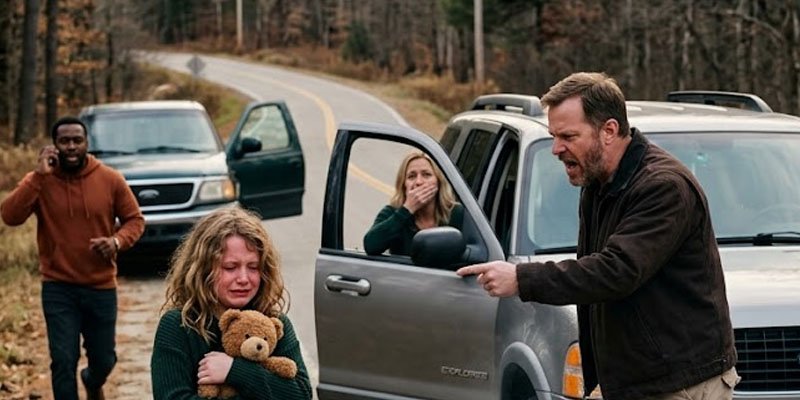
We were driving down a lonely rural road when my father abruptly stopped the car, climbed out, and removed my suitcase from the trunk.
“Get out of the car.”
For a moment, I honestly believed he was joking.
But then he threw my clothes onto the roadside and soaked my suitcase with fuel.
“Dad, what are you doing?”
He struck a match.
In a matter of seconds, the flames swallowed everything I had packed.
“You are not part of this family anymore,” he announced. “Don’t ever come home again.”
My mother sat silently in the front passenger seat.
She couldn’t even bring herself to look at me.
Through the rear window, I watched my younger brother staring at me as my father drove away.
I remained standing barefoot on the roadside, watching smoke rise from what was left of my possessions.
I didn’t have a phone.
I had no money.
And I had absolutely no idea where I was.
After some time, a driver passing along the road pulled over and called the police.
When a police officer asked me where my parents lived, I gave him their address.
Then, although part of me still wanted desperately to run after my family, I finally said something I had never found the courage to say before.
“I don’t want to go back home. Not after what my dad just did to me.”
The officer looked at me silently for several moments. I was determined not to let fear control me anymore.
“You’re safe with us now,” he reassured me.
At first, I lived with relatives, but eventually I was placed in foster care.
After that day, I never contacted my family again.
Years passed.
I built an entirely new life without them.
Then, last week, an invitation to a wedding appeared in my mailbox.
My younger brother was getting married.
My first instinct was to throw the invitation away.
But before I could, I noticed a second envelope tucked inside.
Across the front, written in my mother’s unmistakable handwriting, were six words:
“Please read this before the wedding.”
I opened the envelope and unfolded the letter.
The very first sentence made my hands go numb.
“Your father deceived you that night.”
I thought I had left those memories behind twenty years ago.
But one letter was enough to make me question everything I believed about my past. The truth turned out to be far more complicated than the story I had carried since I was a child.
I read that opening sentence three times.
“Your father deceived you that night.”
Underneath those words, my mother had written a date: October 14, 2012.
It was the exact day my father had abandoned me.
She explained that she had kept the truth hidden for twenty years because she was terrified of what might happen if she revealed it.
Then she shared the first shocking detail.
My father had told our relatives that I had stolen $900 from his wallet, made up an excuse, and become so difficult that nobody could control me.
Not a single word of that story was true.
The money had actually been given to me by my mother.
She had secretly handed it to me so I could buy food after my father stopped giving us money for groceries.
When Dad discovered what she had done, he twisted the entire situation.
But that still wasn’t the actual reason he had left me alone beside that road.
The next paragraph of my mother’s letter made my hands shake.
“Your father was secretly taking money from Grandma’s bank account. You found the statements.”
And suddenly, the memory came rushing back.
At thirteen, I had come across several envelopes in my father’s desk. I didn’t understand the amounts written on the documents, but I recognized my grandmother’s name.
I had asked Dad why money was disappearing from her savings.
My question frightened him.
He immediately accused my mother of snooping through his private belongings, making up accusations, and trying to tear our family apart.
After that, he decided he needed to get rid of me.
In her letter, Mom admitted that she had said nothing while he drove me away from home.
“I was terrified of him,” she admitted. “But being afraid doesn’t excuse what I did. I realize that now.”
She then explained the real reason I had received the wedding invitation.
My brother, Ethan, had discovered an old lockbox belonging to Grandma while getting ready to empty the family house before his wedding.
Inside the box, he found copies of bank records, several letters, and a handwritten note with my name on it.
Grandma had discovered that Dad was taking money from her account without permission.
She had planned to confront him about it.
Unfortunately, she never got the chance.
In her note, Grandma had instructed that the evidence should be given to a lawyer if I ever came back looking for the truth.
Then I reached the sentence in my mother’s letter that frightened me more than anything else.
“Ethan knows your father has been lying. And your father knows Ethan found the lockbox.”
I glanced at the wedding invitation and immediately called Ethan. He didn’t pick up. About a minute later, a text appeared on my phone: “Stay away from the house. Dad knows you received the letter.”
That was when I finally understood why Mom had written, “Please read this before the wedding.”
The invitation wasn’t simply about attending a marriage ceremony.
It was also meant to warn me.
And inside Grandma’s lockbox, another sealed envelope was waiting with my name written across it.
I stared at Ethan’s text until the words started to blur.
“Stay away from the house. Dad knows you received the letter.”
I called him again. This time, he answered in a voice barely louder than a whisper.
“Dad found out Grandma kept proof of everything. He’s demanding that we give it back.”
“Then why did you send me an invitation?”
“Because I can’t start my married life knowing our family destroyed my sister’s childhood.”
For twenty years, whenever I thought about Ethan, I pictured the little boy looking through the car’s rear window as our parents drove away.
Now I realized that he had also been carrying pieces of the truth all those years.
He told me that Grandma had saved more than bank documents. She had also written personal letters for me, Ethan, and our mother. She kept them hidden because she was afraid Dad would destroy them.
Ethan had discovered the lockbox three weeks before his wedding.
The documents showed that Dad had moved money from Grandma’s account into a separate account he controlled. When he realized I had seen the financial records, he invented the story about me stealing his money.
Mom had begged him not to leave me behind. But he told her that if she wanted to keep the family together, she had to support him.
So she chose to remain quiet.
The next morning, I met Ethan at a place close to the church. He placed a brown box on the table between us.
“I’m really sorry.”
“What are you apologizing for?”
“For not doing something sooner.”
I opened the box.
It contained photocopies of bank statements, handwritten notes from Grandma, and photographs of important documents.
At the very bottom was an envelope with my name on it.
I knew immediately that it was the one Mom had mentioned.
My hands shook as I opened it.
I recognized Grandma’s handwriting instantly.
“If this letter has reached you, it means the truth has finally survived longer than his lies.”
I couldn’t bring myself to read any further.
Ethan quietly extended his hand across the table.
“There’s no rush. Take all the time you need.”
In her letter, Grandma explained that she had confronted Dad with questions about the missing money and planned to report him to the authorities.
But after she suffered a stroke, she focused on carefully recording and preserving all the evidence.
She also revealed that Mom had begged her not to involve the police because she feared what Dad might do in response.
For the first time, I could understand why everyone had stayed silent.
Understanding their fear, however, didn’t make their choices acceptable.
On the final page, Grandma had written one simple instruction.
“Never let him convince you that you were responsible for any of this.”
My eyes filled with tears.
Those words couldn’t erase everything I had suffered.
But at last, they helped me make sense of it.
What happened to me wasn’t punishment, and it wasn’t simply a family argument that had gotten out of control.
It was abandonment.
And somehow, I had made it through.
Before Ethan’s wedding, we took all the documents to an attorney.
After reviewing the evidence, the lawyer discovered something neither of us had expected. Dad had used property that previously belonged to Grandma as collateral for a private loan, even though he had never legally owned it.
The wedding was supposed to take place the following day. Dad wasn’t interested in repairing our broken family. His actual plan was to use the gathering to pressure Mom into signing paperwork that would place the property under his control.
Ethan immediately canceled those plans and made changes to the wedding guest list.
The next day, I arrived for the wedding ceremony.
My father was standing near the entrance.
He turned and looked straight at me.
Then he said, “You have no business being here.”
I answered, “That’s exactly what you told me twenty years ago.”
His face tightened.
“You have no idea what’s going on.”
“I know the whole truth now.”
Behind him stood my mother, her eyes filled with tears.
Ethan walked toward us.
“Dad, this ends right here.”
My father stared at him in disbelief.
“So you’re choosing her over me?”
Ethan slowly moved his head from side to side.
“No. I’m choosing to stand by the truth.”
At that moment, the attorney arrived with the paperwork.
A process server was with him.
The expression on my father’s face changed immediately.
There was no shouting, no confrontation, and no public disturbance. He simply looked like a man who had finally realized he could no longer control the story our family told.
Mom stepped forward at last.
“I should have kept her safe,” she said quietly.
Dad turned toward her with an angry expression.
“You never spoke up before.”
She wiped the tears from her cheeks.
“I know I didn’t.”
Then she looked directly at me.
“What I did was wrong.”
Hearing her admit that hurt more than I expected.
I had waited years to hear those words.
But I didn’t run into her arms or pretend everything was suddenly fine.
I simply gave a small nod.
The legal case went on for several months. Our lawyer challenged the planned property transfer and ensured that Grandma’s records remained protected.
In the end, Dad repaid the money that could be recovered and gave up his claim to the property.
Ethan went ahead with his wedding without asking me to explain my past to any of the guests.
Just before the ceremony, he wrapped his arms around me and whispered, “I’m so glad you came.”
I returned his smile.
“I’m glad I came too.”
Over time, Mom and I met several times. She spoke openly about how afraid she had been. I told her that fear might help explain why she acted the way she did, but it couldn’t erase the damage those decisions had caused.
She accepted that.
Our relationship never became what it had once been, but gradually, we found a way to speak honestly with each other.
As for me, I no longer allowed the family I had lost to determine what my future would look like. I established a career, bought a small house, and built friendships with people who appreciated me for who I really was, rather than the person my father had falsely described.
I placed Grandma’s final letter in a locked drawer.
More than anything, I needed the reminder she had left me: I had only been a child.
Nothing I had done could ever have justified being abandoned.
The adults who were supposed to protect me had failed because they were unwilling to confront their own choices.
But despite everything, my life continued.
Twenty years after my father set fire to my suitcase on that lonely roadside, I finally understood something that had taken me years to recognize.
The frightened little girl left standing there had believed her family had completely erased her from their lives.
But they hadn’t erased her.
They had simply walked away from the future she would go on to build for herself.
When I first opened the wedding invitation, I thought it was asking me to return to the family that had turned its back on me.
But that wasn’t its true purpose.
It gave me the chance to finally bring the years of lies to an end.
I could never look at my family in quite the same way again. Still, I learned to speak with my brother, my mother, and eventually myself without constantly hearing my father’s cruel judgment in my mind.
He had once looked at a thirteen-year-old girl and told her, “You are not part of this family anymore.”
Two decades later, I finally understood what was true all along.
My value as a person had never disappeared.
And no matter what he did, that was something my father would never have the power to take away.