PART 1
For an entire year, I learned to live with questions that no mother should ever be forced to ask herself.
Was my daughter terrified when she disappeared? Had she cried out for me? Was she still alive somewhere, waiting desperately for someone to find her?
Then, on one chaotic Monday morning, a damaged suitcase zipper triggered a series of events that made me doubt everything I had been told.
The harsh fluorescent lights above the TSA line seemed almost blinding as an officer sent my suitcase through the scanner for a second time.
Something inside me tightened.
But that was Monday.
To understand why it mattered, I need to go back a year.
My fourteen-year-old daughter, Cynthia, had gone on a Disney vacation with my husband, Gary. I couldn’t go because of work, and Cynthia hadn’t appeared upset about it. She had always shared a close bond with her father.
For the first three days, my phone was constantly filled with pictures.
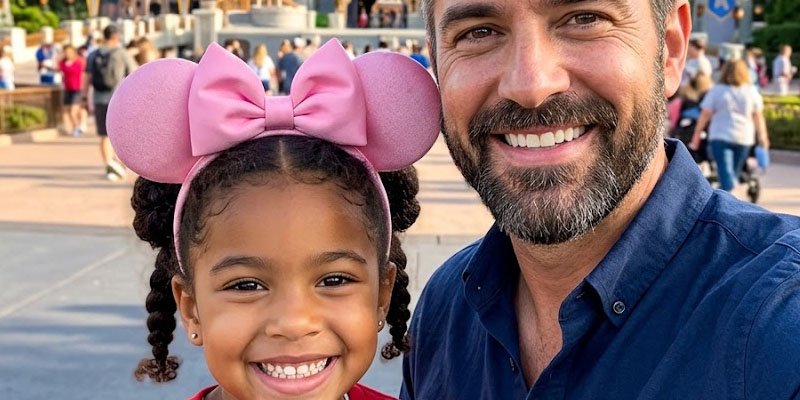
Cynthia wearing mouse ears.
Gary holding a ridiculously oversized sundae.
The two of them laughing together on the rides.
Then, at 2:13 a.m. on the fourth night, Gary called me.
Cynthia was missing.
He told me, and later told the police, that he had left their hotel room for less than fifteen minutes to get food. When he came back, our daughter was gone.
There was no note.
No clear trail.
Weeks of searching revealed nothing.
Eventually, investigators told us what every parent fears most: they believed Cynthia had been abducted.
I threw myself into work because keeping busy was the only thing that stopped my hands from trembling.
Gary reacted completely differently.
He quit traveling, stopped meeting friends, and spent hours sitting on the couch staring at old photographs of Cynthia.
He said he would never forgive himself.
There was one thing he became unusually protective of: the suitcase he had taken with him to Disney.
After he came home, Gary pushed it deep into the back of our bedroom closet and refused to use it again.
Months later, I suggested that we donate it.
“Don’t,” he snapped.
The harshness in his voice caught me off guard.
“Don’t ever touch that suitcase.”
I gave an uneasy laugh.
“Okay. Fine.”
I convinced myself that grief could make people become attached to strange things.
A white Tile tracker was attached inside the suitcase’s front pocket.
“What’s this for?”
Gary barely glanced in its direction.
“In case the bag gets lost.”
I frowned.
“How does a suitcase sitting in our closet get lost?”
He said nothing.
I dropped the subject.
Sometimes his phone would chime when I opened the closet. Gary would appear almost instantly, check the suitcase, and return it to its place.
Once again, I found an explanation for it.
Grief.
Everything unusual inside our home became grief.
Then, the week before my flight, our neighbor came over for dinner.
Gary repeated a story about Cynthia picking out mouse ears at Disney.
“She wanted the pink ones,” he said.
I stopped.
Pink?
During his police interview, he had sworn they were purple.
I had been sitting right beside him.
“Pink?” I asked casually. “I thought you said purple.”
Gary answered without even pausing.
“Did I? I can barely remember anything clearly anymore.”
Our neighbor gave him a sympathetic smile.
I didn’t.
Whenever I brought up contacting Gary’s estranged sister, Rhonda, he immediately changed the subject.
Years before, the two of them had supposedly stopped speaking after a nasty inheritance dispute. Since Cynthia disappeared, Gary had also grown more and more distant from me.
Still, I had no evidence that any of those things meant something.
Then Monday came.
I was hurrying to catch an early work flight when the zipper on my suitcase suddenly tore apart in my hand.
The taxi was already waiting outside.
Gary was asleep on the couch.
There was no time to purchase another bag.
Then I remembered the Disney suitcase.
I stood before the closet for several seconds before finally pulling it out.
For the first time in an entire year, I opened it.
The main compartment appeared empty except for the faint scent of old sunscreen.
“It’s only a bag,” I whispered.
I moved my clothes and work folders into it, zipped it closed, and hurried out.
But inside the cab, I noticed something strange.
The suitcase felt a little heavier than it should have.
Not enough to scare me.
Just enough to make me wonder.
At the airport, I placed it onto the security belt.
The suitcase entered the scanner.
Then it stopped.
The belt moved backward.
It went through the scanner again.
The officer watching the monitor tilted his head and called another person over.
Then a second officer joined him.
My mouth went completely dry.
A tall TSA officer named Delgado came toward me.
“Ma’am, could you step over here?”
“Is there a problem?”
He carried the suitcase over to a metal inspection table.
“Something appears unusual beneath the inside lining.”
My heart began pounding faster.
Delgado opened the suitcase, moved my folders aside, and traced his gloved fingers along the bottom seam.
Then he stopped.
“Come take a look at this.”
Tiny red stitches ran across the black material.
They were different from the original stitching.
“That isn’t factory work,” he said.
“I’ve never seen it before.”
“Is this your suitcase?”
I swallowed.
“My husband’s.”
His eyes remained on me for a moment.
“Do I have your permission to open the lining?”
“Yes.”
He cut through the first stitch.
Then another.
A second officer bent closer.
“These look recent.”
“How recent?”
“Weeks, possibly less.”
My stomach sank.
Weeks?
Gary had insisted that the suitcase hadn’t been touched in a year.
Then the second officer pointed to older puncture marks.
“It looks like someone has opened and resealed this lining more than once.”
Delgado slipped his fingers beneath the fabric.
When he pulled his hand back out, he was holding a flat package wrapped in clear plastic and thick silver tape.
He placed it on the table between us.
“Do you know what this is?”
“No.”
My voice was barely audible.
“I swear I’ve never seen it.”
As Delgado started cutting through the wrapping, my phone vibrated against the table.
Gary.
Several missed calls.
Then I remembered the Tile tracker.
The suitcase had been moving for more than an hour.
He knew.
I answered.
“Where are you?” Gary demanded.
“At the airport. Security stopped me.”
Silence.
Then his entire voice changed.
“Please tell me you didn’t take my Disney suitcase.”
I glanced at Delgado.
“Come home,” Gary said quickly. “Just come home and I’ll explain. Don’t let them open it. Please.”
“Explain what?”
“Not over the phone.”
At that exact moment, Delgado removed the final layer of plastic.
And everything I thought I knew about the past year fell apart.
PART 2
There was no weapon inside.
No blood.
No horrifying nightmare made real.
There were documents.
A thick bundle of papers.
A cheap black phone I had never seen before.
Then a blue passport slipped onto the metal table and fell open.
The photograph was Cynthia.
My daughter.
But the name printed beside her picture wasn’t hers.
I couldn’t breathe.
Beneath the passport was a folded piece of drawing paper.
My hands moved before my brain could catch up.
I unfolded it.
It showed a beach house drawn in pencil, with a dog standing beside it.
In the bottom corner were two words written in handwriting I would recognize anywhere.
Love, Cynthia.
Then I noticed the date.
Three months earlier.
Three months.
My daughter had created this only three months ago.
She was alive.
She had been alive while I spent an entire year believing someone had taken her away from us.
Beside the drawing sat an envelope postmarked from a coastal town.
The location sounded familiar.
Gary had mentioned it once, years earlier, before he supposedly stopped speaking to Rhonda.
There was something else.
A Greyhound ticket stub from Orlando.
A rental car receipt dated the day after Cynthia disappeared.
Documents tied to another identity.
Suddenly, every strange moment from the past year fell into place in a horrifying new pattern.
Gary checking the closet.
His phone chiming whenever the suitcase moved.
His refusal to let me donate it.
The inconsistencies in his stories.
His panic whenever I mentioned Rhonda.
He hadn’t kept the suitcase because grief prevented him from letting go.
He had been using it.
Opening the lining.
Putting documents inside.
Receiving drawings.
Keeping a hidden connection to our daughter alive.
My phone was still against my ear.
“You told me she was gone,” I whispered.
“Melissa, I can explain.”
“You let me believe she had been kidnapped.”
“Please come home.”
“You watched me cry over her every night for a year.”
“I did this for Cynthia.”
I almost screamed.
“For her?”
“You have to let me explain why.”
I stared at the drawing.
“Where is my daughter?”
“Come home and we’ll talk. I’ll take you to her. I swear.”
“No. Tell me where she is right now.”
“Melissa, please.”
“WHERE IS SHE?”
People began looking in my direction.
I didn’t care.
Gary lowered his voice.
“Don’t do this in an airport. Don’t do this to us.”
Us.
That single word made something inside me turn cold.
I looked at the drawing of the beach house, at the dog Cynthia must have known, at the life she had apparently been living without me.
Then I turned toward Officer Delgado.
“Officer,” I said as I lowered the phone, “you need to hear this.”
I handed the phone to him.
That choice changed the entire investigation.
Instead of getting onto my flight, I spent the next several hours speaking with law enforcement.
Eventually, a detective named Marsh met me inside a small room at the airport precinct.
A family liaison sat nearby as he pushed photocopies across the table toward me.
“Your husband opened accounts using a relative’s information two years before the Disney trip,” Marsh said.
Two years.
This hadn’t started on the night Cynthia disappeared.
Gary had been planning it.
“The postmark on the drawing leads to a coastal town,” Marsh continued. “Your husband’s sister lives there.”
“Rhonda,” I whispered.
He nodded.
Then he explained how Gary had hidden her.
Rhonda had taken her husband’s last name after getting married. Gary never included that surname on any family paperwork.
When detectives originally questioned him about relatives, he gave them Rhonda’s maiden name and insisted they had been estranged for years.
He had even provided old emails and documents from their inheritance dispute to prove they were no longer in contact.
Investigators now believed Gary had intentionally used that genuine family conflict as cover.
Police had been searching for one woman.
Rhonda was living under a different surname at a different address.
On paper, there was no obvious reason to connect her residence with Cynthia.
Gary had hidden his own sister in plain sight.
Detective Marsh leaned forward.
“We’d like you to make a controlled call.”
I agreed.
Gary picked up on the first ring.
He was already crying.
“Please come home before you say anything.”
“Tell me where Cynthia is.”
“I did it for her.”
“Then explain.”
Gary finally started confessing to what he had done.
He said my job demanded that I travel too much.
He said Cynthia was drifting away from both of us.
He convinced himself that she needed a quieter life with Rhonda.
Rather than discussing custody or parenting with me, he decided that an ordinary conversation would never give him the result he wanted.
He believed that if we ever separated, he could lose a custody battle.
So he came up with another answer.
He secretly got back in contact with his sister.
Together, they arranged for Cynthia to stay with her.
Then he used the Disney trip as a way to make our daughter disappear.
“You let me grieve for her,” I said.
“I know.”
“You watched me stop beside her pictures every morning.”
“I know.”
“You knew I thought she could be dead.”
He began sobbing.
“I thought this was better for her.”
My hands trembled with anger.
But one question remained that I desperately needed answered.
What had he told Cynthia about me?
Two days later, I finally learned the truth.
PART 3
I was brought into a quiet office.
For an entire year, I had pictured the moment I would find my daughter.
Sometimes, in my nightmares, she was injured.
In my happier dreams, Cynthia would run straight into my arms just as she had when she was little.
But when the door finally opened, I froze.
Cynthia walked inside.
She looked taller.
Thinner.
Somehow older.
For half a second, she only stared at me.
Then her expression broke.
“Mom!”
She ran toward me.
I caught her and held her so tightly that I could barely breathe.
I kissed her hair, her forehead, her cheeks.
I couldn’t stop touching her because some frightened part of me still believed she could disappear all over again.
Finally, Cynthia pulled away.
“They told me you agreed.”
My stomach dropped.
“Agreed to what?”
“To me living with Aunt Rhonda.”
I stared at her.
“No. Cynthia, I never agreed to any of this.”
Tears filled her eyes.
“I know that now.”
Then she told me what Gary and Rhonda had told her.
At first, they said I was too busy with work.
Whenever Cynthia asked to call me, there was always another excuse.
I was traveling.
I was unavailable.
I needed space.
She had been told that the arrangement was temporary and that I supported it.
As the months went by, Cynthia grew suspicious.
Then, several months earlier, she demanded to speak to me herself.
That was when they made their biggest mistake.
They told her I didn’t want any contact with her.
Cynthia knew me too well to believe that.
“I knew you’d never abandon me without even talking to me,” she whispered.
That was the reason she drew the beach house.
She hoped the picture might somehow find its way to me.
She intentionally put a date on it.
It was evidence.
Evidence that she was alive.
Evidence that she was somewhere she believed I didn’t know about.
Evidence that she wanted me to find her.
I held her close again.
“I never stopped wanting you,” I said. “Not for one second.”
“I know, Mom.”
Months later, Cynthia and I were living together in a small apartment.
Nothing suddenly became normal again.
How could it?
We attended therapy every Thursday.
We slowly created new routines.
Sunday morning pancakes became one of our favorite traditions.
Sometimes Cynthia asked questions I had no answers for.
Sometimes I woke up furious about the year that had been stolen from us.
Gary, meanwhile, was answering to the court.
One broken zipper destroyed a lie that had lasted an entire year.
The truth.
If that zipper had survived for one more morning, I might still have been walking past Cynthia’s photographs, wondering if she was alive.
And Cynthia might still have been sitting near that beach house, wondering why I had stopped searching for her.
Instead, I found her.
Or perhaps, in her own quiet way, Cynthia had found a way to guide me back to her.