
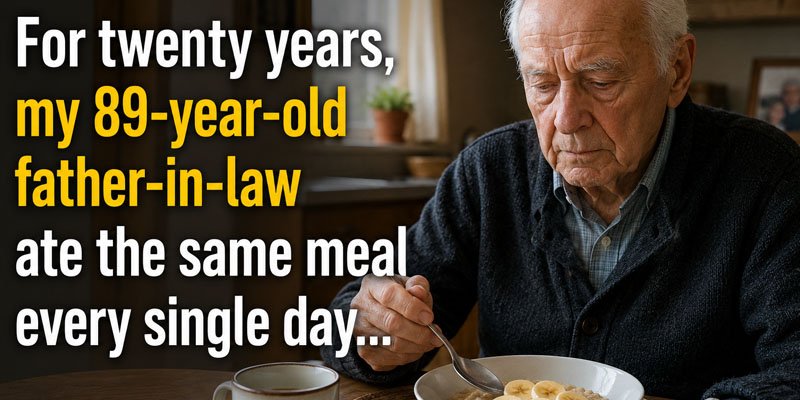
For twenty years, my 89-year-old father-in-law ate at my table without contributing a single penny. I called him a burden, until he died and a lawyer knocked on my door with a folder that left me breathless.
For two decades, my eighty-nine-year-old father-in-law shared every meal at my table without ever paying a cent toward the household.
At least, that was the version of the story I kept telling myself.
Mr. Jacob Whitaker stayed in the small room at the back of the house beside the laundry area.
My wife, Helen, insisted it was our responsibility to care for him.
And every other Friday, when I brought home my paycheck from the auto repair shop in Dayton, Ohio, I watched the pantry grow emptier while he quietly sipped his coffee as though everything was perfectly fine.
He was never a cruel man.
That was the thought I clung to so I would not let resentment consume me.
He was simply elderly.
Reserved.
Strong-willed.
A frail man with dim, cloudy eyes, hands that constantly trembled, and an old gray wool cap he refused to take off, even indoors.
Every morning, he slowly made his way from the back room into the kitchen, poured himself a cup of coffee, toasted a slice of bread, opened a can of soup, or reheated leftover stew without ever wondering what any of it cost.
Every now and then, he would quietly say, “Thank you, son.”
But gratitude did not cover the gas bill.
It did not keep the lights on.
It did not pay for his blood pressure medication.
It did not refill the pantry after he finished the last serving of oatmeal, scraping the spoon across the bowl as though there would always be another box waiting.
Helen stood up for him every single time.
“He’s my father, Martin,” she would say, her voice already trembling before I had even finished complaining.
“He doesn’t have anyone else.”
“He has us,” I always answered.
“But we’re barely managing ourselves.”
Then tears would fill her eyes.
And I would stop talking.
Mr. Whitaker always acted as though he had heard nothing.
More than anything else, that silence fueled my frustration.
The way he lowered his head and withdrew into himself until I became the one who looked heartless for saying what I believed everyone already understood.
We were supporting him.
We had been supporting him for twenty years.
Birthday after birthday passed with him sitting quietly in the corner, smiling gently while the children blew out their candles.
Christmas after Christmas came with him unwrapping socks, flannel shirts, shaving cream, and the same worn sweater Helen carefully repaired every winter.
Illnesses came and went.
Debt arrived and never seemed to leave.
My sons spent their childhood sharing a single bedroom because their grandfather occupied the only extra room in the house.
I sold my old pickup truck so we could afford his cataract operation.
I delayed repairing the roof because his medications had to come first.
I told my boys they would have to wait until the next payday for new sneakers because Grandpa Jacob had another doctor’s appointment across town, and gasoline wasn’t free.
I learned how to make canned beans, rice, and ground beef stretch further than my pride ever could.
After finishing my regular shift, I picked up extra work, changing oil in neighbors’ driveways, replacing brake pads beneath porch lights, and repairing engines using nothing more than the flashlight on my phone.
Because there was always another expense.
Another prescription to refill.
Another medical appointment.
Another reason Mr. Whitaker needed something we simply could not afford.
Whenever my temper got the better of me, he would simply bow his head and repeat the words I dreaded hearing most.
“I’m sorry, son.”
“One of these days, I won’t be a burden anymore.”
Those words always made my anger burn even hotter because they carried so much quiet sorrow.
And because, one morning, they became reality.
We found him just before sunrise, sitting in the chair beside the kitchen window.
The old radio was still playing softly, its signal crackling while a morning announcer talked about traffic on I-75 as though nothing in the world had changed.
Mr. Whitaker was seated with his gray cap resting across his lap, both hands gently folded over it.
His head was tilted ever so slightly to one side.
At first glance, I honestly believed he had drifted off to sleep.
Helen spotted him from the hallway.
She let out a scream.
I rushed over.
But the moment I placed my hand on his shoulder, I knew his body had already settled into the silence that sleep never carries.
There was no fear in his expression.
No sign that he had struggled.
Only peace.
The kind of peace that belongs to someone who had been waiting for permission to let go and had finally found it.
Helen fell against him, sobbing into his shirt.
I remained frozen with one hand resting on the old man’s shoulder, unable to take a single step.
For twenty years, I had pictured this house without him.
More room.
Lower expenses.
Fewer medications.
One less place set at the table.
One less gentle voice asking if there was any coffee left.
Now that chair held nothing but death.
And all I could feel was an icy emptiness.
The funeral was modest.
Just a handful of flowers.
A quiet service at a small church outside Dayton.
The sort of farewell hardworking families arrange when grief still has to fit within limited means.
Helen wore black and clutched a tissue so tightly that her knuckles turned pale.
My sons, Andrew and Dylan, stood beside her. They were grown now, solemn, and burdened by every impatient remark they had ever made about their grandfather.
Mr. Whitaker’s other children showed up late.
Raymond arrived first.
A neatly pressed shirt.
Costly cologne.
A pair of sunglasses hanging from his collar as though he had squeezed the funeral in between business appointments.
His brothers and sisters followed behind him.
The very people who had refused to give their father a home.
The very people who had never covered the cost of his medication.
The very people who rarely visited except around Christmas, when they wanted everyone to believe they were devoted children.
They cried loudly beside the casket.
Then they left before the service was truly over.
At the cemetery, Raymond gave my back a light pat.
“Well,” he said quietly.
“Now you can finally get some rest, brother.”
I said nothing.
Because a part of me I hated had been thinking exactly the same thing.
That perhaps now I could finally breathe.
That evening, the chair by the kitchen window stood empty for the first time in two decades.
I expected to feel relieved.
Instead, guilt took its place.
It sat in Mr. Whitaker’s chair, wearing his gray cap, drinking coffee, and slowly turning the knob on the old radio.
It followed me into the kitchen.
It followed me to bed.
It stood beside me while Helen quietly wept beneath the blanket.
For the first time, I had no idea how to comfort her.
Because I feared that my own sense of relief had destroyed something good inside me.
Three days after we buried him, there was a knock at the front door.
I opened it expecting a neighbor, perhaps someone from church carrying a casserole.
Instead, a man dressed in a dark suit stood on my porch, holding a leather briefcase in one hand and a thick folder tucked beneath his arm.
“Mr. Martin Carter?”
“That’s me.”
“My name is Attorney Harris.”
“I’m here on behalf of Mr. Jacob Whitaker.”
Helen stepped up behind me, her face pale and swollen from crying.
“My father?”
The attorney gave a small nod.
“He left very specific instructions.”
“And a letter that was to be delivered only after he had been laid to rest.”
Raymond showed up about an hour later with the rest of his siblings.
Naturally, he did.
Word about an attorney spreads faster than mourning.
He stepped into my home as though it already belonged to him, carrying the scent of greed more than any expensive cologne.
His brothers and sisters trailed behind, speaking in hushed voices while scanning the living room, their eyes silently judging the furniture, the walls, and anything else they imagined they could claim.
“A letter?” Raymond said with a brief chuckle.
“What could Dad possibly have left behind?”
“He depended on Martin for the last twenty years.”
Attorney Harris offered no reaction.
He quietly opened his briefcase.
The first thing he placed on the table was a thick file.
Next came a small cloth bag secured with a piece of string.
Finally, he set down a yellow envelope with my name written across the front in Mr. Whitaker’s shaky handwriting.
Martin.
Not Helen.
Not my children.
Not even his own sons and daughters.
My name.
Raymond’s expression immediately hardened.
“That has to be some kind of mistake.”
Attorney Harris looked at the first page.
“It isn’t.”
My knees nearly gave out before I even realized the reason.
Spread across my dining table was far more than a stack of legal paperwork.
There were receipts.
Photographs.
A blue notebook covered with figures.
Medical records.
Bank deposit slips.
Carefully folded letters.
And the evidence of twenty years I had never wanted to face.
Attorney Harris cleared his throat.
“Before we address the estate or any inheritance matters, Mr. Whitaker specifically instructed that Mr. Carter hear this letter with the entire family present.”
Helen reached over and held my hand.
Raymond’s smug smile disappeared.
Attorney Harris carefully broke the envelope’s seal.
The opening sentence of the letter shattered something inside me.
Martin, forgive me for taking so long to repay what I owed you.
The attorney paused after reading those words.
Perhaps he realized I needed time.
Perhaps he understood that those who have passed away can still wound the living more deeply than anyone else.
My grip on Helen’s hand tightened.
She was already in tears again, but these were quiet tears.
Not the overwhelming grief from the morning we discovered her father.
This was something heavier.
Something she had carried inside her long before I ever recognized it.
Attorney Harris continued reading.
Martin, if these words are being read to you, then I have finally stopped being a burden.
A sound escaped Helen.
It was not quite a sob.
It was more like the breath leaving an old injury.
I wanted the attorney to stop reading.
I wanted to take the letter and finish it in private.
I wanted Raymond and the rest of them out of my house.
But Mr. Whitaker had specifically asked for everyone to hear it together.
And after spending twenty years assuming I understood what he meant without ever asking him, I owed him that much.
I know what you believed about me.
Do not feel ashamed of those thoughts.
I heard far more than you ever imagined.
Older people hear everything because everyone forgets they are still sitting in the room.
Raymond shifted uneasily in his chair.
I remembered every complaint I had made in the kitchen.
Every resentful remark about money.
Every cabinet door I slammed shut.
Every loaf of bread I counted as though each slice were another accusation.
I remembered Mr. Whitaker lowering his head and pretending the radio was loud enough to drown it all out.
You called me a burden one time.
You said it while you were repairing the washing machine in the laundry room.
You believed I was asleep.
I picked that chair because it gave me a clear view of the kitchen, the hallway, and the front door.
I enjoyed watching my family as they came and went.
I should have sat somewhere else.
And forgive me for taking your chair as well.
Memory is merciless because it never comes back as wisdom.
It comes back as moments.
Mr. Whitaker sitting in my chair.
Me feeling annoyed because my back was aching.
His hand reaching toward the radio, turning the volume down as soon as I walked in.
His biscuit crumbling into his coffee.
His quiet words.
“Thank you, son.”
My silence.
Attorney Harris untied the cloth pouch.
Inside were neatly bundled receipts, organized by year.
Gas bills.
Electric bills.
Pharmacy receipts.
Medical clinic invoices.
School payment records.
A receipt for repairing the roof from the year I believed we had simply been fortunate because the leak had stopped.
I had always assumed Helen had borrowed the money.
She had only told me,
“I took care of it.”
Mr. Whitaker had taken care of it.
Not every single time.
Not enough to make our lives easy.
But far more than I had ever realized.
Then Attorney Harris revealed the photographs.
The first showed Mr. Whitaker standing outside Dylan’s elementary school, watching from behind a tree during a school ceremony I had missed because I was at work.
Dylan stood onstage wearing a paper hat, speaking into a microphone.
Written on the back in Mr. Whitaker’s handwriting were the words:
Martin could not be here.
So I applauded twice as hard.
The second photograph showed Andrew asleep over his homework at the kitchen table.
Mr. Whitaker sat beside him with a dictionary opened in front of him.
I had always believed Helen was the one helping with homework because I came home too exhausted.
Sometimes she had.
Sometimes it had been the elderly man with fading eyesight.
The third photograph was of me.
I never knew anyone had taken it.
I was standing in the repair bay at the garage, leaning over an engine, grease covering my face, my shoulders heavy with exhaustion.
On the back, Mr. Whitaker had written:
My son who has no idea he is my son.
That was the moment I finally broke.
Not with loud tears.
Not with dramatic sobbing.
Not by collapsing to the floor.
Something deep inside me simply gave out.
Attorney Harris remained silent.
Raymond did not.
“That’s enough,” he snapped.
“What exactly did he leave behind?”
The word he chose was leave.
Not feel.
Not suffer.
Not remember.
Leave.
Attorney Harris’s expression turned icy.
“Very well.”
He pulled a legal document from the folder.
“Mr. Jacob Whitaker executed a notarized will two years ago, properly signed, medically verified, and witnessed by two independent individuals.”
Raymond leaned across the table.
“To his biological children,” Attorney Harris continued, “he left one dollar each.”
Margaret let out a gasp.
Raymond shot to his feet.
“This is a fraud.”
Attorney Harris calmly lifted one hand.
“To his daughter, Helen Carter, he left his blessing, his wedding ring, and a written apology for allowing shame to keep him silent for far too long.”
Helen covered her mouth with both hands.
“To his grandsons, Andrew and Dylan Carter, he left education accounts funded with savings accumulated over fourteen years.”
Both of my sons stared at him.
Andrew whispered,
“What?”
“To Mr. Martin Carter,” Attorney Harris said, his voice gentler now, “Mr. Whitaker left the remainder of his estate.”
Raymond slammed his hand onto the table.
“What estate?”
“He didn’t own anything.”
Attorney Harris unfolded another document.
“He owned two parcels of land outside Springfield, Ohio, inherited from his mother and never transferred to his biological children.”
“For many years, those properties were worth very little.”
“Recently, because of a highway access project and nearby commercial development, their appraised value increased significantly.”
“How significant?” I asked.
My own voice sounded distant to me.
Attorney Harris met my eyes.
“The current purchase offer from a logistics company is 1.8 million dollars.”
The room fell completely silent.
Raymond lunged toward the documents.
Without thinking, I stood and stepped between him and the attorney.
For twenty years, I had resented protecting Mr. Whitaker’s place inside my home.
Now, only three days after burying him, I was protecting his papers instead.
Raymond pointed directly at me.
“You manipulated him.”
A single bitter laugh escaped me.
“I didn’t even know he owned any land.”
“You knew enough to keep him.”
His words struck something inside me, but not in the way he intended.
“Yes,” I answered quietly.
“I kept him.”
Raymond’s face tightened with anger.
“He was our father.”
“No,” Helen said.
Her voice was quiet, yet it sliced through the room.
“You were his children.”
“Martin was the one who came home exhausted and still made sure everyone had something to eat.”
“Martin was the one who sold his pickup.”
“Martin was the one who installed the safety rail in the bathroom after Dad began losing his balance.”
“Martin was the one who lifted him into the car when he could no longer walk on his own.”
She faced her brothers and sisters, and the hurt she had buried for two decades was written plainly across her face.
“You only came to mourn beside his coffin.”
“He needed you long before then.”
Margaret broke down in tears.
Raymond, however, only raised his voice even more.
“I’m going to challenge the will.”
“You’re free to try,” Attorney Harris replied.
“Mr. Whitaker expected that possibility.”
He reached into the folder and removed another stack of documents.
“Your father kept detailed records of every loan he gave each of you before he moved in with the Carters.”
“Signed agreements.”
“Dates.”
“Dollar amounts.”
“Business financing.”
“Money for property.”
“Medical expenses.”
“He also documented every visit you failed to make, every phone call where he was told there wasn’t time for him, and every month Martin and Helen cared for him without any help from you.”
Raymond’s certainty began to fade.
“He did not gather these records to get revenge,” Attorney Harris said.
“He gathered them so everyone would understand why he made his decision.”
The room no longer felt like a family meeting.
It felt like a courtroom without a judge.
And Jacob Whitaker, a man who had spent twenty years keeping silent, had finally made his voice heard.
Raymond challenged the will.
Naturally, he did.
Men like Raymond rarely walk away from money simply because the truth exposes them.
He hired an attorney, filed formal objections, claimed his father had been manipulated, questioned Mr. Whitaker’s mental capacity, accused Helen of concealing property, and suggested that I had isolated an elderly man for financial gain.
The accusation would have been laughable if it had not made me feel so ill.
For twenty years, I had believed Mr. Whitaker was simply a responsibility I carried.
Now people were claiming I had cared for him because I expected a fortune.
The legal battle stretched across five months.
Five months filled with hearings, paperwork, certified records, medical files, witness testimony, and attorneys using courteous language to describe painful realities.
Attorney Harris remained composed throughout the entire process.
He submitted Mr. Whitaker’s mental competency evaluation.
He produced financial records proving the land had never belonged to Raymond or any of his siblings.
He introduced the blue notebook.
He submitted the receipts.
He presented the signed acknowledgments for the loans received by the very children who now insisted they had been cheated.
Then, during the final hearing, he revealed a video.
I had no idea it existed.
Neither did Helen.
Mr. Whitaker appeared seated in the same chair beside the kitchen window where we had discovered him after he passed away.
The recording had been made two years earlier by a notary’s assistant.
He was wearing his gray cap along with his favorite sweater.
His voice was quiet, yet steady.
“My name is Jacob Whitaker,” he said.
“I am eighty-seven years old today.”
“I know exactly what I own.”
“I know who my children are.”
“And I know who stood beside me.”
He glanced away from the camera for a brief moment before looking back.
“I’m leaving what I have to Martin because he gave me everything he could when he believed I had nothing left.”
My throat tightened.
On the screen, the elderly man gave a gentle smile.
“Some people will say family by blood deserves more.”
“Perhaps.”
“But blood only came around on holidays.”
“Martin came home every single evening.”
The judge rejected Raymond’s challenge.
The will remained valid.
Two months later, the logistics company purchased the land.
After taxes, legal expenses, the education funds, and the payments Mr. Whitaker had directed, there was still enough money left to transform our lives.
Even so, I did not feel wealthy.
I felt judged.
The very first thing Helen and I took care of was the roof.
We did not simply repair it.
We rebuilt it the right way.
Fresh support beams.
New insulation.
Brand-new shingles.
When the first hard rainstorm arrived, I stood in the hallway waiting for the familiar drip that had haunted our winters for years.
It never came.
Helen noticed me looking up at the ceiling.
“He would have been happy to see this,” she said.
I gave a small nod, but no words came.
We finally cleared the debts I had been carrying for so many years they had become part of my life.
We bought Andrew a computer for college.
We paid Dylan’s tuition before he ever had the chance to ask.
I bought a secondhand pickup.
Not a brand-new one.
But dependable enough for the work I needed.
The first time I turned the key, I thought about the truck I had once sold to pay for Mr. Whitaker’s eyesight.
I stayed behind the wheel for nearly ten minutes before driving away.
Helen placed her father’s wedding band inside a small wooden box on the table beside her bed.
His gray cap remained hanging on the hook near the kitchen door.
His radio stayed on the shelf.
His chair remained exactly where it had always been.
I tried moving it once.
I got only as far as the hallway before guilt hit me so hard that I carried it straight back.
That chair had always been where he sat to quietly watch his family live their lives.
It deserved to stay there.
The back room was the most difficult part.
Even after the estate was settled, I stayed away from it for weeks.
Helen went inside to clean, fold his clothes, separate what could be donated, and decide what needed to stay.
I always managed to find another task instead.
A vehicle that needed repairs.
A wall waiting to be painted.
An errand that suddenly seemed important.
One Sunday afternoon, she placed the key into my hand.
“You need to go inside,” she said.
“I already know what’s in there.”
“No,” she answered softly.
“You really don’t.”
The room carried the scent of old soap, dust, and menthol ointment.
The narrow bed was neatly made.
The blanket had been tucked in with careful precision.
On the small bedside table rested a chipped mug, a comb, a pair of reading glasses, and a bundle of envelopes tied together with string.
Letters.
Every one of them addressed to me.
None had been mailed.
None had been sealed.
I sat on the bed and opened the first one.
Martin, today you came home upset because the gas bill was so high.
Later you apologized to Helen, but never to yourself.
You believe a man has to be as hard as stone.
Even stones eventually crack.
I opened another.
Martin, I watched you hand Dylan the last piece of chicken and tell him you weren’t hungry.
My own father once did the same thing for me.
I didn’t understand it then.
Now I do.
I opened another.
Martin, today you called me a burden.
It wounded me.
But tonight I heard you coughing alone in the kitchen, and later I heard your alarm ringing at five in the morning.
If I had been healthier, I would have carried part of the weight for you.
I kept reading until daylight disappeared.
When Helen came looking for me, I was sitting on the floor surrounded by letters, tears covering my face.
“He loved you,” she said.
“I treated him badly.”
“You were exhausted.”
“That doesn’t excuse the hurt I caused.”
“No,” she whispered.
“But he understood that both could exist at once.”
That was the deepest act of grace.
Mr. Whitaker had truly seen me for who I was.
Not as someone flawless.
Not as someone beyond redemption.
He saw a weary man who kept giving, even while resenting how much it demanded.
A man who cared for him while grumbling under the weight.
A man whose patience often failed, yet whose responsibility never did.
And despite seeing every bit of that, he loved me all the same.
I had no idea how to carry that kind of forgiveness.
So I returned to the one thing I knew how to do.
I got to work.
Using part of the inheritance, Helen and I created a modest fund through the local church clinic to help elderly people living with family members who struggled to afford basic medical care.
It was not a charity with signs and speeches.
There was no ceremony.
Nothing extravagant.
Only a simple account overseen by Attorney Harris and the clinic director.
Medication for blood pressure.
Diabetes essentials.
Eye care appointments.
Wheelchairs.
Emergency food assistance.
We called it the Jacob Whitaker Care Fund.
Raymond claimed we were only trying to draw attention to ourselves.
I offered no reply.
The first person the fund helped was a seventy-four-year-old woman who needed prescription eye drops after surgery.
Her son worked construction and had been stretching each bottle by using only half the prescribed amount so it would last longer.
When I placed the pharmacy bag into his hands, embarrassment washed over his face.
I knew that feeling well.
I rested my hand on his shoulder.
“Don’t wait until caring for someone turns into resentment,” I told him.
“Reach out for help before it gets that far.”
He simply looked at me.
I never explained what I meant.
The years moved on, as they always do once they have finished delivering their hardest lessons.
Andrew finished college.
Dylan became a teacher.
Silver slowly appeared around Helen’s temples.
The house grew quieter for a time, only to fill with laughter again when grandchildren arrived.
The back room was turned into a cozy guest bedroom, but Mr. Whitaker’s old reading glasses remained on the shelf.
Every morning, I still brew coffee before leaving for work.
One cup for me.
One for Helen.
And every so often, almost without realizing it, I pour a little into the cracked mug with the faded blue stripe.
I know he is no longer here.
I know those who have passed do not drink coffee.
Still, some habits become their own kind of prayer.
Every Thanksgiving, we place his photograph on the mantel.
His gray cap.
His radio beside it.
A cup of coffee.
A small toy truck that one of the grandchildren insisted belonged there because Great-Grandpa Jacob should have something to drive in heaven.
That first Thanksgiving, I stood in front of the mantel and finally spoke the words I should have said more often while he was alive.
“Thank you, Mr. Whitaker.”
Helen gently smiled and corrected me.
“He called you son.”
I paused, swallowing the lump in my throat.
“Thank you, Dad.”
The photograph gazed back at me with the same peaceful expression he had worn for twenty years while sitting in my chair.
There was a time when I believed gratitude was too insignificant to matter.
“Thank you, son,” he would always say.
Back then, all I could think about was what those words could never repay.
Now I understand that some debts are settled only after many years.
Some are paid through money hidden inside old notebooks.
Some through land whose value no one ever imagined.
Some through letters left behind by a man who witnessed your lowest moments and still believed they did not erase your goodness.
And some payments are far simpler.
A grandfather applauding twice as hard because a father could not be there.
A Social Security check quietly slipped to his daughter so an exhausted man could keep his dignity.
A favorite chair kept warm by an old man whose greatest wish was simply to watch his family come and go through the home.
A final letter addressed to me.
Martin, please forgive me for taking so many years to repay what I owed you.
He was mistaken about that.
The truth was, he had been repaying all of us the entire time.
I was the one who needed twenty years before I finally understood.