
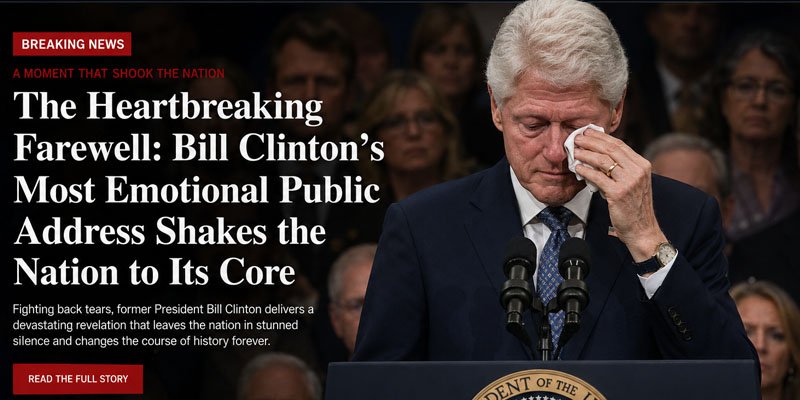
The atmosphere inside the room felt unbearably heavy, as though every ounce of hope had been replaced by an overwhelming sense of grief. A silence unlike any other settled over the audience while television cameras captured every passing second. Across the nation, millions watched without blinking, sensing that they were about to witness a moment destined to be remembered for generations. Former President Bill Clinton slowly approached the podium, his shoulders weighed down by emotion, his expression revealing a level of sorrow rarely seen during his decades in public life. The familiar confidence that had long defined his speeches was absent. Instead stood a man visibly burdened by a heartbreaking reality, preparing to deliver words that seemed almost impossible to speak.
The room itself reflected the emotional intensity of the occasion. Journalists who were normally eager to compete for attention sat unusually quiet, their notebooks untouched as they focused entirely on Clinton’s every movement. His hands rested firmly against the lectern, gripping it as though it were the only thing keeping him steady. The slightest tremble in his fingers betrayed the emotional battle taking place beneath his composed exterior. His breathing appeared slow and uneven, and his eyes carried the unmistakable weight of sleepless nights spent wrestling with a painful truth. It was evident that whatever he was about to reveal extended far beyond politics—it touched something deeply human.
When he finally began to speak, his voice emerged almost as a whisper. Every sentence was delivered with extraordinary care, as though each word carried enormous emotional significance. There was no attempt to dramatize the moment; the emotion itself spoke louder than any performance ever could. Rather than opening with statistics, policy, or political commentary, he addressed the audience from the perspective of someone confronting immense personal sorrow. His words reflected compassion, regret, and a profound awareness that life can change without warning. Looking out across the room, he seemed to search not only for understanding from those present but also for the strength to continue.
As the address unfolded, the emotional atmosphere deepened. The audience leaned forward in complete silence, hanging on every sentence. Clinton reflected on loss, responsibility, and the painful reality that some moments forever alter the course of history. His remarks suggested that the tragedy before him could not be measured solely by headlines or political consequences—it represented a wound that would leave lasting emotional scars on countless lives. Even after experiencing years of political battles, public scrutiny, and personal hardship, he acknowledged that certain moments remain impossible to prepare for. His honesty transformed the speech from a formal public address into a deeply personal reflection on human vulnerability.
Gradually, his message expanded beyond individual grief to address the wider consequences facing society. He described how a single devastating event could ripple outward, affecting families, communities, institutions, and ultimately the nation itself. The uncertainty of the future became a central theme of his remarks. He painted a picture of a country standing at a crossroads, forced to confront difficult realities that had seemed unimaginable only days earlier. His words encouraged listeners to recognize how fragile stability can be and how quickly life can shift in unexpected directions. It was not merely a discussion about one tragic event—it became a meditation on resilience in the face of uncertainty.
Throughout the speech, moments of silence proved just as powerful as the words themselves. Every pause allowed the weight of his message to settle over the room. His voice occasionally cracked with emotion, and several times he stopped briefly to regain his composure. Reaching for a handkerchief, he quietly wiped tears from his eyes before continuing. These unscripted moments revealed not the image of a former president, but of an ordinary human being struggling to carry extraordinary emotional pain. The vulnerability on display reminded viewers that public figures, regardless of their influence or accomplishments, remain susceptible to the same heartbreak experienced by every family across the world.
Despite the overwhelming sadness, Clinton gradually shifted his focus toward hope. While acknowledging the enormity of the challenge before the nation, he reminded the audience that history has repeatedly shown humanity’s remarkable ability to endure even its darkest chapters. He urged citizens not to allow fear, anger, or division to define their response. Instead, he appealed for compassion, unity, patience, and understanding. His message emphasized that genuine strength is measured not by the absence of hardship but by the willingness to stand together during times of unimaginable difficulty. It was a familiar theme throughout his public life, yet it carried a far deeper emotional resonance under these circumstances.
He also reflected on the importance of preserving empathy during moments of national crisis. According to his remarks, future generations would not judge society solely by the tragedy it faced, but by how people responded to one another in its aftermath. Acts of kindness, shared sacrifice, and mutual support, he suggested, would ultimately define the nation’s legacy far more than the event itself. Even while visibly overwhelmed, he encouraged Americans to look beyond immediate despair and believe that healing, though slow, remained possible.
As the speech approached its conclusion, the emotional intensity became almost overwhelming. The room remained completely still, with even the faintest sounds seeming amplified by the profound silence. Clinton paused once more, taking a slow, trembling breath before offering what felt less like a political statement and more like a heartfelt appeal to humanity itself. Rather than presenting a detailed solution, he asked the nation to remember its shared values, protect one another, and never lose sight of compassion in the face of tragedy.
When his final words faded, he stepped away from the podium with deliberate, measured movements. His expression reflected exhaustion, grief, and quiet acceptance all at once. For several moments, no one spoke. Reporters who normally rushed to ask questions remained silent, fully aware they had witnessed an exceptionally emotional chapter in public life. Only after he disappeared from view did whispered conversations slowly begin to fill the room, as the significance of the address settled over everyone present.
Long after the cameras stopped recording, the impact of the moment continued to resonate. Viewers across the country reflected not only on the painful revelation itself but also on the remarkable display of vulnerability from a leader who had spent decades in the public eye. Whether remembered as a farewell, a warning, or a deeply personal confession, the speech became a powerful reminder that even those who have occupied the highest offices are never beyond the reach of grief. It stood as a testament to the enduring strength of honesty, compassion, and hope in the face of overwhelming adversity, leaving an unforgettable mark on the nation’s collective memory.