
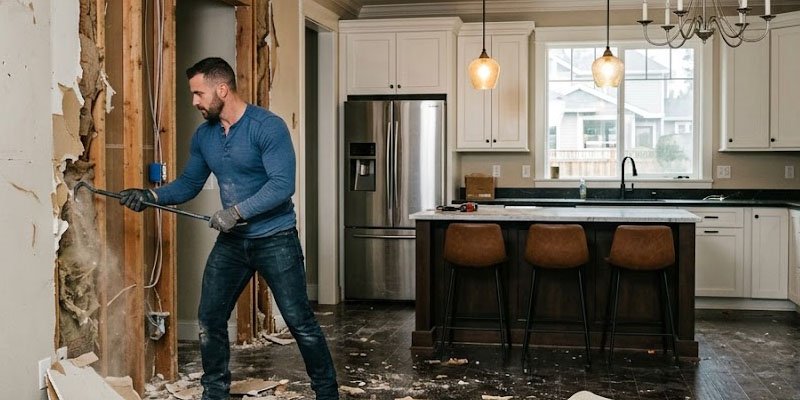
Following Eight Months of Fighting Through Divorce, the Judge Finally Granted Me Ownership of Our Home.
Yet When I Stepped Inside, I Discovered Holes in the Walls, All the Faucets Running, and My Grandmother’s Treasured Antique Mirror Sm3shed All Over the Floor. My Ex-Husband Believed He Had Left One Last Heartless Surprise for Me. But Then My 68-Year-Old Dad Entered the Courtroom Wearing a Suit—and Disclosed Something My Ex Had Never Anticipated.
The very first sound I noticed as I opened the front door was water.
It wasn’t a gentle drip.
Nor was it a pipe slowly leaking.
Water was pouring at full pressure from somewhere within the home.
I remained on the porch with the key still lodged in the lock, listening.
For an instant, I questioned whether I’d left something running during my last visit.
Then it occurred to me I had not entered the place in months.
Brian had occupied the house by himself.
And his deadline to move out had ended the day before.
My stomach knotted.
Somehow, even before I crossed across the threshold, I sensed my former husband had left me something awful waiting for me.
I’m Nicole Harmon. I’m thirty-seven, and I’d just survived eight grueling months of divorce litigation.
When the judge ultimately ruled that the home was mine, I believed the hardest part had ended.
I was completely mistaken.
***
Our home was a simple two-story house with light-yellow siding, white shutters, and a vivid red front door.
That shade had been my choice.
Brian had objected that it was too striking, but in the end he painted it himself one Saturday afternoon as I held the ladder steady.
We had purchased the place when we were both twenty-nine.
Back then, we had already been married two years.
I could still picture standing on the front steps, showing off our new keys toward the camera and grinning as though we had achieved something remarkable.
For a long time, that photograph had been among my most cherished pictures.
By then, I couldn’t tell where it had gone.
Possibly tucked inside a moving carton.
Or perhaps discarded.
I had quit asking Brian where our possessions had ended up.
The divorce had dragged on for almost eight months.
We had disputed savings, retirement accounts, vehicles, and furniture.
Yet the fight over the home hurt the most.
Brian insisted we sell it.
I was determined to hold on to it.
It wasn’t because the place was grand.
It wasn’t.
But I had planted the hydrangeas beside the front porch.
The red door had been my idea.
And For a long time I had pictured that us growing old in that house.
It was also where where I had mourned two miscarriages.
I had sat on the floor of our pale-green guest bedroom, weeping for the family I had dreamed of.
Eventually, I managed to find the strength to get up again.
Those walls contained some of the most painful memories of my life.
Yet they also reminded me that I had made it through.
I could not bear to surrender that as well.
The judge had ultimately decided in my favor.
Brian was allowed fourteen days to collect his possessions.
I had given it one additional day after the deadline to avoid another argument.
For a full twenty minutes, I had remained in my car at the end of the driveway, trying to summon the nerve to walk inside.
With that rushing water in my ears, I regretted coming alone.
The entrance hall was nearly bare.
Brian had removed the small wooden bench, the coat rack, and the narrow table where our keys once sat.
Faded rectangular patches remained on the walls where our pictures used to hang.
That part came as no surprise.
What caught me off guard was the odor of moisture.
It smelled like a basement following a downpour.
I stepped into the living room.
And froze.
Someone had punched a sizable hole straight through the plasterboard next to the fireplace.
A layer of white powder coated the wooden flooring.
Sharp chunks of plaster protruded around its edges.
I gazed at the damage, trying to imagine an accidental cause.
Perhaps the movers had let something fall.
Perhaps furniture had collided with the wall.
That was when I spotted another hole by the corridor.
The same dimensions.
At the same level.
I headed toward the guest bedroom.
A third hole appeared next to the window.
My pulse started racing.
Three ruined walls.
Three separate rooms.
And all the holes seemed to be roughly shoulder level on Brian.
Suddenly I recalled the running water.
I rushed into the kitchen.
The tap had been turned all the way on.
Scalding water streamed into the basin, clouding the nearby window with steam.
I shut it off.
The abrupt quiet survived barely a moment.
I could still make out water upstairs.
I raced up the stairs.
Water was flowing from the bathroom sink.
The bathtub tap was on as well.
The drain had been left unplugged, but water kept streaming onto the porcelain.
Condensation covered the mirror.
The bathmat was drenched.
I closed both taps.
Then I heard water running in the bathroom attached to our former bedroom.
Another faucet had been left open.
I shut it off too.
At last, silence settled over the house.
I remained shaking in the doorway.
How many hours had those taps been open?
Just a few hours?
A whole day?
Since Brian had left?
I couldn’t tell.
My thoughts kept returning to was the destruction and the inevitable water charges.
I braced myself against the wall and attempted to steady my breathing.
The holes were fixable.
A plumber could examine the pipes.
Eventually, the bill could be settled.
The amount was staggering, but life would go on.
I made my way back downstairs.
And noticed something glittering across the living-room floor.
***
Initially, I assumed one of the windows had shattered.
Small shards of glass glimmered in the afternoon sun, casting little flashes of light across the hardwood.
I moved in for a closer look.
And my legs almost buckled.
My grandmother’s antique mirror was lying in pieces across the floor.
“No,” I murmured.
I sank to the floor beside it.
Its dark walnut frame had cracked at a corner.
One of the carved wooden roses had been chipped.
The glass had fractured into dozens of shards.
A few pieces were substantial.
Others were scarcely larger than sugar crystals.
They were scattered throughout the room in a broad circle.
It didn’t look as if the mirror had merely fallen from its hook.
It looked like someone had hurled it.
I pressed a hand over my mouth.
Out of everything Brian might have ruined, this was the single possession I could least bear to lose.
My grandmother was named Lena.
She made her home in a small white farmhouse roughly an hour outside our town.
The porch dipped a little in the middle, and her kitchen was always scented of cinnamon and freshly brewed coffee.
Each summer, from the time I was five until I was fourteen, I stayed with her for a fortnight.
Her old mirror was mounted over the dresser in her sleeping room.
It had a tall oval shape, encircled by an elegant walnut frame decorated with carved roses.
Its aged glass had a gentle ripple.
Whenever I looked into it, my image appeared as if seen beneath water.
Each morning, I would brush my hair in that mirror.
And almost every morning, Grandma Lena would gently take the brush out of my hand.
“Easy, Nicky,” she’d say. “Your hair hasn’t done anything wrong.”
Then she would do the brushing herself.
Unhurriedly.
Tenderly.
A full hundred strokes.
She spoke every number out loud.
I would watch her face reflected behind mine and feel utterly protected.
After my mother passed away the year I turned fifteen, I spent most of that summer at Grandma Lena’s house.
I said almost nothing.
On certain days, I barely touched food.
But every morning, Grandma brushed my hair.
She never ordered me to quit crying.
Nor did she insist everything happened for a reason.
She merely stood behind me, counted to one hundred, and gave me room to mourn.
Eleven years prior to the divorce, Grandma Lena died.
Dad passed the mirror on to me.
“She would have wanted it to be yours,” he said. “You were the one who was always looking into it.”
I had just a handful of belongings that had belonged to her.
A quilt.
A recipe box.
Her reading glasses.
And that mirror.
For reasons I couldn’t understand, it turned into the one item Brian battled hardest to claim during our divorce.
***
What made it so strange was that Brian had always disliked it.
When I originally put up the mirror in our living room, he dismissed it as old-fashioned.
When his parents came over for Christmas, he wanted me to remove it because his mother thought it seemed dated.
After we repainted the walls, he proposed swapping it for a newer design.
So when the divorce litigation began, I expected him to leave it with me without a fight.
Instead, he argued it was part of the property.
His lawyer went so far as to suggest it was a built-in fixture.
“A fixture?” I’d asked during mediation. “It’s only hanging from a nail.”
Brian insisted that because it had been there for years, it should remain with the property.
After that reasoning fell apart, he claimed my family had given us the mirror as a wedding gift.
That could not have been true.
My grandmother had died prior to our wedding.
And my father had given the mirror to me before Brian and I ever met.
I produced the paperwork.
I laid out its background.
I went so far as to offer Brian half of its assessed worth.
The mirror had been valued at around $400.
“I’ll give you $200 today,” I told him. “Just let me keep it.”
He moved his head in refusal.
“I don’t want the money.”
“Then what do you want?”
He met my eyes with a smile.
It was that slight, icy smile I had learned to recognize during the final year of our marriage.
He gave no answer.
In the end, a judge had to decide the disagreement.
Three weeks before Brian’s moving deadline, the court declared the mirror belonged to me alone.
I recall sitting in the courthouse parking lot afterward, weeping from sheer relief.
I believed Brian had lost his chance to take it away.
Yet there I was, kneeling next to what was left of it.
And it finally dawned on me that he hadn’t wanted the mirror.
What he wanted was the control to keep me from having it.
I extended my hand toward the damaged frame.
But I hesitated.
My attorney’s voice rang through my thoughts.
*Take pictures of absolutely everything.*
Claire Delgado had reminded me of that countless times during the entire divorce.
I pulled out my phone.
I took pictures of the broken mirror.
The split frame.
The chipped wooden rose.
Every section of shattered glass.
Then I took pictures of the holes in the walls.
The damp bathroom floors.
The soaked bathmat.
The water stains.
My hands shook so much that a few shots came out blurred.
I retook them.
Afterward, I phoned Claire.
She picked up almost at once.
“Nicole?”
“He destroyed the house.”
Her tone shifted.
“What happened?”
“There are holes in the walls. Every faucet was running. And my grandmother’s mirror…”
My words caught in my throat.
“He smashed it.”
Claire switched to a professional tone.
“Leave everything untouched for now. Record all the evidence.”
“I’ve taken photographs.”
“All right. Next, make a video covering the whole house. Say the date and time as you film.”
“Okay.”
“Photograph the water meter if you can.”
“I will.”
She hesitated for a moment.
“Nicole, don’t phone Brian.”
I looked at his name on my phone.
That was exactly what I wanted to do.
I desperately wanted him to explain himself.
I wanted to ask how he could destroy the one possession he knew meant so much to me.
But I assured Claire I would not reach out to him.
She reminded me that we still had a last court hearing concerning the remaining financial assets toward the end of the week.
What I had found could matter.
I did exactly as she instructed.
I walked through every room recording video.
I spoke the date aloud, the time, and the damage I found.
When the camera reached the mirror, I was unable to say anything.
I just kept the phone pointed above the broken pieces.
For a number of seconds, the recording captured only the sound of my breathing.
Dad showed up before I had finished recording the damage.
I had not contacted him.
It was Claire who had.
Dad was sixty-eight, an electrician who had retired with big hands marked by scars and a reserved personality.
He had spent many years repairing wiring, fuse boxes, and old household systems.
He was the sort of person who almost never spoke loudly.
During eight months of divorce litigation, he had never tried to dictate my decisions.
He had taken me to court appearances.
Allowed me to sleep in my childhood bedroom.
Prepared grilled-cheese sandwiches when I couldn’t eat anything else.
And stayed nearby when I needed to cry.
He’d never said he told me so, even though he had never especially liked Brian.
When my father stepped into the living room that afternoon, he stopped.
His gaze traveled from the hole near the fireplace to the damaged hallway.
Then his eyes dropped.
At Grandma Lena’s mirror.
He approached and carefully knelt down.
For quite some time, he silently examined the broken frame.
Then he touched the chipped wooden rose.
With extraordinary care.
“He understood how much this meant to you,” Dad said.
I struggled to swallow.
“Yes.”
It was the first direct criticism he’d said about Brian during the entire divorce.
Dad rose to his feet.
“Did you take pictures?”
“Yes.”
“Of everything?”
“Claire told me to photograph the whole house.”
He nodded.
“Good.”
Then his expression changed.
His jaw clenched.
He stared at the damaged wall as though he had just connected the pieces.
“Dad?”
He looked at me.
“Just do what Claire tells you,” he said. “And don’t worry about me.”
I didn’t understand what he meant.
But he refused to explain.
Instead, he stepped outdoors before coming back carrying a broom, a dustpan, and a cardboard box.
“For when your lawyer says it’s okay to clean,” he told me.
He remained with me until nightfall.
He helped me find the water meter.
He examined the floors for signs of damage.
He looked over the ceilings with a flashlight.
Yet he said almost nothing about Brian again.
I spent that night at Dad’s house.
I could not stand the idea of staying alone among the holes and broken glass.
At some point past midnight, I overheard Dad talking softly on the phone.
His words were too faint for me to make out.
I figured he was speaking to Claire or another relative.
I never questioned him.
I would later regret not asking.
***
In the days that followed, Claire organized quotes for the repairs.
A drywall contractor assessed the three openings.
A plumber examined the bathrooms along with the water heater.
Thankfully, the drains had remained open, averting a serious flood.
But water exposure had harmed a section of the upstairs bathroom flooring.
And the water heater had been running continuously.
One tradesman surveyed the destruction and gave a disbelieving shake of his head.
“Someone was very angry.”
I managed a weary smile.
“That’s certainly one way of describing it.”
The plumber pointed out something else.
“Whoever left those faucets open knew they could waste an enormous amount of water without immediately flooding the house.”
His words lingered in my mind.
Brian had always gone silent when anger took hold of him.
He was not someone who normally yelled.
He turned icy.
Restrained.
Calculating.
And that was precisely what this destruction suggested.
Not an impulsive explosion of rage.
A calculated act to cause the greatest amount of trouble while remaining difficult to explain.
***
Wednesday afternoon, Claire invited me into her office.
Once I got there, she passed me a printed email from Brian’s attorney.
Brian rejected any accusation of intentional destruction.
He claimed the holes were normal wear from moving furniture.
He suggested the faucets might have been accidentally left running by people whose identities were unknown.
And he insisted he had no knowledge of how the mirror had broken.
I looked at the page in disbelief.
“Unknown individuals?”
Claire let out a sigh.
“Nicole—”
“Who else was living there?”
“I understand.”
“And the mirror just happened to smash itself?”
She shot me a glance that told me that I should not say that in front of the judge.
She then picked up another piece of paperwork.
“There is one more thing.”
It was a motion filed by Brian’s lawyer just before I found the destruction.
Brian was petitioning the judge to cut my portion of the marital property still to be divided.
Retirement accounts.
Savings.
Money connected to our second vehicle.
He was asking for almost one-third of my remaining share to be taken away.
The reason he gave was financial difficulties.
I stared at Claire.
“He’s claiming he’s struggling?”
“Yes.”
“Yet his income is higher than mine.”
“I know.”
“He has a brand-new truck. He paid a deposit on a condo by the lake.”
Claire tapped her pen against the desk.
“What counts is what we can prove in court.”
Then she looked at the photographs of the damaged house.
“He filed this motion before you discovered what happened.”
I saw what she was getting at.
Brian seemed to have planned to present himself as a financially struggling man.
He hadn’t expected the judge to see evidence that the home he’d just vacated had been deliberately damaged.
Or at least I wanted to believe so.
***
On the evening before court, Dad and I went back to the property.
It was Claire who had finally confirmed that the damaged areas had been sufficiently documented.
We were free to start cleaning up.
Dad brought thick work gloves and the cardboard box he’d left near the door.
“I’ll take care of the broken glass,” he said.
I nearly objected.
But I hesitated.
He crouched down and started gathering the broken pieces of Grandma’s mirror.
He avoided sweeping the bigger pieces.
Instead, he lifted them one by one, setting each one carefully into the box.
As he picked up the wooden frame, he flipped it around.
Faint handwriting was visible on the reverse.
I had seen it previously but never been able to decipher it.
Dad angled it into the light.
“L.M. — from Mama — 1952.”
My forehead creased.
“What is that supposed to mean?”
“Your grandmother’s maiden name was Lena Moretti,” he told me. “Her mother gave her this mirror on her wedding day.”
I looked at him in shock.
“I couldn’t tell.”
Dad gave a small nod.
“She purchased it from a cabinetmaker and paid it off in small installments. A quarter a week, for two years.”
He traced his thumb across the old pencil markings.
“Your grandmother brushed her hair in front of this mirror for decades. Then she brushed mine. And yours.”
My eyes welled up.
I believed I understood the mirror’s history.
Yet it had been part to even more of our family’s generations than I’d realized.
“Did Brian know that?” I asked.
“Some of it. You told him.”
He was telling the truth.
At our first Christmas as a couple, I had shared everything with Brian about Grandma Lena.
The mirror.
The hundred brushstrokes.
The summer after my mother died.
He had taken my hand and said the memory was beautiful.
Yet after all those years, he’d destroyed the one object I thought he understood.
***
On the morning of our last hearing, Dad came to my apartment earlier than usual.
I opened the door while a towel was still wrapped around my hair.
And froze.
He had put on a charcoal-gray suit.
I had not seen him in such formal clothes since we buried my mother.
The jacket hung slightly loose on his frame.
His shirt collar sat a little crooked.
“Dad? What’s with the suit?”
“I’ll be taking you to the courthouse.”
“You really don’t need to come. We’re only settling the last financial issues.”
He pulled open the passenger-side door of his truck.
“I’ll be there.”
The firmness in his tone made it clear there was no point arguing.
On the way there, the radio stayed off.
He gripped the wheel with both hands and kept his eyes fixed on the road.
“Dad, is something wrong?”
“No.”
“Then why are you acting so strange?”
He remained silent for a few moments.
Then he said, “No matter what takes place today, allow Claire to deal with it.”
I looked at him.
“What is that supposed to mean?”
He didn’t explain.
And my nerves were starting to fray.
***
Brian was already sitting beside his attorney as we came into the courtroom.
He had on a smart navy suit and his hair looked freshly trimmed.
He seemed self-assured.
At ease.
More or less smug.
When he noticed me, his face showed almost no reaction.
But his gaze then shifted toward my father.
And I noticed a change.
His shoulders went rigid.
His lips pressed together.
For a split second, real fear crossed his face.
Then he hastily lowered his eyes to the documents.
I bent closer to Dad.
“Did you notice that?”
His gaze remained on the judge’s seat.
“Let Claire handle today.”
Uneasiness twisted in my stomach.
Judge Alvarez came in several minutes afterward.
We stood.
The proceedings then got underway.
Claire submitted pictures of the destruction.
The three holes.
The running faucets.
The water meter readings.
The soaked bathroom floors.
The repair estimates.
The judge scrutinized every piece of evidence.
Brian’s lawyer then rose.
He portrayed his client as a man who had suffered considerable emotional stress and money troubles.
In his account, moving out of the marital home had been an ordeal.
Any damage might have happened by accident.
The faucets could have been left on without anyone realizing.
And the holes might have been caused during the move.
I listened without moving.
Next he addressed the division of finances.
He outlined Brian’s rent, legal bills, vehicle payments, and additional bills.
He asked the court to reduce my share of the remaining assets because Brian was supposedly experiencing serious financial difficulties.
Once he had finished, I noticed my father move his hand beside mine.
Dad bent forward.
Then he murmured a few words to Claire.
I couldn’t make out what he said.
But her expression told me plenty.
Her eyes opened wide.
She pivoted to face him.
And across the courtroom, the color drained from Brian’s face.
Dad gradually lifted a hand.
“Your Honor?”
The judge raised her eyes.
In eight months of proceedings, Dad had never spoken to the judge.
“Yes?”
“With your permission,” he said, “I have something important to bring to your attention.”
Brian’s attorney objected at once.
Dad had not been named as a witness.
He was not directly involved as a party.
The information had not been shared beforehand.
The judge heard the lawyer’s objections.
She then permitted Dad to describe the circumstances, while making clear that the lawyers would address which information would be admissible.
Dad rose to his feet.
He fastened the middle button of his jacket.
He turned to address the judge.
“Your Honor, my daughter is unaware of something.”
I looked at him in shock.
“Dad?”
He kept his eyes away from mine.
“Three days prior to Brian was required to move out of the house, he phoned me.”
My throat went dry.
“I let it go unanswered,” Dad went on. “He therefore left a voice message.”
Brian’s attorney raised another objection.
The judge directed my father to describe the circumstances without presuming the recording could automatically be used as evidence.
Dad gave a small nod.
“The recording lasts forty-seven seconds.”
He stopped briefly.
“Brian asked me to convince Nicole to give up contesting the rest of the settlement.”
I looked at him in shock.
“He believed she would listen to me,” Dad went on. “And that I should convince her to agree to his conditions.”
His voice then dropped.
“He also said she would be sorry she forced him out of that house.”
Silence filled the courtroom.
Brian abruptly straightened in his chair.
“You’re twisting what I meant!”
His lawyer caught hold of his arm.
The judge gave him a stern look.
“Mr. Lawson, you must let your lawyer speak for you.”
Brian settled back into his seat.
Dad went on.
“He said that if Nicole was so determined to have the home, she could take it in whatever condition he chose to leave it.”
A shiver ran through me.
The holes.
The faucets.
The damaged bathroom.
My grandmother’s mirror.
All at once, they stopped seeming like the the result of a momentary loss of temper on moving day.
They appeared calculated.
Dad lowered his eyes.
“I saved that voice message.”
Then he took his seat.
The lawyers began debating whether the voicemail was admissible.
Brian’s lawyer argued that it had not been provided in advance.
Claire explained why the statement could help establish motive and reliability.
Judge Alvarez ordered that the recording be kept intact and said she would address whether it qualified as evidence together with the remaining testimony and records.
Then she declared a brief break.
***
As soon as we walked out into the courthouse corridor, I faced my father.
“You suspected he was planning something?”
“No,” he answered.
“Dad.”
“I figured he might leave a mess. Perhaps take a couple of things he had no right to take. It never crossed my mind he would wreck the walls or your grandmother’s mirror.”
“Why didn’t you warn me, then?”
He appeared worn out.
“Because I thought I knew how you would react.”
I crossed my arms.
“And what exactly would I have done?”
“You would have headed there immediately to face him.”
I started to respond.
But stopped myself.
He was telling the truth.
Had he told me Brian had threatened to make me regret keeping the house, I likely would have rushed there on the spot.
Alone.
While Brian was still living inside.
Still, knowing that did not ease the hurt.
“I’m thirty-seven,” I said. “You cannot hide things from me just because you believe it will keep me safe.”
Dad gave a small nod.
“I know.”
“You needed to tell me.”
“I know, Nicky.”
He lowered himself onto a bench.
He raised his face toward me.
“Sometimes a dad understands his daughter is strong enough to hear the truth and still still chooses badly in an attempt to shield her.”
I stayed standing for a little while.
Then I took a seat next to him.
“Are you keeping anything else from me?”
Dad hesitated before replying.
My stomach knotted.
“Dad?”
He glanced at the courtroom entrance.
“He called me another time.”
I turned toward him.
“Brian called you again?”
He nodded.
“What was he asking for?”
Dad spoke more softly.
“He wanted me to tell a lie.”
I looked at him in shock.
“What was I supposed to lie about?”
“The mirror.”
I was speechless for a moment.
During the divorce, Brian had insisted Grandma Lena’s mirror was given to us for our wedding intended for both of us.
Dad knew that claim was false.
He himself had handed it down to me before I met Brian.
But it turned out, Brian had approached him with a proposal.
If Dad would back up Brian’s version, Brian would give up his claims to several other marital assets.
Furniture.
Savings.
A vehicle.
Possessions we had fought about for months.
In return, Dad merely needed to say that Grandma Lena had had meant for the mirror to be shared between us.
“He told me it would simplify things for you,” Dad explained. “That you could get the other things without further conflict.”
I looked at him in shock.
“He attempted to negotiate with you by offering my own possessions?”
“Yes.”
“And you said no?”
“Naturally.”
I struggled to swallow.
“What did he say after that?”
Dad’s jaw tightened.
“He said, ‘In that case, perhaps neither of you gets the mirror.’”
It felt like the air had been knocked from my lungs.
The entire situation clicked into place.
Brian hadn’t fought for the mirror because he liked it.
Selling it had never been his goal.
He never truly thought it was his.
His goal was to deprive me of something he understood was irreplaceable to me.
And after the judge denied his claim, he chose to break it.
It had nothing to do with the mirror being worth $400.
It was because the memories inside it were beyond any price.
I sat in silence next to Dad.
He placed a reassuring hand on my upper back.
“I’m sorry, darling.”
“What are you apologizing for?”
“For keeping it from you for so long. I can’t stop thinking if I might have rescued it by going to the house.”
I shook my head slowly.
“There was no way you could have predicted his actions.”
But Dad still did not seem persuaded.
***
After the court reconvened, Claire questioned Dad about the calls.
Brian’s attorney kept raising objections.
The judge restricted the questions to details she deemed pertinent.
Dad responded without losing his composure.
He outlined the recorded message.
Their later conversation.
The deal Brian had proposed.
His decision to reject it.
And Brian’s remark that perhaps nobody would get the mirror.
He added no embellishments.
He never attacked Brian personally.
He gave an honest account and nothing more.
Then Claire showed one last image.
My grandmother’s shattered mirror.
The walnut frame.
The broken carved rose.
The glass scattered across the living room floor.
Judge Alvarez spent a long while examining the picture.
Then Claire responded to the claim of financial trouble.
She emphasized that intentionally destroying property before surrendering it was not proof of money troubles.
It showed a conscious choice.
Brian’s attorney argued that no video existed of him causing the damage.
No one who had witnessed it.
And that my father’s version of events was contested.
The judge posed a series of questions.
Had Brian kept control of the home up to the move-out deadline?
Yes.
Did he still possess the second set of keys?
Yes.
Was anyone claiming that I was responsible for the destruction?
No.
Could Brian offer any believable alternative explanation for the damaged walls, running water, and destruction of an item he’d specifically fought over during the divorce?
His lawyer paused uncertainly.
Eventually, he acknowledged there was no convincing alternate account.
Brian spoke to him in an urgent whisper.
His attorney only shook his head.
The judge then announced her ruling.
Brian’s attempt to decrease my portion of the remaining assets was rejected.
The documented property damage was incorporated into the settlement calculations.
The repair costs were deducted from his share of the settlement.
I retained ownership of the home.
And the remaining disputes over vehicles, savings, furniture, and retirement funds were settled at last.
Nobody gave a grand speech.
There was no shouting from the bench or dramatic pounding of a gavel.
She calmly issued her decisions.
Put her signature on the required papers.
And announced that the hearing was over.
After eight long months, I needed nothing more.
***
While we made our way along the courthouse corridor, Brian rushed to catch up with us.
“Nicole, wait.”
I came to a halt.
Maybe it was simply habit.
After being married for nine years, I was still used to to looking back whenever he said my name.
Claire moved into the space between us.
“Brian, all future contact needs to be handled by the attorneys.”
He paid her no attention.
“You made everyone think I wrecked the whole house.”
I looked at him.
A few months before, I probably would have burst into tears.
I might have fought back verbally until I could hardly speak.
He would have accused me of overreacting.
And somehow, I’d have found myself justifying how I felt.
But on that afternoon, I felt no need to shout.
“You ruined the walls,” I said.
“You have no way of knowing that.”
“You kept the taps open.”
“You have no proof—”
“And you smashed my grandmother’s mirror.”
His face shifted.
For an instant, I thought guilt flickered across his face.
Then he spoke more quietly.
“Nicole, it was nothing more than a mirror.”
Dad came to stand next to me.
He made no threats toward Brian.
He did not yell.
He merely moved near enough that our shoulders brushed.
Then, in an even voice, he said:
**“No. It was the only thing you knew could never be replaced.”**
Brian looked at him.
He parted his lips.
Then pressed them shut.
Not another word came out.
I faced the other direction.
With my father on one side and Claire on the other, I walked down the hallway and never glanced behind me.
In the weeks that came next, the house gradually started feeling like my own home again.
Workers patched the damaged drywall.
I handled the painting myself.
I selected a soft, creamy shade named Morning Light.
I devoted a whole weekend applying paint with a roller with classic rock playing on an aging radio.
I also gave the guest bedroom fresh paint.
The pale-green walls carried years of heartache.
When the job was done, I paused at the entrance and surveyed the space.
For once, it seemed like a normal bedroom.
No longer a room shaped by grief.
Simply a space ready for the future.
The plumber fixed the water-damaged bathroom flooring.
The water heater proved to be in working order.
Then the utility bill showed up.
The amount was staggering.
I remained seated at the kitchen table studying it for ages.
But under the settlement terms ordered by the court, the charge was taken from Brian’s part of the settlement.
I forwarded the bill to Claire.
In time, the amount was covered.
The walls had been repaired.
The plumbing was working again.
But there was still one possession I believed was beyond repair.
Grandma Lena’s mirror.
Or so I thought.
Dad located a specialist in antique furniture restoration named Abe in a town roughly an hour’s drive away.
Abe operated out of a renovated barn packed with carpentry equipment, sawdust, and aging furniture awaiting restoration.
Dad drove the box himself holding the mirror’s broken pieces over to the workshop.
Seven days afterward, Abe called.
“Most of the frame is salvageable,” he told me.
Hope stirred in my chest.
“I can reconstruct the corner. I can find walnut that matches. Even the chipped rose can be fitted with a replacement petal.”
“And the glass?”
He fell quiet briefly.
“Unfortunately, there is no way to restore the original glass.”
I shut my eyes.
It was antique glass whose reflective surface had a subtle antique distortion.
Abe could fit a new, modern mirror pane.
But the appearance would be different.
“So the reflection won’t ripple?” I asked.
“No, honey.”
I remained silent.
Then I said, “That’s okay. You can unwrap it and install the replacement glass.”
Abe worked on the mirror for almost two months.
Dad phoned him often for updates on the restoration.
Then one Sunday afternoon in December, I recognized the sound of Dad’s aging truck coming up the driveway.
Peering outside, I saw him unloading a large, flat object from the back of his truck.
Moving blankets were wrapped around it.
He brought it inside to the living room and rested it gently against the sofa.
“You can unwrap it,” he said.
I crouched down and pulled away the blankets.
And there it stood.
Grandma Lena’s mirror.
The walnut frame had been repaired.
The damaged corner felt smooth again.
The carved wooden roses looked lovely once more.
The repaired petal was a shade paler than the others, but it was barely noticeable unless I inspected it.
A fresh sheet of mirror glass filled the frame.
Clear.
Crystal clear.
For once in my life, my image was not warped.
I could see myself without distortion.
Thirty-seven years old.
My hair pulled into a loose, messy bun.
My sweatshirt marked with paint.
Tears slipping along my cheeks.
Dad slipped a hand into his coat pocket.
“Abe kept something aside for you.”
He opened a folded handkerchief.
Nestled inside was a fragment of the original mirror glass, roughly as big as my palm.
Its sharp edges had been polished smooth.
As I raised it into the light, my reflection had that familiar rippling look.
A little label was attached to the back.
**L.M. — 1952.**
I cradled the fragment with care.
A little piece of Grandma Lena.
A tiny remnant of my younger years.
Something Brian had failed to erase entirely.
***
Dad assisted me in rehanging the restored mirror where it used to be.
Over the same stretch of wall.
Using the very same nail.
He supported the frame as I stepped back to guide him.
“Move it slightly left.”
He shifted it.
“A little higher now.”
He made another adjustment.
“No, the other direction.”
Dad exhaled.
“Nicole.”
I burst out laughing.
At last, it looked level.
More or less.
Dad cocked his head.
“Your grandmother would insist it isn’t straight.”
I examined it.
“You’re right, it’s crooked.”
He grinned.
We nudged it another quarter of an inch together.
Dad then headed to the kitchen to brew coffee.
I stayed behind in the living room.
Just me and the mirror.
I spent a long time gazing at my reflection.
The glass had changed.
And the woman reflected in it had changed too.
My thoughts returned to Grandma Lena.
Her farmhouse.
Her gentle voice.
The patient way her hands brushed my hair.
*Easy, Nicky. Your hair hasn’t done anything wrong.*
I climbed upstairs to get my hairbrush.
After coming back, I positioned myself in front of the mirror and loosened my hair so it fell across my shoulders.
I started to brush.
Unhurriedly.
Tenderly.
Speaking the numbers aloud.
One.
Two.
Three.
At twenty strokes, tears were streaming over my cheeks.
At fifty, I found myself laughing through the tears.
And when I reached one hundred, I was breathing steadily.
My hair lay smooth against my back.
When I glanced at the entrance, Dad rose to his feet there with a cup of coffee in each hand.
I couldn’t tell how long he had stood there.
“She would be proud of you,” he said.
I managed a tearful smile.
“Because I brushed my hair?”
He passed me one of the cups.
“Because you made it through all one hundred strokes. She used to say you would quit at thirty.”
I burst out laughing.
We settled onto the sofa together.
Afternoon light struck the mirror and sent a little rainbow onto the living-room wall.
Directly over the place where one of Brian’s holes had been.
Throughout those eight months, I had assumed victory meant retaining the home.
Or securing an equitable settlement.
Or at last showing the judge that Brian was not as reasonable as he liked to appear.
Naturally, all those things were important.
I owned the house.
The financial battles were finally over.
Brian was made accountable for the proven damage.
Yet those outcomes alone could not bring back my peace.
What truly helped me recover was seeing my soft-spoken dad collect the shattered pieces of Grandma’s mirror.
It was watching him stand in a courthouse, in a suit that had become too loose, and speak honestly.
It was the knowledge that an older craftsman had devoted weeks to repairing a wooden rose because he recognized that certain belongings are worth far more than their price.
And it was being able to face that mirror once more, brushing my hair and counting every stroke up to one hundred.
Brian had attempted to ruin something I treasured knowing how deeply it would wound me.
For that single afternoon, his plan worked.
I wept on the floor of my living room.
I felt powerless.
I thought he had stolen something from my life that that I would never get back.
And in one way, that was true.
The antique glass was lost.
I could never again look upon the identical reflection I’d seen when I was fifteen in Grandma Lena’s bedroom.
But my memories remained beyond his reach.
My father’s love was still mine.
And nor had he robbed me of the strength to rebuild a life of my own.
***
I now store the shard of antique glass inside my jewelry box.
It lies next to Grandma Lena’s reading glasses and my mother’s wedding ring.
From time to time, I bring it out and raise it toward the light.
My image still has that underwater appearance.
Afterward, I return it to its place.
Then I stand before the repaired mirror on my living-room wall.
The new glass reflects a changed woman.
A woman who endured a difficult divorce.
A woman who entered a wrecked home and managed to record the evidence instead of being drawn into another fight.
A woman who stood in the courthouse corridor and addressed her ex-husband without crying or raising her voice.
I have come to admire that woman.
Eight months earlier, she was almost a stranger to me.
I am happy to know her now.
Dad comes by on nearly every Sunday.
At times, he repairs things that that were hardly broken to begin with.
Other times, he settles at my kitchen table, sips his coffee, and shares memories of Grandma Lena that that are completely new to me.
This past Sunday, I at last put a question to him.
“Dad, what made you wear that suit to court?”
He gazed into his coffee cup.
Then a small smile crossed his face.
“Your mom once said to me that if I ever needed to defend you before the entire world, I should dress like I was serious.”
I had no words.
He drank the last of his coffee, placed a kiss on the top of my head, and made his way to the door.
Before he went out, though, he paused by Grandma’s mirror.
He examined it thoughtfully.
Then he nudged the frame a little.
“Crooked,” he declared.
I burst out laughing.
“It was perfectly straight!”
Dad lifted his shoulders in a shrug.
“It is never quite straight. That’s the sign that this is someone’s home.”
Then he left for home.
And I remained in my peaceful living room, gazing at the mirror he had just adjusted.
I have spent a lot of time thinking about what Brian did.
About the financial losses.
About the damaged walls.
About hearing him say it was nothing more than a mirror.
For quite a while, I believed my hatred for him would never fade.
But carrying hatred takes effort.
And nowadays, I prefer to use that energy redecorating rooms, hearing my father share his stories, and creating a life I look forward to each morning.
The judge held Brian financially liable for the destruction.
I appreciate that outcome.
Having the wrongdoing formally acknowledged meant more to me than I had anticipated.
Yet money was not what allowed me to reclaim my life.
It was understanding that another person might break an item I cherished without erasing the meaning behind it.
The mirror has changed.
And so have I.
For once, that change no longer frightens me.
One question still stays with me: When someone intentionally ruins something meaningful just to cause you pain, does winning mean holding them accountable for their actions—or becoming strong enough that they cannot hurt you anymore?
In my case, I needed both.
Yet only one of those triumphs allowed me to face the mirror once more and at last recognize the person looking back at me.




