PART 1
The very first time I noticed the mark behind my best friend’s baby’s ear, I felt my stomach twist.
For a moment, I was convinced I had stumbled upon proof of an affair.
I never imagined the real explanation would stretch much further into the past—and involve people I had trusted my entire life.
When my son, Liam, came into the world, one of the nurses gently turned his tiny head before suddenly pausing.
“Well, that’s unusual.”
For one frightening second, panic rushed through me. I thought something had gone wrong.
“What is it?” I asked, drained and shaking after giving birth.
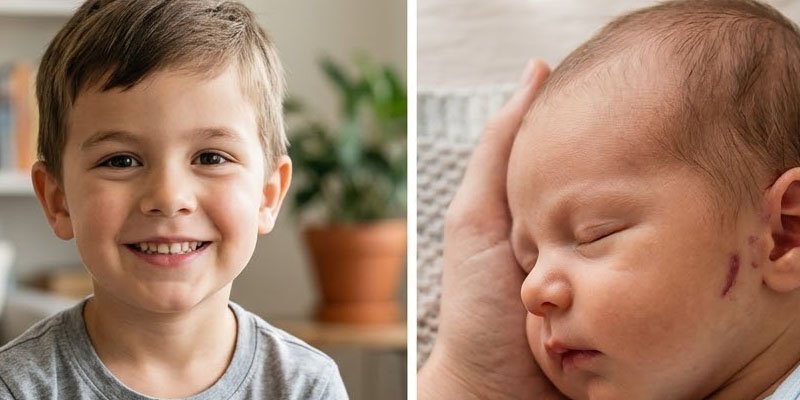
The doctor carefully brushed aside Liam’s damp little strands of hair, revealing a small crescent-shaped birthmark tucked behind his left ear.
“It’s completely harmless,” she reassured me. “Just a rare feature.”
My husband, Ben, let out a relieved breath before leaning over to kiss my forehead.
“Well, at least he’ll always have a permanent way to identify him if he ever gets lost.”
Everyone in the room laughed.
It became one of those treasured family stories I never imagined would one day feel like a piece of evidence.
For the next five years, that little birthmark was simply part of Liam. I kissed it each night before bed, noticed it after every bath, and knew it as well as every other tiny detail only a mother remembers.
Then my closest friend, Emily, welcomed her own son, Noah.
Emily and I had been inseparable ever since college. We had stood beside each other through broken relationships, demanding jobs, weddings, and years of heartbreaking fertility struggles.
The day Noah was born, I hurried to the hospital carrying flowers and coffee.
Emily looked exhausted but radiant. Her husband, Daniel, was asleep in the chair beside the window.
She gently placed Noah into my arms.
He was tiny, warm, and absolutely perfect.
Then he turned his head.
Behind his left ear was a crescent-shaped birthmark.
It wasn’t just similar to Liam’s.
It matched perfectly—the same shape, the same size, and in the exact same spot.
My stomach sank.
Emily caught the look on my face.
“What’s wrong?”
“Noah has a birthmark behind his ear.”
She simply shrugged.
“So?”
“Liam has the exact same one.”
Emily smiled as if it were nothing more than a funny coincidence.
“That’s amazing.”
I smiled back, but deep inside, something had already begun to change.
For months, I kept trying to convince myself it meant nothing.
Kids had birthmarks. Genetics could be unpredictable. Strange coincidences happened all the time.
But as Noah got older, the similarities between the two boys became harder and harder to ignore.
They shared the same gray-green eyes, thick dark lashes, determined chin, and identical serious look whenever they were focused.
Other people noticed it too.
At the playground, strangers asked if they were cousins. Cashiers assumed they were brothers. Other parents frequently remarked that the boys looked almost identical.
Emily was always laughing.
I forced myself to laugh along with her.
Deep inside, though, suspicion was slowly eating away at me.
After Emily and Noah came over one evening, Ben could immediately tell something was wrong.
He found me in the kitchen stuffing dishes into the dishwasher far more aggressively than necessary.
“You’re doing that thing again,” he said.
“What thing?”
“You act so calm that it actually becomes unsettling.”
I closed the dishwasher door.
“The boys resemble each other far too much.”
Ben froze for a brief moment.
It was only a second, but it changed everything.
“Why did you hesitate?” I asked.
He ran a hand over his face.
“Because I knew this question would come someday.”
A wave of heat rushed through my body.
“Question? What question?”
He stayed silent.
I kept staring at him.
“Did you have an affair with Emily?”
The color drained from his face.
“No.”
“You hesitated.”
“I know.”
“You look terrified.”
“I know.”
“If you weren’t sleeping with Emily, then explain why our sons look like they’re related.”
Ben lowered himself into a chair at the kitchen table as though he no longer had the strength to stand.
“I can’t tell you.”
That response felt even worse than admitting guilt.
For the next several weeks, I questioned every memory I had.
I examined every interaction between Ben and Emily. I replayed old family dinners, vacations, text messages, and every glance they had exchanged.
Once doubt takes hold, even the most innocent moments begin to look suspicious.
Then I came across a photo from Liam’s sixth birthday.
Liam and Noah were standing side by side, both wearing matching pirate hats.
I sank onto the kitchen floor, unable to stop looking at the picture.
There was simply no denying it anymore.
They looked like they shared the same blood.
That evening, after Liam had gone to bed, I placed the photograph in front of Ben.
“Tell me the truth.”
The moment he saw it, every bit of color disappeared from his face.
“I hoped you would never ask.”
“So it’s true.”
“No. It’s not what you’re thinking.”
“Then explain what it is.”
Ben walked into the hallway, opened a closet, and reached for an old sealed envelope resting on the top shelf.
Written across the front in my late father’s handwriting were six words:
For Ben. Open only if necessary.
I looked at him in disbelief.
“What does my father have to do with any of this?”
Ben’s expression filled with guilt.
“He made me promise.”
Inside the envelope were fertility clinic records, medical documents, and a handwritten letter from my father.
The opening lines said:
If you are reading this, the resemblance has become too obvious to ignore. I am sorry. I truly believed I was protecting everyone.
As I continued reading, it felt as though the ground beneath me had shifted.
Years earlier, while Ben and I were going through fertility treatments, my father had helped pay for the costs.
What I had never been told was that he had also been communicating privately with the clinic’s director, who happened to be an old friend.
Ben’s infertility issues were severe.
Emily and Daniel had been receiving treatment at that same clinic because they were facing a similar problem.
Without informing either family, my father arranged for both couples to use the very same anonymous sperm donor.
The boys weren’t connected because of an affair.
They were biological half-brothers.
I turned to Ben.
“You knew?”
“Not until Liam was born,” he replied. “Your father told me that night.”
“And you kept this from me for six years?”
“He was dying. He begged me not to tell you unless the resemblance became too obvious to deny.”
I let out a bitter laugh.
“My father has been gone for seven years, yet he’s still managing to control my life.”
PART 2
My father’s letter insisted that everything he had done was meant to safeguard both marriages.
He believed keeping the donor anonymous would avoid embarrassment, protect both families, and spare everyone from unnecessary heartache.
In the letter, he described me as too emotional and Emily as delicate. He assumed the men would have difficulty accepting infertility, so he convinced himself that secrecy was the most sensible answer.
He wrote about control as if it were an act of compassion.
I looked at Ben.
“You let me believe you had been unfaithful.”
“I never imagined you’d think that.”
“That doesn’t answer my question.”
For the first time, his own frustration broke through.
“What do you want me to say? That I was scared? That I lacked the courage? Fine. I was. Your father was dying, and he convinced me that telling you would forever ruin your memories of Liam’s birth—and of him.”
“And you decided that choice was yours to make instead of mine?”
Ben dropped his gaze.
“I kept telling myself that staying quiet would hurt less.”
“Silence is just another form of lying when people want to convince themselves they’re innocent.”
I called Emily right away.
The moment she answered, I asked only one thing.
“Did you know?”
Silence filled the line.
Then she quietly replied, “Ben told you.”
That single sentence gave me all the confirmation I needed.
Emily and Daniel had uncovered the truth shortly after Noah was born. Daniel had pushed the fertility clinic for answers after noticing how much the boys resembled each other.
Everyone had known except me.
“We believed telling you would only tear everything apart,” Emily said.
“Don’t tell me you were trying to protect me.”
She started sobbing.
At that moment, I couldn’t find any sympathy for her.
The fact that both boys shared the same donor explained why they looked so alike—but one thing still wouldn’t leave my mind.
The birthmark.
The same unusual shape in the exact same place felt far too precise to be simple coincidence.
Then I reread one sentence from my father’s letter:
The children will still look as though they belong.
I couldn’t stop thinking about those words.
A month later, I started requesting the clinic’s original records.
The fertility practice had since been taken over by a larger company. Its director had retired, and the archived files had been moved to off-site storage.
It took official requests, countless phone calls, and assistance from an attorney before I was finally granted partial access.
Ben begged me to let it go.
“You already know the truth,” he said.
“No. I only know the version of the truth everyone decided I deserved.”
Emily also urged me to stop searching.
“You already had the chance to give me peace,” I told her. “Instead, you chose secrecy.”
Eventually, I found myself sitting in a records archive with a woman named Marisol, surrounded by stacks of scanned files.
There were consent documents, laboratory reports, donor records, and handwritten authorization forms.
Then I noticed it.
The original donor identification number assigned to my treatment had been crossed out.
Another donor code had been written beside it in blue ink and approved by the clinic’s director.
Attached to it was a handwritten request signed by my father.
The document explained that both couples had originally been assigned different donors.
My father had personally instructed the clinic to replace those selections with one specific donor.
He had chosen a man whose mother’s family carried a rare inherited crescent-shaped birthmark that frequently appeared behind the left ear or near the hairline.
That same characteristic existed in my father’s family.
He had intentionally selected that donor so his future grandchildren would share recognizable family features.
He wanted them to look like they belonged with us.
My father hadn’t simply hidden the truth.
He had carefully designed it.
In his notes, he argued that recognizable physical traits would lessen emotional distance and prevent anyone from questioning the children’s place within the family.
To him, children became genetic outcomes to be planned.
Marriage became something to organize.
My consent no longer mattered.
“My father did this,” I whispered.
Marisol gently asked if I needed a few moments.
That evening, I laid every document across my dining room table.
Ben remained standing as he read them.
Halfway through, he slowly dropped into a chair.
“He switched the donor?”
“Yes.”
“Because of the birthmark?”
“Yes.”
I sent Emily and Daniel a single message:
You need to see what I found.
They arrived without delay.
Emily read through the records first before breaking down in tears. Daniel became more furious with every page.
When he reached my father’s handwritten instructions, he threw the papers back onto the table.
“He had no right.”
“No,” I said. “He didn’t.”
Emily whispered, “He told us he was helping.”
“He was controlling every outcome.”
Ben looked directly at me.
“I should have told you the truth, no matter what your father wanted.”
For the first time, he wasn’t making excuses.
“Yes,” I replied. “You should have.”
The most difficult part was accepting that my father truly loved me.
He taught me how to drive, stayed by my side whenever I was sick, cried on my wedding day, and held my hand after I lost my pregnancy.
He was also the man who decided that my permission didn’t matter.
Both versions of him existed at the same time.
Accepting that reality was far harder than simply calling him a villain.
Betrayal doesn’t always come from people who have been cruel all their lives.
Sometimes it comes from the same person who once tucked a blanket around your shoulders and promised that everything they ever did was for your own good.