
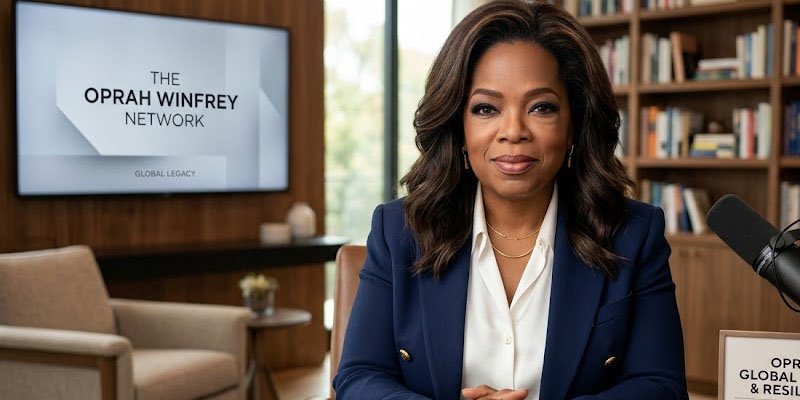
Oprah Winfrey: From a Difficult Childhood to a Global Legacy
Oprah Winfrey’s journey from a difficult childhood to becoming one of the most influential figures in global media is a story of resilience, ambition, and extraordinary determination. Across decades, she has built a career that extends far beyond television, establishing herself as a producer, philanthropist, author, and cultural force whose influence has reached millions of people around the world.
As she enters her 72nd year in 2026, Winfrey’s legacy continues to attract public attention. Her career has evolved through numerous chapters, from local broadcasting to daytime television, film, publishing, and large-scale philanthropic work. At the same time, her enormous public profile has made her the subject of speculation and sensational headlines. Yet her professional history offers a much more meaningful story: one centered on perseverance, reinvention, and control over her own narrative.
A Childhood Shaped by Hardship
Oprah Winfrey was born in 1954 in Kosciusko, Mississippi, and spent parts of her childhood living with relatives in Mississippi before moving to Milwaukee and later Nashville. Her early years were marked by poverty, instability, and serious personal trauma.
Winfrey has spoken publicly over the years about experiencing abuse during her childhood and adolescence. She has also discussed becoming pregnant as a teenager and losing her baby shortly after birth. These experiences became some of the most difficult chapters of her life, but they did not define the entirety of her future.
Instead, Winfrey gradually developed an ability to communicate openly about difficult subjects. That willingness to discuss pain, vulnerability, relationships, and personal growth would eventually become one of the defining characteristics of her television career.
Discovering Her Voice in Broadcasting
Winfrey’s path into media began remarkably early. While attending high school in Nashville, she worked in radio and developed experience as a broadcaster. Her natural ability to communicate with audiences quickly became apparent.
At just 19, she became a television news anchor in Nashville. Although traditional news broadcasting demanded a formal presentation style, Winfrey’s greatest strength was her ability to connect with people emotionally. Her conversational approach eventually helped guide her toward a different kind of television career.
Her move to Baltimore brought another important opportunity. She joined the talk-show program People Are Talking, where her relaxed style and ability to engage guests helped establish her reputation as a distinctive television personality.
The Chicago Breakthrough
The defining turning point arrived in 1984, when Winfrey moved to Chicago to host AM Chicago. The program was struggling in the ratings, but within a relatively short period, Winfrey transformed it into a major success.
Her approach was different from that of many traditional television hosts. Rather than maintaining emotional distance from her guests, she frequently allowed conversations to become personal and spontaneous. Audiences responded to that authenticity.
The program was eventually renamed The Oprah Winfrey Show, and its reach expanded dramatically. What began as a local Chicago production became a nationally syndicated program and ultimately one of the most recognizable talk shows in television history.
Building More Than a Television Career
Winfrey’s influence expanded when she founded Harpo Productions. The company gave her greater control over the programs and projects associated with her name, an important development in an entertainment industry where performers traditionally had limited control over production and business decisions.
Through Harpo, Winfrey became involved not only as a host but also as a producer and business leader. Her success demonstrated that a television personality could build a broader media enterprise rather than remaining dependent on a single program.
That business transformation became an important part of her legacy. She was no longer simply the person sitting behind a television desk. She had become an executive, producer, and owner with significant influence over the content she created.
The Oprah Book Club Effect
One of the most powerful examples of Winfrey’s cultural influence came through her book club.
When Winfrey recommended a book, sales could change dramatically. Authors who were relatively unknown to large audiences could suddenly find themselves at the center of national conversation.
The book club also helped turn reading and literary discussion into mainstream television subjects. Winfrey’s recommendations demonstrated the unusual relationship she had developed with her audience: viewers did not simply watch her programs; many trusted her judgment enough to act on her recommendations.
Over time, the book club became an important part of her broader cultural identity.
From Talk Show Host to Global Brand
The end of The Oprah Winfrey Show in 2011 did not mark the end of Winfrey’s influence. Instead, it represented another transition.
She continued developing television and film projects, publishing ventures, interviews, philanthropic initiatives, and digital media partnerships. Her work increasingly reflected interests in personal development, wellness, literature, leadership, and social issues.
Her career illustrates an important principle of modern media: lasting influence does not necessarily depend on remaining in one format forever. Winfrey repeatedly adapted to changes in the entertainment landscape while maintaining the central element of her brand—her relationship with audiences.
A Legacy Built on Connection
Perhaps the most distinctive aspect of Winfrey’s career has been her ability to make personal stories feel culturally significant.
For decades, her programs provided a platform for people to discuss subjects that were often considered private or uncomfortable. Family relationships, grief, addiction, personal identity, trauma, success, failure, and emotional wellbeing became subjects of public conversation.
Critics have sometimes questioned the boundaries of daytime television and the emotional nature of talk-show programming. Nevertheless, Winfrey’s impact on the format is undeniable. She helped establish a style of television in which empathy and personal storytelling became central elements.
Facing Public Scrutiny
Being one of the world’s most recognizable media figures has also brought constant scrutiny.
Over the years, Winfrey has faced rumors, online speculation, exaggerated headlines, and conspiracy theories. The modern social-media environment has made this phenomenon even more complicated, because unverified claims can spread rapidly before reliable information reaches audiences.
For a public figure with a career spanning several decades, separating legitimate reporting from sensational content is particularly important.
Winfrey’s long public record provides substantial evidence of her professional activities, charitable work, media projects, and public appearances. Claims about major developments in her life should therefore be evaluated through credible sources rather than anonymous posts or clickbait headlines.
Philanthropy and Social Impact
Beyond entertainment, philanthropy has become another major component of Winfrey’s legacy.
She has supported educational initiatives, disaster relief, humanitarian causes, and organizations serving young people and communities in need. Her charitable efforts have included substantial investments in education, most notably through the Oprah Winfrey Leadership Academy for Girls in South Africa.
The school reflects one of the themes that has repeatedly appeared throughout Winfrey’s career: education as a pathway toward opportunity and independence.
Her philanthropic work has helped shift public perceptions of what a media celebrity can accomplish outside entertainment.
Reinvention as a Career Strategy
Winfrey’s career is also a case study in reinvention.
She began in radio, moved into television news, found her defining role in daytime talk television, became a producer and business executive, expanded into film and publishing, and later embraced new forms of digital and streaming media.
Each transition required her to adapt to a changing audience and changing technology.
That ability to evolve may ultimately prove as important to her legacy as the extraordinary success of her talk show.
The Meaning of Oprah’s Story
Oprah Winfrey’s life cannot be reduced to a simple story of fame and wealth. Her biography contains difficult experiences, professional setbacks, major achievements, criticism, and continual reinvention.
Her story demonstrates how personal adversity can coexist with professional ambition—and how a person can gradually transform their circumstances through education, communication, opportunity, and persistence.
At the same time, her career shows the importance of controlling one’s own narrative. From a young broadcaster in Nashville to the head of a major media enterprise, Winfrey repeatedly expanded her ability to decide what stories she wanted to tell and how those stories would reach audiences.
Looking Toward the Future
At 72, Oprah Winfrey remains an influential name in entertainment and popular culture. Her relevance is no longer dependent on a daily television program. Instead, it comes from the enormous body of work she has accumulated across broadcasting, production, publishing, philanthropy, and cultural conversation.
The future of her legacy will likely depend less on individual headlines and more on the institutions, stories, books, educational initiatives, and media projects connected to her decades of work.
From a challenging childhood in Mississippi to an extraordinary career on the world stage, Winfrey’s journey remains one of the most notable transformations in modern American media.
Her story is ultimately not simply about becoming famous. It is about finding a voice, developing that voice into a career, and eventually using that platform to influence conversations far beyond television.