
PART 1
I couldn’t afford the football camp my thirteen-year-old son had been looking forward to all year.
So rather than spending his summer on a football field, Ronald decided to volunteer at our church’s soup kitchen.
A month later, the very same boys who had made fun of him covered our front yard with nearly thirty enormous soup pots.
But what happened next changed everything.
I had just completed another double shift at the nursing home when Ronald came rushing through the door with a flyer in his hand.
“Mom, registration opens Friday!”
His eyes were brighter than I had seen them in weeks.
“For what?”
“Coach Miller’s summer football camp. Everybody’s going.”
Then he set the flyer down on the kitchen table.
At the bottom was the cost.
$850.
The amount may as well have been $8,500.
Between rent, groceries, utilities, and all the other expenses, there was simply no way I could afford it.
“Ronald…”
“I know,” he said quickly.
I hated that he understood before I had even finished speaking.
“There’ll be other summers, Mom.”
He never brought up the camp again.
Three days later, our pastor announced that the community soup kitchen was looking for summer volunteers.
Before I could say anything, Ronald raised his hand.
“If I can’t spend the summer playing football,” he whispered, “I might as well help someone.”
I had never felt prouder of him.
Unfortunately, some boys from school heard about it.
A week before camp started, I drove past a parking lot where several of them were proudly showing off their new cleats and matching equipment.
“Which session are you doing, Ronald?” one boy shouted.
Another one laughed.
“Didn’t you hear? He’s spending the summer serving soup.”
Someone else called out, “His teammates are probably eighty years old.”
Ronald kept walking.
I wanted to pull the car over and say something.
He looked at me through the windshield and shook his head.
So I remained silent.
Every morning after that, Ronald got up before sunrise.
He wore an apron that was far too large and spent hours peeling vegetables, carrying trays, cleaning tables, and remembering small details about the people who came through the serving line.
“Mrs. Alvarez likes extra crackers,” he told me one evening.
“And Mr. Dean can’t eat spicy food.”
“You remember all that?”
“Of course. It matters.”
Then, one morning, Ronald shook me awake.
“Mom. You need to come outside.”
I followed him downstairs.
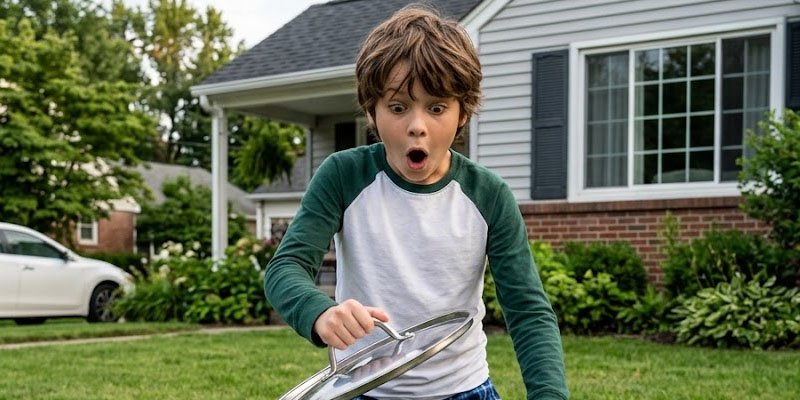
When I opened the front door, I froze.
Our entire lawn was covered in enormous stainless-steel soup pots.
There had to be thirty of them.
In the center was one massive pot with an envelope tied around its handle.
Two words were written across it:
For Ronald.
He opened the envelope.
Inside was a message:
Your reward is inside.
Ronald lifted the lid.
Inside was a cardboard trophy with thick marker writing across the front.
SOUP KITCHEN MVP.
Underneath was another note making fun of him for missing football camp and choosing to spend his summer volunteering instead.
Ronald’s expression changed.
“These are from the church,” he whispered.
He recognized the pots.
Someone had taken them specifically to humiliate him.
I wanted to know who had done it.
Ronald stopped me.
“Please, Mom. Let it go.”
I promised.
By midnight, I knew I couldn’t keep that promise.
Because someone had sent me a video.
And the boys responsible had recorded the entire thing themselves.
PART 2
A coworker from the nursing home texted me that night.
“This is going around. I’m sorry.”
There was a link underneath her message.
I opened it.
The video showed several boys unloading the soup pots onto our lawn before sunrise.
They laughed as they placed the fake trophy inside the largest one.
One boy stared straight into the camera.
“Special delivery for the soup boy.”
The caption beneath the video was even crueler.
When you’re too broke for camp.
It had already received thousands of views.
I clicked on the profile.
I recognized the boys immediately.
They were the same kids who had ridiculed Ronald outside school.
And every one of them was attending the summer football camp.
They had uploaded the evidence themselves.
Ronald had asked me to let it go.
But I couldn’t.
The next morning, I called the camp.
The receptionist told me the director was there because families were attending orientation.
So I drove there.
When I walked into the lobby, two sets of parents were standing near the desk.
They recognized me right away.
One father stepped toward me.
“You must be Ronald’s mother. It was just a harmless joke.”
“Harmless?”
“They’re kids,” he said. “Boys tease each other.”
Another parent crossed her arms.
“If Ronald can’t handle a few jokes, maybe competitive sports aren’t right for him.”
I kept my voice calm.
“My son spent a month helping people who needed food. Your sons used that to publicly humiliate him.”
The first father gave me a smile I didn’t trust.
“We’ve supported this program for years. You don’t want to make this into something bigger than it is.”
I had no lawyer.
No money.
No influential connections.
Only the truth.
Then a voice came from behind them.
“I think it’s already big enough.”
The camp director had come out of his office.
He had watched the video.
“All of it,” he said.
The parents immediately started offering excuses.
“It was harmless.”
“They’re teenagers.”
“Nobody was hurt.”
The director shook his head.
“They filmed themselves mocking a boy because he spent his summer feeding people instead of attending camp.”
One mother objected.
“We pay full tuition. We’ve donated to this program.”
“That buys your children a place here,” the director answered. “It does not give them permission to treat someone badly.”
The room became silent.
Then I finally said what I had been keeping inside.
“His name is Ronald.”
Everyone looked at me.
“He wanted this camp more than anything.”
I swallowed.
“But when he realized I couldn’t afford it, he stopped asking because he didn’t want me to feel guilty.”
The director listened.
“So instead, he volunteered. Every day. Without complaining.”
I looked at the parents.
“You keep talking about money like it determines somebody’s worth.”
I paused.
“My son has something money can’t buy.”
Nobody responded.
The director turned toward his staff.
“Call those boys in.”
One parent looked stunned.
“You’re serious?”
“Completely.”
The boys were brought into the room.
Their confidence vanished almost immediately.
Then the director explained exactly what would happen next.
They would publicly apologize to Ronald.
And, if Pastor Ruiz agreed, they would spend Saturdays volunteering at the same soup kitchen they had mocked.
One boy looked up.
“What if we don’t?”
“Then you won’t be attending this camp.”
The parents started protesting.
The director stopped them.
“Argue, and they lose their places completely.”
No one said another word after that.
Then he turned to me.
“I have one more question.”
I nodded.
“Why didn’t Ronald register for camp?”
I took a breath.
“Because I couldn’t afford $850.”
The director stared at me for a moment.
Then he said something I never could have expected.
“Bring Ronald here tomorrow.”
PART 3
I thought I must have misunderstood him.
“What?”
The director folded his arms.
“Ronald has a fully sponsored place at this camp.”
I immediately shook my head.
“I can’t accept charity.”
“It isn’t charity.”
He glanced toward the boys sitting quietly nearby.
“I spend the entire summer trying to teach young athletes discipline, leadership, humility, and character.”
Then he looked back at me.
“Your son already understands those things.”
My throat tightened.
“He earned a place here before he ever stepped onto the field.”
When I told Ronald that evening, he thought I was joking.
“Mom, stop.”
“I’m serious.”
His expression changed.
“But how?”
“The director saw the video.”
Ronald looked down.
For a moment, I worried he would turn it down because he didn’t want anyone feeling sorry for him.
Then I explained what the director had told me.
“This isn’t because people pity you. He wants you there because of who you are.”
Ronald stayed quiet for a long time.
Then he smiled.
A week later, I sat in the bleachers watching him jog onto the field in his new camp jersey.
His cleats gleamed beneath the afternoon sun.
Several of the same boys who had mocked him stood along the sideline.
They weren’t laughing anymore.
They had already apologized.
And on Saturday mornings, they were expected to be at the soup kitchen.
Pastor Ruiz had agreed to let them volunteer.
At first, I thought Ronald would hate having them there.
Instead, he treated them like every other volunteer.
He showed them where the supplies were kept.
He explained which guests needed extra help.
He even reminded one boy:
“Mr. Dean doesn’t like spicy food.”
That was Ronald.
He never needed to make someone else feel small in order to prove he was strong.
One afternoon, I asked him if he was still angry.
He thought about it for a moment.
“I was embarrassed,” he admitted.
“But I don’t want to become like them just because they were mean to me.”
That sentence stayed with me.
For weeks, I had felt ashamed that I couldn’t afford his camp.
I had watched parents spend hundreds of dollars on equipment while I worked double shifts simply to keep our bills paid.
I thought being unable to give Ronald $850 meant I had failed him.
But sitting there in those bleachers, I realized something.
Ronald’s greatest lesson that summer had never come from football.
It came from the soup kitchen.
He learned that dignity had nothing to do with money.
That serving others was never something to be ashamed of.
And that another person laughing at your circumstances does not make those circumstances shameful.
The boys had tried to make “soup kid” into an insult.
Instead, everyone learned what those words really meant.
They meant the boy who woke before sunrise to serve strangers.
The boy who remembered who needed extra crackers.
The boy who gave up something he desperately wanted rather than make his mother feel guilty.
The boy whose character impressed a football coach before he ever touched the field.
Near the end of camp, Ronald ran toward the bleachers after practice.
“How’d I do?”
I smiled.
“You were great.”
“Coach says I might make the fall team.”
“That’s amazing.”
Then he sat beside me and stared across the emptying field.
“You know what’s weird?”
“What?”
“I still want to volunteer at the soup kitchen after camp ends.”
I laughed.
“Why is that weird?”
He shrugged.
“I guess it isn’t.”
As we headed toward the parking lot, I heard someone behind us whisper:
“That’s the soup kid.”
A month earlier, those words would have made my son lower his head.
This time, Ronald turned around.
Then he smiled.
Because now everyone understood exactly what those words said about him.
And none of it was anything to be ashamed of.