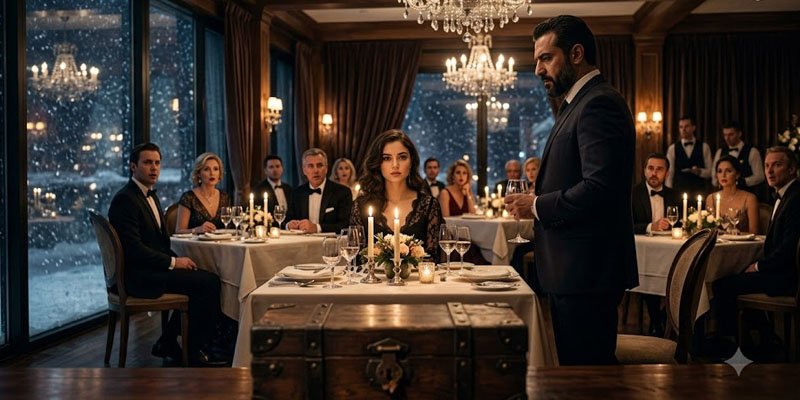
Hannah could feel every pair of eyes fixed on her. The professor watched her closely. The translator did the same. Amber stood frozen with one hand covering her mouth.
“I don’t know,” Hannah replied.
“That wasn’t what I asked.”
Heat crept across her cheeks. She lowered her gaze to the floor before lifting it again. Deep inside, the strange force she had lived with for years—the reason she had spent countless lonely nights studying forgotten languages and ancient histories—pressed against her chest like an invisible hand.
If she lied, she could leave this place as Hannah Reed, a waitress.
If she spoke the truth, she knew with complete certainty that she would never again be just that.
Khalid’s eyes grew sharper.
“Do you know the answer?”
Hannah drew in a slow breath.
Then she answered in the same ancient Arabic he had spoken.
The effect on him was instant.
The color drained from his face. His confident smile disappeared. His eyes widened with an emotion no one in the restaurant had ever expected to see on Khalid Al-Masri.
Fear.
No one dared move.
Khalid slowly stepped back from his chair.
“Say it again,” he demanded.
Hannah’s throat had gone dry.
Even so, she repeated the words.
Clearly.
Flawlessly.
Khalid shut his eyes for a brief moment, as though the sentence had struck a place buried deep within him.
When he looked at her again, he whispered, “Impossible.”
The restaurant burst into noise.
“What did she say?”
“Was her answer correct?”
“Who is this woman?”
Khalid lifted one hand, and somehow the entire room fell silent.
“The question,” he said carefully, “was this: What grows lighter when shared by two, yet heavier when carried by one alone?”
Voices immediately called out different guesses.
“Responsibility!”
“A secret!”
“A child!”
“Debt!”
Khalid paid no attention to any of them.
His eyes remained locked on Hannah.
“Tell them.”
Hannah swallowed hard.
“Pain,” she answered.
Silence settled over the room again, but this silence felt different. Gentler. Deeper.
“When pain is shared between two people,” Hannah said softly, “it becomes lighter. But when someone bears it alone, it becomes overwhelming.”
For the first time that evening, no one was laughing.
The professor slowly rose to his feet. “But there’s something more, isn’t there?”
Without looking away from Hannah, Khalid nodded.
“Yes,” he replied. “Knowing the answer is only part of it. The original ancient wording includes a rare expression. Almost nobody recognizes it.”
Hannah looked at him. “You mean haml al-ruh.”
The professor turned toward her in surprise. “How do you know that?”
“Because in that context,” Hannah explained, “it doesn’t simply refer to pain. It describes the burden carried by the soul itself.”
Khalid stared at her as though she had reached inside him and unlocked something long hidden.
Then he asked the question that transformed curiosity into fear.
“Have you ever heard the name Saeed Al-Faruq?”
Hannah caught her breath.
“Yes,” she answered slowly. “He was a scholar who collected disappearing dialects. Nearly a hundred years ago, he vanished without a trace.”
The smiles disappeared from the faces of Khalid’s business partners.
Hannah noticed.
Khalid stepped nearer. “What else do you know?”
“There was a story that part of his archive disappeared along with him.”
One of the men seated at Khalid’s table murmured something under his breath.
Khalid heard it.
So did Hannah.
“Who are you?” Khalid asked.
“I already told you,” Hannah replied. “I’m a waitress.”
“No.” His voice became quieter. “That is your job. It is not your identity.”
Hannah felt her heartbeat pounding in her throat.
Khalid leaned in slightly, and when he spoke again, his words sent a chill through her entire body.
“Did your father ever tell you about an old wooden chest?”
Part 2
The restaurant faded away.
Not in a literal sense. The candles continued to flicker. Snow still tapped softly against the windows. The guests kept staring at Hannah as if she had suddenly become the most dangerous person in all of Manhattan.
But for Hannah, everything focused on a single image.
A wooden chest tucked away in the back of her apartment closet.
Dark oak. Iron-reinforced corners. A cracked brass latch.
Her father’s chest.
She had not touched it since the day of his funeral.
“How do you know about that?” she whispered.
Khalid’s face grew stern. “Because I’ve spent the last twenty years searching for it.”
The room erupted into stunned murmurs.
Kyle stepped closer. “Mr. Al-Masri, perhaps this discussion should continue somewhere more private.”
Khalid pulled a black card from inside his jacket and placed it on the table.
“Stop admitting new customers,” he instructed. “Compensate everyone here. Triple the value of their bills. But no one leaves yet.”
Kyle stared at him.
Khalid met his eyes only once.
Kyle immediately obeyed.
Within minutes, the entrance doors were locked. The curtains were pulled halfway shut. The jazz trio silently packed away their instruments. And Hannah, who had spent the past three years serving those very tables, now sat across from Khalid Al-Masri as though she were an honored guest.
“Tell me about your family,” Khalid said.
“There’s nothing to tell.”
“Begin with your grandfather.”
“I never met him. His name was Michael Reed.”
Khalid slowly shook his head. “No, it wasn’t.”
Hannah stiffened. “Excuse me?”
Khalid reached into the inside pocket of his coat and removed an old photograph protected in a clear sleeve. He slid it across the table.
Three men stood together in the faded picture. One wore a linen suit. Another carried a leather folio. The third, younger than the others, had familiar gray eyes and the same half-smile Hannah had seen in every childhood photograph of her father.
Her fingers began to shake.
“Who is that?”
“The man you knew as Michael Reed,” Khalid replied. “His birth name was Mikael Al-Faruq.”
A gasp spread through the room.
Hannah shook her head. “No. My grandfather was American.”
“He became American,” Khalid answered. “That is very different from being born with the surname Reed.”
“This is insane.”
“Yes,” Khalid said quietly. “The truth often is.”
He placed another document in front of her. It was a copy of an old letter, written mostly in Arabic, with English notes carefully added along the margins.
Hannah leaned in.
Her chest tightened.
She recognized the handwriting.
It was her father’s.
The same slanted letter T. The same neat loops. The same habit of pressing too hard whenever he wrote the letter H.
“No,” she whispered. “No, that can’t be.”
“Your father knew,” Khalid said.
“Knew what?”
“That your family descended from Saeed Al-Faruq, the last known man who fully understood the language I spoke tonight.”
Hannah pushed her chair back. “My dad sold insurance in Queens. He watched baseball every Sunday. He made awful pancakes. He wasn’t involved in some secret historical conspiracy.”
For the first time, Khalid’s voice became gentle.
“People hide remarkable truths inside ordinary lives all the time.”
Hannah hated hearing those words because they sounded exactly like something her father would have said.
Before she could respond, the locked front door opened.
Every head turned.
A man walked inside wearing a dark wool coat sprinkled with snow. He looked about forty-five, completely ordinary in the most unsettling way. Brown hair. Clean-shaven face. Calm eyes. No visible weapon. No sign of urgency.
His eyes settled directly on Hannah.
Then he said, “We found her.”
Khalid shot to his feet so quickly that his chair scraped loudly across the floor.
His security team reacted at once.
The newcomer didn’t even blink.
“Who let you in?” Khalid demanded.
“Doors rarely stop people who already know where they’re headed.”
“Who are you?” Hannah asked.
The stranger gave a slight nod. “David Rayne.”
“That name means nothing to me.”
“It will.”
Khalid’s jaw tightened. “The Order.”
One of Khalid’s partners whispered under his breath, “God help us.”
David removed his coat and carefully draped it over a chair, as if he had simply arrived for dinner.
“I represent an organization that has existed for more than three centuries,” he said. “We’ve been watching your family for a very long time, Miss Reed.”
A wave of nausea hit Hannah.
“Watching my family?”
“To protect what your family carried.”
Khalid snapped back, “To control what your family carried.”
David glanced toward him. “Protection and control often appear identical to those looking from the outside.”
Hannah stood up. “Stop talking about me as if I’m not standing here.”
Both men turned toward her.
The entire room seemed to stop breathing.
“What’s inside the chest?” Hannah asked.
David and Khalid exchanged a brief look.
“No one knows completely,” David admitted.
Hannah let out one sharp, humorless laugh. “You forced your way into a locked restaurant, frightened a room full of strangers, and you don’t even know what you’re searching for?”
“We do know people have died trying to find it,” David said.
Her laughter disappeared instantly.
“Twenty-three confirmed disappearances over the last century,” he continued. “Scholars. Collectors. Couriers. Members of the family. Every one of them connected to Saeed Al-Faruq’s missing archive.”
Khalid’s expression darkened. “And now the people responsible know where you live.”
Hannah felt the blood drain from her face.
“How?”
David raised a tablet and displayed a black-and-white photograph.
Her apartment building.
At night.
Two men standing near the fire escape.
The timestamp showed it had been taken three years earlier.
Hannah stared silently.
David swiped to the next image.
Different men.
The same building.
Another swipe.
Her hands lost all feeling.
“They tried to break in?”
“Three separate times,” David answered. “We stopped two attempts. The third group left before reaching your apartment.”
“Why didn’t anyone tell me?”
“Because your father asked us not to unless you were found.”
Hannah looked toward Khalid.
He reached inside his jacket and pulled out an old yellow envelope sealed with wax.
Her name was written neatly across the front.
To my daughter, Hannah. Open only when they find you.
She recognized the handwriting before her mind could fully accept it.
Her father.
Her knees almost gave out beneath her.
Khalid gently slid the envelope across the table. “It belongs to you.”
With trembling fingers, she broke the wax seal.
Inside was a single letter and one photograph.
The picture showed her father years younger, standing beside a wooden chest.
The very chest in her closet.
She unfolded the letter.
My sweet Hannah,
If you are reading this, then the story I prayed would never reach you has finally arrived.
You will be frightened. You will be angry. You will wonder why I kept the truth from you.
I did not hide it because I was ashamed of our family’s past.
I hid it because I wanted you to stay alive.
People will tell you they want the archive. Others will insist they wish to protect it. Never trust anyone simply because they know part of the truth.
The chest does not hold the archive.
It reveals the path.
The key is inside you.
Hannah stopped reading.
“What does that mean?” David asked.
She slowly shook her head. “I don’t know.”
“Read the rest,” Khalid urged.
She forced herself to continue.
When you find the map without roads, remember the story of the bird that never flew.
Hannah lowered the letter.
David’s expression changed instantly.
Khalid noticed. “You know what it means.”
“Maybe,” David replied.
Before anyone could say another word, bright headlights swept across the partially closed curtains.
One of Khalid’s security guards hurried to the window and looked through a narrow opening.
His shoulders instantly became rigid.
“Three SUVs,” he said.
David’s face went pale.
Khalid stepped to the window.
Outside, in the snow, three black vehicles had parked at the curb.
Their engines were running.
Men in dark coats stepped out one by one.
They did not rush.
They did not shout.
They simply stood facing the restaurant.
Hannah’s stomach turned. “Who are they?”
Khalid answered without looking away.
“The Keepers of the Seal.”
“That sounds like a movie.”
“I wish it were.”
One of the men outside lifted his hand.
Four fingers.
David whispered, “They’ve started the count.”
“What count?” Hannah asked.
“Until midnight.”
“And what happens at midnight?”
David looked at her.
“They come for the chest.”
Hannah clutched her father’s letter. “And if I don’t give it to them?”
Khalid’s expression was stone.
“They take it anyway.”
The back exit opened into an alley that smelled like wet brick and snow. Hannah left the restaurant wearing only her server coat until Khalid’s driver wrapped a black cashmere overcoat around her shoulders.
She did not thank him.
She was too busy trying not to fall apart.
Within minutes, she was in the back of Khalid’s armored sedan, speeding toward Queens with Khalid on one side and David on the other.
No one spoke until Hannah said, “My father used to tell me a story.”
Both men turned.
“What story?” David asked.
“A bird that never flew. I thought he made it up.”
Khalid leaned forward. “Tell us.”
Hannah stared out at the city lights sliding past the windows.
“There was a bird born in a cage with a silver door. Every day, other birds told him to fly east because the sun rose there. But he refused. He said the sun only showed where morning began, not where home waited.”
David’s breathing changed.
Hannah continued.
“One night, the cage broke. The bird still didn’t fly east. He walked north under the stars until he found a house with no road leading to it.”
Khalid whispered, “A map without roads.”
“I don’t know what it means,” Hannah said.
David looked at the driver. “Faster.”
When they reached her building, the street was too quiet.
That was the first warning.
The second warning came when the power died.
Every window on the block went black at once.
Hannah looked up at her apartment.
“Oh God.”
Khalid’s men moved first, but Hannah was already out of the car.
“Hannah!” Khalid snapped.
“It’s my father’s chest.”
“And it may get you killed.”
She turned on him. “Then you should’ve let me stay a waitress.”
For one second, Khalid had no answer.
Then David said, “Move.”
They climbed the stairs in darkness. On the fourth floor, Hannah unlocked her apartment with hands that barely worked. Everything inside looked exactly as she had left it that morning. A mug by the sink. A blanket on the couch. A stack of library books by the window.
Ordinary things.
A life she had trusted.
Hannah opened the closet.
The wooden chest waited under an old quilt.
David crouched before it with reverence. Khalid shone a flashlight over the lid.
At first, the carvings along the edge looked decorative.
Then the light shifted.
Tiny symbols emerged from the wood.
Hannah’s breath caught.
“That’s not decoration,” she whispered.
“No,” David said. “It’s a star map.”
Khalid looked at Hannah. “The map without roads.”
A sound came from the stairwell.
Footsteps.
Slow.
Steady.
Coming closer.
Part 3
No one moved.
The footsteps climbed from the third floor to the fourth with terrible patience, each step echoing through the dead building.
Khalid’s security men took positions by the door.
David worked faster, shining his phone light across the chest carvings while muttering calculations under his breath.
“Hannah,” he said, “the story. Say it again.”
“Now?”
“If your father said the key is inside you, then yes. Now.”
Hannah closed her eyes.
Fear clawed at her throat, but beneath it came memory.
Her father sitting at the edge of her childhood bed.
His tired smile.
His warm hand smoothing her hair.
The bird never flew east because morning is not home.
The bird walked north until the stars stopped moving.
The bird found a house with no road.
And under the house, the old voices slept.
Hannah’s eyes opened.
“There was another line,” she whispered.
David looked up.
“My dad always ended it the same way.” Her voice shook. “The bird never flew east because home was north.”
David stared at the carved star map.
“North,” he breathed.
He rotated the image in his notebook. Drew three lines. Counted points from the brightest carved star. His face changed.
“Khalid.”
“What?”
“These are coordinates.”
“Where?”
David swallowed.
“The Adirondacks.”
Khalid went still. “No.”
“Yes.”
“What’s in the Adirondacks?” Hannah demanded.
Khalid turned to her. “An old private research lodge. Burned down in 1929. It belonged to a foundation connected to Saeed Al-Faruq.”
The footsteps stopped outside the apartment door.
A calm male voice spoke from the hallway.
“Miss Reed. Open the door.”
Hannah’s blood turned to ice.
Khalid’s guard lifted his weapon.
David closed the chest. “We have what we need.”
“We can’t carry that thing down four flights,” Hannah said.
“We don’t have to,” David replied. “Your father was right. The chest opens the path. It is not the treasure.”
The voice outside came again.
“Miss Reed, this does not need to become violent.”
Hannah looked at the door.
For the first time all night, something stronger than fear rose inside her.
Anger.
Her father had lived with this. Her grandfather had changed his name because of this. Her family had been watched, hunted, and cornered by men who thought old knowledge belonged to whoever had enough power to steal it.
She stepped toward the door.
Khalid grabbed her arm. “No.”
Hannah looked down at his hand.
He released her.
She stood behind the locked door and said, “What do you want?”
“The chest.”
“You don’t even know what’s inside.”
“We know it does not belong to you.”
Hannah laughed softly. “That’s funny. Every man I’ve met tonight said the same thing in a different way.”
Silence.
Then the man said, “You are a waitress. You are frightened. You are being used by men who will discard you when this is over.”
Hannah’s eyes burned.
Maybe that was supposed to break her.
Instead, it steadied her.
“My father was an insurance salesman,” she said. “My grandfather was an immigrant with a fake name. My great-grandfather was hunted for protecting something powerful men wanted. And I waited tables tonight because rent was due Friday. Don’t talk to me about being used.”
Khalid watched her with something like respect.
David whispered, “We need to go. Fire escape.”
The first hit struck the door.
Wood cracked.
Hannah grabbed her father’s letter and the photo. David copied the coordinates. Khalid’s guard lifted the old chest just long enough to shove it against the door as a barricade.
“The chest?” Hannah said.
Khalid looked at it.
Then at her.
“Your father said the archive was not inside.”
Another hit shook the door.
Hannah understood.
The chest had protected the secret for decades.
Now it would protect them for thirty seconds more.
They went out the window.
Snow whipped into Hannah’s face as she stepped onto the fire escape. Below, the alley looked impossibly far away. Khalid climbed after her, expensive suit ruined, one hand braced against the frozen rail. David followed, clutching the notebook.
Behind them, the apartment door splintered.
They ran.
By 2:15 a.m., they were on the highway heading north, Manhattan shrinking behind them.
Hannah did not sleep.
She sat in the back of Khalid’s SUV with her father’s letter in her lap and watched the city become suburbs, then dark roads, then black trees under snow.
At dawn, they reached the Adirondacks.
The lodge was not on any tourist map. The road ended miles away, forcing them to continue on foot through snow and pine. Khalid, who looked like he had never carried anything heavier than a fountain pen, said nothing as he pushed forward beside Hannah.
The sun was just lifting when they found the ruins.
Stone foundations.
Burned beams under ice.
A collapsed chimney standing like a warning.
David checked the coordinates again. “This is it.”
Hannah looked around. “There’s nothing here.”
Khalid pointed.
Beyond the ruins stood an old iron weather vane half-buried in snow.
A bird.
Not flying.
Facing north.
Hannah walked toward it as if pulled by a string.
At its base was a flat stone marked with the same symbol carved into the chest.
She knelt and brushed away snow.
There was a handle.
David helped lift the stone.
Below it, stairs descended into darkness.
Nobody spoke for a long moment.
Then Khalid handed Hannah the flashlight.
“It should be you.”
She almost refused.
Then she thought of her father.
She went first.
The chamber below was cold, dry, and impossibly large. Shelves lined the stone walls. Clay tablets. Wrapped manuscripts. Metal cylinders. Wax-sealed boxes. Journals in languages Hannah recognized and others she did not.
The air smelled of cedar and dust and a hundred years of waiting.
David whispered, “My God.”
Khalid slowly turned, overwhelmed despite himself.
“It’s real,” he said.
Hannah stepped deeper into the archive.
At the center of the chamber sat a plain wooden desk.
On it was a final letter.
Not addressed to Khalid.
Not to David.
To the one who answers with pain.
Hannah opened it.
The handwriting was not her father’s.
It was older.
Saeed Al-Faruq’s.
She read silently at first. Then aloud.
Knowledge is not treasure. It is responsibility.
Those who hunted me believed the archive contained a weapon, a fortune, or the names of men who could be destroyed.
They were wrong.
The archive contains memory.
The memory of people erased by empires. Languages buried by conquest. Medicines forgotten after wars. Maps of communities burned and renamed. Testimonies of those who had no kings to protect them and no armies to avenge them.
If this archive belongs to one powerful man, it will become a weapon.
If it belongs to one secret order, it will become a prison.
If it belongs to fear, it will vanish again.
It must belong to the living.
Hannah’s voice broke.
Khalid looked away.
David lowered his head.
Then headlights flashed through the narrow opening above.
They had been followed.
Khalid’s men shouted.
David grabbed Hannah’s arm. “We need to seal the entrance.”
“No,” Hannah said.
“Hannah—”
“No.”
She walked to the desk and found what Saeed had left beside the letter.
A metal case.
Inside were dozens of small glass plates and a handwritten index.
David stared. “Copies.”
Hannah looked at Khalid. “You have satellites, servers, newspapers, lawyers, governments that answer your calls. Right?”
He blinked. “Yes.”
She turned to David. “And your Order has spent three hundred years keeping secrets.”
David understood before Khalid did.
“Hannah,” he said carefully, “once this becomes public, no one can control what happens.”
“Exactly.”
Above them, voices echoed. The Keepers were entering the ruins.
Hannah lifted Saeed’s letter.
“My father carried pain alone because he thought silence would keep me safe. My grandfather carried it alone. Saeed carried it alone. That question tonight was never about being smart.”
She looked at Khalid.
“It was a warning.”
Khalid’s expression shifted.
Pain becomes lighter when carried by two.
He nodded once.
Then the billionaire who had entered a restaurant to mock strangers took out his phone and made the most important call of his life.
Within twenty minutes, encrypted images of the archive plates were moving through channels Khalid controlled but could not erase. Within forty minutes, David had contacted historians, preservationists, and journalists tied to the Order but not owned by it. Within an hour, three major newsrooms had received proof of the archive’s existence and the names of the groups that had hunted it.
The Keepers reached the chamber too late.
Their leader stopped at the bottom of the stairs, snow melting on his coat, his face unreadable.
Hannah stood in front of the desk.
He looked past her at the shelves.
“You don’t understand what you’ve done,” he said.
“Yes,” Hannah replied. “I do.”
“This will create chaos.”
“No,” she said. “It will create witnesses.”
Khalid stepped beside her.
Then David.
Then one of Khalid’s guards.
Then another.
The man looked at Hannah as if seeing her for the first time.
Not a waitress.
Not a mistake.
Not a girl who had answered a question above her station.
A keeper of memory.
Sirens sounded in the distance.
The man in the dark coat lowered his eyes.
For the first time, he looked afraid.
Six months later, Hannah Reed stood in front of the New York Public Library, wearing a simple navy dress and her father’s watch.
Cameras filled the steps.
Beside her stood Khalid Al-Masri, no longer smiling like a man who enjoyed humiliating people. He had funded the preservation of the archive on one condition: that no corporation, government, or private collector could own it.
David Rayne stood farther back, watching quietly as members of his Order handed over documents they had hidden for generations.
The world had argued for months.
Scholars fought. Governments denied. Families came forward with names found in the archive. Languages thought lost were heard again in recordings made from phonetic notes. Medical historians discovered remedies that led to new research. Descendants of erased communities finally saw proof that their grandparents’ stories had been true.
And Hannah?
She still lived in Queens.
She still made her own coffee.
She did not return to waiting tables.
Instead, she became the first director of the Al-Faruq Public Memory Project, not because she had the most degrees in the room, but because she was the only one Saeed had chosen without ever meeting her.
On opening day, a reporter shouted, “Miss Reed, what was really inside the archive?”
Hannah looked at the crowd.
Then at Khalid.
Then at the old photograph of her father tucked safely inside her coat pocket.
“Pain,” she said.
The reporters went quiet.
“But not only pain,” Hannah continued. “Pain that was finally carried by more than one person.”
That evening, after the ceremony, Khalid found her standing alone in the library’s main hall.
“I owe you an apology,” he said.
Hannah smiled faintly. “For which part?”
“For thinking I could measure people with questions.”
“And?”
“For thinking the quietest person in the room had nothing to say.”
She looked up at the marble ceiling.
“My dad used to tell me that some doors only open when you stop trying to look important in front of them.”
Khalid almost smiled. “Your father sounds wiser than I was.”
“He was.”
For a moment, they stood together in silence.
Not the cold silence of fear.
Not the stunned silence of a restaurant watching a billionaire lose control.
A different silence.
The kind that comes after a burden is finally set down.
Outside, snow began to fall over New York again.
Softly this time.
Hannah watched it through the library windows and thought of a bird that never flew east, a chest that held no treasure, and a question meant to humiliate a waitress that had instead opened a century of buried truth.
She touched her father’s watch and whispered, “I’m not carrying it alone anymore.”
THE END