At thirteen, Mom dumped me at Aunt June’s cattle ranch, my belongings stuffed into a trash bag. “Your sister deserves proper summers,” she said. “You’re the one who ruins them.” They never came back. Years later, Dad tried to buy that same ranch for my sister. The moment the real-estate agent disclosed the owner’s name, Dad went quiet. By dawn, I had eighty-eight missed calls.
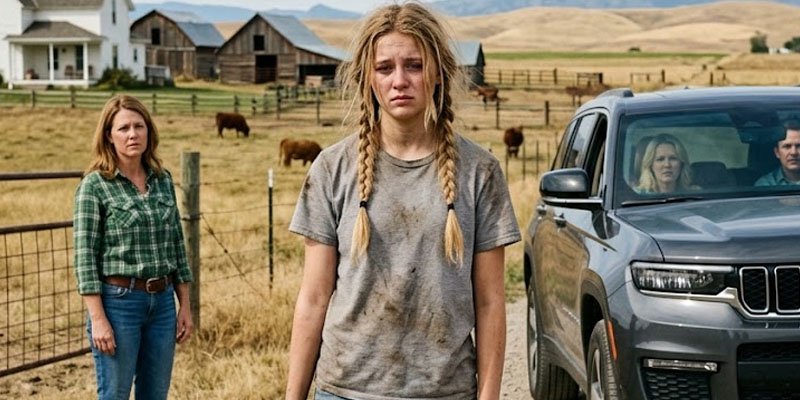
When I was thirteen, my mother abandoned me at Aunt June’s cattle ranch, leaving my belongings packed inside a black garbage bag. Before driving away, she told me, “Your sister deserves proper summers. You’re the one who spoils them.”
I stood in the gravel driveway, watching until the taillights disappeared into the distance.
Twenty minutes later, Aunt June discovered me standing there, gripping the bag.
“She promised they’d return in August,” I whispered.
June looked down the empty road.
“They never mentioned that to me.”
August came and went.
Then September arrived.
Nobody came for me.
June never gave me speeches about being unwanted. She made up the spare bedroom with clean sheets, grilled me a cheese sandwich, and sat with me until I no longer felt the need to hide my tears. The next morning, she handed me a pair of work gloves.
“You can stay here for however long you need,” she said.
Nobody had ever made the idea of staying forever sound so effortless.
My parents stopped answering June’s calls. They mailed my school records, a notarized guardianship document, and nothing else. Meanwhile, my younger sister, Claire, posted pictures of beaches, amusement parks, ski vacations, and Christmas cruises.
Not one photograph included me.
For years, I told myself my parents must have made a mistake.
By sixteen, I finally understood the truth.
They had done it intentionally.
June never made me feel like an inconvenience. She taught me everything from cattle breeding and bookkeeping to repairing fences, managing irrigation, and understanding land agreements. She also made certain I finished school.
“Land remembers the people who care for it,” she often reminded me.
At twenty-two, I returned from agricultural college and began modernizing the ranch. I introduced rotational grazing, rented unused acreage for solar infrastructure, and established a direct-to-market beef business that turned June’s struggling operation into a profitable enterprise.
Nine years later, June passed away and left the ranch to me.
Not because my family had abandoned me there.
But because I had worked to earn my place.
I never contacted my parents.
Then, eighteen years after they left me behind, a real-estate broker named Tom Alvarez called.
“Ms. Harper, I have a prospective buyer interested in Cedar Ridge Ranch.”
“The property isn’t for sale.”
“I explained that to him.”
“Then what are you calling about?”
Tom hesitated.
“The interested buyer is Robert Harper.”
My father.
My fingers tightened around the phone.
“He says he wants to purchase the property as a present for his younger daughter.”
Claire.
Of course.
Tom continued carefully, “He also claims there might be an issue involving family ownership.”
I almost laughed.
“There’s no issue.”
That evening, Tom met with Dad and showed him the county’s property records.
My name was the only one listed on the deed.
Tom later told me Dad stared at the document for nearly a minute.
Then he muttered, “That can’t possibly be right.”
By sunrise, eighty-eight missed calls were waiting on my phone.
I answered his eighty-ninth attempt.
Dad didn’t bother saying hello.
“You need to explain why your name is listed on June’s property.”
Outside my office window, cattle moved across a pasture glowing beneath the golden morning sun.
“It belongs to me.”
“That ranch belongs to our family.”
“Which family are you talking about?”
The line fell silent.
Then Mom’s voice came through the phone. “Don’t drag up that old drama again, Hannah.”
Old drama.
Apparently, abandoning a thirteen-year-old child had become nothing more than an unfortunate family disagreement.
Dad took the phone back. “Claire needs stability. She and Mark want to raise their children somewhere wholesome. You’re single. You have no use for twelve hundred acres.”
I laughed.
“You made eighty-eight calls to tell me I own too much land?”
His voice hardened. “We can settle this privately. I’ll pay you two hundred thousand dollars.”
Cedar Ridge was worth close to six million.
“That’s very generous.”
He completely missed the sarcasm.
“I knew you’d understand.”
“I never agreed to anything.”
He immediately began shouting.
I ended the call.
An hour later, Tom forwarded me Dad’s purchase documents. In them, Dad described himself as having an “equitable family interest” in the ranch, alleging that June had only held the title temporarily.
That claim mattered.
So did the financing letter attached to the documents.
Dad intended to use commercial property jointly owned by him and Mom as collateral for the Cedar Ridge purchase. The lender’s approval depended on his confirming that there were no ownership disputes or undisclosed claims involving the property.
I forwarded the entire package to my attorney, Melissa Grant.
“Don’t take any action yet,” she advised. “Let him continue talking.”
And Dad did exactly that.
He contacted county officials, accusing June of manipulating me into taking possession of family property. Mom told the neighbors I was refusing to honor a “deathbed promise.” Claire posted a photograph of Cedar Ridge online, declaring that she was finally returning the ranch “back where it belongs.”
They were convinced their campaign of pressure would force me to surrender.
This time, their confidence didn’t intimidate me. It simply made them careless, and careless people tend to leave evidence behind.
Then Melissa discovered something even more significant.
Fifteen years earlier, during a drought, June had refinanced the ranch. Dad had signed a notarized disclaimer stating that he possessed no legal, equitable, or inheritance interest in Cedar Ridge.
The bank had required anyone who might claim a family interest to formally relinquish those rights.
Dad’s signature directly contradicted the claims he was making now.
There was another problem, too.
The commercial property Dad planned to pledge as collateral was partially owned through a family trust established by my grandfather. Yet Dad’s loan application represented him as the property’s sole owner.
I was one of that trust’s beneficiaries.
Melissa leaned back in her chair.
“Your father appears to be making materially false statements to a lender.”
I studied the old disclaimer.
For eighteen years, my family had acted as though leaving me behind had somehow erased me from their lives.
Instead, they had abandoned me in the one place where every important record had been preserved.
“Send the lender the public records,” I told her.
Melissa nodded.
“And Hannah?”
“Yes?”
“Don’t sell them anything.”
I smiled.
“That was never my intention.”
Three days later, Dad arrived at Cedar Ridge with Mom, Claire, and an attorney.
I met them outside the original ranch house.
Claire stepped out of a new SUV wearing white boots that sank straight into the mud.
“This is absurd,” she complained. “Dad already offered you money.”
Mom looked across the property as if she were already deciding what to do with her future inheritance.
“Hannah, this has gone far enough. We’re still your parents.”
I met her gaze.
“You left me here with my belongings in a garbage bag.”
“You were difficult to deal with.”
“I was thirteen.”
Dad shoved a folder toward me. “Sign the sale agreement.”
Melissa stepped out of the ranch office behind me.
Dad froze.
She handed his attorney three documents: the notarized disclaimer, the current deed to the property, and the correspondence notifying his lender of inconsistencies in his financing application.
His attorney examined the papers and visibly paled.
“Robert,” he said under his breath, “we need to leave.”
Dad ignored him.
“What exactly did you send to the bank?”
“The truth,” I replied.
His financing collapsed that afternoon.
Without the loan, buying Cedar Ridge was financially impossible for him. Worse, the lender began investigating his ownership claims involving the commercial property. The family trust’s attorney also stepped in. Eventually, Dad had to refinance properly, cover the associated fees, and surrender management of the trust-owned asset after the trustees removed him over unauthorized representations.
Claire’s dream of owning my ranch vanished with the failed financing.
She called me selfish.
Then she called again to ask whether I would give her five acres near the creek.
“No.”
“What about the children?”
“No.”
“You don’t even have kids!”
There was that familiar logic again.
In my parents’ world, the more visibly Claire wanted something, the less entitled I was to keep it.
“I don’t need children to justify owning what belongs to me.”
She hung up.
My parents cycled through guilt, anger, and apologies that were little more than attempts to negotiate a better deal.
I ignored every message.
Six months later, Cedar Ridge expanded by another two hundred acres when I purchased the neighboring property. I transformed June’s old farmhouse into accommodation for agricultural interns and created a scholarship in her memory for students who had grown up under the care of guardians or extended family members.
On the day of the dedication, I found the old garbage bag tucked inside a storage trunk.
For a moment, I was thirteen again, standing in the driveway dust and wondering what was wrong with me.
Then I stepped outside.
Dozens of people had gathered in the yard. Ranch employees. Students. Neighbors. People who had chosen to stay.
I didn’t burn anything. I destroyed nothing. I took nothing that had ever rightfully belonged to my parents.
I simply held on to what they had abandoned.
Cedar Ridge no longer represented the place where I had been discarded. It had become proof that surviving abandonment could eventually lead to something of my own.
That evening, I stood beside the fence and watched the sun sink behind the pasture.
My phone vibrated.
Mom: We miss our daughter.
I looked across the land June had protected and finally understood the difference.
They missed having access to me.
June had truly loved me.
I deleted the message and went home.