
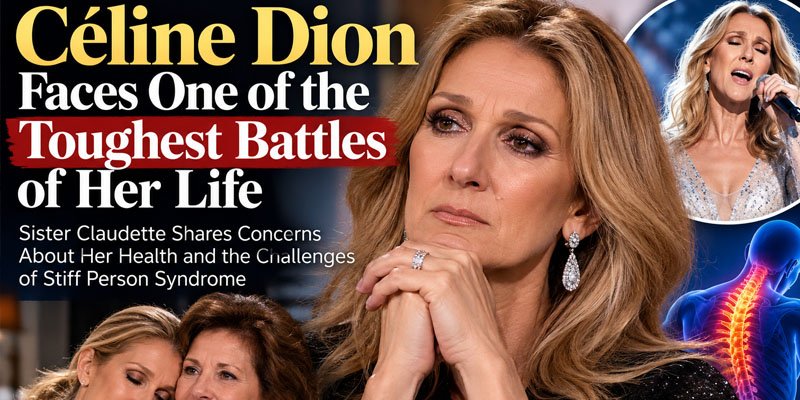
Céline Dion Faces One of the Toughest Chapters of Her Life as Sister Claudette Shares Concerns About Her Health
The legendary singer continues to navigate the challenges of stiff person syndrome, a rare neurological disorder that has affected her daily life and raised questions about her future on stage.
For decades, Céline Dion has captivated audiences around the world with her extraordinary voice, emotional performances, and remarkable dedication to music. From unforgettable ballads to spectacular live concerts, the Canadian singer has built a legacy that extends far beyond the entertainment industry. However, behind her remarkable success lies a deeply personal struggle that has changed many aspects of her life.
Dion has been living with stiff person syndrome (SPS), a rare neurological condition that can cause muscle stiffness, painful spasms, and difficulties with movement. The diagnosis has presented significant challenges for an artist whose career depends on precise vocal control, physical coordination, and the ability to perform demanding shows.
As concerns about her health have continued to attract public attention, comments from her sister, Claudette Dion, have offered insight into the difficulties facing the family. Their experiences have also highlighted the uncertainty that can accompany a rare medical condition, particularly when it affects someone’s independence, professional ambitions, and everyday activities.
Although fans around the world continue to hope for her return to the stage, Dion’s journey is about much more than her career. It is also a story of adapting to unexpected circumstances, relying on family support, and finding ways to move forward despite uncertainty.
Claudette Dion Opens Up About Her Sister’s Difficulties
Claudette Dion has spoken about the challenges her younger sister has faced while living with stiff person syndrome. Her comments have drawn attention to the physical difficulties associated with the disorder and the effect they can have on a person’s everyday life.
For Céline, these challenges are particularly significant because her profession requires a combination of physical stamina, carefully controlled breathing, and precise coordination. Delivering a demanding live performance involves much more than simply singing the correct notes. Artists must also manage their posture, breathing, movement, and energy throughout a concert.
When a neurological condition affects muscle control, these activities can become increasingly difficult.
Muscle stiffness and spasms may interfere with ordinary movements, making some routines more complicated than they were before. The effects can vary considerably from one person to another, meaning that the experience of living with the condition is not necessarily the same for every patient.
For someone who has spent much of her life performing before enormous audiences, adapting to these changes can be especially challenging.
Claudette’s comments have helped bring attention to the seriousness of her sister’s condition. At the same time, it is important to distinguish between statements attributed to family members and unverified claims circulating online. Specific details about Céline’s current mobility, medical progress, and daily activities should not be assumed without reliable confirmation.
What Is Stiff Person Syndrome?
Stiff person syndrome is an uncommon neurological disorder that affects the central nervous system and can interfere with the body’s normal control of muscles.
The condition is associated with muscle stiffness and episodes of spasms that may be painful or triggered by certain stimuli. Some individuals experience stiffness mainly in particular parts of the body, while others develop more widespread symptoms that affect movement and daily functioning.
In some cases, sudden sounds, emotional stress, or physical contact can trigger muscle spasms. The severity and pattern of symptoms vary, making the condition difficult to predict and manage.
Stiff person syndrome is believed to involve abnormal immune-system activity affecting processes that help regulate movement. Researchers continue to investigate its underlying mechanisms and why it develops in some individuals.
Because the disorder is rare, diagnosis can be challenging. Doctors may need to consider a patient’s symptoms, medical history, neurological examination, and specialized laboratory tests before reaching a conclusion.
There is currently no established cure for stiff person syndrome, but treatment can help some patients manage symptoms and improve their quality of life. Depending on the individual case, care may involve medications, rehabilitation, and specialist medical supervision.
For patients and their families, understanding the condition is an important part of navigating its uncertainties.
Why the Illness Has Had Such a Significant Effect on Her Career
Céline Dion’s career has been built on extraordinary vocal ability and an intense commitment to live performance. Her concerts have often involved demanding schedules, extensive rehearsals, international travel, and the physical endurance required to perform night after night.
Stiff person syndrome introduces challenges that can make this kind of professional routine difficult to maintain.
Muscle stiffness may affect posture and movement, while spasms can disrupt the physical coordination required during a performance. Breathing control and overall physical comfort are also important considerations for a singer, particularly during lengthy concerts.
For Dion, whose performances are known for their emotional intensity and vocal precision, these challenges have created considerable uncertainty about what she may be able to do in the future.
Her diagnosis has also demonstrated how a serious health condition can affect a profession that appears glamorous from the outside but requires years of physical and technical preparation.
The impact is not limited to the stage. Rehearsal schedules, travel commitments, and the pressure to meet professional expectations can all become more complicated when health needs change.
Nevertheless, the illness does not diminish the accomplishments she achieved before her diagnosis. Her recordings, concerts, and influence on generations of listeners remain important parts of her legacy.
The Search for Better Treatments Continues
Rare neurological conditions can present substantial challenges for both patients and researchers. Because relatively few people are affected by stiff person syndrome, gathering extensive research data can be difficult compared with studying more common illnesses.
Scientists continue to investigate the mechanisms behind the disorder, ways to recognize it earlier, and treatments that may help patients manage their symptoms more effectively.
For people living with SPS, improvements in symptom management can make a meaningful difference in everyday life. Reducing muscle stiffness, managing spasms, and supporting mobility may help individuals maintain greater independence, depending on the severity of their condition.
Treatment plans must be individualized because symptoms, medical histories, and responses to therapy differ from patient to patient.
It is equally important to recognize the limits of current medical knowledge. Research may eventually lead to improved therapies, but scientific progress cannot guarantee a particular breakthrough or timeline.
Céline Dion’s public disclosure of her diagnosis has helped introduce stiff person syndrome to a much wider audience. Her experience has encouraged conversations about rare diseases and the importance of continued research into conditions that can have life-changing consequences.
Addressing Rumors About Céline Dion’s Mobility
As news of Dion’s illness attracted attention, speculation about her physical abilities began circulating across social media and entertainment websites.
Some online claims have made dramatic suggestions about the extent of her mobility limitations. However, such statements should not be treated as established facts unless they are supported by credible reporting or reliable statements from the singer or her representatives.
A medical diagnosis does not automatically establish how a person will function in every situation. Symptoms can differ between individuals and may change over time.
For this reason, it is important to avoid drawing conclusions about Dion’s exact physical condition based on photographs, brief public appearances, or unverified online reports.
Her family’s concerns deserve to be understood in context rather than turned into sensational headlines.
Responsible reporting should focus on what is known about the condition, the challenges the singer has publicly acknowledged, and the uncertainty surrounding her individual medical journey.
Respecting these boundaries allows fans to remain informed without spreading unnecessary fear or misinformation.
Céline Dion’s Hope of Returning to the Stage
For many fans, one of the most emotional questions surrounding Dion’s health is whether she will perform live again.
Music has been central to her life since the beginning of her career. Her relationship with audiences has developed over decades, creating a connection that extends across generations and countries.
The prospect of returning to the stage therefore represents more than a professional ambition. It is connected to an activity that has played a major role in shaping her identity.
However, a desire to perform again should not be confused with a confirmed return date or a guarantee that her health will allow her to resume the same demanding schedule.
Live performances require preparation, stamina, and a level of physical reliability that may be difficult to achieve while managing a complex neurological condition.
Any future performance plans will depend on her individual medical circumstances, progress, personal decisions, and professional considerations.
For now, fans can continue to appreciate her music while recognizing that protecting her health must remain a priority.
Whether her future includes large-scale concerts, occasional appearances, or a different relationship with performing, her existing achievements remain secure.
The Emotional Challenges of Living With a Serious Illness
The physical symptoms of a chronic neurological condition are only one part of the experience. Living with an illness that can affect movement and independence may also bring emotional challenges.
Patients may face uncertainty about their future abilities, changes to familiar routines, and the need to reconsider personal or professional plans.
For someone whose career has involved constant activity and public appearances, these adjustments can be especially difficult.
There may also be frustration associated with having to approach everyday tasks differently or with being unable to make firm plans because symptoms can vary.
Dion’s situation highlights the importance of allowing people with chronic illnesses to define their own experiences rather than assuming that they must always demonstrate strength or optimism.
Determination can be valuable, but it does not eliminate the realities of illness. People can remain hopeful while also acknowledging that some days are more difficult than others.
Access to appropriate medical care, emotional support, and practical assistance can all contribute to a person’s well-being.
The goal is not necessarily to return to life exactly as it was before an illness, but to find the best possible way forward under changing circumstances.
The Importance of Family Support
Family relationships can become especially meaningful when someone faces a serious health challenge.
For Céline Dion, her family has remained an important part of the public conversation surrounding her condition. Her sister Claudette’s comments have helped audiences understand that the illness affects not only the individual diagnosed but also the people who care about them.
Supporting a loved one may involve providing reassurance, helping with practical responsibilities, attending appointments, or simply offering companionship during uncertain periods.
However, family members also have to navigate the limits of what they can control. They cannot remove every medical difficulty or predict how a condition will develop.
Their role is often to help create a supportive environment in which the person receiving care can make decisions and focus on their well-being.
Claudette’s willingness to discuss her sister’s situation has drawn attention to these personal realities while reminding audiences that public figures also need understanding and privacy.
Behind the headlines, the experience of illness is deeply personal, and every family must find its own way of coping.
Fans Continue to Stand Behind the Legendary Singer
Céline Dion’s music has accompanied countless personal moments in the lives of listeners around the world.
Her songs have been played at weddings, celebrations, anniversaries, and moments of heartbreak. Her voice has become familiar to people who grew up listening to her as well as younger audiences discovering her work for the first time.
Songs such as My Heart Will Go On and Because You Loved Me remain closely associated with her career and enduring popularity.
When Dion revealed her diagnosis, many fans expressed concern and offered messages of encouragement. For listeners who have followed her career for years, the news was a reminder that even internationally celebrated artists face vulnerabilities that cannot be overcome through talent or fame alone.
Public support can provide encouragement, but it is not a substitute for appropriate treatment or professional medical guidance.
The most meaningful way to support Dion is to respect her privacy, rely on credible updates, and continue appreciating the music she has shared with the world.
Her connection with audiences does not depend entirely on whether she can return to the same performance schedule.
Remembering the Legacy She Has Already Built
Long before stiff person syndrome became part of her story, Céline Dion had established herself as one of the most recognizable singers in international popular music.
Her career has been marked by powerful ballads, memorable live performances, and a distinctive ability to communicate emotion through music.
Her international success brought her audiences across language and cultural boundaries. Her recordings have reached millions of listeners, and her performances have helped establish her as a major figure in modern music.
Her professional journey has also included personal hardships, including the loss of her husband and longtime manager, René Angélil, in 2016.
These experiences form part of a much larger story that includes years of dedication, artistic achievement, family life, and a lasting relationship with her fans.
Her current medical challenges are an important chapter, but they do not define the entirety of her life.
The songs she recorded, the performances she delivered, and the memories she helped create remain part of her legacy regardless of what happens next.
Raising Awareness About Rare Neurological Disorders
One important consequence of Dion’s decision to discuss her diagnosis publicly has been increased awareness of stiff person syndrome.
Before her announcement, many people had never heard of the disorder. Her experience has helped bring attention to the difficulties faced by individuals living with rare neurological conditions.
People with uncommon illnesses may experience delays in diagnosis, uncertainty about treatment options, and difficulties finding healthcare professionals familiar with their condition.
Greater awareness can encourage people to seek appropriate medical advice and help families understand why specialized care may be necessary.
It can also support conversations about research funding, clinical studies, and the importance of developing better approaches to managing rare diseases.
However, public attention alone cannot solve these challenges. Meaningful progress requires scientific research, careful clinical evaluation, and continued efforts to improve patient care.
Dion’s experience has provided a recognizable example of how a rare illness can affect daily life, professional ambitions, and family relationships.
That awareness may remain valuable even as public attention eventually shifts elsewhere.
What Could the Future Hold for Céline Dion?
The future remains uncertain, and it would be premature to make definitive predictions about Dion’s health or career.
Stiff person syndrome can affect individuals in different ways, and the course of the condition cannot be reliably predicted from another person’s experience.
Her future activities will depend on her medical circumstances, the effectiveness of her treatment, her personal priorities, and the demands associated with any potential return to performing.
It is understandable that fans want clear answers, particularly after years of enjoying her music and watching her career develop.
Nevertheless, health-related uncertainty cannot always be resolved quickly, and public expectations should not place additional pressure on someone managing a serious illness.
A return to the stage would undoubtedly be meaningful to many admirers, but her well-being matters independently of her professional future.
She has already accomplished what many artists spend their entire careers hoping to achieve: building a body of work that resonates with audiences around the world.
Her next chapter does not have to replicate the past to have value.
Conclusion: A Story of Strength, Uncertainty, and an Enduring Musical Legacy
Céline Dion’s experience with stiff person syndrome has brought a deeply personal struggle into public view. Through her diagnosis and her family’s comments, audiences have gained a greater understanding of the physical challenges associated with a rare neurological condition.
The illness has affected important aspects of her life and created uncertainty around the demanding performances that once defined her professional routine. Her sister Claudette’s concerns have also highlighted the importance of family support, accurate information, and compassion when discussing another person’s health.
Although fans continue to hope for the opportunity to see Dion perform again, no one can guarantee what the future will bring. Her medical care, individual progress, and personal choices will help determine the path ahead.
What remains clear is that her accomplishments cannot be measured solely by her ability to return to the stage.
Her voice has touched millions of people, her songs have become part of popular culture, and her dedication to music has left a lasting mark on the entertainment industry.
Her journey also serves as a reminder that resilience does not always mean overcoming every obstacle or returning to exactly the same life. Sometimes, it means adapting to difficult circumstances, accepting support, and finding meaning in a future that may look different from the one originally imagined.
For Céline Dion, the next chapter remains unwritten. Whatever it holds, her musical legacy will continue to connect with audiences around the world, while her experience brings greater attention to the challenges faced by people living with rare neurological disorders.




