Former President George W. Bush Steps Into the Spotlight With Powerful Reflection on Leadership
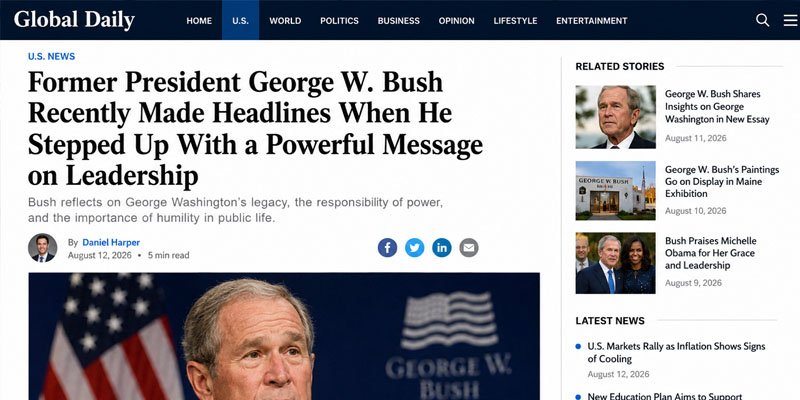
Former President George W. Bush recently made headlines when he stepped up once again to share his thoughts on one of the most important principles in American political life: the responsible use of power.
Bush, who served as the 43rd president of the United States from 2001 to 2009, has largely remained outside the center of day-to-day national politics since leaving office. However, his recent contribution to the “In Pursuit” project has attracted renewed attention.
The project, created as part of the United States’ 250th-anniversary observances, invited former presidents, historians, authors, and other prominent figures to reflect on the lives and legacies of past presidents and first ladies. Bush chose to write about America’s first president, George Washington.
A Message About the Meaning of Power
In his essay, Bush focuses on Washington’s decision to voluntarily give up power at crucial moments in his life.
Bush highlights the fact that Washington stepped away from command of the Continental Army after the Revolutionary War and later established an important precedent by leaving the presidency after two terms. Bush presents these decisions as examples of humility and respect for democratic institutions.
The former president’s reflections have drawn attention because they go beyond a simple historical discussion. They raise a broader question about what presidential leadership should look like and how political leaders should respond when they possess enormous authority.
For Bush, Washington’s legacy demonstrates that leadership is not only about gaining power. It is also about knowing when and how to give it up.
Bush’s Life After the Presidency
Since leaving the White House, Bush has taken a different path from many former presidents. Through the George W. Bush Presidential Center and the Bush Institute, he has remained involved in initiatives involving democracy, economic opportunity, veterans, global affairs, and education.
He has also developed a second public identity as an artist. Bush began painting after his presidency and has produced portraits, landscapes, and other works. In August 2026, more than 40 of his paintings depicting Kennebunkport and surrounding locations were displayed at the University of New England as part of a fundraiser for St. Ann’s Episcopal Church. Bush donated the paintings for the event but was not expected to attend personally.
The exhibition offered another glimpse into the quieter life Bush has built since leaving Washington.
A Former President Looking Back
Bush’s latest essay is particularly notable because it does not focus on his own presidency. Instead, he uses the example of George Washington to discuss a principle that has remained relevant throughout American history.
The decision to surrender political power peacefully has long been regarded as one of the foundations of the American constitutional system. Bush’s essay argues that Washington’s willingness to step away from authority helped establish a standard for future presidents.
That message has resonated with readers because it speaks to a question larger than any individual political party or administration: whether leaders are willing to place institutions above themselves.
Why the Story Is Receiving Attention
The renewed attention surrounding Bush comes at a time when Americans are once again debating the limits of presidential authority and the strength of democratic institutions.
Although Bush does not make contemporary politics the focus of his essay, his emphasis on Washington’s humility has naturally prompted discussion about leadership in the present day. The broader “In Pursuit” project was deliberately designed to look at American history from a perspective that rises above current political divisions.
Bush’s participation therefore represents something different from a traditional political statement. Rather than returning to the campaign trail or directly addressing current political battles, he is using history to reflect on the responsibilities that come with public office.
A Different Chapter for George W. Bush
At 80, Bush is now several years removed from the presidency and appears increasingly comfortable with life outside electoral politics. His work through the Bush Center, his public appearances, his writing, and his art have allowed him to remain involved in public life without occupying an official political position.
His recent activities also demonstrate how former presidents can continue contributing to national conversations long after leaving office.
For Bush, the story of George Washington provides a particularly meaningful example. It is a reminder that the legacy of a leader is not measured only by the power they acquire, but also by the restraint they show.
As America marks 250 years, Bush’s reflection on Washington offers a timeless message: leadership carries responsibilities that extend beyond one person, one administration, or one political moment.
And perhaps that is why the former president’s latest appearance has attracted so much attention. Rather than making the story about himself, George W. Bush chose to look backward—to the nation’s first president—and remind Americans that sometimes the most powerful act a leader can take is knowing when to step away from power.